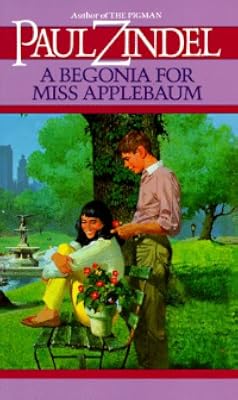
A Begonia for Miss Applebaum
by Paul Zindel
On This Page
Description
Discovering that their beloved former teacher Miss Applebaum is terminally ill, fifteen-year-old Henry and his friend Zelda accompany her on her excursions to the colorful parts of New York City and join her in confronting death with quiet courage.Tags
Recommendations














Member Reviews
This is the story of two teenagers and their teacher, Miss Applebaum, who is dying (presumably of cancer, but her disease is never actually named). The two teenagers, Henry and Zelda, are very different from each other, but very close friends. They take turns telling the story of their relationship with Miss Applebaum as she slowly dies. The story is quiet, with few major plot moments, but very powerful. There are so many facts packed into this book that it almost boggles the mind, and yet they never feel forced - it seems totally natural that Miss Applebaum would babble information at them in an attempt to teach them everything she can while she’s still got time.
The most interesting part of the book was Henry and Zelda’s musings on show more death. They explain their fears, thoughts and wishes in terms of dying. We learn that Henry believes that he will always be connected to everything else, but fears death by falling pianos and spectacular car crashes. Zelda is more afraid of death itself and less of the act of dying. The discussion of death is carried throughout the entire book, not always obviously there, but always just below the surface ready to peek out from time to time. It deals with death both concretely and philosophically and does an amazing job with both. I’m not sure that I’ve ever read an adult book that deals with the subject near this well, and certainly never before found it in a children’s book!
The writing in the book is fantastic. Each narrator, Henry and Zelda, has their own distinct voice and way of telling the story. Henry is very methodical and records what happened when and exactly what he saw. He’s almost scientific in his way of telling the story, but never ever cold. His observations tend to focus on the big picture and rarely give details or more than cursory emotional impressions. Zelda is less linear and far more artistic in her descriptions. Her storytelling is full of emotion and imagery, but often less clear about what is actually happening. We know she’s upset, but not always sure why (and it seems that she isn’t sure why either sometimes). Her descriptions are amazing, though. They are poetic and so full of colour, detail and emotional reactions that you can’t help but sink into them! As different as the two narrative voices are, they work together brilliantly. They work with each other to tell the story beautifully and completely. It’s masterful.
The emotional impact of this book is strong, but it is also very thought-provoking. It made me think about death and about the way we think about death. It made me wonder what I would have done in Henry or Zelda’s place and fume at Miss Applebaum’s niece’s actions. It was emotional to read and made me wish that every story I read felt as real as this one. It was brilliant and I highly recommend it. It is sad, but it’s totally worth reading. show less
The most interesting part of the book was Henry and Zelda’s musings on show more death. They explain their fears, thoughts and wishes in terms of dying. We learn that Henry believes that he will always be connected to everything else, but fears death by falling pianos and spectacular car crashes. Zelda is more afraid of death itself and less of the act of dying. The discussion of death is carried throughout the entire book, not always obviously there, but always just below the surface ready to peek out from time to time. It deals with death both concretely and philosophically and does an amazing job with both. I’m not sure that I’ve ever read an adult book that deals with the subject near this well, and certainly never before found it in a children’s book!
The writing in the book is fantastic. Each narrator, Henry and Zelda, has their own distinct voice and way of telling the story. Henry is very methodical and records what happened when and exactly what he saw. He’s almost scientific in his way of telling the story, but never ever cold. His observations tend to focus on the big picture and rarely give details or more than cursory emotional impressions. Zelda is less linear and far more artistic in her descriptions. Her storytelling is full of emotion and imagery, but often less clear about what is actually happening. We know she’s upset, but not always sure why (and it seems that she isn’t sure why either sometimes). Her descriptions are amazing, though. They are poetic and so full of colour, detail and emotional reactions that you can’t help but sink into them! As different as the two narrative voices are, they work together brilliantly. They work with each other to tell the story beautifully and completely. It’s masterful.
The emotional impact of this book is strong, but it is also very thought-provoking. It made me think about death and about the way we think about death. It made me wonder what I would have done in Henry or Zelda’s place and fume at Miss Applebaum’s niece’s actions. It was emotional to read and made me wish that every story I read felt as real as this one. It was brilliant and I highly recommend it. It is sad, but it’s totally worth reading. show less
Other people might think Miss Applebaum eccentric, but to Zelda and Henry she's the most special teacher they've ever known. They buy her a gift when she retires, but meeting her means having to face up to more in life than they imagined.
Henry and Zelda arrive at the beginning of the school year to find that their favorite teacher, Miss Applebaum, has retired. They decide to bring her a begonia, and soon learn that she is actually dying of cancer. But, Miss Applebaum has quite a few more things to teach them before she goes.
This novel is at times wacky and delightful, at times poignant and grave, and always quite genuine and believable. One wishes for her own Miss Applebaum to learn from.
This novel is at times wacky and delightful, at times poignant and grave, and always quite genuine and believable. One wishes for her own Miss Applebaum to learn from.
I discovered Paul Zindel as a tween in the 1970s and like many kids my age, I read The Pigman and loved it.
Fast foward decades and I am now 55 and loved the above book which was written long after I was an adult and it is as wonderful as anything else I've read by him. He was a marvelous storyteller and I am sorry that he is no longer with us, as there will not be any new book forthcoming.
I hope to read everything he has ever written in time - my library does not own everything, so some of them I will have to buy on Amazon or Ebay.
Highly recommended ! A
Fast foward decades and I am now 55 and loved the above book which was written long after I was an adult and it is as wonderful as anything else I've read by him. He was a marvelous storyteller and I am sorry that he is no longer with us, as there will not be any new book forthcoming.
I hope to read everything he has ever written in time - my library does not own everything, so some of them I will have to buy on Amazon or Ebay.
Highly recommended ! A
Henry Ledniz and Zelda Einnab are distressed when their favorite science teacher, Miss Applebaum, retires suddenly. When they take her a begonia, Miss Applebaum meets them at the door wearing a bathrobe. She is obviously tired and having trouble breathing. Dr. Oblicheck comes, and Henry and Zelda see him stick a long needle into Miss Applebaum's chest. The treatment leaves her feeling better, and she invites them to spend next Saturday in Central Park. Before Saturday arrives, Zelda finds out that Miss Applebaum has terminal cancer. At Central Park, Henry and Zelda watch Miss Applebaum feed the homeless. She shows them her favorite haunts and Central Park's "roller coaster." After returning to Miss Applebaum's apartment, Bernice, Miss show more Applebaum's niece, arrives and orders her aunt to bed. She tells Henry and Zelda to let her aunt die in peace. Miss Applebaum assures Henry and Zelda that Bernice’s only real concern is Miss Applebaum’s estate. Ignoring Bernice's advice, the trio's next jaunt is to the Metropolitan Museum. Then, Henry and Zelda talk Miss Applebaum into seeing an oncologist who puts her in the hospital for treatment. Henry and Zelda soon realize that they’ve made a mistake. Miss Applebaum's cancer is so advanced that she’s destined to die in the hospital. Instead of leaving her to “die in peace,” they help her live for the time she has left.
©2024 Kathy Maxwell at https://bookskidslike.com show less
©2024 Kathy Maxwell at https://bookskidslike.com show less
I remember reading this book in jr. high school. Paul Zindel really turned me on to reading, and this one is my favorite. I recommend it most highly for the adolescent reader.
I really do like the characters Paul Zindel writes into his books.
Members
- Recently Added By
Author Information

71+ Works 9,258 Members
Paul Zindel Born on Staten Island, New York, Zindel was raised by a single mother who pursued a variety of odd and mostly unsuccessful jobs and took in terminally ill patients to supplement the family income. Due to her eccentricity and restlessness, the mother moved the family from one apartment to another, making it difficult for Zindel to form show more lasting friendships. As a consequence, the boy lived in the world of his imagination, developing interests in both science and writing. Zindel majored in chemistry at Wagner College on Staten Island, completing both bachelors and masters degrees. During this period he also took a creative-writing course offered by the playwright Edward Albee. After college he worked briefly as a technical writer for a chemical company and then discovered a more fulfilling vocation as a teacher of chemistry and physics at a Staten Island high school. It was during this period in the early 1960s that Zindel was able to develop his potential as a playwright by drawing on his own background as well as the experiences of his young students. The Effect of Gamma Rays on Man-in-the-Moon Marigolds premiered at the Alley Theater in Houston in 1965, was presented in a condensed version on television the following year, and finally opened off-Broadway at the Mercer-O'Casey Theater in 1970. Because of a fire in the theater, the play was moved, with a new cast, to the New Theater on Broadway, where it ran for a total of 819 performances. In addition to being enormously popular, Gamma Rays earned in 1970 an Obie Award as the best play of the season, the New York Drama Critics Circle Award as the best American play, and the Vernon Rice Drama Desk Award for most promising playwright. In 1971 the play was awarded the Pulitzer Prize in Drama. Gamma Rays is the story of an embittered, half-mad widow, Beatrice Hunsdorfer; her teenaged daughters, Ruth and Tillie; and Nanny, a decrepit old woman who boards with them. The family lives in chaos, with Beatrice dealing out petty vengeance to everyone. Nanny has been abandoned by her daughter. Ruth is wanton, untidy, and subject to seizures. Tillie, however, has become interested in science and enters her marigold experiment in the science fair; by exposing the marigold seeds to radiation, she shows that some produce normal plants, others produce mutations with beautiful double blooms, while still others die. The metaphor, of course, is that Tillie has emerged from her chaotic environment as a beautiful and whole person, a human "double bloom." Zindel's other plays include And Miss Reardon Drinks a Little (1971), The Secret Affairs of Mildred Wild(1973), Let Me Hear You Whisper (1973), and Ladies at the Alamo(1975). While these plays continue to show Zindel's skill in writing excellent roles for women, none of them have matched the critical and popular success of Gamma Rays. Since the late 1960s, Zindel has also written several novels for young adults. The Pigman (1968), which is about a lonely widower and two destructive teenagers, has sold more than 1 million copies. His other novels include My Darling, My Hamburger (1969), I Never Loved Your Mind (1970), Pardon Me, You're Stepping on My Eyeball (1976), Confessions of a Teenage Baboon (1977), and The Undertaker's Gone Bananas (1978). As in Gamma Rays, these works display not only a penchant for grotesque humor but an uncanny awareness of the problems of teenagers. Zindel's works, which also include several screenplays, explore the themes of loneliness, escapism, and eccentricity. His best works are humorous, perceptive, and warm; they present an affirmation of life emerging from desperate and grotesque circumstances. He is especially noted for his excellent women's roles, which has helped sustain him as a best-selling playwright for school and community groups. (Bowker Author Biography) show less
Awards and Honors
Common Knowledge
- Original publication date
- 1989
Classifications
- Genres
- Fiction and Literature, Teen, Young Adult
- DDC/MDS
- 813.54 — Literature & rhetoric American literature in English American fiction in English 1900-1999 1945-1999
- LCC
- PZ7 .Z647 .B — Language and Literature Fiction and juvenile belles lettres Fiction and juvenile belles lettres Juvenile belles lettres
- BISAC
Statistics
- Members
- 181
- Popularity
- 180,523
- Reviews
- 7
- Rating
- (3.91)
- Languages
- English
- Media
- Paper, Ebook
- ISBNs
- 15
- ASINs
- 5