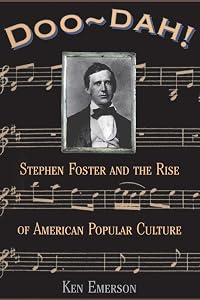
Doo-dah!: Stephen Foster And The Rise Of American Popular Culture
by Ken Emerson
On This Page
Description
"Stephen Foster was America's first great songwriter. The composer of classics such as "Oh! Susanna," "Jeanie with the Light Brown Hair," "Beautiful Dreamer," "My Old Kentucky Home," "Old Folks at Home" ("Way down upon the Swanee River"), and "Camptown Races" ("Doo-dah! Doo-dah!"), Foster virtually invented popular music as we recognize it to this day. Yet by his death in 1864, at the early age of thirty-seven, he was all but forgotten. In the first biography of Foster in more than sixty show more years, Ken Emerson makes the man as well as his music come alive." "Foster's life was riddled with contradictions. Although his songs celebrated the rural South, he scarcely set foot there, spending most of his life in Pittsburgh, the smoky cradle of America's industrial revolution. He won fame by writing blackface minstrel songs, doing what white boys from Irving Berlin to Elvis Presley to Michael Bolton have been doing ever since: mimicking black music. Yet the best of his songs transcended burnt-cork caricature and expressed a profound sympathy for African Americans that even Frederick Douglass applauded. Foster's yearning for respectability drove him to write genteel love songs, but these ballads were belied by his own broken marriage. Unable to equal the success of his earlier hits, he died a nearly penniless alcoholic on the Bowery." "Doo-dah! evokes not only Foster's songs but the wide-ranging music of his era, from high opera to low dives, and it looks ahead to the ragtime, rock, and rap of our own century. It's a sweeping panorama with a cast of characters that extends from Davy Crockett to Andrew Carnegie, from America's first great classical pianist, Louis Moreau Gottschalk, to its first great proponent of Afrocentrism, Martin Delany. It was the era of industrialization; of steamboats, railroads, and the telegraph; of westward expansion and the California gold rush; and, of course, of slavery and the Civil War. Foster absorbed it all, and all of it infused his music. After Emerson's exploration of the multiple meanings of Foster's first hit song - relating it to the tragic death of Foster's sister, the catastrophic triumph of technology, and the casual cruelty of racism as well as to the writings of Whitman, Melville, Thoreau, and Mark Twain - "Oh! Susanna" will never sound the same."--BOOK JACKET.Title Summary field provided by Blackwell North America, Inc. All Rights Reserved show lessTags
Recommendations













Member Recommendations
theoldanarchist In "Where Dead Voices Gather," Nick Tosches discusses Foster's importance and influence in 19th and 20th century music, including his influence on early blues and country music.
Member Reviews
Stephen Foster was the first of his kind. And he paid the price.
Foster was not in fact America's first professional "pop" composer of minstrel songs; that honor probably should be accorded to Daniel Decatur Emmett, who wrote "Dixie" among other songs. But Emmett also performed, and made most of his money as a performer. Foster tried to make a living solely as a songwriter. And his brilliance meant that he could have pulled it off.
Could have -- but didn't. Foster simply didn't know how to use his talents. While still a relatively young man, he ruined his marriage and his career and his life, and ended up drunk and alone and scorned by his publishers. He died broke after an accident in a flophouse.
This book details both Foster's success show more and his downfall. It is mostly a biography, but with some sidelights on the business practices of the time. As such, it is tremendously useful for someone who wants to know just how Foster went wrong. (I personally suspect autism.)
Sadly, it's not the easiest read. Author Emerson has clearly studied his material in so much depth that he has forgotten that the rest of us don't know it that well. It's easy to get lost in all the detail. There were times I ended up skimming.
But there really aren't any other good Foster biographies. If you want to know about the man who gave us "Camptown Races" and "Oh! Susannah" and "Old Folks At Home" ("Swanee River") and "My Old Kentucky Home," this is the book for you. show less
Foster was not in fact America's first professional "pop" composer of minstrel songs; that honor probably should be accorded to Daniel Decatur Emmett, who wrote "Dixie" among other songs. But Emmett also performed, and made most of his money as a performer. Foster tried to make a living solely as a songwriter. And his brilliance meant that he could have pulled it off.
Could have -- but didn't. Foster simply didn't know how to use his talents. While still a relatively young man, he ruined his marriage and his career and his life, and ended up drunk and alone and scorned by his publishers. He died broke after an accident in a flophouse.
This book details both Foster's success show more and his downfall. It is mostly a biography, but with some sidelights on the business practices of the time. As such, it is tremendously useful for someone who wants to know just how Foster went wrong. (I personally suspect autism.)
Sadly, it's not the easiest read. Author Emerson has clearly studied his material in so much depth that he has forgotten that the rest of us don't know it that well. It's easy to get lost in all the detail. There were times I ended up skimming.
But there really aren't any other good Foster biographies. If you want to know about the man who gave us "Camptown Races" and "Oh! Susannah" and "Old Folks At Home" ("Swanee River") and "My Old Kentucky Home," this is the book for you. show less
This is the story of Stephen Foster, who wrote so many songs in the nineteenth century that are considered American standards such as "Oh, Susanna", "Campdown Races" and "Swanee River". The book focuses on Foster as one of the first song writers to be benefited by the commercialization of music, in the guise of sheet music and copyrights. He became a well recognized figure based upon his fame as a popular music composer. Foster initially struggled to be a successful composer, then spend of good part of the rest of his life in court defending his rights and chasing "music pirates", to use a modern term. However, the book is not easy to read. The author goes on for page after page, chapter after chapter, relating how Foster did this and show more went there and said that and after a while it becomes a blur. Recommended only to those who really have an interest in the subject. show less
Ratings
Members
- Recently Added By
Author Information

3 Works 264 Members
Common Knowledge
- Original publication date
- 1997
- People/Characters
- P. T. Barnum; James Buchanan; Andrew Carnegie; E. P. Christie; Martin R. Delaney; Dan Emmett (show all 22); Ann Eliza Foster (sister of Stephen C. Foster); Charlotte Susanna Foster (sister of Stephen C. Foster); Dunning McNair Foster (brother of Stephen C. Foster); Eliza Clayland Foster (mother of Stephen C. Foster); Henrietta Angelica Foster (sister of Stephen C. Foster); Henry Baldwin Foster (brother of Stephen C. Foster); Jane Denny McDowell Foster (wife of Stephen C. Foster); Marion Foster (daughter of Stephen C. Foster); Morrison Foster (brother of Stephen C. Foster); Stephen C. Foster; William Barclay Foster (father of Stephen C. Foster); Henry Kleber; Thomas Moore; Thomas Dartmouth "Daddy" Rice; Harriet Beecher Stowe; Walt Whitman
- Important places
- Pittsburgh, Pennsylvania, USA; Cincinnati, Ohio, USA
- Dedication
- To Ellen and Maude
- First words
- Introduction -- Early in the evening on January 17, 1992, the day I delivered to my agent the proposal for this book, I boarded the No. 6 subway at Thirty-third Street and Park Avenue in Manhattan.
Classifications
- Genres
- Music, Nonfiction, Biography & Memoir, History, General Nonfiction
- DDC/MDS
- 782.42164 — Arts & recreation Music Vocal music Secular forms of vocal music Songs General principles and musical forms Traditions of secular songs {genres} Western popular songs
- LCC
- ML410 .F78 .E46 — Music Literature on music Literature on music History and criticism Biography
- BISAC
Statistics
- Members
- 87
- Popularity
- 368,523
- Reviews
- 2
- Rating
- (3.42)
- Languages
- English
- Media
- Paper
- ISBNs
- 3