A for Anything
by Damon Knight
On This Page
Description
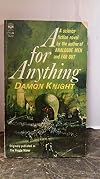
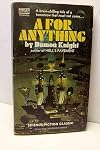
What would happen if someone invented a machine that could create an exact duplicate of anything? That is the simple but remarkable premise of Damon Knight's classic 1959 novel, A for Anything (formerly entitled The People Maker). ""The Gismo"", as the machine is known, seems like it will end poverty and need forever. But of course, things are not that simple. Like any truly great work of science fiction, Knight's novel boldly pursues the ramifications of his premise. What will people show more do if there is no longer any need to work for anything? What happens if this device is spread carelessly show lessTags
Recommendations

















Member Reviews
In un futuro non troppo lontano un'invenzione promette l'assoluta abbondanza per tutta l'umanità, se non che, per un tremendo errore di valutazione, la benedizione si trasforma in maledizione, precipitando l'umanità in un nuovo medio evo, testosteronico e pieno di schiavi, riprodotti in serie dai prototipi un tempo più efficienti. In questo ambiente malsano un ragazzo attraversa l'adolescenza e l'iniziazione all'età adulta, senza però diventare altro da ciò che la sua società l'ha cresciuto per diventare.
Probabilmente il libro è bello, e alla sua uscita è stato acclamato come un capolavoro, se non che la traduzione pessima e i frequentissimi errori di stampa rendono irritante la lettura.
Resta il fatto che è un testo molto show more datato, e, come si sa, la fantascienza va a scadenza ancora più in fretta del pesce. show less
Probabilmente il libro è bello, e alla sua uscita è stato acclamato come un capolavoro, se non che la traduzione pessima e i frequentissimi errori di stampa rendono irritante la lettura.
Resta il fatto che è un testo molto show more datato, e, come si sa, la fantascienza va a scadenza ancora più in fretta del pesce. show less
2.5/5
While better than the other Knight that I've read (Hell's Pavement), A For Anything still leaves a lot to be desired and leaves me feeling like I can safely pass up anything else written by Knight in the future, especially since most consider this his best work.
The narrative is far more coherently drawn than Hell's Pavement, though we still have a dystopia that was nucleated by a singular macguffin technology. In A For Anything the macguffin is a simple matter duplicator called a "Gismo" that gets spread to the public, prompting widespread societal upheaval. The story takes place some generations after this event, when the control of this device has been taken over by an aristocratic class who rule over a much large slave caste, show more much of whom have been 'duped' by the device itself, clones that get replaced as they age out of their function. The central character, Dick Jones, is the juvenile heir apparent to a feudal lord who rules over a portion of land near Pittsburgh. Much like the aristocratic class in Vance's The Last Castle, Dick and his family are mostly wrapped up in political intrigue games, focused on concepts like honor and tradition as their every whim is serviced by the slaves that serve as the backbone of society. Dick is sent off to Eagles, the capital city located near Denver, to earn his stripes in society, make connections with other nobles, and become worthy of inheriting his fathers estate. During this time at Eagles, Dick is involved in political subterfuge that eventually gets overshadowed by a widespread slave revolt.
The central thematic idea is that, once material goods becomes unlimited in quantity, the dominant commodity will become labor itself, and wealth will subsequently be measured by how much labor you command. Hence, a slavery caste system. Knight certainly has a pessimistic view. Where others might see a utopia, he sees reason to believe that without the struggle to survive we would find ourselves reverting to some of our most sinful tendencies as a species. I find it hard to agree with him in many ways.
The characters, the setting, the prose, and everything else outside of the central idea and narrative are boilerplate at best. Nothing memorable or exciting that would set it apart from the million other dullard dystopian novels of the time period. The Last Castle is its superior in most every way, so it's hard to get excited about the limited strengths that I found here. It's also rife with a lot of the more regrettable gender and racial stereotypes that were common at the time.
Interesting to a point, but ultimately not super noteworthy in any particular way. show less
While better than the other Knight that I've read (Hell's Pavement), A For Anything still leaves a lot to be desired and leaves me feeling like I can safely pass up anything else written by Knight in the future, especially since most consider this his best work.
The narrative is far more coherently drawn than Hell's Pavement, though we still have a dystopia that was nucleated by a singular macguffin technology. In A For Anything the macguffin is a simple matter duplicator called a "Gismo" that gets spread to the public, prompting widespread societal upheaval. The story takes place some generations after this event, when the control of this device has been taken over by an aristocratic class who rule over a much large slave caste, show more much of whom have been 'duped' by the device itself, clones that get replaced as they age out of their function. The central character, Dick Jones, is the juvenile heir apparent to a feudal lord who rules over a portion of land near Pittsburgh. Much like the aristocratic class in Vance's The Last Castle, Dick and his family are mostly wrapped up in political intrigue games, focused on concepts like honor and tradition as their every whim is serviced by the slaves that serve as the backbone of society. Dick is sent off to Eagles, the capital city located near Denver, to earn his stripes in society, make connections with other nobles, and become worthy of inheriting his fathers estate. During this time at Eagles, Dick is involved in political subterfuge that eventually gets overshadowed by a widespread slave revolt.
The central thematic idea is that, once material goods becomes unlimited in quantity, the dominant commodity will become labor itself, and wealth will subsequently be measured by how much labor you command. Hence, a slavery caste system. Knight certainly has a pessimistic view. Where others might see a utopia, he sees reason to believe that without the struggle to survive we would find ourselves reverting to some of our most sinful tendencies as a species. I find it hard to agree with him in many ways.
The characters, the setting, the prose, and everything else outside of the central idea and narrative are boilerplate at best. Nothing memorable or exciting that would set it apart from the million other dullard dystopian novels of the time period. The Last Castle is its superior in most every way, so it's hard to get excited about the limited strengths that I found here. It's also rife with a lot of the more regrettable gender and racial stereotypes that were common at the time.
Interesting to a point, but ultimately not super noteworthy in any particular way. show less
I did not like this book. The story starts well, with some good science-fiction premises. This "Gismo" is able to duplicate anything, including itself, almost for free.
The inventor mails a hundred samples to random people in the US, then a physicist drops out of nowhere and starts talking of really exciting stuff, like rockets that duplicate fuel as they go (and I, the reader, become all excited for some space action).
Then an ex-marine comes, kills him and enslaves everyone else (and I, the reader, am very disappointed) .
Jump to 70 years later or so to some medieval society with pistol duels, flying machines and more slaves (more disappointment).
It is a bit too much to digest in just one sitting, why the slavery? Why the guy created show more only 100 instead of keeping duplicating new ones? How could just one hundred samples break down society? And if the first one hundred where duplicated to the point of really troubling the economy, how the whole master-slave relation could come into effect?
Everything is possible in science fiction, but the story should be able to stand up by itself. Here a lot of logic is missing: ok the author wanted to explore the slavery theme, but how did we get there? show less
The inventor mails a hundred samples to random people in the US, then a physicist drops out of nowhere and starts talking of really exciting stuff, like rockets that duplicate fuel as they go (and I, the reader, become all excited for some space action).
Then an ex-marine comes, kills him and enslaves everyone else (and I, the reader, am very disappointed) .
Jump to 70 years later or so to some medieval society with pistol duels, flying machines and more slaves (more disappointment).
It is a bit too much to digest in just one sitting, why the slavery? Why the guy created show more only 100 instead of keeping duplicating new ones? How could just one hundred samples break down society? And if the first one hundred where duplicated to the point of really troubling the economy, how the whole master-slave relation could come into effect?
Everything is possible in science fiction, but the story should be able to stand up by itself. Here a lot of logic is missing: ok the author wanted to explore the slavery theme, but how did we get there? show less
In A for Anything, it is 1971 (the not-so-distant future!) and a scientist invents a machine (a "Gismo") that can make an exact replica of anything else, including itself (and, eventually, people). The scientist is excited and sees this as the answer to all of humanity's problems -- why if no one had to work, go hungry, or want for anything, then what could possibly go wrong? Well, for starters the government tries to seize the invention before it causes the downfall of capitalism. On to their plan, the scientist mails out 100 pairs of Gismos to random addresses and then heads to his idyllic retreat with his family to await the utopia. It soon becomes apparent that his good-intentioned idea has resulted in anarchy, violence, and a huge show more power struggle between those who have the Gismos and those who don't.
Jump ahead to 2049:
Over half the population has been killed in a series of large-scale wars and small-scale battles for position. No scientific progress has been made since 1970. Huge swaths of the country have reverted to nature. And the country is divided up among a set of noble families who own slaves (which they call Slobs) and live lives of medieval decadence under the ever-present shadow of potential treason and overthrow by a rival family.
Our protagonist, who we never really like all that much, is Dick Jones, a young man who is next-in-line as the leader of a settlement in the Poconos. Just before he is about to fly to Colorado for his four years of military service at the Eagles, the gigantic court of a very big boss, he gets in an argument with his cousin that ends in a duel. But leaving his small pond in the Poconos for the oceanic grandeur of a Colorado mountaintop knocks Jones down a peg. In fact, much of the book is about Jones learning to navigate the complex levels of power that make up life in Eagles. As one might expect, this uneven society can't last forever, and when it finally explodes, Jones is right at the center of it.
[full review here: http://spacebeer.blogspot.com/2009/04/for-anything-1959.html ] show less
Jump ahead to 2049:
Over half the population has been killed in a series of large-scale wars and small-scale battles for position. No scientific progress has been made since 1970. Huge swaths of the country have reverted to nature. And the country is divided up among a set of noble families who own slaves (which they call Slobs) and live lives of medieval decadence under the ever-present shadow of potential treason and overthrow by a rival family.
Our protagonist, who we never really like all that much, is Dick Jones, a young man who is next-in-line as the leader of a settlement in the Poconos. Just before he is about to fly to Colorado for his four years of military service at the Eagles, the gigantic court of a very big boss, he gets in an argument with his cousin that ends in a duel. But leaving his small pond in the Poconos for the oceanic grandeur of a Colorado mountaintop knocks Jones down a peg. In fact, much of the book is about Jones learning to navigate the complex levels of power that make up life in Eagles. As one might expect, this uneven society can't last forever, and when it finally explodes, Jones is right at the center of it.
[full review here: http://spacebeer.blogspot.com/2009/04/for-anything-1959.html ] show less
(Original review, 1980)
Here's my two cents' worth on matter transmission (MT) regarding Damon Knight's "A For Anything".
First of all, I am skeptical of any MT system that works by scanning/rebuilding. Leaving aside the duplicator aspects of such a system, I don't believe such a system can be made to transmit a living human. Carl Sagan has estimated (in "Dragons of Eden") that the human genome contains some 10^10 bits of information, the human brain about 10^13. This puts a lower limit of 10^23 "pertinent" bits you must transmit. NB: that to achieve this compression you must first have BOTH ultra-fast cloning AND mechanical telepathy. More to the point, I don't believe there can be a scanning system fast enough to record 10^13 bits of show more brain info within a reasonable interval. By "reasonable" I mean short enough to be imperceptible to the brain being scanned. Let's be generous and call it a millisecond (though even this might be too long to avoid scrambling a train of thought). That means a scanning rate of 10^16 bits/second, i.e. ten million gigabits. The wavelength of such a pulse train is around 10^-8 meters, or 100 Angstroms. You'd need an X-ray modulator to transmit it. Like I said, I don't believe it.
As for "space-warp" systems, I see two kinds: those based on a new kind of fundamental force, and those that work by tunnelling. New forces, needless to say, will tend to shake up current physical theory a bit -- especially if they can be propagated faster than light (while we're shaking things up we might as well go the whole route). I would hesitate to predict what kind of side effects such a shakeup would have.
It seems to me that large scale tunneling involves some violations of probability by arranging for ALL the subatomic particles in an object to tunnel simultaneously to a distant point. Of course, a device that affects probabilities offers some interesting variations of its own. You could use it to disrupt the timing of atomic clocks, randomize bits in a computer memory, make all the air rush to one end of an occupied room, cause an H-bomb to fizzle or blow Terreiro do Paço sky-high...
CONCLUSION: No matter what kind of technology you use to build your MT system, you end up with something else as well: a duplicator, or a probability distorter, or a whole new concept of physics. In each case the technical/social impact of the something else by far outweighs the reduction in transportation costs gained by the MT application. As with many new technologies, fulfilling the stated goal turns out to be the LEAST important result. show less
Here's my two cents' worth on matter transmission (MT) regarding Damon Knight's "A For Anything".
First of all, I am skeptical of any MT system that works by scanning/rebuilding. Leaving aside the duplicator aspects of such a system, I don't believe such a system can be made to transmit a living human. Carl Sagan has estimated (in "Dragons of Eden") that the human genome contains some 10^10 bits of information, the human brain about 10^13. This puts a lower limit of 10^23 "pertinent" bits you must transmit. NB: that to achieve this compression you must first have BOTH ultra-fast cloning AND mechanical telepathy. More to the point, I don't believe there can be a scanning system fast enough to record 10^13 bits of show more brain info within a reasonable interval. By "reasonable" I mean short enough to be imperceptible to the brain being scanned. Let's be generous and call it a millisecond (though even this might be too long to avoid scrambling a train of thought). That means a scanning rate of 10^16 bits/second, i.e. ten million gigabits. The wavelength of such a pulse train is around 10^-8 meters, or 100 Angstroms. You'd need an X-ray modulator to transmit it. Like I said, I don't believe it.
As for "space-warp" systems, I see two kinds: those based on a new kind of fundamental force, and those that work by tunnelling. New forces, needless to say, will tend to shake up current physical theory a bit -- especially if they can be propagated faster than light (while we're shaking things up we might as well go the whole route). I would hesitate to predict what kind of side effects such a shakeup would have.
It seems to me that large scale tunneling involves some violations of probability by arranging for ALL the subatomic particles in an object to tunnel simultaneously to a distant point. Of course, a device that affects probabilities offers some interesting variations of its own. You could use it to disrupt the timing of atomic clocks, randomize bits in a computer memory, make all the air rush to one end of an occupied room, cause an H-bomb to fizzle or blow Terreiro do Paço sky-high...
CONCLUSION: No matter what kind of technology you use to build your MT system, you end up with something else as well: a duplicator, or a probability distorter, or a whole new concept of physics. In each case the technical/social impact of the something else by far outweighs the reduction in transportation costs gained by the MT application. As with many new technologies, fulfilling the stated goal turns out to be the LEAST important result. show less
En algún punto del pasado, un loco visionario inventó el Gismo. El Gismo podía duplicarlo todo, incluso podía reproducir otro Gismo…
Para Dick todo estaba bien como estaba: su padre, el Hombre, era poderoso. Algún día, Dick ocuparía su lugar y sería el quinto Hombre de la familia. Pero antes, tenía que pasar cuatro años en Eagles, el enigmático y fantástico imperio del Jefe. En Eagles todo era poder, riqueza, intrigas, odios, venganzas…
Cerca de Eagles se erguía la gigantesca mole de la Torre, una estructura parecida a la del cohete en que el "visionario" inventor del Gismo y otros compañeros trataron de huir de la Tierra en busca de otros mundos donde aún se desconociera el terrible poder de un Gismo… duplicador de show more objetos, animales… y hombres. show less
Para Dick todo estaba bien como estaba: su padre, el Hombre, era poderoso. Algún día, Dick ocuparía su lugar y sería el quinto Hombre de la familia. Pero antes, tenía que pasar cuatro años en Eagles, el enigmático y fantástico imperio del Jefe. En Eagles todo era poder, riqueza, intrigas, odios, venganzas…
Cerca de Eagles se erguía la gigantesca mole de la Torre, una estructura parecida a la del cohete en que el "visionario" inventor del Gismo y otros compañeros trataron de huir de la Tierra en busca de otros mundos donde aún se desconociera el terrible poder de un Gismo… duplicador de show more objetos, animales… y hombres. show less
Apr 13, 2023Spanish
Un inventor desconocido inventa un dispositivo que permite replicar (o duplicar?) cualquier cosa incluso el aparato mismo. La economía mundial se destroza en cuestion de días...
La historia empieza casi 80 años despues de esto, cuando un nuevo sistema de gobierno basado en la esclavitud impera en el mundo.
La historia empieza casi 80 años despues de esto, cuando un nuevo sistema de gobierno basado en la esclavitud impera en el mundo.
Apr 22, 2009Spanish
Members
- Recently Added By
Author Information

Some Editions
Common Knowledge
- Original title
- The People Maker
- Alternate titles
- A for Anything
- Original publication date
- 1959
- Dedication
- for Justin Leiber, a good joe
- First words
- This happened not in 312 A.D., but in August, 1971.
- Last words
- (Click to show. Warning: May contain spoilers.)There was no feeling left in him now: but he knew he was a Man at last, and had his work ahead of him.
Classifications
Statistics
- Members
- 291
- Popularity
- 110,658
- Reviews
- 7
- Rating
- (3.13)
- Languages
- English, French, Spanish
- Media
- Paper, Ebook
- ISBNs
- 8
- ASINs
- 24