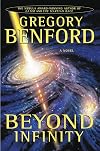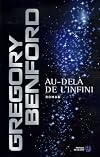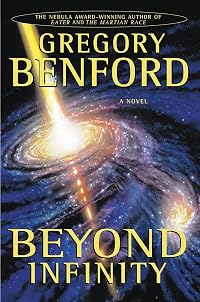
Beyond Infinity
by Gregory Benford
On This Page
Description
Escaping from the unbending constraints of Earth in the company of a brilliant beast, a young woman soon discovers that Alien agencies have mastered the ability to span parallel universes, which are undetectable by man-made devices.Tags
Recommendations










Member Reviews
The timescale and ideas in this book have an extensive span. From theoretical physics to philosophy to evolutionary biology... it touches on all of them. The problem is, the scope is so grand, the times so vast, the setting so strange, it is difficult for the reader to identify with the characters, making it interesting but ultimately unsatisfying. I enjoy science fiction, and a bit of satirical fantasy is fun too, but I prefer my fiction anchored to reality, or at least the bits of it with which I'm familiar. Beyond Infinity felt more adrift, with a setting in a distant, unfamiliar future and characters biologically diverse and yet seemingly childish at times.
I've been reading SF for over 40 years, and this was one of the more difficult books to read. Seemed like a flimsy plot that simply allowed Benford to introduce a wide variety of fascinating concepts -- from the pinwheel to the brane and his evolution of the human species. No sooner though was I getting my mind wrapped around the idea he was presenting then we'd jet off to another one -- so quite disjointed reading from that aspect.
Benford is a physicist, so he writes with a very hard scientific perspective. In this case, way TOO hard. First of all, I couldn't follow the science (I'm not a scientist myself, but I'm educated enough that I can usually follow such things). Second of all, his descriptions of very odd things was not very interesting- he seems totally hooked on color; when describing scenes there is always a cornucopia of color descriptions, which was almost worthy of parody. I don't expect or need great writing in sci fi, but this was particularly poor.
It's too bad, because the concept had potential- set in the REALLY distant future, billions of years from now. Some thought-provoking stuff- history that is so vast that much of it is literally show more forgotten. I thought that was pretty cool.
But the science, including a lot of stuff about beings in 4 dimensions, was just too tough to follow. show less
It's too bad, because the concept had potential- set in the REALLY distant future, billions of years from now. Some thought-provoking stuff- history that is so vast that much of it is literally show more forgotten. I thought that was pretty cool.
But the science, including a lot of stuff about beings in 4 dimensions, was just too tough to follow. show less
This is only a review of the first hundred or so pages as I could not get any further. The 'plot', such as it is, seems to come from pre-60s 'sensawunda' science fiction and appears cartoonish. The writing tries to be deep but only succeeds in being irritating. The central 'character' Cley is a cardboard cut-out. A failed experiment (is it meant to be a 'Young Adult' book?) from an otherwise excellent writer.
I like Benford, but this one struggles so hard to convey ideas that I simply couldn't follow it. Just not much of a story there.
Hard-SF novel set billions of years in the future.
http://nhw.livejournal.com/155939.html
I liked it. Based on his shorter "Beyond the Fall of Night" and very much in the tradition of Arthur C Clarke with nods to Stapledon and Aldiss.
I liked it. Based on his shorter "Beyond the Fall of Night" and very much in the tradition of Arthur C Clarke with nods to Stapledon and Aldiss.
Members
- Recently Added By
Author Information

239+ Works 22,561 Members
Gregory Benford, was born on January 30, 1941 in Mobile, Alabama. He is a physicist and science fiction writer who earned his Ph.D. from the University of California, San Diego, in 1967. He is a Woodrow Wilson Fellow and a consultant for NASA. Benford's first novel "Deeper than the Darkness" (1970), which was revised as "The Stars in Shroud" show more (1978), gave him notice as a serious Science Fiction writer. His most popular work is "Timescape" (1980), which was the winner of the Nebula and John W. Campbell Memorial Awards; it presented a hard physics approach to limited time travel. "In the Ocean of Night" (1977), "Across the Sea of Suns" (1984), "Great Sky River" (1987), "Tides of Light" (1989) and "Furious Gulf" (1994) were all a part of the Galactic Cluster Series. He has also written the juvenile novel "Jupiter Project" (1975), "Against Infinity" (1983) and the thriller "Artifact" (1985). He has been nominated for 12 Nebula Awards (winning for "Timescape" and for the novelette, "If the Stars are Gods"). Benford, writing alternately with Bruce Sterling, produces science fact articles for the Magazine of Fantasy and Science Fiction. They took over after the death of regular columnist Isaac Asimov. He has also co-edited theme anthologies with Martin H. Greenburg, which include "Hitler Victorious" (1986), "Nuclear War" (1988), "What Might Have Been, Volume 1: Alternate Empires" (1988), "Volume 2: Alternate Heroes" (1989) and "Volume 3: Alternate Wars." (Bowker Author Biography) show less
Some Editions
Common Knowledge
- Original publication date
- 2004
- Dedication
- To Arthur Clarke, without whom...
- First words
- At times Cley thought she was, well, a bit too intense.
Classifications
Statistics
- Members
- 359
- Popularity
- 88,147
- Reviews
- 8
- Rating
- (3.26)
- Languages
- English, French
- Media
- Paper, Ebook
- ISBNs
- 6
- ASINs
- 2