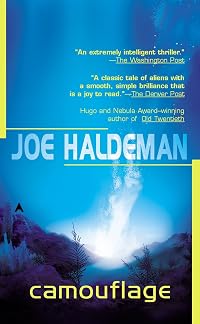
Camouflage
by Joe Haldeman
On This Page
Description
Fiction. Literature. Science Fiction. HTML:Two aliens have wandered Earth for centuries. The Changeling has survived by adapting the forms of many different organisms. The Chameleon destroys anything or anyone that threatens it.Now, a sunken relic that holds the key to their origins calls to them to take them home—but the Chameleon has decided there's only room for one.
Tags
Recommendations






Member Reviews
Two alien beings emerge from the ocean waves, both taking on new forms and learning new language, melding into this society called humanity. Decades pass, the changeling and the chameleon experience lifetime after lifetime - becoming male, female and even animal. They amass a wealth of knowledge and experiences. It's been so long though, that they've forgotten about whatever they started as. That is, until an announcement comes about the discovery of an alien ship. It kindles a memory and sparks a desire to relearn who they are and where they came from.
I love Joe Haldeman's science fiction. I trust him enough that even though I don't read a great deal of sci-fi, if I see one of his books I'll pick it up. He has a way of conveying what show more could be a difficult or technical concept in a way that feels so simple and every day. I never feel that he's overtaxing my suspension of disbelief even when he's writing some very out-there stuff. I had no problem at all envisioning these shape-shifters and how they functioned. My difficulty came from keeping them apart. They took on so many identities that I had trouble remembering who was who. Much like the difficulty I had keeping Edmund's alter-egos in The Count of Monte Cristo straight. I did enjoy it and would probably benefit from a second reading at some point, but not right away. show less
I love Joe Haldeman's science fiction. I trust him enough that even though I don't read a great deal of sci-fi, if I see one of his books I'll pick it up. He has a way of conveying what show more could be a difficult or technical concept in a way that feels so simple and every day. I never feel that he's overtaxing my suspension of disbelief even when he's writing some very out-there stuff. I had no problem at all envisioning these shape-shifters and how they functioned. My difficulty came from keeping them apart. They took on so many identities that I had trouble remembering who was who. Much like the difficulty I had keeping Edmund's alter-egos in The Count of Monte Cristo straight. I did enjoy it and would probably benefit from a second reading at some point, but not right away. show less
I think I have to start this with a confession: I'm a book snob. A book being an easy read means that I will read it quickly, and may even enjoy it, but I will automatically downgrade it in my mind for not being sufficiently pretentious. A good example are Greg Bear's "Darwin's Radio" and "Darwin's Children" books - both really engaging, thought-provoking science fiction (except the bits where they degenerate into God), but written very much like techno-thrillers. So while I enjoyed reading them, it felt a bit weird.
Now enter old age. Okay, I'm only 26, but the way my mind works has changed a lot recently, and I'm actually finding it very hard to get into my previously favoured pretentious books these days. They end up half-read in show more various corners of the house. So I've actively started looking for easy reads to at least keep my mind the habit of reading.
I came across "Camouflage" in the form of an extract in the second Tiptree Award anthology, only a few chapters, enough to introduce us to the three main characters. I found the extract easy to read, but more than that, I found it engaging. I could work with those characters (I'm a sucker for character-driven stories!), I wanted to know what happened to them. So off to Amazon I went, and by the time I finished the Tiptree anthology, "Camouflage" had dropped through my letterbox.
As with the above-mentioned Greg Bear books, "Camouflage" has a certain techno-thriller quality when it comes to the style of writing: short chapters, headed only with time and place, short sentences, hardly any words you wouldn't find in the average native English-speaker's vocabulary, and at one point it even degenerates into diagrams and strings of binary!
And yet, I found the novel extremely engaging and thought-provoking. In the simple language which makes it more accessible to the general public than your average contemporary genre novel, it manages to address some really interesting questions around what it means to be human, as well as touch on themes of gender, sxuality and race in an almost casual but entirely effective way. The story is very character-driven, the character-development believeable and compassionate.
Then ending is about 90% predictable, to the point where I started second-guessing the author and suspecting a Giant Plot Twist of Doom which never came. Still, that does not dimish the impact of the novel.
The one question left in my mind is why the two creatures (the changeling and the chameleon) are so different. Why was one able to empathise with humans where the other only wanted to destroy? I would love to go home with either or both of them and explore the evolutionary and social pressures which led to their different responses to very similar situations.
Overall, a great book and one I never would have read had it not picked up a Tiptree Award. show less
Now enter old age. Okay, I'm only 26, but the way my mind works has changed a lot recently, and I'm actually finding it very hard to get into my previously favoured pretentious books these days. They end up half-read in show more various corners of the house. So I've actively started looking for easy reads to at least keep my mind the habit of reading.
I came across "Camouflage" in the form of an extract in the second Tiptree Award anthology, only a few chapters, enough to introduce us to the three main characters. I found the extract easy to read, but more than that, I found it engaging. I could work with those characters (I'm a sucker for character-driven stories!), I wanted to know what happened to them. So off to Amazon I went, and by the time I finished the Tiptree anthology, "Camouflage" had dropped through my letterbox.
As with the above-mentioned Greg Bear books, "Camouflage" has a certain techno-thriller quality when it comes to the style of writing: short chapters, headed only with time and place, short sentences, hardly any words you wouldn't find in the average native English-speaker's vocabulary, and at one point it even degenerates into diagrams and strings of binary!
And yet, I found the novel extremely engaging and thought-provoking. In the simple language which makes it more accessible to the general public than your average contemporary genre novel, it manages to address some really interesting questions around what it means to be human, as well as touch on themes of gender, sxuality and race in an almost casual but entirely effective way. The story is very character-driven, the character-development believeable and compassionate.
Then ending is about 90% predictable, to the point where I started second-guessing the author and suspecting a Giant Plot Twist of Doom which never came. Still, that does not dimish the impact of the novel.
The one question left in my mind is why the two creatures (the changeling and the chameleon) are so different. Why was one able to empathise with humans where the other only wanted to destroy? I would love to go home with either or both of them and explore the evolutionary and social pressures which led to their different responses to very similar situations.
Overall, a great book and one I never would have read had it not picked up a Tiptree Award. show less
A very easy to read book, I breezed right through this one.
The premise is interesting, even if a bit hard to swallow, with two aliens among us and a mysterious artifact pulled out of the ocean.
Following the aliens through history has some really great moments of history brought to life, I wish he'd done more of it.
In fact, since both aliens are immortal I thought the whole time line was pretty rushed. Even though they keep telling themselves they have all the time in the world, most of the action is in the last couple of months, with a time line covering millions of years.
One alien is much more developed than the other as a character. I think it could have been a little less lopsided, although the emphasis on one is needed. Developing show more them is the main point of the book, and the best parts of it.
Reading the other reviews, I was surprised to note how much the sex in the book seemed to push people's buttons, and different people took it completely differently. I don't think there complaints are in the book as much as they are part of the reviewers viewpoint. At any rate, it didn't upset any of my preconceived ideas, so I didn't think it was objectionable. :-)
My real problem with this book is the humans. They start out as interesting, independent, big thinkers but then just dwindle away in importance. The love story takes over, and science pretty much gets tossed out the window. Sure, you can wave the Clarke 'indistinguishable from magic' quote around to try and help, but it still feels like cheating. Better hand waving was desperately required to save the ending.
All in all, worth reading, but not Haldeman's best by a fair margin. show less
The premise is interesting, even if a bit hard to swallow, with two aliens among us and a mysterious artifact pulled out of the ocean.
Following the aliens through history has some really great moments of history brought to life, I wish he'd done more of it.
In fact, since both aliens are immortal I thought the whole time line was pretty rushed. Even though they keep telling themselves they have all the time in the world, most of the action is in the last couple of months, with a time line covering millions of years.
One alien is much more developed than the other as a character. I think it could have been a little less lopsided, although the emphasis on one is needed. Developing show more them is the main point of the book, and the best parts of it.
Reading the other reviews, I was surprised to note how much the sex in the book seemed to push people's buttons, and different people took it completely differently. I don't think there complaints are in the book as much as they are part of the reviewers viewpoint. At any rate, it didn't upset any of my preconceived ideas, so I didn't think it was objectionable. :-)
My real problem with this book is the humans. They start out as interesting, independent, big thinkers but then just dwindle away in importance. The love story takes over, and science pretty much gets tossed out the window. Sure, you can wave the Clarke 'indistinguishable from magic' quote around to try and help, but it still feels like cheating. Better hand waving was desperately required to save the ending.
All in all, worth reading, but not Haldeman's best by a fair margin. show less
Take a central idea which is anything but fresh, ask Mr. Haldeman to write a book about that idea, and he comes up with a novel that won Science Fiction's prestigious Nebula Award for the year 2005.
The story revolves around two aliens who have been on earth even before life crawled out of the oceans. One of them is a brutal killer, and the other has become almost human during his stay on earth, and both of them are shape-changers. They have been on earth far too long to remember who they got here, but when their spaceship is discovered at the bottom of the ocean and raised by a private American firm, both of them decide to get to it to discover their true origins.
A masterful narrative full of complex ideas wrapped in deceptively simple show more prose which has become Haldeman's trademark, this is a very engaging book which is simultaneously an entertaining thriller as well as a thought-provoking novel which looks at human nature from a non-human perspective. show less
The story revolves around two aliens who have been on earth even before life crawled out of the oceans. One of them is a brutal killer, and the other has become almost human during his stay on earth, and both of them are shape-changers. They have been on earth far too long to remember who they got here, but when their spaceship is discovered at the bottom of the ocean and raised by a private American firm, both of them decide to get to it to discover their true origins.
A masterful narrative full of complex ideas wrapped in deceptively simple show more prose which has become Haldeman's trademark, this is a very engaging book which is simultaneously an entertaining thriller as well as a thought-provoking novel which looks at human nature from a non-human perspective. show less
It's not as bad as most reviews say it is, but I suspect most reviews are salty because this took the Nebula award from Jonathan Strange and Mr. Norrell... and, well, they are completely right, Jonathan Strange is an absolute masterpiece and this is just an ok-ish book. But is not that bad though, it's a fast and fun read to kill some time.
What makes you human?
SF writers have been exploring this question for a long time. One approach has been to use an android - said machine goes on a lengthy quest to emulate its "superior" human creators. Two famous examples are [b:The Bicentennial Man and Other Stories|70787|The Bicentennial Man and Other Stories|Isaac Asimov|http://photo.goodreads.com/books/1307490924s/70787.jpg|4186] and Data from Star Trek: The Next Generation. Generally, the android starts out more or less niave and incomprehending of human nature and gradually learns to emulate humans more accurately. Emotion and death seem to be characteristics singled out as definining humanity.
Well, that's been done before, so why not do it with aliens instead? In fact, let's show more have two aliens that try to hide amongst the Earthlings and contrast how that affects them. These aliens are not the same species as each other but they both turn out to be physically much more robust than life from Earth in general, so they survive through a looooong time on our planet and see many changes. Both are looking for others who are also not local...
The story is diverting enough and easy to read. I feel that I should have guessed how the ending would play out but I didn't. A competent but not greatly remarkable book. show less
SF writers have been exploring this question for a long time. One approach has been to use an android - said machine goes on a lengthy quest to emulate its "superior" human creators. Two famous examples are [b:The Bicentennial Man and Other Stories|70787|The Bicentennial Man and Other Stories|Isaac Asimov|http://photo.goodreads.com/books/1307490924s/70787.jpg|4186] and Data from Star Trek: The Next Generation. Generally, the android starts out more or less niave and incomprehending of human nature and gradually learns to emulate humans more accurately. Emotion and death seem to be characteristics singled out as definining humanity.
Well, that's been done before, so why not do it with aliens instead? In fact, let's show more have two aliens that try to hide amongst the Earthlings and contrast how that affects them. These aliens are not the same species as each other but they both turn out to be physically much more robust than life from Earth in general, so they survive through a looooong time on our planet and see many changes. Both are looking for others who are also not local...
The story is diverting enough and easy to read. I feel that I should have guessed how the ending would play out but I didn't. A competent but not greatly remarkable book. show less
Generally I hate books that constantly switch viewpoints, even more when they don't cross paths often, but Camouflage is an exception. The narratives are separated not only by their viewpoint but also by time. They converge towards the end but there is never a sense of urgency. Every experience of the characters seems important and, for the reader, interesting.
The ending wasn't a let down but wasn't exactly brilliant either. The story just seemed to jump off a cliff. I wouldn't let this be a reason not to read it though. It's just slightly less perfect then the bit that came before. Reading the book is incredibly enjoyable and I highly recommend it.
The ending wasn't a let down but wasn't exactly brilliant either. The story just seemed to jump off a cliff. I wouldn't let this be a reason not to read it though. It's just slightly less perfect then the bit that came before. Reading the book is incredibly enjoyable and I highly recommend it.
Members
- Recently Added By
Lists

Nebula Award
111 works; 14 members

Books Read in 2014
2,343 works; 89 members
Author Information

191+ Works 30,833 Members
Joe Haldeman has uniquely blended a strong interest in astronomy and with his love for writing to publish numerous novels, anthologies and short stories over three decades. He holds a B.S. in astronomy from the University of Maryland (1967), and an M.F.A. in English from the Iowa Writers Workshop (1975). An adjunct professor at Massachusetts show more Institute of Technology, Haldeman has also taught at Michigan State, Larion West Seattle, SUNY Buffalo, Princeton, University of North Dakota, Kent State and the University of North Florida Haldeman's works include War Year (1972), The Forever War (1975), Worlds (1981), Worlds Apart (1983), Tools of the Trade (1987), and The Hemingway Hoax (1990). He has also co-authored and edited numerous works of science fiction. Born in Oklahoma on June 9, 1943, Haldeman grew up in Puerto Rico, New Orleans, Washington D.C., and Alaska. He was drafted into the military in 1967, fighting in the Central Highlands of Vietnam as a combat engineer with the 4th Division (1/22nd Airmobile Battalion), for which he received the Purple Heart, among other medals. (Bowker Author Biography) show less
Some Editions
Awards and Honors
Awards
Distinctions
Work Relationships
Common Knowledge
- Canonical title*
- Camouflage
- Original publication date
- 2004
- People/Characters
- Russell Sutton; Jack Halliburton; Jan Dagmar; The changeling; The chameleon
- Important places
- Apia, Samoa; Bataan, the Philippines; California, USA; Samoa; San Guillermo, California, USA; USA
- Dedication
- For Ralph Vicinanza, faithful navigator
- First words
- The monster came from a swarm of stars that humans call Messier 22, a globular cluster ten thousand light-years distant.
- Last words
- (Click to show. Warning: May contain spoilers.)He paused, then stepped over the threshold and felt himself start to glow.
- Original language
- English
*Some information comes from Common Knowledge in other languages. Click "Edit" for more information.
Classifications
Statistics
- Members
- 1,249
- Popularity
- 19,694
- Reviews
- 40
- Rating
- (3.43)
- Languages
- 6 — English, German, Polish, Portuguese, Romanian, Spanish
- Media
- Paper, Audiobook, Ebook
- ISBNs
- 14
- ASINs
- 9