On This Page
Description
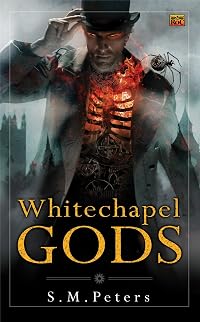
In this steampunk fantasy set in the Whitechapel section of Victorian London, a mechanized, steam-driven hell ruled by two mysterious, mechanical gods--Mama Engine and Grandfather Clock--a few human veterans of the recent Uprising have formed a resistance group and are preparing another attack, with a secret weapon that could free them, or destroy them all.Tags
Recommendations








Member Reviews
This was one of those books that I couldn't stop reading and yet once I did, because the story had ended, I was ultimately unsatisfied.
The imagery and atmosphere were gorgeous. I picked this book up because I wanted to read something steampunk and this book not only did not disappoint, it went over and above in providing me what I was craving. I could so easily visualize this heavily-industrialized area of London, from its frightening Gods to its citizens who were ill with the clacks.
Where the book lost me was with its characters. I found myself fascinated with Missy, Bergen, Tommy, Oliver, and even Baron Hume, but in the end the only character I really felt I had a handle on was Jeremy Longshore, a clickrat of great achievements.
All show more in all I enjoyed it even though it seemed there was a bit too much crammed into one small book. show less
The imagery and atmosphere were gorgeous. I picked this book up because I wanted to read something steampunk and this book not only did not disappoint, it went over and above in providing me what I was craving. I could so easily visualize this heavily-industrialized area of London, from its frightening Gods to its citizens who were ill with the clacks.
Where the book lost me was with its characters. I found myself fascinated with Missy, Bergen, Tommy, Oliver, and even Baron Hume, but in the end the only character I really felt I had a handle on was Jeremy Longshore, a clickrat of great achievements.
All show more in all I enjoyed it even though it seemed there was a bit too much crammed into one small book. show less
The steampunk elements are incredibly steampunky, and pretty unnerving. The themes of man, machine, power, and man as machine are interesting. The plot is … pretty standard, unfortunately, and the characters don’t really bring it to life. Close, in parts, but not quite. There are some spots where the plot diverges from, “Oliver will get out of this and keep saving the day” and a fair number of those were cool, but lost points for being slightly confusing. Like, I had to stop and read the passages over to work out what had happened? But if all you want is literal human machines and clockwork animals and giant steam guns and robots, well, have I got a book for you.
6/10
6/10
I don't rate books that I didn't finish. Why I didn't finish is because that the writing is unrelenting bleak.... The plot is interesting, and has so much possibility, but the writing, while adequate, is not fun. It is dark, bleak, and depressing. I really wish the writing was better, this world is fascinating and has a lot going for it.
Really good, but frustratingly vague at times. But I think that's part of the charm; Peters gives you just enough information to follow along with the plot, and nothing more. And the atmosphere and the characters are well-realized and memorable.
S.M. Peters really impressed me with his weird first novel.
I’d picked this one up because I wanted to try a steampunk novel (and the cover really grabbed my eye). I think this is not really a steampunk novel (or at least not what I was expecting one to be). I guess if I had to categorize it as something I would say it's a Weird Tale.
Peters has created a unique world where the district of Whitechapel has been cut off from the rest of the world. A cancer-like disease (the clacks) is turning people into machines and steel girders seem to grow like trees.
His dialogue and narration worked pretty well. I thought he did a nice job of evoking his quasi-Victorian era of the story with just the right turn of phrase or bit of slang (or unusual show more character name). He was able to lace enough of this in to feel natural without hammering me over the head and breaking my suspension of disbelief.
His characters were also handled well. I thought for a first time author he did a good job at creating believable characters with some depth to them. His main characters were very well realized, three dimensional people. His secondary characters also came off as more than just sketches.
I would like to have a bit more description though. I admit I like description more than most. It wasn't bad, but his description was a little too vague for me. Especially when he was describing some of the more esoteric settings, creatures and devices in his world, things would be a little fuzzy around the edges. The setting was so outlandish that I think some real, detailed and concrete description was called for.
Also there are several threads and characters to follow and the novel jumps rapidly back and forth between them. None of the threads were dull or irrelevant to the plot. But I did lose track a couple of times of who was who, though was able to catch up. For a first time author to try something so out there, I give him a lot of credit.
I was also happy to see that the novel seems to stand alone I appreciate him putting so much creativity into his first novel without (as far as I know) intending to milk it forever in book after book.
I am very curious to see where S.M. Peters will go from here. show less
I’d picked this one up because I wanted to try a steampunk novel (and the cover really grabbed my eye). I think this is not really a steampunk novel (or at least not what I was expecting one to be). I guess if I had to categorize it as something I would say it's a Weird Tale.
Peters has created a unique world where the district of Whitechapel has been cut off from the rest of the world. A cancer-like disease (the clacks) is turning people into machines and steel girders seem to grow like trees.
His dialogue and narration worked pretty well. I thought he did a nice job of evoking his quasi-Victorian era of the story with just the right turn of phrase or bit of slang (or unusual show more character name). He was able to lace enough of this in to feel natural without hammering me over the head and breaking my suspension of disbelief.
His characters were also handled well. I thought for a first time author he did a good job at creating believable characters with some depth to them. His main characters were very well realized, three dimensional people. His secondary characters also came off as more than just sketches.
I would like to have a bit more description though. I admit I like description more than most. It wasn't bad, but his description was a little too vague for me. Especially when he was describing some of the more esoteric settings, creatures and devices in his world, things would be a little fuzzy around the edges. The setting was so outlandish that I think some real, detailed and concrete description was called for.
Also there are several threads and characters to follow and the novel jumps rapidly back and forth between them. None of the threads were dull or irrelevant to the plot. But I did lose track a couple of times of who was who, though was able to catch up. For a first time author to try something so out there, I give him a lot of credit.
I was also happy to see that the novel seems to stand alone I appreciate him putting so much creativity into his first novel without (as far as I know) intending to milk it forever in book after book.
I am very curious to see where S.M. Peters will go from here. show less
(Amy) In a somewhat steampunk Victorian London gone very much awry, Whitechapel has been walled off from the world outside, presumably by the "gods" of the title, Mama Engine and Grandfather Clock, or their minions. The people of this sealed-off bit of London are kept quite firmly in their place by the gold cloaks (minions of Grandfather Clock), the black cloaks (minions of Mama Engine), and the Boiler Men, whose precise allegiance I did not determine, but are definitely not on the side of humanity. A disease is sweeping the people, infecting them with a machine plague entirely unlike those the term is usually used to describe by nanotech-era writers - this causes people to bleed oil, and grow gears, and become virtually unkillable. And show more eventually, they lose themselves in the machine...
The plot here follows an underground group, each with his own reasons for disliking the status quo, in their attempt to bring down the powerful creatures ruling Whitechapel. The plot is fast-paced and fairly gripping, and one does come to be fairly invested in the plucky rebels and their battles. The structure of the thing is a little flimsy, but I'm not so sure that really matters so much in this case, given that it's a fast read, and the pace doesn't really leave one much chance to dwell upon the possible plot holes. Recommended as a vacation book or for other circumstances in which entertainment is key. Not recommended for critical reading practice.
( http://weblog.siliconcerebrate.com/zenos-library/2008/03/whitechapel-gods-s-m-pe... )
(Alistair) Well, now. This is an interesting pseudo-steambook book. I say pseudo-steampunk, because here the machines are not taking over society in the ordinary sense, but rather as extensions of rather more metaphysical entities - the "gods" of the title, Grandfather Clock and Mama Engine, representing cold logic and hot drives, respectively. Pushing their way into the reality of Victorian England via its technology as their bodies - and, in Grandfather Clock's case, thousands of slaved brains - they've sealed off the district of Whitechapel, effectively enslaved those living there to their will, through their steam-driven transhuman minions, and (a side effect of their presence, possibly?) inflicted upon them "the clacks", a disease causing mechanical parts to grow on and in those it infects, replacing their flesh.
Over several days, the book takes us through an attempt to overthrow these mechanical deities, orchestrated by a resistance group assisted by those outside, seeking to reclaim Whitechapel for England, and a local crime boss with his own plans.
I thoroughly enjoyed it. The plot was fast-paced and pretty gripping - my one real complaint with the book, in fact, is that it sped up a little too much near the end, and ended rather abruptly for my taste - the characters well-drawn, and a very good job, I think, of capturing the feel and the language of the supposed era.
Recommended, I think. Hope to see more from this author.
( http://weblog.siliconcerebrate.com/cerebrate/2008/10/whitechapel_gods_s_m_peters... ) show less
The plot here follows an underground group, each with his own reasons for disliking the status quo, in their attempt to bring down the powerful creatures ruling Whitechapel. The plot is fast-paced and fairly gripping, and one does come to be fairly invested in the plucky rebels and their battles. The structure of the thing is a little flimsy, but I'm not so sure that really matters so much in this case, given that it's a fast read, and the pace doesn't really leave one much chance to dwell upon the possible plot holes. Recommended as a vacation book or for other circumstances in which entertainment is key. Not recommended for critical reading practice.
( http://weblog.siliconcerebrate.com/zenos-library/2008/03/whitechapel-gods-s-m-pe... )
(Alistair) Well, now. This is an interesting pseudo-steambook book. I say pseudo-steampunk, because here the machines are not taking over society in the ordinary sense, but rather as extensions of rather more metaphysical entities - the "gods" of the title, Grandfather Clock and Mama Engine, representing cold logic and hot drives, respectively. Pushing their way into the reality of Victorian England via its technology as their bodies - and, in Grandfather Clock's case, thousands of slaved brains - they've sealed off the district of Whitechapel, effectively enslaved those living there to their will, through their steam-driven transhuman minions, and (a side effect of their presence, possibly?) inflicted upon them "the clacks", a disease causing mechanical parts to grow on and in those it infects, replacing their flesh.
Over several days, the book takes us through an attempt to overthrow these mechanical deities, orchestrated by a resistance group assisted by those outside, seeking to reclaim Whitechapel for England, and a local crime boss with his own plans.
I thoroughly enjoyed it. The plot was fast-paced and pretty gripping - my one real complaint with the book, in fact, is that it sped up a little too much near the end, and ended rather abruptly for my taste - the characters well-drawn, and a very good job, I think, of capturing the feel and the language of the supposed era.
Recommended, I think. Hope to see more from this author.
( http://weblog.siliconcerebrate.com/cerebrate/2008/10/whitechapel_gods_s_m_peters... ) show less
Good solid Steampunk worldbuilding, with some wonderful Victorian revolutionaries; loses a few points on some very cookie-cutter characters and their emotional plotlines and developments. I do think this is the most gore I've ever seen in Steampunk; it got downright bloody at times. But there were always gears involved, which made it okay.
Members
- Recently Added By
Author Information
2 Works 682 Members
Some Editions
Series

Common Knowledge
- Canonical title
- Whitechapel Gods
- Original title
- Whitechapel Gods
- Original publication date
- 2008-02
- People/Characters
- Oliver Sumner; Michelle Plantaget; Thomas Moore; Phineas Macrae; John Scared; Heckler
- Important places
- Whitechapel; London, England, UK
- Dedication
- For my wife
- First words
- With a hiss of steam, mechanisms inside the walls shot a steel beam across the door as Aaron slammed it and leapt away.
- Last words
- (Click to show. Warning: May contain spoilers.)She reached out and took it.
Classifications
Statistics
- Members
- 509
- Popularity
- 58,959
- Reviews
- 15
- Rating
- (3.30)
- Languages
- English, German
- Media
- Paper, Ebook
- ISBNs
- 4
- ASINs
- 1