On This Page
Description
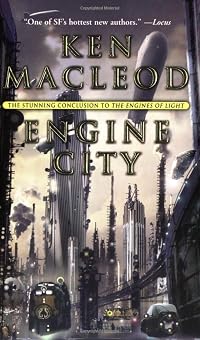
The acclaimed Engines of Light series that began with COSMONAUT KEEP and DARK LIGHT reaches its staggering conclusion in ENGINE CITY. For ten thousand years the varied races of the Second Sphere lived in peaceful co-existence, building their civilisations under the gaze of the ever-vigilant cometary minds. But then the cosmonauts of the Bright Star came. And with them they have brought a revolution ... For one of the Bright Star's crew has warned that an invasion of the Second Sphere is show more imminent and has armed the ancient city of Nova Babylonia against it. Another cosmonaut thinks he's the very man to lead the invasion. The new regime of Nova Babylonia is certain it can withstand the alien onslaught. Whether it can defend itself against Matt Cairns is a question only the gods can answer ... Find out more about this and other titles at www.orbitbooks.co.uk show lessTags
Recommendations




Member Reviews
This is the concluding volume to Macleod's Engines of Light trilogy. Eight years or so have passed (for some characters) since the action of the second book, Dark Light, and the action has moved on, with the same characters that we met in the first two volumes. (None of the action from the second novel has any direct bearing on the plot of this one). We start out with a prologue from the point of view of the gods, the sentient assemblages of extremophile nanobacteria resident in the asteroid belt. This recapitulates the prior history of the books to date. We then alternate between Grigori Volkov on the Second Sphere world of New Earth and his sometime opponent, Matt Cairns, back on the cosmonaut world of Mingulay. In the time that has show more passed since the last novel, human-navigated lightspeed ships - once the sole preserve of the krakens, ancestral creatures removed from Earth in prehistory by an alien race - have become widespread and interstellar trade and travel has become more commonplace. But then news comes from his family that there is evidence that the ancient aliens may be about to return. Things go downhill from there.
I enjoyed this novel greatly, far more than the first two in the trilogy. I don't know why. Macleod still injects elements of Leftist philosophy and background into the story (and it's a brand of socialism not previously seen in his writings). He also includes a number of Easter Eggs for his reader, including a delicious one for all readers of classic British children's historical fiction. The invasion turns out to be rather different to what was expected; throughout, humans, near-humans and non-humans interact in a number of ways that feel intuitively right. Given that the populations of the Second Sphere were originally humans abducted from Earth over a period of centuries, but kept separate from the mainstream of human technological development until the late 21st century, when the starship 'Bright Star' travelled to the system as described in the first novel, Cosmonaut Keep, the civilizations those humans built in the Second Sphere are well-described and have an air of permanency and the weight of history behind them.
A coda suggests that events continue, though the trilogy is completed with this novel. Some critics found this trilogy less satisfying than Macleod's first four novels, the Fall Revolution sequence, despite their being earlier and less accomplished novels. But I found these novels more coherently plotted and in a more consistent setting; perhaps not a spectacular advance on his earlier books, but still indicative of a serious - if sometimes playful - writer hard at work. show less
I enjoyed this novel greatly, far more than the first two in the trilogy. I don't know why. Macleod still injects elements of Leftist philosophy and background into the story (and it's a brand of socialism not previously seen in his writings). He also includes a number of Easter Eggs for his reader, including a delicious one for all readers of classic British children's historical fiction. The invasion turns out to be rather different to what was expected; throughout, humans, near-humans and non-humans interact in a number of ways that feel intuitively right. Given that the populations of the Second Sphere were originally humans abducted from Earth over a period of centuries, but kept separate from the mainstream of human technological development until the late 21st century, when the starship 'Bright Star' travelled to the system as described in the first novel, Cosmonaut Keep, the civilizations those humans built in the Second Sphere are well-described and have an air of permanency and the weight of history behind them.
A coda suggests that events continue, though the trilogy is completed with this novel. Some critics found this trilogy less satisfying than Macleod's first four novels, the Fall Revolution sequence, despite their being earlier and less accomplished novels. But I found these novels more coherently plotted and in a more consistent setting; perhaps not a spectacular advance on his earlier books, but still indicative of a serious - if sometimes playful - writer hard at work. show less
The closing volume of Ken MacLeod's "Engines of Light" trilogy certainly accelerates towards its end. About fifty pages from the finish, I was wondering how the book could supply adequate closure to the series. But things really did wrap up, along with a dime-dropping epilogue to demonstrate that it may stop, but it never ends.
This book is in two parts. The locations for the first part "The Very City Babylon" are several worlds in the Second Sphere--the interstellar archipelago on the opposite side of our galaxy. It is only in the second part "The Human as Alien" that focus is brought almost exclusively to bear on Nova Terra, the planet of New Babylon which had been the human capital of the Second Sphere.
Characters from the first book show more continue to be pivotal, although none of the characters native to Croatan prominent in the second book make a transition to this one. Lydia de Tenebre's role is a bit enlarged and reoriented, and Engine City also introduces Susan Cairns Harkness, the daughter of earlier protagonists.
In my reviews of the earlier books, I've discussed the unusual splitting of narrative voice that takes place in this trilogy. I believe that this third book does explain the reason for the establishment of the present-tense "Matt voice" in the second.That voice continues to alternate with a narrative past tense (when Matt Cairns is absent) in the third volume, until the end of Chapter 5 "Tidal Race," where it disappears, and Matt loses his "presenting" effect in the narrative.
In Cosmonaut Keep, the alternating first-person narrative by Matt was eventually revealed to be his retelling of the events on 21st-century Earth and 10049 Lora to Gregor and Elizabeth on Mingualay in the Second Sphere, where the third-person story had been playing out. The point at which the "Matt voice" is eclipsed in Engine City is the one where Matt has been offered, and as we later learn, accepted, integration into the physical and psychic society of the Multipliers. From then on, he is simply one character among others. The reasonable deduction, it seems to me, is that the Multiplier consciousness is itself the "omniscient third person" exhibited in the past-tense narration. The fact that no similar switch centers on other characters, despite their analogous transitions, casts doubt on my conclusion; but his role in joining the books together seems to establish Matt as the framing character for the saga as a whole.
The political emphases of the earlier books are carried even further in this one, to the point where I thought it made a very interesting interleaving with Debord's Society of the Spectacle, which I had been reading at the same time. In particular, the latter's chapter on "The Proletariat as Subject and Representation" seemed in sync, with observations by Debord such as this one:
"The bourgeoisie came to power because it is the class of the developing economy. The proletariat cannot itself come to power except by becoming the class of consciousness. ... No ideology can help the proletariat disguise its partial goals as general goals, because the proletariat cannot preserve any partial reality which is really its own." (par. 88)
As MacLeod declares in his coda, "There is no meanwhile." show less
This book is in two parts. The locations for the first part "The Very City Babylon" are several worlds in the Second Sphere--the interstellar archipelago on the opposite side of our galaxy. It is only in the second part "The Human as Alien" that focus is brought almost exclusively to bear on Nova Terra, the planet of New Babylon which had been the human capital of the Second Sphere.
Characters from the first book show more continue to be pivotal, although none of the characters native to Croatan prominent in the second book make a transition to this one. Lydia de Tenebre's role is a bit enlarged and reoriented, and Engine City also introduces Susan Cairns Harkness, the daughter of earlier protagonists.
In my reviews of the earlier books, I've discussed the unusual splitting of narrative voice that takes place in this trilogy. I believe that this third book does explain the reason for the establishment of the present-tense "Matt voice" in the second.
In Cosmonaut Keep, the alternating first-person narrative by Matt was eventually revealed to be his retelling of the events on 21st-century Earth and 10049 Lora to Gregor and Elizabeth on Mingualay in the Second Sphere, where the third-person story had been playing out. The point at which the "Matt voice" is eclipsed in Engine City is the one where Matt has been offered, and as we later learn, accepted, integration into the physical and psychic society of the Multipliers. From then on, he is simply one character among others. The reasonable deduction, it seems to me, is that the Multiplier consciousness is itself the "omniscient third person" exhibited in the past-tense narration. The fact that no similar switch centers on other characters, despite their analogous transitions, casts doubt on my conclusion; but his role in joining the books together seems to establish Matt as the framing character for the saga as a whole.
The political emphases of the earlier books are carried even further in this one, to the point where I thought it made a very interesting interleaving with Debord's Society of the Spectacle, which I had been reading at the same time. In particular, the latter's chapter on "The Proletariat as Subject and Representation" seemed in sync, with observations by Debord such as this one:
"The bourgeoisie came to power because it is the class of the developing economy. The proletariat cannot itself come to power except by becoming the class of consciousness. ... No ideology can help the proletariat disguise its partial goals as general goals, because the proletariat cannot preserve any partial reality which is really its own." (par. 88)
As MacLeod declares in his coda, "There is no meanwhile." show less
I wanted to like this series more than I did. I just could not bring myself to care about the competing communist/socialist/anarchist/democratic etc ideologies (really, Volkov, *must* you cause a revolution in every society you encounter, even happy, functional ones?), and the author's tendency to hint at an explanation for something, end the scene, and never bring it up again was pretty irritating.
Overall I liked this one better than the first two, but the end was out of left field--it's explained why killing a god is a crime, i guess, but why did they even do that, did they accomplish anything by it? And why *this* one, besides convenience? I mean, the one they encounter first in book 2 didn't seem to have a problem with humans and it show more was a tragedy that it died, but then they go out and kill some random one just because some gods, maybe not including this one, might attack, and somehow this helps? And then it's unreasonable that this is a crime. What? show less
Great ending to this series of books. The stuff that I thought would happen pretty much happened in the first few chapters and then it kind of went to a new place from there.
How do you review a book without giving away half the plot? Synopsis: the cosmonaughts on the different worlds in the second sphere prepare themselves for the 'alien invasion'. Most of the action is the race to Nova Babylona where Volkov has had a big influence. Matt does his own style of invasion on Nova Babylona (as is given away on the back of the book) which is pretty funny.
I liked the way the characters in this book varied in their levels of polarisation and commitment to ideology. I think this last book is kind of about ideology. Some people commit themselves show more to rules or morals and refuse to budge from them whereas others commit themsleves to a way of thinking. Then there are the moderates who do some of the above or don't think too much about it. show less
How do you review a book without giving away half the plot? Synopsis: the cosmonaughts on the different worlds in the second sphere prepare themselves for the 'alien invasion'. Most of the action is the race to Nova Babylona where Volkov has had a big influence. Matt does his own style of invasion on Nova Babylona (as is given away on the back of the book) which is pretty funny.
I liked the way the characters in this book varied in their levels of polarisation and commitment to ideology. I think this last book is kind of about ideology. Some people commit themselves show more to rules or morals and refuse to budge from them whereas others commit themsleves to a way of thinking. Then there are the moderates who do some of the above or don't think too much about it. show less
The prologue clarifies the role of the gods, and spells out the reason that they seeded the Second Sphere with earth flora and fauna, which I was very happy about as I had been wondering about it since reading the first book of the trilogy. From there we follow Grigori Volkov and the Tenebre trading ship to Nova Babylonia, and Gregor and Elizabeth back on Mingulay, where they discover evidence that the spider-monkey aliens may have returned. And from then onwards, events unroll in extremely unexpected ways.
While still an enjoyable read, this is not up to the same standard as Cosmonaut Keep or Dark Light. The plots loses coherence as events pile up, leading to a conclusion which, while logical, is unsatisfying.
Kind of an anti-climax, but I enjoyed it while it lasted and there were some interesting twists on what I was expecting to happen.
Members
- Recently Added By
Author Information

61+ Works 12,411 Members
Some Editions
Awards and Honors
Distinctions
Series

Work Relationships
Is contained in
Common Knowledge
- Canonical title
- Engine City
- Original title
- Engine City
- Original publication date
- 2002-11
- Epigraph
- There is no middle path between these two, for a man must either be free and true commonwealth's man or a monarchical tyrannical royalist.
Kingly goverment governs the earth by that cheating art of buying and selling... (show all), and thereby becomes a man of contention, his hand is against every man and every man's hand is against him; and take this government at the best, it is a diseased government, and the very city Babylon, full of confusion
--Gerard Winstanley, The Law of Freedom in a Platform (1651) - Dedication
- To Carol, with love
- First words
- The god who later became known as the asteriod 10049 Lora, and shortly as the ESA mining station Marshal Titov, was not unusual of its kind.
- Quotations
- "Do you know how many Multiplier skiffs were in our system in the years before we left? Two! And you know what they did to us! They had us thinking we were under constant surveillance! Thinking we were about to be invaded... (show all)! For every real incident there were ten unreal incidents! We made them up ourselves! That's what we have to do here! Make them doubt their concept of reality! Guerrilla ontology!"
He glared around like a lone gladiator facing a hostile colosseum.
"Fuck with their heads!" he shouted. "*Fuck with their heads!*" - Last words
- (Click to show. Warning: May contain spoilers.)Overhead quietly, without any fuss, the starships were coming in.
- Blurbers
- Robinson, Kim Stanley
- Original language
- English
Classifications
Statistics
- Members
- 734
- Popularity
- 38,713
- Reviews
- 12
- Rating
- (3.46)
- Languages
- English, Spanish
- Media
- Paper, Ebook
- ISBNs
- 7
- ASINs
- 3