On This Page
Description
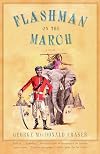
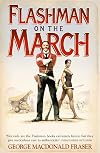
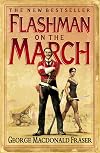
Fiction. Literature. Historical Fiction. HTML:It’s 1868 and Sir Harry Flashman, V.C., arch-cad, amorist, cold-headed soldier, and reluctant hero, is back! Fleeing a chain of vengeful pursuers that includes Mexican bandits, the French Foreign Legion, and the relatives of an infatuated Austrian beauty, Flashy is desperate for somewhere to take cover. So desperate, in fact, that he embarks on a perilous secret intelligence-gathering mission to help free a group of Britons being held captive show more by a tyrannical Abyssinian king. Along the way, of course, are nightmare castles, brigands, massacres, rebellions, orgies, and the loveliest and most lethal women in Africa, all of which will test the limits of the great bounder’s talents for knavery, amorous intrigue, and survival.Flashman on the March—the twelfth book in George MacDonald Fraser’s ever-beloved, always scandalous Flashman Papers series—is Flashman and Fraser at their best. show less
Tags
Recommendations










Member Reviews
The recent death of George McDonald Fraser has brought a close (maybe permanent, maybe not?) to this delightful series of books. I have had the pleasure of following this series every since the release of the first book back in the sixties. The Flashman novels combine history (including substantial endnotes) with sex, action, adventure and the secret pleasure of enjoying the exploits of one of the most notoriously popular non-politically correct characters of 20th Century literature. Flashman is a womanizer, a coward, a scoundrel and a cheat, but in the novels, which are all narrated by Flashman himself, he is utterly honest with his readers. He is a man not proud of his faults, but certainly unabashed about them.
The Flashman novels show more could be dismissed as sensationalized light reading , but Fraser cleverly tied his character into most of the major events of the last sixty years of the nineteenth century, a Victorian Zelig or Forrest Gump. Flashman casually mentions this minor detail or that simple observation, then Fraser in his assumed role as editor of the Flashman papers meticulously explains in the endnotes how these mentions by Flashman confirm the truth of his narrative, since only if Flashman was there could he have known about this fact or that. Fraser's endnotes also round out the historic details of the narrative, giving background and elaboration to the history-as-I-lived-it tales told by Flashman. It all works wonderfully, even if you somewhat suspect that some details are being outrageously fabricated.
I very strongly recommend these books to anyone who has an interest in history and is willing to keep an open mind towards the womanizing and the language (the n-word appears quite a bit, but completely in character for Flashman). I would suggest the best way to read them is in order of publication. This doesn't follow Flashman's own life chronology, but the books published later often make reference to previous editions of the "Flashman Papers" and so is more fun for the reader to follow. show less
The Flashman novels show more could be dismissed as sensationalized light reading , but Fraser cleverly tied his character into most of the major events of the last sixty years of the nineteenth century, a Victorian Zelig or Forrest Gump. Flashman casually mentions this minor detail or that simple observation, then Fraser in his assumed role as editor of the Flashman papers meticulously explains in the endnotes how these mentions by Flashman confirm the truth of his narrative, since only if Flashman was there could he have known about this fact or that. Fraser's endnotes also round out the historic details of the narrative, giving background and elaboration to the history-as-I-lived-it tales told by Flashman. It all works wonderfully, even if you somewhat suspect that some details are being outrageously fabricated.
I very strongly recommend these books to anyone who has an interest in history and is willing to keep an open mind towards the womanizing and the language (the n-word appears quite a bit, but completely in character for Flashman). I would suggest the best way to read them is in order of publication. This doesn't follow Flashman's own life chronology, but the books published later often make reference to previous editions of the "Flashman Papers" and so is more fun for the reader to follow. show less
I'd be skulking behind enemy lines, figged out like Ali Baba, risking capture by a maniac who twisted his victims' limbs off, and playing travelling salesman to a demented bitch who thought it ever so jolly to throw visitors to the lions – and not a thing to be done about it except feign eagerness with a churning stomach and a grin of glad hurrah…" (pg. 57)
Flashman on the March is a fine end to the long-running series, representing any and all of the qualities which have made the Flashman Papers my number one all-time favourite read. There is a rollicking adventure, engrossing prose, moments of pathos and stomach-churning horror, lashings of humour, meticulous historical research, stirring battle scenes and, perhaps above all, show more well-drawn characters. Not least the titular anti-hero Harry Flashman, in my opinion the greatest comedic character in literature (though the only thing in March's minus column is that there is an absence of Flashy's dotty wife Elspeth – who in previous books proved to be the second greatest comedic character in literature). You just never tire of hearing Flashy's un-PC musings and sly turns-of-phrase.
I'll not talk much about Flashman on the March specifically in this review, because I'll just end up recycling stuff I've said in past reviews. That's not a criticism because whilst there is often a Flashman 'formula' each book feels fresh and different. March sees us again with Flashy shanghaied into a British military campaign in Abyssinia (author George MacDonald Fraser makes a thought-provoking contrast to the then-current Iraq War in his foreword) and fleeing and fornicating his way to a happy ending, all the while commenting on the various scenarios and characters in his inimitable way. For example, the British general wants him, if worst comes to the worst, to kill the mad Abyssinian emperor Theodore – who had all the other mad monarchs he'd met beat "in the race to Alice's tea party" (pg. 203) – in order to avoid public embarrassment of a trial. We "can't have him hanging around Aldershot on a pension", you know (pg. 111).
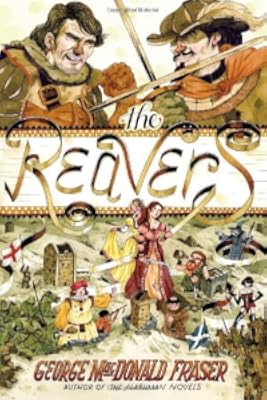
I've already waxed lyrical about the various qualities of the Flashman novels in my reviews of the previous eleven books; on that note, I suppose all there is left to say in their credit is that I have often lamented that there is "only" twelve of the books. I could happily read another hundred. I can turn now to some of Fraser's other works – his reputedly-brilliant war memoir Quartered Safe Out Here and his self-admittedly "nonsense" novel The Reavers both sit on my shelf primed and ready to go – but to be honest I doubt there'll ever be anything else that ticks all of the criteria I look for in a good book. It's a terrible cliché, I know, but I've often got the feeling that these books could have been written just for me. I've read hundreds of books over the last few years alone and, no matter how often I reconsider it, the Flashman Papers come out top every time.
I should also (for the first time in my reviews of the Flashman books) credit where I first heard of the series. I fortuitously came across a glowing review/critique of this last book, Flashman on the March, in the Arguably compendium of writings by Christopher Hitchens and it was Hitchens' examples of Flashman's poltroonery and bastardry (not least the stuff with Uliba-Wark at the waterfall in March) which got me interested. I expected a good laugh in picking up the first Flashman book – and I got it – but never expected that I would also find such consistently incredible and engrossing adventure fiction, such dedicated historical research, so much pathos and cynicism and craft. And each book with an average of only about 300 pages, b'gad!
"You can always tell when something is coming to an end. You know, by the way events are shaping, that it can't last much longer, but you think there are still a few days or weeks to go… and that's the moment when it finishes with a sudden bang that you didn't expect. Come to think of it, that's probably true of life, or so it strikes me at the age of ninety – but I don't expect it to happen before tea. Yet one of these days the muffins will grow cold and the tea-cakes congeal as they summon the lads from belowstairs to cart the old cadaver up to the best bedroom. And if I've a moment before the light fades, I'll be able to cry, 'Sold, Starnberg and Ignatieff and Iron Eyes and Gul Shah and Charity Spring and all the rest of you bastards who tried to do for old Flashy, 'cos he's going out on his own, and be damned to you!'" (pg. 257)" show less
Flashman on the March is a fine end to the long-running series, representing any and all of the qualities which have made the Flashman Papers my number one all-time favourite read. There is a rollicking adventure, engrossing prose, moments of pathos and stomach-churning horror, lashings of humour, meticulous historical research, stirring battle scenes and, perhaps above all, show more well-drawn characters. Not least the titular anti-hero Harry Flashman, in my opinion the greatest comedic character in literature (though the only thing in March's minus column is that there is an absence of Flashy's dotty wife Elspeth – who in previous books proved to be the second greatest comedic character in literature). You just never tire of hearing Flashy's un-PC musings and sly turns-of-phrase.
I'll not talk much about Flashman on the March specifically in this review, because I'll just end up recycling stuff I've said in past reviews. That's not a criticism because whilst there is often a Flashman 'formula' each book feels fresh and different. March sees us again with Flashy shanghaied into a British military campaign in Abyssinia (author George MacDonald Fraser makes a thought-provoking contrast to the then-current Iraq War in his foreword) and fleeing and fornicating his way to a happy ending, all the while commenting on the various scenarios and characters in his inimitable way. For example, the British general wants him, if worst comes to the worst, to kill the mad Abyssinian emperor Theodore – who had all the other mad monarchs he'd met beat "in the race to Alice's tea party" (pg. 203) – in order to avoid public embarrassment of a trial. We "can't have him hanging around Aldershot on a pension", you know (pg. 111).
I've already waxed lyrical about the various qualities of the Flashman novels in my reviews of the previous eleven books; on that note, I suppose all there is left to say in their credit is that I have often lamented that there is "only" twelve of the books. I could happily read another hundred. I can turn now to some of Fraser's other works – his reputedly-brilliant war memoir Quartered Safe Out Here and his self-admittedly "nonsense" novel The Reavers both sit on my shelf primed and ready to go – but to be honest I doubt there'll ever be anything else that ticks all of the criteria I look for in a good book. It's a terrible cliché, I know, but I've often got the feeling that these books could have been written just for me. I've read hundreds of books over the last few years alone and, no matter how often I reconsider it, the Flashman Papers come out top every time.
I should also (for the first time in my reviews of the Flashman books) credit where I first heard of the series. I fortuitously came across a glowing review/critique of this last book, Flashman on the March, in the Arguably compendium of writings by Christopher Hitchens and it was Hitchens' examples of Flashman's poltroonery and bastardry (not least the stuff with Uliba-Wark at the waterfall in March) which got me interested. I expected a good laugh in picking up the first Flashman book – and I got it – but never expected that I would also find such consistently incredible and engrossing adventure fiction, such dedicated historical research, so much pathos and cynicism and craft. And each book with an average of only about 300 pages, b'gad!
"You can always tell when something is coming to an end. You know, by the way events are shaping, that it can't last much longer, but you think there are still a few days or weeks to go… and that's the moment when it finishes with a sudden bang that you didn't expect. Come to think of it, that's probably true of life, or so it strikes me at the age of ninety – but I don't expect it to happen before tea. Yet one of these days the muffins will grow cold and the tea-cakes congeal as they summon the lads from belowstairs to cart the old cadaver up to the best bedroom. And if I've a moment before the light fades, I'll be able to cry, 'Sold, Starnberg and Ignatieff and Iron Eyes and Gul Shah and Charity Spring and all the rest of you bastards who tried to do for old Flashy, 'cos he's going out on his own, and be damned to you!'" (pg. 257)" show less
This is the final “Flashman” book by order of publication and the next to last in chronological sequence. I read the previous eleven installments over a relatively short period. For some reason, I allowed over five years to pass before finishing up the series with this book.
Harry Flashman, bon vivant wastrel and ne’er do well, is the protagonist in this satire of mid-19th century English society and colonialism. Published over 40 years ago, the story is as raucous and entertaining as the day it went to print. As in the previous installments, Flashman finds himself in the midst of the most historically significant events of the period, this time the British Abyssinian campaign of 1868.
As in all previous “packets”, Flashman show more ultimately finds himself covered in glory, despite desperately avoiding danger, by whatever means necessary. This is standard Flashman fare. If you enjoyed the previous installments, you will find little different here. show less
Harry Flashman, bon vivant wastrel and ne’er do well, is the protagonist in this satire of mid-19th century English society and colonialism. Published over 40 years ago, the story is as raucous and entertaining as the day it went to print. As in the previous installments, Flashman finds himself in the midst of the most historically significant events of the period, this time the British Abyssinian campaign of 1868.
As in all previous “packets”, Flashman show more ultimately finds himself covered in glory, despite desperately avoiding danger, by whatever means necessary. This is standard Flashman fare. If you enjoyed the previous installments, you will find little different here. show less
I know I'm going straight to hell for saying this, but this is not one of Fraser's better Flashman books. It felt, as I was reading, as if he was just phoning it in, using a tried and true formula. Perhaps it was the relentless name dropping with all the previous books, something I hadn't noticed before - e.g. "This was just like Balaclava or Little Big Horn or Gettysburg all over again." sort of thing. Make no mistake - this was still an enjoyable book, as books go, and I loved reading about a forgotten (to me) piece of Victorian history, it just wasn't up to Fraser's usual quality. Still worthwhile for Flashman fans, though.
An excellent end to an excellent series. More derring do, more cowardly escapes, more poltroonish behaviour, and more absolutely accurate historical reporting. Very good but not the best Flashman ever
Another of Mr. Fraser's light-hearted looks at the palmy days of Empire. The footnotes often contain useful information. In this case it is a short sketch of George A. Henty, a foreign correspondent of the period, and an author whose juvenile fictions I devoured. So "those who like this sort of thing, will like this example of it very much."
Harry Flashman, soldier, gambler, drinker, whoremonger and all-round Incorrigible rogue does what he does best - ie. soldiering, gambling, drinking and whoring - in this gloriously politically incorrect return to form from George MacDonald Fraser.
Members
- Recently Added By
Published Reviews
ThingScore 100
When Fraser first ushered his Homeric duffer onto the stage, P. G. Wodehouse was tempted into a rare comment, saying, "If ever there was a time when I felt that 'watcher-of-the-skies-when-a-new-planet' stuff, it was when I read the first Flashman."
Well, just as Wodehouse could have quoted the whole of that Keats poem with ease, one imagines that Flashman (or his creator) knows better in the show more 12th and latest novel, Flashman on the March, when he remarks that the British government is caught "between Scylla and t'other thing." This is Wooster to the life, half remembering something from the schoolroom until corrected by Jeeves. As Bertie ruefully phrases it, never learning from his mistakes, it is just when you are stepping high and confident that Fate waits behind the door with a stuffed eelskin. show less
Well, just as Wodehouse could have quoted the whole of that Keats poem with ease, one imagines that Flashman (or his creator) knows better in the show more 12th and latest novel, Flashman on the March, when he remarks that the British government is caught "between Scylla and t'other thing." This is Wooster to the life, half remembering something from the schoolroom until corrected by Jeeves. As Bertie ruefully phrases it, never learning from his mistakes, it is just when you are stepping high and confident that Fate waits behind the door with a stuffed eelskin. show less
added by SnootyBaronet
Lists

Historical Fiction
889 works; 91 members

Best Antiheroes and Antiheroines
119 works; 7 members
Author Information

48+ Works 19,709 Members
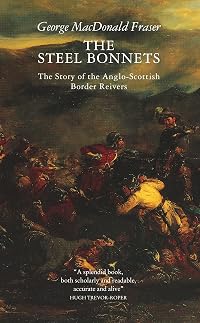
Author George MacDonald Fraser was born April 2, 1925 in Carlisle. He was refused entrance to the medical faculty of Glasgow University, so he joined the army in 1943. He served as an infantryman with the 17th Indian Division of the XIVth Army in Burma, a lance corporal and was commissioned in the Gordon Highlanders. After the war, he became a show more sports reporter with the Carlisle Journal; and during this time, he met and married Kathleen Hetherington, a reporter from another paper. He worked as a reporter and sub-editor on the Cumberland News and then moved to Glasgow, in 1953, where he worked at the Glasgow Herald as a features editor and deputy editor. Fraser's first novel was "Flashman" (1969), which was followed by nine sequels, so far, that deal with different venues of the 19th century ranging from Russia, Borneo and China to the Great Plains of the America West. Some of the other titles in the Flashman Papers are "Royal Flash" (1970), "Flashman in the Great Game" (1975), "Flashman and the Redskins" (1982), and "Flashman and the Angel of the Lord" (1994). Some of his non-fiction work includes "The Steel Bonnets" (1971), which is a factual study of the Anglo-Scottish border thieves in the seventeenth century, and "Quartered Safe Out Here" (1992). Fraser has also written a number of screenplays that include "The Three Musketeers" (1973), "Royal Flash" (1975), "Octopussy" (1983), and "Return of the Musketeers" (1989). He has also written a series of short stories about Private McAuslan whose titles include "The General Danced at Dawn" (1970), "McAuslan in the Rough" (1974), and "The Sheik and the Dustbin and other McAuslan Stories" (1988). He died of cancer on January 2, 2008. (Bowker Author Biography) show less
Some Editions
Series

Work Relationships
Common Knowledge
- Canonical title
- Flashman on the March
- Original publication date
- 2005
- People/Characters
- Harry Paget Flashman
- Important places
- Africa; Ethiopia (as Abyssinia)
- Dedication
- For Kath,
twelve in a row - First words
- “Half a million in silver, did you say?”
- Quotations
- My spirits were rising as we set off down the bank, the birds were carolling, there was a perfumed breeze blowing from the water, we were within a few miles of journey's end, I was absolutely humming 'Drink, Puppy, Drink,' th... (show all)e larks and snails were no doubt on their respective wings and thorns, God was in his heaven, and on the verge of the jungle, not twenty yards away, a white-robed helmeted lancer was sitting his horse, watching us.
- Last words
- (Click to show. Warning: May contain spoilers.)“My views, sir? Can’t think I have many . . . oh, I don’t know, though. Wouldn’t mind suggesting to Her Majesty’s ministers that next time they get a letter from a touchy barbarian despot, it might save ’em a deal of trouble and expense if they sent him a civil reply by return of post . . .”
Classifications
Statistics
- Members
- 884
- Popularity
- 30,525
- Reviews
- 7
- Rating
- (3.77)
- Languages
- English, German, Spanish
- Media
- Paper, Audiobook, Ebook
- ISBNs
- 19
- ASINs
- 11