
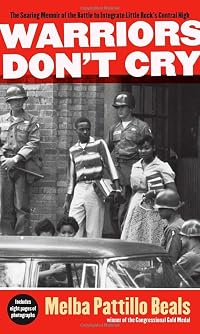
Warriors Don't Cry: A Searing Memoir of the Battle to Integrate Little Rock's Central High
by Melba Pattillo Beals
On This Page
Description
The landmark 1954 Supreme Court ruling, Brown v. Board of Education, brought the promise of integration to Little Rock, Arkansas, but it was hard-won for the nine black teenagers chosen to integrate Central High School in 1957. They ran a gauntlet flanked by a rampaging mob and a heavily armed Arkansas National Guard-opposition so intense that soldiers from the elite 101st Airborne Division were called in to restore order. For Melba Beals and her eight friends those steps marked their show more transformation into reluctant warriors-on a battlefield that helped shape the civil rights movement.Warriors Don't Cry, drawn from Melba Beals's personal diaries, is a riveting true account of her junior year at Central High-one filled with telephone threats, brigades of attacking mothers, rogue police, fireball and acid-throwing attacks, economic blackmail, and, finally, a price upon Melba's head. With the help of her English-teacher mother; her eight fellow warriors; and her gun-toting, Bible-and-Shakespeare-loving grandmother, Melba survived. And, incredibly, from a year that would hold no sweet-sixteen parties or school plays, Melba Beals emerged with indestructible faith, courage, strength, and hope. show lessTags
Recommendations










Member Reviews
After a tour of Central High School in Little Rock, I was inspired to pick up this book. I read the Young Readers Edition. I don't know how the Little Rock nine made it through the year. To take on that mantle in the face of such determined hatred and harassment and find the strength to go to school day after day during the 1957-1958 school year, it's amazing.
Beals was one of the Little Rock Nine -- the nine black students who integrated Central High in Little Rock, Arkansas, in 1957. Living hell is an appropriate term for what they went through. On their first day in class, the mob outside became so dangerous that officials inside the school discussed whether they should give up one of the black students to the mob -- that it might create enough of a distraction that they might be able to get the other eight out alive.
(My brain breaks. You've got nine terrified kids in your office, some of whom are still bleeding from the in-school violence that morning, the mob outside is bribing the police officers into taking off their badges and joining them, and you're discussing whether or not it show more makes sense to turn one of the kids over to the lynch mob? And not only are you even considering this, you're discussing this right in front of the kids? As if they do not exist? As if they do not need you to care for and protect them, both psychologically and physically?)
Even after the 101st Airborne was sent to Little Rock to subdue the mob outside the school, the violence continued inside the school, this time executed by their classmates. Despite the presence of a bodyguard from the 101st who followed Beals from class to class, Beals was throttled during assembly, stabbed during class, had acid shot into her eyes with a squirt gun, had a stick of lit dynamite thrown at her in the stairwell... These weren't isolated freak incidents. They were the highlights of an unremitting campaign of violence: of being slapped, pushed down stairs, spat on, kicked, punched, sprayed with ink or urine...
And then, at Thanksgiving, the 101st Airborne were withdrawn from Central High, leaving Beals and her eight classmates on their own.
If you can pull your eyes away from the violence, there are other important aspects to this story: political thrusts and counter-thrusts, social dynamics, peer pressure, psychological tactics. The ferocity and persistence of the violence was largely incited by the actions of one man, the Arkansas governor. The Nine were under pressure within their black community to give up the fight; everyone was suffering retaliatory violence and economic pressure, not just these nine students. As the year continued, the segregationists did not "get used to" the presence of the black students and start settling down, as so many had predicted; instead, the segregationists became more organized and more effective. Beals hints at other folks' stories: the white vice-principal who gradually stopped being an ally as the social pressure on her increased; the Airborne bodyguard who tried to secretly teach her the psychological necessities of battle; the white student who attended segregationist planning meetings and fed Beals information about where and when the most lethal attacks would be, but who also went crazy on Beals, both blaming her for "screwing up his senior year" and considering her his property since he had saved her life so many times over.
Somehow, Beals accomplished the goal she set for herself: to make it to the end of the school year, still alive and still enrolled. (One of her black classmates did not make it: she was suspended at mid-year, and then later expelled, for spilling a bowl of chili on her aggressors. Again my brain breaks.) Yet Beals never graduated from Central High -- all the high schools in the district were closed the following year -- what would have been Beals' senior year -- and then, because of escalating death threats, Beals fled Arkansas and finished high school in California.
The book is written through the voice of the fifteen year old girl Beals was at the time, and so is emotionally raw and bewildered, without the moderating perspective of the forty years that have passed. The story is both powerful and chilling, and liable to rock the comfortable worlds of people who never understood what segregation in the South meant. show less
(My brain breaks. You've got nine terrified kids in your office, some of whom are still bleeding from the in-school violence that morning, the mob outside is bribing the police officers into taking off their badges and joining them, and you're discussing whether or not it show more makes sense to turn one of the kids over to the lynch mob? And not only are you even considering this, you're discussing this right in front of the kids? As if they do not exist? As if they do not need you to care for and protect them, both psychologically and physically?)
Even after the 101st Airborne was sent to Little Rock to subdue the mob outside the school, the violence continued inside the school, this time executed by their classmates. Despite the presence of a bodyguard from the 101st who followed Beals from class to class, Beals was throttled during assembly, stabbed during class, had acid shot into her eyes with a squirt gun, had a stick of lit dynamite thrown at her in the stairwell... These weren't isolated freak incidents. They were the highlights of an unremitting campaign of violence: of being slapped, pushed down stairs, spat on, kicked, punched, sprayed with ink or urine...
And then, at Thanksgiving, the 101st Airborne were withdrawn from Central High, leaving Beals and her eight classmates on their own.
If you can pull your eyes away from the violence, there are other important aspects to this story: political thrusts and counter-thrusts, social dynamics, peer pressure, psychological tactics. The ferocity and persistence of the violence was largely incited by the actions of one man, the Arkansas governor. The Nine were under pressure within their black community to give up the fight; everyone was suffering retaliatory violence and economic pressure, not just these nine students. As the year continued, the segregationists did not "get used to" the presence of the black students and start settling down, as so many had predicted; instead, the segregationists became more organized and more effective. Beals hints at other folks' stories: the white vice-principal who gradually stopped being an ally as the social pressure on her increased; the Airborne bodyguard who tried to secretly teach her the psychological necessities of battle; the white student who attended segregationist planning meetings and fed Beals information about where and when the most lethal attacks would be, but who also went crazy on Beals, both blaming her for "screwing up his senior year" and considering her his property since he had saved her life so many times over.
Somehow, Beals accomplished the goal she set for herself: to make it to the end of the school year, still alive and still enrolled. (One of her black classmates did not make it: she was suspended at mid-year, and then later expelled, for spilling a bowl of chili on her aggressors. Again my brain breaks.) Yet Beals never graduated from Central High -- all the high schools in the district were closed the following year -- what would have been Beals' senior year -- and then, because of escalating death threats, Beals fled Arkansas and finished high school in California.
The book is written through the voice of the fifteen year old girl Beals was at the time, and so is emotionally raw and bewildered, without the moderating perspective of the forty years that have passed. The story is both powerful and chilling, and liable to rock the comfortable worlds of people who never understood what segregation in the South meant. show less
Wow. I've already said how impressed by this book I am. How these nine students had the fortitude & guts to do what they did just awes me. I think it should be required reading for all U.S. high school students. Though progress has obviously been made on many fronts, not enough progress has been made & there has been significant erosion in the past couple of years (imo). It's history I didn't know enough about & now that I've learned so much more, I feel it's history we need to make sure we don't forget.
I won't get into a long political diatribe but I will say that some of the concluding paragraphs (looking back at the whole situation through the lens of time) just underscores how dangerous it is that we have a president who is doing show more things similar to the then-governor of Arkansas. ("He could ignite and fuel segregationists' anger without being caught holding the matches.") But, back then, Eisenhower stepped in to overrule the governor. Now we don't have that & this book just further underscores the scary level of power that is currently being abused, imo. So, lots of relevance even today.
Really, these students, though, are true heroes. show less
I won't get into a long political diatribe but I will say that some of the concluding paragraphs (looking back at the whole situation through the lens of time) just underscores how dangerous it is that we have a president who is doing show more things similar to the then-governor of Arkansas. ("He could ignite and fuel segregationists' anger without being caught holding the matches.") But, back then, Eisenhower stepped in to overrule the governor. Now we don't have that & this book just further underscores the scary level of power that is currently being abused, imo. So, lots of relevance even today.
Really, these students, though, are true heroes. show less
This book is heartbreaking, as it details the grinding tale of the ongoing abuse the author struggled with as one of the 9 black children who were at the forefront of integrating Little Rock. The failure of authority figures (police, school teachers and officials) who ignored, or worse, encouraged the physical and verbal abuse is stomach turning. After a few months, it sounds like all of the kids were suffering from PTSD. Imagine going to school and only feeling safe if there was a soldier next to you. Imagine not being able to go to the bathroom because girls would light paper on fire and drop it on you. In PE, their clothes were stolen and groups of kids would keep them under the shower as they turned it up to scalding.
The families of show more the children were also threatened, lost jobs, etc. All but one child finished out the school year.
It's a reminder that heroism often isn't a single moment of glory, but often a long, lonely path that requires persistence and unshakable conviction. show less
The families of show more the children were also threatened, lost jobs, etc. All but one child finished out the school year.
It's a reminder that heroism often isn't a single moment of glory, but often a long, lonely path that requires persistence and unshakable conviction. show less
In 1957, Melba Patillo is one of nine black teenagers who attempts to integrate Central High in Little Rock, Arkansas. This story details her harrowing experiences in the battle for civil rights. What is most remarkable about this book is the narrator's voice. The events of the book are so traumatic, but the narrative style is more like journalistic reporting than emotionally fraught personal memoir. This point of view gives immediacy to events and puts the reader in the young character’s shoes. However, the restraint makes the book more powerful because it makes the conflicts more authoritative. In this way, the main character in the book, Melba Beals, reveals much about herself by what she chooses not to say. High school students show more who are struggling with bullying could take comfort from the strength of this book's author. show less
Melba Pattillo Beals provides a heart-breaking, first-hand account of what it meant to face integration head-on in Little Rock Arkansas in 1957 as she and eight other black students struggled against all odds to successfully complete an entire school year at Little Rock's all-white Central High School.
Beals' memoir goes beyond simply an "eyewitness account" of integration and provides chilling insight to the personal trials, hopes, and tests of relentless courage Melba, along with the other members of the "Little Rock Nine," endured. This inspiring story of the "awakening of a warrior within" is appropriate for adult and teenage readers alike.
Beals' memoir goes beyond simply an "eyewitness account" of integration and provides chilling insight to the personal trials, hopes, and tests of relentless courage Melba, along with the other members of the "Little Rock Nine," endured. This inspiring story of the "awakening of a warrior within" is appropriate for adult and teenage readers alike.
Courageous, determined, brave, gutsy, and many more adjectives all describe Melba during the school year of 1957-58 in the attempts of the Little Rock Nine to integrate Central High School. The unfathomable mental and physical brutality and torture inflicted by the segregationists on these teenagers was relentless. How any of the nine survived is amazing and the fact that eight of them completed the year, shows the depth of their integration conviction.
It also highlights the struggles of Melba's family to support her valiant efforts to receive the same quality of education as her white counterparts in their setting.
As readers we are very fortunate that Melba shared her experiences in this book, as so many of us have no idea what show more African-Americans have experienced and, unfortunately, many probably still experience, along with other racial minorities.
I was a white, northern, naive 10-year-old in 1957; I cannot imagine the courage it took for those nine students to start, then continue, this monumental effort. show less
It also highlights the struggles of Melba's family to support her valiant efforts to receive the same quality of education as her white counterparts in their setting.
As readers we are very fortunate that Melba shared her experiences in this book, as so many of us have no idea what show more African-Americans have experienced and, unfortunately, many probably still experience, along with other racial minorities.
I was a white, northern, naive 10-year-old in 1957; I cannot imagine the courage it took for those nine students to start, then continue, this monumental effort. show less
Members
- Recently Added By
Lists

Black Authors
384 works; 32 members

Sonlight Books
1,487 works; 25 members
Author Information

7+ Works 2,193 Members
Melba Pattillo Beals is a recipient of this country's highest honor, the Congressional Gold Medal, for her role, as a fifteen-year-old, in the integration of Central High School in Little Rock, Arkansas. She has been a university professor, a television broadcaster and news reporter, a radio talk show host, and a writer for various magazines. Her show more award-winning book Warriors Don't Cry has sold more than one million copies. She lives in San Francisco and is the mother of three adult children. show less
Awards and Honors
Awards
Distinctions
Work Relationships
Common Knowledge
- Canonical title
- Warriors Don't Cry: A Searing Memoir of the Battle to Integrate Little Rock's Central High
- Original publication date
- 1994
- People/Characters
- Melba Pattillo Beals; Elizabeth Eckford; Ernest Green; Gloria Ray Karlmark; Carlotta Walls LaNier; Minnijean Brown Trickey (show all 9); Terrence Roberts; Jefferson Thomas; Thelma Mothershed Wair
- Important places
- Little Rock Central High School, Little Rock, Arkansas, USA
- Important events
- Little Rock School Integration (1957 | 1958); Brown v. Board of Education (1954)
- Dedication
- I dedicate this book to the eight brave and gentle warriors with whom I attended Central High School in 1957:
Elizabeth Eckford
Ernest Green
Gloria Ray Karlmark
Carlotta Walls LaNier
Minnijean Brown Trickey... (show all)
Terrence Roberts
Jefferson Thomas
Thelma Mothershed Wair
and to our mothers, fathers, and family members who supported us through this incredible experience - First words
- Some people call me a heroine because I was one of nine black teenagers who integrated Central High School in Little Rock, Arkansas, in 1957. (Author's Note)
The stone steps are slippery with morning drizzle as we begin the tedious climb up to the front door of Central High School. (Introduction: Little Rock Warriors Thirty Years Later)
In 1957, while most teenage girls were listening to Buddy Holly's "Peggy Sue," watching Elvis gyrate, and collecting crinoline slips, I was escaping the hanging rope of a lynch mob, dodging lighted sticks of dynamite, and was... (show all)hing away burning acid sprayed into my eyes. - Quotations
- Black folks aren't born expecting segregation, prepared from day one to follow its confining rules. Nobody presents you with a handbook when you're teething and says, "Here's how you must behave as a second-class citizen." ... (show all) Instead, the humiliating experiences creep over you, slowing stealing a teaspoonful of your self-esteem each day. (Chap.2)
- Last words
- (Click to show. Warning: May contain spoilers.)The task that remains is to cope with our interdependence -- to see ourselves reflected in every other human being and to respect and honor our differences.
Namaste
(the God in me sees and honors the God in you)
Classifications
- Genres
- Biography & Memoir, Nonfiction
- DDC/MDS
- 379.263092 — Society, government, & culture Education Public policy issues in education Illiteracy; Instruction of Illiterates
- LCC
- LC214.23 .L56 .B43 — Education Special aspects of education Special aspects of education Social aspects of education Educational sociology Educational equalization. Right to education
- BISAC
Statistics
- Members
- 1,607
- Popularity
- 14,066
- Reviews
- 35
- Rating
- (4.14)
- Languages
- English, German
- Media
- Paper, Audiobook, Ebook
- ISBNs
- 18
- ASINs
- 22