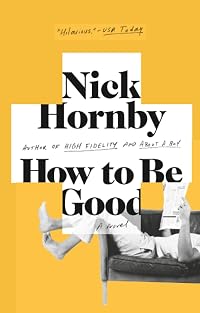
How to Be Good
by Nick Hornby
On This Page
Description
According to her own complex moral calculations, Katie Carr has earned her affair. She's a doctor, after all, and doctors are decent people, and on top of that, her husband David is the self-styled angriest man in Holloway. But when David suddenly becomes good Katie's sums no longer add up, and she asks herself some very hard questions.Tags
Recommendations













Member Recommendations
ellengryphon Opposite sides of the same mid-life crisis coin, both books are witty, imaginative while raising those big, capital 'Q' life questions. Ironically Hornby does a great job of giving voice to a bewildered, soul-searching woman while Holmes brilliantly pens her book in the male voice. I highly recommend both -- fun reads with some depth.
10
Member Reviews
What does it mean to "be good". Katie thinks she's a good person; she is, after all, a doctor. She's having an affair -- but she's still, based on her perception of herself, a good person.
Her husband, David, writes a regular column as the "angriest man" and rants about everything from the size of ice cream containers to public parks. Until David meets a spiritual healer and becomes a good person. He takes in homeless people, gives away half of the children's toys to a women's shelter, gives away money and food.
And when Katie makes what are, to most of us, reasonable objections, she starts to wonder if she is, after all, a good person. David's work with the homeless always trumps her efforts.
Nick Hornby has written an examiniation of show more what it means to be good. He's also written the story of a marriage in mid-life crisis mode. And, he's done so with a dry sense of humor and wit. Katie is a wonderful character that I really identified with -- her world is changing and she is trying to understand and hold on to what's important. show less
Her husband, David, writes a regular column as the "angriest man" and rants about everything from the size of ice cream containers to public parks. Until David meets a spiritual healer and becomes a good person. He takes in homeless people, gives away half of the children's toys to a women's shelter, gives away money and food.
And when Katie makes what are, to most of us, reasonable objections, she starts to wonder if she is, after all, a good person. David's work with the homeless always trumps her efforts.
Nick Hornby has written an examiniation of show more what it means to be good. He's also written the story of a marriage in mid-life crisis mode. And, he's done so with a dry sense of humor and wit. Katie is a wonderful character that I really identified with -- her world is changing and she is trying to understand and hold on to what's important. show less
The voice is pitch perfect. So easy to read, I snapped this up in three days. Funny, canny, with entertaining presentation of some ugly truths about the nuclear family.
::Spoilers start here::
Katie is going to sleep at a friend's apartment and thinking about why she wants to step away, have a time out from being David's wife. "That's all there is left, when you take away working hours and family suppers and family breakfasts: the time I get on my own is the time I would have spent being a wife, rather than being a mother or a doctor. (And God, how frightening, that those are the only options available. The only times when I am not performing one of those three roles is when I am in the bathroom.)"
I liked how Katie has moved to some self show more knowledge by the end of the book. She knows that she wants to be with her family, including her husband. She knows that it's important that they function and support each other as a family and not invite various acquaintances into that intimacy. She knows that she needs to read and take in art in order to nourish her mind. She's fairly clear that she will choose middle class complacency and the easy path rather than engaging with every issue that comes past. But she's still ignorant of her own values beyond these items. I thought the last line of the book was an atonal clash with what was a satisfying falling together at the end. But I grant that Katie has not widened her consciousness very far and has not done wrestling with her selfish ness and her vanity about being "good". So the blankness she sees beyond her family makes sense. show less
::Spoilers start here::
Katie is going to sleep at a friend's apartment and thinking about why she wants to step away, have a time out from being David's wife. "That's all there is left, when you take away working hours and family suppers and family breakfasts: the time I get on my own is the time I would have spent being a wife, rather than being a mother or a doctor. (And God, how frightening, that those are the only options available. The only times when I am not performing one of those three roles is when I am in the bathroom.)"
I liked how Katie has moved to some self show more knowledge by the end of the book. She knows that she wants to be with her family, including her husband. She knows that it's important that they function and support each other as a family and not invite various acquaintances into that intimacy. She knows that she needs to read and take in art in order to nourish her mind. She's fairly clear that she will choose middle class complacency and the easy path rather than engaging with every issue that comes past. But she's still ignorant of her own values beyond these items. I thought the last line of the book was an atonal clash with what was a satisfying falling together at the end. But I grant that Katie has not widened her consciousness very far and has not done wrestling with her selfish ness and her vanity about being "good". So the blankness she sees beyond her family makes sense. show less
How to Be Good is Nick Hornby's third novel and his first to feature a female main character. Katie Carr is stuck in an unhappy marriage with an angry husband. Not angry in an abusive sense, but in a mad at the world sense. Her husband, David, is changed by an encounter with GoodNews, a self-named spiritual healer. He suddenly goes from being the Angriest Man in Holloway to a man bent on saving the world. Though Katie has wished for David to be less angry, his transformation does not improve their marriage. The title of the book has a double meaning. It is both the title of the book David and GoodNews start working on and what Katie has to learn.
All of Hornby's books up to this point are set in the Holloway neighborhood of London. For show more those who have followed him, you even get the brief reward of a mention of Dick from High Fidelity. In my last challenge update, I mentioned remembering that this is not my favorite Hornby novel. While I would still say this is the case, I enjoyed it more this time around. I think I was deceived the first time by some of the blurbs on the book calling it "hilarious." While there are some moments that elicited a giggle from me, I don't find it hilarious. The book is clever, but I think it has a distinctly forlorn quality. It's a book that makes you think about what it means to be good, which is a good thing. I just find it a little sad that Katie can't find her way out of this unhappy situation. Even David, who thinks he has learned how to be good, begins to have doubts about what he is doing.
If you're a Hornby fan, I certainly wouldn't deter you from reading How to Be Good, but don't expect the same clearly positive growth of High Fidelity or About a Boy. How to Be Good represents a clear shift in Hornby's writing. This novel leaves you questioning. Thinking about what it means to be good isn't a bad idea, but don't expect Hornby to give you a tidy solution.
http://iubookgirl.blogspot.com/2011/03/review-how-to-be-good.html show less
All of Hornby's books up to this point are set in the Holloway neighborhood of London. For show more those who have followed him, you even get the brief reward of a mention of Dick from High Fidelity. In my last challenge update, I mentioned remembering that this is not my favorite Hornby novel. While I would still say this is the case, I enjoyed it more this time around. I think I was deceived the first time by some of the blurbs on the book calling it "hilarious." While there are some moments that elicited a giggle from me, I don't find it hilarious. The book is clever, but I think it has a distinctly forlorn quality. It's a book that makes you think about what it means to be good, which is a good thing. I just find it a little sad that Katie can't find her way out of this unhappy situation. Even David, who thinks he has learned how to be good, begins to have doubts about what he is doing.
If you're a Hornby fan, I certainly wouldn't deter you from reading How to Be Good, but don't expect the same clearly positive growth of High Fidelity or About a Boy. How to Be Good represents a clear shift in Hornby's writing. This novel leaves you questioning. Thinking about what it means to be good isn't a bad idea, but don't expect Hornby to give you a tidy solution.
http://iubookgirl.blogspot.com/2011/03/review-how-to-be-good.html show less
I don't know what to think of this novel. I have enjoyed Nick Hornby's black humor and ferocious wit in his other books, but this one is so dismal in its darker spots, and so painful at times, and yet so funny. I cringe while I laugh, and then cringe that I am laughing at all. I kept thinking: there must be hope, he will find a way to offer redemption. Somehow. And he did, but then perhaps snatched it away again in the final pages. I am at a loss.
It is difficult to believe Hornby is not a menopausal woman. Wry, dry, utterly honest and self-deprecating, with no great attempt at prettifying reality.
Nicholas Hornby is the philosopher-novelist every struggling English graduate wishes he were. Though he’s British (strike one) and insufferably upper-middle-class (strike two), he still manages to write his characters anonymously enough to allow them to translate across the point.
Hornby frequently attempts to tackle life’s larger questions in his novels – why are we here, how pop culture has replaced everything else in our lives, and (as you might guess), how to be good. Or, more accurately, what is good, and why we strive so to achieve it.
Leaving aside a bit of mysticism that’s largely irrelevant to the overall plot, How To Be Good tells the story of a middle-aged English woman who’s unsatisfied with her marriage. As she show more readily admits, she is not a battered woman, at least in the proper sense. Rather, she’s middle-class abused, an altogether passive-aggressive sort of agony endured by housewives whose husbands have grown complacent and even mildly contemptuous regarding their better halves.
She engages in a spot of hanky-panky, but comes home to a man entirely different than the one she cheated on. Her husband has undergone a bit of spiritual healing (the aforementioned unnecessary mysticism) and has a complete reversal in his personality. No longer angry, spiteful and bitter, he actually seeks to change the world, or at least his small part of it.
From taking in homeless children off the streets (and encouraging his neighbors to do so) to giving away his children’s possessions (the second computer, nothing vital or necessary), David is an entirely changed man. This of course is what Katie desired when she had her half-baked non-hubby humping, but finds it grossly distasteful after the smallest sample of what being Good requires.
Quite a conundrum for Katie, a doctor, who always considered her career to place her above reproach in that department. Now she’s forced to figure out precisely how she can reconcile herself to a life of superficial goodness while looking down her nose at her husband, his faith healer (DJ GoodNews) and her insufferable daughter Molly, who’s joined forces with Daddy to try and rid the world of all Bad Things.
I don’t think Hornby ever anticipates his readers to walk away from his books with a sudden renewed sense of humanity, but he does offer a lot to think about. He quite astutely points out the main reason that stops people from doing the things they always talk about (embarrassment), though he perhaps leans on liberal guilt a bit much for explaining the motives of every altruistic act ever done.
What is goodness? Is it the internal sense of accomplishment and pride that comes from helping out another person, or the perverse glee most of us experience when someone else commends us for our magnanimity? The Christian flavor of piety calls upon its members to refrain from voicing their virtues at the top of their lungs, but no charities regularly trumpet their own righteousness. While I don’t think you’re necessarily a bad person for indulging in self-gratification as a result of your generosity, neither are you without stain.
Hornby describes marriage as devolving into a sort of interminable ennui from which there is no escape (actually, his chosen metaphor is a car with a flat battery). The only reason the couple stays together is a sort of matrimonial momentum that, with no outside force acting upon it, cannot be stopped. It’s a bit depressing, really, as even the characters that crave credibility solely on the basis of their works without recognition are just as afflicted as those who seek only “superficial goodness.”
It’s an absolutely untenable belief, at least for those who wish to continue on without stopping off for an interlude in the bathtub with their MacBook. Hornby’s answer seems to be that escapism is the only way to deal with life, in this case using a Discman (the book was written in 2001) and a book. But this plan of action ignores the fact that we are social creatures, programmed to interact with one another. Essentially, we have to feed off others to survive. Sure, everyone needs a little time to get away from it all. I would wager, though, that for all the vacations people take away from everyone, far more are taken to get away from everyone else – that is, with one person or a group of people (ideally your family, but I’m not particular) whom you actually enjoy being around.
All in all, it’s another excellent outing for Hornby, which is no small feat considering the quality of his other work. One only wishes he would stick a little more to the realm of reality when trying to beat us over the head with moral certitudes, as it helps a bit in keeping the message zeroed in. show less
Hornby frequently attempts to tackle life’s larger questions in his novels – why are we here, how pop culture has replaced everything else in our lives, and (as you might guess), how to be good. Or, more accurately, what is good, and why we strive so to achieve it.
Leaving aside a bit of mysticism that’s largely irrelevant to the overall plot, How To Be Good tells the story of a middle-aged English woman who’s unsatisfied with her marriage. As she show more readily admits, she is not a battered woman, at least in the proper sense. Rather, she’s middle-class abused, an altogether passive-aggressive sort of agony endured by housewives whose husbands have grown complacent and even mildly contemptuous regarding their better halves.
She engages in a spot of hanky-panky, but comes home to a man entirely different than the one she cheated on. Her husband has undergone a bit of spiritual healing (the aforementioned unnecessary mysticism) and has a complete reversal in his personality. No longer angry, spiteful and bitter, he actually seeks to change the world, or at least his small part of it.
From taking in homeless children off the streets (and encouraging his neighbors to do so) to giving away his children’s possessions (the second computer, nothing vital or necessary), David is an entirely changed man. This of course is what Katie desired when she had her half-baked non-hubby humping, but finds it grossly distasteful after the smallest sample of what being Good requires.
Quite a conundrum for Katie, a doctor, who always considered her career to place her above reproach in that department. Now she’s forced to figure out precisely how she can reconcile herself to a life of superficial goodness while looking down her nose at her husband, his faith healer (DJ GoodNews) and her insufferable daughter Molly, who’s joined forces with Daddy to try and rid the world of all Bad Things.
I don’t think Hornby ever anticipates his readers to walk away from his books with a sudden renewed sense of humanity, but he does offer a lot to think about. He quite astutely points out the main reason that stops people from doing the things they always talk about (embarrassment), though he perhaps leans on liberal guilt a bit much for explaining the motives of every altruistic act ever done.
What is goodness? Is it the internal sense of accomplishment and pride that comes from helping out another person, or the perverse glee most of us experience when someone else commends us for our magnanimity? The Christian flavor of piety calls upon its members to refrain from voicing their virtues at the top of their lungs, but no charities regularly trumpet their own righteousness. While I don’t think you’re necessarily a bad person for indulging in self-gratification as a result of your generosity, neither are you without stain.
Hornby describes marriage as devolving into a sort of interminable ennui from which there is no escape (actually, his chosen metaphor is a car with a flat battery). The only reason the couple stays together is a sort of matrimonial momentum that, with no outside force acting upon it, cannot be stopped. It’s a bit depressing, really, as even the characters that crave credibility solely on the basis of their works without recognition are just as afflicted as those who seek only “superficial goodness.”
It’s an absolutely untenable belief, at least for those who wish to continue on without stopping off for an interlude in the bathtub with their MacBook. Hornby’s answer seems to be that escapism is the only way to deal with life, in this case using a Discman (the book was written in 2001) and a book. But this plan of action ignores the fact that we are social creatures, programmed to interact with one another. Essentially, we have to feed off others to survive. Sure, everyone needs a little time to get away from it all. I would wager, though, that for all the vacations people take away from everyone, far more are taken to get away from everyone else – that is, with one person or a group of people (ideally your family, but I’m not particular) whom you actually enjoy being around.
All in all, it’s another excellent outing for Hornby, which is no small feat considering the quality of his other work. One only wishes he would stick a little more to the realm of reality when trying to beat us over the head with moral certitudes, as it helps a bit in keeping the message zeroed in. show less
This was one of those books that I catch myself coming back to and thinking about again and again in the days and weeks after closing its pages.
Katie is discontented in her marriage, and sick of her husband’s anger, and this story shows the way in which she responds when her wish is actually granted, and her husband David’s whole outlook on life changes.
David describes this change as follows:
“I’m a liberal’s worst nightmare ... I think everything you think. But I’m going to walk it like I talk it.” (p. 80)
In a way, this is a cynical indictment about the way in which our actions often fall short of our supposed ideals, about the extent to which we are content to simply mouth platitudes about the way in which we ought to show more think and feel and act, while behaving in the materialistic/ selfish/ comfortable way in which we always have.
And yet David's radical new views don't make Katie's life easy, and I caught myself sympathising with her on many occasions.
Ultimately, this book questioned my own assumptions about what it was to be ‘good’, and challenged me to think about whether I actually walked my own talk ... show less
Katie is discontented in her marriage, and sick of her husband’s anger, and this story shows the way in which she responds when her wish is actually granted, and her husband David’s whole outlook on life changes.
David describes this change as follows:
“I’m a liberal’s worst nightmare ... I think everything you think. But I’m going to walk it like I talk it.” (p. 80)
In a way, this is a cynical indictment about the way in which our actions often fall short of our supposed ideals, about the extent to which we are content to simply mouth platitudes about the way in which we ought to show more think and feel and act, while behaving in the materialistic/ selfish/ comfortable way in which we always have.
And yet David's radical new views don't make Katie's life easy, and I caught myself sympathising with her on many occasions.
Ultimately, this book questioned my own assumptions about what it was to be ‘good’, and challenged me to think about whether I actually walked my own talk ... show less
Members
- Recently Added By
Published Reviews
ThingScore 57
Readers of ''High Fidelity'' will remember that Hornby wrapped up that sharp tale of modern love with a disingenuously bright bow of a last scene. Here, the pattern's reversed, and 305 pages of treacle (cut, it must be said, with acid humor) build to a final paragraph bearing more truth about marriage and family than all that preceded it.
added by stephmo
"How to Be Good" is partly a wry marital comedy about how a spouse's change of heart invariably destabilizes his longtime partner's own identity, but it's also a thorny parable about the dangers of complacent, conventional self-satisfaction. It's also a very funny and shrewd novel, like Hornby's others, full of acerbic observations about book-buying habits, the virtues of friends who don't show more really listen to what you say, the tactlessness of children, movies that all seem to "involve spacecraft or insects or noise" and the poisonous bitchiness of those dissatisfied souls who hover in the margins of the creative life. show less
added by stephmo
A generation ago, Western society held an informal plebiscite to decide whether the common good would be better served by sane, decent people like Katie or lollapaloozas like GoodNews. The holy fools lost, and the vote wasn't close. It's anyone's guess why Hornby felt it was time for a recount.
added by stephmo
Lists

Booker Prize
491 works; 62 members

Best Books Set in London
157 works; 42 members

Love and Marriage
93 works; 10 members

Books Set in Great Britain
191 works; 13 members

Books Read in 2014
2,344 works; 89 members

2000s decade
85 works; 7 members

Books Featured on Readers' Review of the Diane Rehm Show
161 works; 8 members

Man Booker Prize Longlist 2001
24 works; 2 members

Books Read in 2007
326 works; 8 members

Books Read in 2002
201 works; 8 members

Books About Older People
50 works; 11 members
Author Information

60+ Works 68,887 Members
Nick Hornby was born in Redhill, Surrey, England on April 17, 1957. He graduated from Cambridge University where he studied English. His books High Fidelity; Fever Pitch, which won the William Hill Sports Book of the Year Award in 1992; About a Boy and An Education were all made into movies. His other books include Slam; A Long Way Down; How to Be show more Good; Songbook; Shakespeare Wrote for Money; and The Polysyllabic Spree. He has received numerous awards including the American Academy of Arts and Letters' E. M. Forster Award in 1999 and the Orange Word International Writers' London Award in 2003. In addition to his books, his works have appeared in Esquire, Elle, GQ, Time, and Cosmopolitan. In 2015 his title, Funny Girl made The New York Times Bestseller List. (Publisher Provided) show less
Some Editions
Awards and Honors
Awards
Distinctions
Series
Belongs to Publisher Series
Knaur Lemon (61535)
Penguin Celebrations (13)
Work Relationships
Common Knowledge
- Canonical title*
- How to be Good
- Original title
- How to be Good
- Original publication date
- 2001-05-31
- People/Characters
- Katie Carr; DJ GoodNews; David Carr; Molly Carr; Tom Carr
- Important places
- London, England, UK
- Dedication
- For Gill Hornby
- First words
- I am in a car park in Leeds when I tell my husband I don't want to be married to him anymore.
- Last words
- (Click to show. Warning: May contain spoilers.)It's a spark I want to cherish, a sputter of life in the flat battery; but just at the wrong moment I catch a glimpse of the night sky behind David, and I can see that there's nothing out there at all.
*Some information comes from Common Knowledge in other languages. Click "Edit" for more information.
Classifications
Statistics
- Members
- 8,039
- Popularity
- 1,402
- Reviews
- 115
- Rating
- (3.15)
- Languages
- 19 — Catalan, Czech, Danish, Dutch, English, Estonian, Finnish, French, German, Hungarian, Italian, Japanese, Lithuanian, Norwegian (Bokmål), Norwegian, Russian, Spanish, Swedish, Portuguese (Portugal)
- Media
- Paper, Audiobook, Ebook
- ISBNs
- 84
- ASINs
- 23