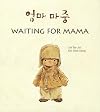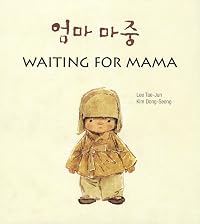
Waiting for Mama (English and Korean Edition)
by Lee Tae-Jun
On This Page
Description
A small child waits patiently for Mama at a streetcar station one cold and snowy day. Includes facts about the development of the Korean alphabet.Tags
Recommendations






















Member Reviews
This book gave me the creeps, and even once I sorted out the problem with the final spread I still find it a little weird.
A child goes to the trolley stop to wait for his mother. With each arriving trolley he looks for his mother and asks the driver "Have you seen my mother?" He waits all day, into the early evening, watching the dull winter day fade into a dark winter night. Bundled against the cold, he waits. And snow begins to fall until, at last, the child is buried. The end.
No! Wait!
Study that last spread carefully -- it is a huge cityscape done in shades of seasick green, and you can see a just-ever-so-slightly-darker green splotch of mother and child walking home, alone, at night, through the snow.
Am I missing something here? An show more unwatched child can go an entire day at a trolley stop without being noticed or cared for? He waits all day for his mother because... she ditched him to go to work and thought it was okay to leave the little fellow behind? I'll bend quite a way forward and backward on a book from another time and place because I can't hold my modern expectations to an older book, except that I need to have something to hold onto in order to make it relevant to my experience if it's going to be republished. Especially with a children's picture book, if I'm going to have to explain some element (Why is the boy alone all day? Why does no one help him? Why did his mother leave him?) then I need to be able to place it into a context more complete than "Well, that's just the way things were."
As far as the illustrations go, though they are contemporary they are meant to feel older, from a different time, which explains their monochromatic feel. The browns and greens do recall those days when color printing was prohibitive and present a sort of mood, but that doesn't explain why any editor would have found the last spread acceptable. It is way too easy to scan that final scene and not see the parent and child, leaving a reader only with the final image of the motherless child buried in snow at the trolley stop. Nothing before in the scant few lines of text indicates that she has arrived and they have been unified, no text explains that everything is okay. It is the most morose ending one could imagine, and while you spend the entire book hoping for the better, without catching that tiny (less than half an inch) image of the reunited family you find yourself drawing the saddest conclusion.
I think this book should be required reading for illustration students as an example of how not to illustrate a book that requires so much storytelling from the visuals. show less
A child goes to the trolley stop to wait for his mother. With each arriving trolley he looks for his mother and asks the driver "Have you seen my mother?" He waits all day, into the early evening, watching the dull winter day fade into a dark winter night. Bundled against the cold, he waits. And snow begins to fall until, at last, the child is buried. The end.
No! Wait!
Study that last spread carefully -- it is a huge cityscape done in shades of seasick green, and you can see a just-ever-so-slightly-darker green splotch of mother and child walking home, alone, at night, through the snow.
Am I missing something here? An show more unwatched child can go an entire day at a trolley stop without being noticed or cared for? He waits all day for his mother because... she ditched him to go to work and thought it was okay to leave the little fellow behind? I'll bend quite a way forward and backward on a book from another time and place because I can't hold my modern expectations to an older book, except that I need to have something to hold onto in order to make it relevant to my experience if it's going to be republished. Especially with a children's picture book, if I'm going to have to explain some element (Why is the boy alone all day? Why does no one help him? Why did his mother leave him?) then I need to be able to place it into a context more complete than "Well, that's just the way things were."
As far as the illustrations go, though they are contemporary they are meant to feel older, from a different time, which explains their monochromatic feel. The browns and greens do recall those days when color printing was prohibitive and present a sort of mood, but that doesn't explain why any editor would have found the last spread acceptable. It is way too easy to scan that final scene and not see the parent and child, leaving a reader only with the final image of the motherless child buried in snow at the trolley stop. Nothing before in the scant few lines of text indicates that she has arrived and they have been unified, no text explains that everything is okay. It is the most morose ending one could imagine, and while you spend the entire book hoping for the better, without catching that tiny (less than half an inch) image of the reunited family you find yourself drawing the saddest conclusion.
I think this book should be required reading for illustration students as an example of how not to illustrate a book that requires so much storytelling from the visuals. show less
I thought it was interesting how in the Korean version of this book, there's a last page that just seems like a view of the city but if you look closer you can see that in the end of the story, the child ended up finding his mom. However, you can't see this unless you look very closely. It's interesting how in other countries (English) where this book was published, they felt the need to zoom in on the mother and the child, physically showing the reader that they were reunited. It really shows the difference in cultures on how the endings need to end "happy." I really loved the illustrations, as well. They were beautiful and very captivating!
Waiting for Mama is a bilingual book (Korean and English) that shares the central message of perseverance. The main character is a small child waiting patiently for his mother. The book takes place in a city in Korea.
I liked this book because of the unique illustrations to display what is happening. The author and illustrator worked together to show a passing of time with a few pages with just illustrations. I liked this book because of its simplicity. The author used repetitions and onomatopoeias to convey their message of perseverance. The ending of this story also leaves the readers thinking.
I liked this book because of the unique illustrations to display what is happening. The author and illustrator worked together to show a passing of time with a few pages with just illustrations. I liked this book because of its simplicity. The author used repetitions and onomatopoeias to convey their message of perseverance. The ending of this story also leaves the readers thinking.
There are three reasons why I liked this book and one why I did not like this book. The first reason I enjoyed this book was the language. There were some repetitions in some phrases, like , "Isn't my mama coming? " Although a simple read and the fact that not all pages had text, this was pretty detailed and descriptive. " The child stands still, even though the wind blows hard." this is so simple , but if you close your eye you can just see the little boy waiting quietly in the cold. The second reason I enjoyed this book was that it had its originally language text, Korean, which I thought was fabulous. The final reason I enjoyed this book was the illustrations. the illustrator used, what i believe is, watercolor paints to create the show more different scenes. The illustrator also does wonders setting the time in 1930s Korea.
The one reason I did not like this book was the ending, the author doesn't tell you if the little boy gets back together with his mama. This was left to the illustrator. If you look closely at the last two pages you'll see the little boy holding his mamas hand. show less
The one reason I did not like this book was the ending, the author doesn't tell you if the little boy gets back together with his mama. This was left to the illustrator. If you look closely at the last two pages you'll see the little boy holding his mamas hand. show less
On a cold, winter's day, a young boy waits and waits and waits for his mama to pick him up from the streetcar station. As streetcars pass, he peeks his head into three different drivers and asks "Isn't my mama coming?" The drivers all have the same answer, "Do I know your mama?" The young boy patiently waits all day until finally we see him and his mama holding hands and walking in the snow.
The setting of this story was very dreary and took place at a streetcar station where the little boy stood all day. The tip of his nose was red from being out in the cold for so long. This setting gave the story a lonely feel. Because he was in the same place all day and could only ask for his mama, it seems that he did not know anybody else and had show more no where to go even for warmth. Because this book is written in two languages, I got universal feel. I felt that many people could relate to the boys feelings and many could understand. show less
The setting of this story was very dreary and took place at a streetcar station where the little boy stood all day. The tip of his nose was red from being out in the cold for so long. This setting gave the story a lonely feel. Because he was in the same place all day and could only ask for his mama, it seems that he did not know anybody else and had show more no where to go even for warmth. Because this book is written in two languages, I got universal feel. I felt that many people could relate to the boys feelings and many could understand. show less
The ending was not very clear to me at first. I had to read it again to realize that Mama did in fact come home. This is a sad, dreary tale, however I am glad I read it.
This was cute book, kinda made me sad seeing him wait outside in the cold for so long waiting for his mother.
Members
- Recently Added By
Author Information
1 Work 81 Members
Common Knowledge
- Original publication date
- 2007
Classifications
- Genres
- Picture Books, Children's Books
- DDC/MDS
- 895.733 — Literature & rhetoric Literatures of other languages Literatures of East and Southeast Asia Korean Korean fiction 1910–1945
- LCC
- PZ50.531 .Y5354 — Language and Literature Fiction and juvenile belles lettres Fiction and juvenile belles lettres Juvenile belles lettres
- BISAC
Statistics
- Members
- 81
- Popularity
- 392,749
- Reviews
- 10
- Rating
- (3.55)
- Languages
- English, Korean
- Media
- Paper
- ISBNs
- 1
- ASINs
- 1