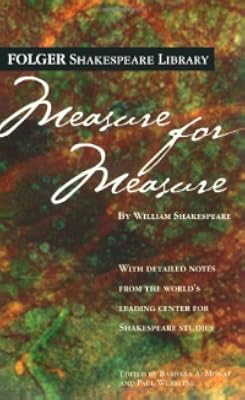
Measure for Measure
by William Shakespeare
On This Page
Description
Telling his followers he is leaving the city on affairs of state, the Duke of Vienna appoints the puritanical Angelo to govern in his absence. Will Angelo prove as virtuous as he seems once power is in his hands? Roaming the city disguised as a friar, the duke looks on as Angelo's lust for the virtuous Isabella sweeps him into the corruption he has so sternly condemned in others. The duke's manipulation at last produces a happy ending for this dark comedy, with its brilliant exploration of show more the themes of justice and mercy. show lessTags
Recommendations













Member Reviews
43. Measure for Measure by William Shakespeare
originally performed: 1604
format: 223-page Signet Classic
acquired: June
read: Aug 16 – Sep 19
time reading: 14:27, 3.9 mpp
rating: 4
locations: Vienna
about the author: April 23, 1564 – April 23, 1616
Editors
[[Sankalapuram Nagarajan]] – editor (c1964, 1988, 1998)
[[Sylvan Barnet]] – series editor (c1963, 1988, 1998)
Criticism
[[G. Wilson Knight]] – Measure for Measure and the Gospels (1949)
[[Mary Lascelles]] – from [2045459::Shakespeare’s Measure for Measure] (1953)
[[Marcia Reifer Poulsen]] – “Instruments for some more mightier member”: The Constriction of Female Power in Measure for Measure (1984)
[[Ruth Nevo]] – Complex Sexuality (1987)
[[Sankalapuram Nagarajan]] – Measure for show more Measure on Stage and Screen (c1964, 1988, 1998)
Our latest Shakespeare group read on Litsy. It's odd that this is considered one of Shakespeare's better plays. It's mainly provocative, generating frustration from an involved audience or reader. The play centers on a sexual assault, a sleep-with-me-or-else scenario, and a ruling duke playing director, resolving all the problems. But this duke creates problems for the audience. We aren't satisfied. The bad guys aren‘t punished and the good one is strained by dilemma, and then mid-play she becomes a humble role player in the Duke's production. Our good guy is Isabella, a young attractive nun who spends the whole play trying to preserve her chastity in a impossible situation controlled by the surrounding men. The play ends with the duke marrying her...
A more detailed synopsis here:The setting is a Vienna whose general character is captured by the wide spread of syphilis. The ruling Duke takes a leave to visit some other place, and places the city in the hands of the a known extremely upright citizen, Angelo. The Duke doesn't actually leave, he disguises himself as a friar and stays in town to see what will happen. Angelo starts enforcing Vienna's neglected draconian laws, and condemns Claudio to execution for impregnating his unofficial fiancé. Claudio begs his sister Isabella's help. She is becoming a nun in an extreme order of St. Claire. She pleads Claudio's case to Angelo, who, after huffing and puffing about how he's just all about the law, gives Isabella the ultimatum, sleep with me or Claudio dies. Isabella, caught in this dilemma, goes to her brother with the intention of his accepting this as unreasonable, but Claudio wants to live.
At this point the play takes a turn. The Duke in disguise works out resolutions, and then has to figure out what to do when everything starts to go wrong. He becomes something of a harried director, working out how everyone should shake out and then trying to fix whatever backfires. First he uses the bed trick and has Isabella swap herself out with Angelo's own spurned ex-fiancé. (it works) Later he has deal with Angelo's reneging. Instead of releasing Claudio, he moves up his execution to immediate, afraid of Claudio seeking a revenge of honor. In the end the Duke takes off his disguise and places judgment of everyone. No one dies, Angelo is dealt with. Claudio is released, and Isabella's chastity is preserved. And then the Duke slips in that he will marry Isabella.
There are source stories, but Shakespeare manages within the framework for his own purposes. It becomes a look at variations of self righteousness within variations of power and control. Power corrupts. Self-righteousness is flaw. And, the titles notes a prominent theme: "Judge not, that ye be not judged. For with what judgement ye judge, ye shall be judged: and with what measure ye mete, it shall be measured to you again.", Matthew 7:1-2.
I enjoyed this play, but more it riled me up and led to great conversations in my group. It's not artistic and moving, like say Hamlet, as much as it is upsetting. And the play's history doesn't help. In the 1940's the Duke was popularly viewed as a divine, Jesus-like figure, saving everyone. This view was pushed in a 1948 essay by [[G. Wilson Knight]] (included in the Signet edition) and performances followed along. That perspective is practically criminal from some standpoints, including my own expressed here. On the surface to Duke is a good guy. Underneath he's really a kind of monster. He creates the problems and then get what he wants out of it, and gets away with it. I think as an audience we're supposed to see that and be really annoyed. And to have a audience critically buy into him and see him as a Jesus-like hero seems to add another level to what he gets away with. Of course, interpretation is all open to social trends and personal perspectives, including those within our self-identified #metoo era. (I think most contemporary performances are more nuanced and more aware of the display of powerplay, and the abuse of the powerless.)
2021:
https://www.librarything.com/topic/333774#7612203 show less
originally performed: 1604
format: 223-page Signet Classic
acquired: June
read: Aug 16 – Sep 19
time reading: 14:27, 3.9 mpp
rating: 4
locations: Vienna
about the author: April 23, 1564 – April 23, 1616
Editors
[[Sankalapuram Nagarajan]] – editor (c1964, 1988, 1998)
[[Sylvan Barnet]] – series editor (c1963, 1988, 1998)
Criticism
[[G. Wilson Knight]] – Measure for Measure and the Gospels (1949)
[[Mary Lascelles]] – from [2045459::Shakespeare’s Measure for Measure] (1953)
[[Marcia Reifer Poulsen]] – “Instruments for some more mightier member”: The Constriction of Female Power in Measure for Measure (1984)
[[Ruth Nevo]] – Complex Sexuality (1987)
[[Sankalapuram Nagarajan]] – Measure for show more Measure on Stage and Screen (c1964, 1988, 1998)
Our latest Shakespeare group read on Litsy. It's odd that this is considered one of Shakespeare's better plays. It's mainly provocative, generating frustration from an involved audience or reader. The play centers on a sexual assault, a sleep-with-me-or-else scenario, and a ruling duke playing director, resolving all the problems. But this duke creates problems for the audience. We aren't satisfied. The bad guys aren‘t punished and the good one is strained by dilemma, and then mid-play she becomes a humble role player in the Duke's production. Our good guy is Isabella, a young attractive nun who spends the whole play trying to preserve her chastity in a impossible situation controlled by the surrounding men. The play ends with the duke marrying her...
A more detailed synopsis here:
At this point the play takes a turn. The Duke in disguise works out resolutions, and then has to figure out what to do when everything starts to go wrong. He becomes something of a harried director, working out how everyone should shake out and then trying to fix whatever backfires. First he uses the bed trick and has Isabella swap herself out with Angelo's own spurned ex-fiancé. (it works) Later he has deal with Angelo's reneging. Instead of releasing Claudio, he moves up his execution to immediate, afraid of Claudio seeking a revenge of honor. In the end the Duke takes off his disguise and places judgment of everyone. No one dies, Angelo is dealt with. Claudio is released, and Isabella's chastity is preserved. And then the Duke slips in that he will marry Isabella.
There are source stories, but Shakespeare manages within the framework for his own purposes. It becomes a look at variations of self righteousness within variations of power and control. Power corrupts. Self-righteousness is flaw. And, the titles notes a prominent theme: "Judge not, that ye be not judged. For with what judgement ye judge, ye shall be judged: and with what measure ye mete, it shall be measured to you again.", Matthew 7:1-2.
I enjoyed this play, but more it riled me up and led to great conversations in my group. It's not artistic and moving, like say Hamlet, as much as it is upsetting. And the play's history doesn't help. In the 1940's the Duke was popularly viewed as a divine, Jesus-like figure, saving everyone. This view was pushed in a 1948 essay by [[G. Wilson Knight]] (included in the Signet edition) and performances followed along. That perspective is practically criminal from some standpoints, including my own expressed here. On the surface to Duke is a good guy. Underneath he's really a kind of monster. He creates the problems and then get what he wants out of it, and gets away with it. I think as an audience we're supposed to see that and be really annoyed. And to have a audience critically buy into him and see him as a Jesus-like hero seems to add another level to what he gets away with. Of course, interpretation is all open to social trends and personal perspectives, including those within our self-identified #metoo era. (I think most contemporary performances are more nuanced and more aware of the display of powerplay, and the abuse of the powerless.)
2021:
https://www.librarything.com/topic/333774#7612203 show less
If ever you need an example of an old-school fuckboy, look no further than Shakespeare’s Angelo! Very quickly in the play he became one of my least favourite literary characters, because he immediately proved himself to be a total pedant for rules, an unfair judge of people who differ from himself, and an absolute hypocrite! Shakespeare is known for his dramatic characters who reveal the darker side of human nature (along with the brighter and more whimsical), so technically Angelo plays his part in revealing how power-mad some people can get when they’re zealots, but that doesn’t make it any easier to identify with Angelo. If one learns anything by this play (besides never trusting anyone to be reasonable or truthful) it’s that show more one should never be an ass because karma will ensure that you are given what you deserve. show less
Young Claudio is arrested for getting his fiancee pregnant, a situation that isn't so unusual, but the deputy, Angelo, has decided to make Claudio an example. Angelo sentences Claudio to death. Claudio has a sister who is about to become a nun, and he sends for her, hoping that chaste and intelligent Isabel can sway Angelo towards leniency. Angelo is swayed, but only because can exercise even more viciousness by forcing Isabel to choose: sleep with him and save her brother or refuse and save her own soul.
This was one of Shakespeare's plays that has always flown under my radar. It has sat on my shelf for more years than a know, and until I watched an episode of "Shakespeare Uncovered" a few weeks ago, I never even know the plot. They show more made a very interesting point about this play, of all Shakespeare's, being a preface to the modern #MeToo movement or the general disparity of power between genders.
The play begins rather slowly,but when Isabel is introduced both the plot and Angelo's true nature quickly unfold. We know she is good and brave, and she stands up to Angelo and says she will expose him for the kind of man he is. With his reply of "Who will believe thee, Isabel?" he pushes her to make a decision that can be seen as heroic or incredibly selfish. show less
This was one of Shakespeare's plays that has always flown under my radar. It has sat on my shelf for more years than a know, and until I watched an episode of "Shakespeare Uncovered" a few weeks ago, I never even know the plot. They show more made a very interesting point about this play, of all Shakespeare's, being a preface to the modern #MeToo movement or the general disparity of power between genders.
The play begins rather slowly,but when Isabel is introduced both the plot and Angelo's true nature quickly unfold. We know she is good and brave, and she stands up to Angelo and says she will expose him for the kind of man he is. With his reply of "Who will believe thee, Isabel?" he pushes her to make a decision that can be seen as heroic or incredibly selfish. show less
Re-read this to prepare for the 2015 Globe production.
ISABELLA: O! it is excellent
To have a giant's strength, but it is tyrannous
To use it like a giant.
"Problem play", they call it, meaning either that it's a play that revolves around a central moral question (as if Shakespeare's other plays don't), or that it's a bit of a mess that nobody can even figure out if it's supposed to be a comedy or a tragedy (as if that were a necessary distinction). And honestly, both definitions work here. There are questions in Measure for Measure that, sadly, still feel relevant; but yeah, it's also a play that veers wildly from bawdy sex jokes to serious moral cul-de-sacs, with a plot that gets so needlessly complicated that even the characters seem show more lost as to why they're doing what they're doing, before an ending which seems not only tacked-on but also like it misses its own point; the powerful man who helped the virtuous woman of faith escape a fate worse than death thanks her by... claiming her for himself?
ANGELO: Is this her fault or mine?
The tempter or the tempted, who sins most?
The 2015 production, though, really dresses for the ambiguity, and setting it at the Globe - with all its opportunities for the cast to interact with the audience - doesn't hurt either. There are basically two plays going on at once: a bawdy sex comedy in which powerful people get to play dress-up and Prince And The Pauper at stakes that may be high but never feel as if they'll count (and rich tourists get to pay money to see them do it); and a tragedy in which women and working-class stiffs are at the mercy of the whims and games of those in power. Dominic Rowan plays the Duke as a vain, privileged (yes, Shakespeare actually uses that word) joker who's not necessarily a bad guy, just unable to see past his own place in the world or that his power has limitations; while Mariah Gale as Isabella is a barely concealed bundle of nerves, who genuinely does not want to have to be in this play, but then again it's a play about consent and the lack of it... (No, seriously, how are Tumblr not all over this?)
DUKE VINCENTIO
Love you the man that wrong'd you?
JULIET
Yes, as I love the woman that wrong'd him.
DUKE VINCENTIO
So then it seems your most offenceful act
Was mutually committed?
JULIET
Mutually.
The problem at the heart of the play when Shakespeare wrote it in the days of puritanism, was hipocrisy and the inhumanity of hiding behind the law to condemn others. It still is in 2015 - Angelo's monologuing (because he's not really listening to anyone) about how it's not him but the law that condemns sinners to death, he has all the power but no responsibility to anyone living - but played against the current discourse it grows into not only a fun sex farce (which it is, if not always a comfortable one - the happy ending, after all, is basically achieved by the heroes raping the villain) but an actual problem play. One where Isabella always has to start over from the beginning every time a new man blunders on stage and explain yet again how her body and soul are not something to be bartered against her will for their sport, while the men can find no other explanation for her refusal to play along than that she's prude, insane, or being manipulated by a man with an agenda (the irony being that she is being manipulated by the man who makes that accusation). And makes us both laugh and wince at it, sets it in the age Shakespeare wrote it but makes it talk to the present. show less
ISABELLA: O! it is excellent
To have a giant's strength, but it is tyrannous
To use it like a giant.
"Problem play", they call it, meaning either that it's a play that revolves around a central moral question (as if Shakespeare's other plays don't), or that it's a bit of a mess that nobody can even figure out if it's supposed to be a comedy or a tragedy (as if that were a necessary distinction). And honestly, both definitions work here. There are questions in Measure for Measure that, sadly, still feel relevant; but yeah, it's also a play that veers wildly from bawdy sex jokes to serious moral cul-de-sacs, with a plot that gets so needlessly complicated that even the characters seem show more lost as to why they're doing what they're doing, before an ending which seems not only tacked-on but also like it misses its own point; the powerful man who helped the virtuous woman of faith escape a fate worse than death thanks her by... claiming her for himself?
ANGELO: Is this her fault or mine?
The tempter or the tempted, who sins most?
The 2015 production, though, really dresses for the ambiguity, and setting it at the Globe - with all its opportunities for the cast to interact with the audience - doesn't hurt either. There are basically two plays going on at once: a bawdy sex comedy in which powerful people get to play dress-up and Prince And The Pauper at stakes that may be high but never feel as if they'll count (and rich tourists get to pay money to see them do it); and a tragedy in which women and working-class stiffs are at the mercy of the whims and games of those in power. Dominic Rowan plays the Duke as a vain, privileged (yes, Shakespeare actually uses that word) joker who's not necessarily a bad guy, just unable to see past his own place in the world or that his power has limitations; while Mariah Gale as Isabella is a barely concealed bundle of nerves, who genuinely does not want to have to be in this play, but then again it's a play about consent and the lack of it... (No, seriously, how are Tumblr not all over this?)
DUKE VINCENTIO
Love you the man that wrong'd you?
JULIET
Yes, as I love the woman that wrong'd him.
DUKE VINCENTIO
So then it seems your most offenceful act
Was mutually committed?
JULIET
Mutually.
The problem at the heart of the play when Shakespeare wrote it in the days of puritanism, was hipocrisy and the inhumanity of hiding behind the law to condemn others. It still is in 2015 - Angelo's monologuing (because he's not really listening to anyone) about how it's not him but the law that condemns sinners to death, he has all the power but no responsibility to anyone living - but played against the current discourse it grows into not only a fun sex farce (which it is, if not always a comfortable one - the happy ending, after all, is basically achieved by the heroes raping the villain) but an actual problem play. One where Isabella always has to start over from the beginning every time a new man blunders on stage and explain yet again how her body and soul are not something to be bartered against her will for their sport, while the men can find no other explanation for her refusal to play along than that she's prude, insane, or being manipulated by a man with an agenda (the irony being that she is being manipulated by the man who makes that accusation). And makes us both laugh and wince at it, sets it in the age Shakespeare wrote it but makes it talk to the present. show less
This play was the Shakespeare I wanted to direct for a very long time because I love Isabella's journey from religious ideals to discovering how to maintain faith in the everyday world. The Duke has his own journey as he keeps trying to control/manipulate the situation only to discover that without the power vested in him as a ruler, life gets pretty damn messy. Angelo also gets a lesson in discovering that he is also susceptible to the temptations of the flesh - through his mind. There's serious growth and discovery in the piece that the attempt at creating a traditional comedy ending cannot erase or make to fit. That's why it's so compelling.
One of Shakespeare's 'problem plays', and in more ways than one. Its hypothesis is fascinating – asking questions of sexual morality, justice and integrity – and one with great dramatic potential, but it doesn't really succeed in realizing this potential. There are big themes but they are resolved unsatisfactorily, carrying a weight that the play structure cannot bear. It is both comedic and tragic – hence the moniker of the 'problem play' – and yet neither, because the elements of the one cancel out the other. This does not have to be the case, conceptually speaking, and Shakespeare proves in other plays his ability to balance those elements peerlessly, but it is the case in Measure for Measure. Shakespeare usually has clarity show more even in his nuance (see the remarkable acuity of The Merchant of Venice, which has a similar structure, for example), but it is not much in evidence here. show less
The scene with Isabella and Claudio in the prison is, I think, one of the best Shakespeare scenes of all times. There's almost nowhere else where you get something like it, two good characters who love each other but bring each other immense pain because they fundamentally disagree-- Isabella believes that nothing is worth staining her soul, and Claudio is terrified to die, and neither can understand each other and are betrayed and made desperate by the other's stance. Measure is such an interesting play because the challenges of the plot don't come from contrivance (like mistaken identity in Comedy of Errors or miscommunication in R&J) or from a villain who schemes for no discernible reason (Iago in Othello or Much Ado's Don John) but show more from characters who really seem to have genuine beliefs that, because of the complex nature of the legal and moral world of Vienna, happen to be at cross-purposes. The closest the play gets to a meddling villain is its hero(?), Duke Vincentio, who reads like a Prospero with the shine off.
There are no bad roles in this play, each one has something to think about and struggle with-- Mariana the lover of the loathsome, Lucio the good friend and bad citizen, the put-upon middleman of the Provost, beset Julietta, earnest and malaprop-ing Elbow, Escalus the kindly justice hemmed in by his duty to the Duke. There are some truly great scenes, and lots that are difficult to wrangle but have a lot of potential for depth. Basically, I love the problem plays, and this one takes the cake.
By the way, do yourself a favor and read about Davenant's The Law Against Lovers, a mid-17th century adaptation that combined the plot with Much Ado About Nothing, and yes, it seems to be as weird as that sounds. show less
There are no bad roles in this play, each one has something to think about and struggle with-- Mariana the lover of the loathsome, Lucio the good friend and bad citizen, the put-upon middleman of the Provost, beset Julietta, earnest and malaprop-ing Elbow, Escalus the kindly justice hemmed in by his duty to the Duke. There are some truly great scenes, and lots that are difficult to wrangle but have a lot of potential for depth. Basically, I love the problem plays, and this one takes the cake.
By the way, do yourself a favor and read about Davenant's The Law Against Lovers, a mid-17th century adaptation that combined the plot with Much Ado About Nothing, and yes, it seems to be as weird as that sounds. show less
Members
- Recently Added By
Lists

Favorite Shakespeare plays?
37 works; 45 members

Plays I Like
230 works; 31 members

University literature
145 works; 5 members

Literary Works Read in College
316 works; 15 members

Western World's Greatest Books - Project Gutenberg
295 works; 15 members

Five star books
1,757 works; 108 members
Stage Plays/Screenplays/Dialogues/Anything Dialogue-Storytelling Related
81 works; 2 members

Greatest Books, allegedly
484 works; 9 members
'Books You Can't Live Without: The Top 100', The Guardian, 2007
156 works; 7 members

Recommended Reading : 600 Classics Reviewed, Editors of Salem Press, 2015
634 works; 6 members
My Play Collection
769 works; 3 members
Talk Discussions
Past Discussions
July Shakespeare Cat: Justice in 2022 Category Challenge (July 2022)
Author Information

6,113+ Works 442,388 Members
William Shakespeare, 1564 - 1616 Although there are many myths and mysteries surrounding William Shakespeare, a great deal is actually known about his life. He was born in Stratford-Upon-Avon, son of John Shakespeare, a prosperous merchant and local politician and Mary Arden, who had the wealth to send their oldest son to Stratford Grammar School. show more At 18, Shakespeare married Anne Hathaway, the 27-year-old daughter of a local farmer, and they had their first daughter six months later. He probably developed an interest in theatre by watching plays performed by traveling players in Stratford while still in his youth. Some time before 1592, he left his family to take up residence in London, where he began acting and writing plays and poetry. By 1594 Shakespeare had become a member and part owner of an acting company called The Lord Chamberlain's Men, where he soon became the company's principal playwright. His plays enjoyed great popularity and high critical acclaim in the newly built Globe Theatre. It was through his popularity that the troupe gained the attention of the new king, James I, who appointed them the King's Players in 1603. Before retiring to Stratford in 1613, after the Globe burned down, he wrote more than three dozen plays (that we are sure of) and more than 150 sonnets. He was celebrated by Ben Jonson, one of the leading playwrights of the day, as a writer who would be "not for an age, but for all time," a prediction that has proved to be true. Today, Shakespeare towers over all other English writers and has few rivals in any language. His genius and creativity continue to astound scholars, and his plays continue to delight audiences. Many have served as the basis for operas, ballets, musical compositions, and films. While Jonson and other writers labored over their plays, Shakespeare seems to have had the ability to turn out work of exceptionally high caliber at an amazing speed. At the height of his career, he wrote an average of two plays a year as well as dozens of poems, songs, and possibly even verses for tombstones and heraldic shields, all while he continued to act in the plays performed by the Lord Chamberlain's Men. This staggering output is even more impressive when one considers its variety. Except for the English history plays, he never wrote the same kind of play twice. He seems to have had a good deal of fun in trying his hand at every kind of play. Shakespeare wrote 154 sonnets, all published on 1609, most of which were dedicated to his patron Henry Wriothsley, The Earl of Southhampton. He also wrote 13 comedies, 13 histories, 6 tragedies, and 4 tragecomedies. He died at Stratford-upon-Avon April 23, 1616, and was buried two days later on the grounds of Holy Trinity Church in Stratford. His cause of death was unknown, but it is surmised that he knew he was dying. (Bowker Author Biography) show less
All Editions
Some Editions
Awards and Honors
Notable Lists
Series
Belongs to Publisher Series
Work Relationships
Is contained in
4 Plays: All's Well That Ends Well; Hamlet; Measure for Measure; Troilus and Cressida by William Shakespeare
The Annotated Shakespeare: The Comedies, Histories, Sonnets and Other Poems, Tragedies and Romances Complete by William Shakespeare (indirect)
Has the adaptation
Inspired
Has as a study
Has as a supplement
Has as a commentary on the text
Has as a student's study guide
Common Knowledge
- Canonical title
- Measure for Measure
- Original title
- Measure for Measure
- Original publication date
- 1623 (Folio) (Folio)
- People/Characters
- Isabella; Vincentio; Angelo; Escalus; Claudio; Lucio (show all 17); Provost; Thomas; Peter; Elbow; Froth; Abhorson; Barnardine; Mariana; Juliet; Francisca; Mistress Overdone
- Important places
- Vienna, Austria; Austria
- Related movies
- Measure for Measure (1979 | IMDb); Measure for Measure (2006 | IMDb)
- First words
- Escalus.
- Quotations
- Virtue is bold, and goodness never fearful.
Shame to him whose cruel striking
Kill for faults of his own liking.
Some rise by sin, and some by virtue fall.
The law hath not been dead, though it hath slept.
They say, best men are moulded out of faults,
And, for the most, become much more the better
For being a little bad.
What's mine is yours, and what is yours is mine. (show all 8)
Truth is truth
To the end of reckoning.
Our natures do pursue,
Like rats that raven down their proper bane,
A thirsty evil, and when we drink, we die. - Last words
- (Click to show. Warning: May contain spoilers.)Dear Isabel,
I have a motion much imports your good;
Whereto if you'll a willing ear incline,
What's mine is yours, and what is yours is mine: -
So, bring us to our palace; where we'll show
What's yet behind that's meet you all should know. - Publisher's editor
- Nosworthy, J. M. (New Penguin Shakespeare); Briggs, Julia J. M. Nosworthy (Penguin Shakespeare); Nosworthy, J. M. (Penguin Shakespeare)
- Disambiguation notice
- This work is for the complete Measure for Measure only. Do not combine this work with abridgements, adaptations or simplifications (such as "Shakespeare Made Easy"), Cliffs Notes or similar study guides, or anything el... (show all)se that does not contain the full text. Do not include any video recordings. Additionally, do not combine this with other plays.
Classifications
Statistics
- Members
- 4,981
- Popularity
- 2,811
- Reviews
- 57
- Rating
- (3.65)
- Languages
- 18 — Catalan, Chinese, Czech, Danish, English, Finnish, French, German, Greek, Hungarian, Italian, Norwegian (Bokmål), Norwegian, Polish, Spanish, Swedish, Turkish, Portuguese (Portugal)
- Media
- Paper, Audiobook, Ebook
- ISBNs
- 271
- UPCs
- 5
- ASINs
- 98