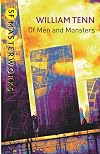
Of Men and Monsters
by William Tenn
On This Page
Description
Giant, technologically superior aliens have conquered Earth, but humankind survives - even flourishes in a way. Men and women live, like mice, in burrows in the massive walls of the huge homes of the aliens, and scurry about under their feet, stealing from them. A complex social and religious order has evolved, with women preserving knowledge and working as healers, and men serving as warriors and thieves. For the aliens, men and women are just a nuisance, nothing more than vermin. Which, show more ironically, may just be humankind's strength and point the way forward. show lessTags
Recommendations


















Member Reviews
I'm sitting here feeling I've almost (not quite, but very nearly) failed some sort of intelligence test with this book. Having completely missed the huge clue in its title, some distance in I was still thinking, 'Well, I like the oddness of this, but it doesn't seem to be going anywhere much' and it looked to be heading for a disappointing two stars.
The set-up is this: after an invasion from space by gigantic aliens (called 'Monsters' throughout) what's left of humanity has been reduced to living in a maze of burrows and tunnels - scuttling to and fro behind the wainscotting so to speak - and risking their lives on expeditions out into Monster territory to steal food from the invaders' gigantic larders. The story itself follows show more raw initiate Eric the Only as he's transformed by his experiences into a resourceful leader; and, although actually published in 1968, it had a pleasantly nostalgic 1950s-or-so feel to it.
It's a satire of course (the quote from Gulliver's Travels at the start was another Monster-sized clue I nearly missed). For 'men' read 'mice' and for 'monsters' read 'men' - the Monsters are us in disguise, while we are now the mice, annoying 'vermin' to be exterminated. 'See how you like it' is the theme, see how it feels to be a couple of inches tall and at the mercy of something a hundred times your size. And an alien invasion is a good metaphor for that: appearing as if out of nowhere (which, in evolutionary terms at least, H. sapiens certainly has), armed with incomprehensible weapons, suddenly here and taking over the whole world. The book does satirise other things too (religion for instance) but in essence it's about us humans seen from the terrifying perspective of a house mouse.
So, in the end, I thoroughly enjoyed this novel as it climbed steadily all the way up to a solid four-star rating. I'm giving myself only one star though; I did get the point of Men and Monsters, did solve the maze and reach the cheese, but only (eek, eek!) by a whisker. show less
The set-up is this: after an invasion from space by gigantic aliens (called 'Monsters' throughout) what's left of humanity has been reduced to living in a maze of burrows and tunnels - scuttling to and fro behind the wainscotting so to speak - and risking their lives on expeditions out into Monster territory to steal food from the invaders' gigantic larders. The story itself follows show more raw initiate Eric the Only as he's transformed by his experiences into a resourceful leader; and, although actually published in 1968, it had a pleasantly nostalgic 1950s-or-so feel to it.
It's a satire of course (the quote from Gulliver's Travels at the start was another Monster-sized clue I nearly missed). For 'men' read 'mice' and for 'monsters' read 'men' - the Monsters are us in disguise, while we are now the mice, annoying 'vermin' to be exterminated. 'See how you like it' is the theme, see how it feels to be a couple of inches tall and at the mercy of something a hundred times your size. And an alien invasion is a good metaphor for that: appearing as if out of nowhere (which, in evolutionary terms at least, H. sapiens certainly has), armed with incomprehensible weapons, suddenly here and taking over the whole world. The book does satirise other things too (religion for instance) but in essence it's about us humans seen from the terrifying perspective of a house mouse.
So, in the end, I thoroughly enjoyed this novel as it climbed steadily all the way up to a solid four-star rating. I'm giving myself only one star though; I did get the point of Men and Monsters, did solve the maze and reach the cheese, but only (eek, eek!) by a whisker. show less
My reactions to reading this novel in 1968. Spoilers follow.
I enjoyed this famous Tenn novel about men living in the walls of the “Monster” alien race that conquered Earth.
This is Tenn so the story is humorous and almost savage in parts. The title comes from Steinbeck’s novel Of Mice and Men, but the inspiration and structure of the novel seems to come from the Brobdingnab section of Gulliver’s Travels. The plot starts as a variation on that favored by many stories and films featuring primitive (or post-holocaust primitives): a young man finds himself on the wrong side of tribal politics and questioning a religious taboo. Here that's that Ancestor-Science is not as efficacious in battling the Monsters as advertised. After all, show more as the uncle who initiates hero Eric the Only into the heresy points out, it didn’t do humanity much good in resisting the Monsters. But Alien-Science turns out to be, in part, a scheme by Eric’s uncle to become Chief, a scheme that leads to a brutally suppressed uprising. Eric takes up with the more advanced “back burrowers” only to find their technology and knowledge of Monsters impressive but their military skills lacking. Eventually, he meets, marries, and mates with a woman of the Aaron People (after a funny scene where he tries to act dignified while assessing his mate’s physical wiles).
In a way, this is one of those conceptual breakthrough stories. Eric learns that the tribal society he was born in was based partly on fraud - rigged visions used in naming initiate warriors and “enemy” chiefs who will band together to quell heretic Alien Sciencers. He also learns that not front or back burrower, Ancestor Science or Alien Science is a total solution, that other points of view have merit, that man lives in the walls of Monster houses (the whole novel is set in one Monster house before man leaves for the stars), and that a whole universe exists outside the Monster house, a universe which renders Monsters as inconsequential as man.
My favorite moments are when Tenn defies the clichés of this sort of plot. There is no claim that lost human science can ever defeat the monsters or bring humanity lordship of the Earth. In a discussion about why some ancients saw the Monsters as divine judgment, Rachel, Eric’s mate, remarks man was always guilty about how he treated other animals. How, she asks, can we judge the Monsters brutal (some of the book depicts experiments on humans in an alien Pest Control Lab) for their actions when man historically (and even in the course of this book) does just as brutal things to each other? Another of my favorite scenes is when Eric, told of the Aaron People’s plan to hope on a Monster starship and infest Monster dwellings throughout the universe, bitterly retorts they can’t expect man to become vermin. The Aaron replies that he already is a vermin of a most superior (like the rat and cockroach) kind. This is a condition Eric and everybody else cheerfully accepts at story’s end. show less
I enjoyed this famous Tenn novel about men living in the walls of the “Monster” alien race that conquered Earth.
This is Tenn so the story is humorous and almost savage in parts. The title comes from Steinbeck’s novel Of Mice and Men, but the inspiration and structure of the novel seems to come from the Brobdingnab section of Gulliver’s Travels. The plot starts as a variation on that favored by many stories and films featuring primitive (or post-holocaust primitives): a young man finds himself on the wrong side of tribal politics and questioning a religious taboo. Here that's that Ancestor-Science is not as efficacious in battling the Monsters as advertised. After all, show more as the uncle who initiates hero Eric the Only into the heresy points out, it didn’t do humanity much good in resisting the Monsters. But Alien-Science turns out to be, in part, a scheme by Eric’s uncle to become Chief, a scheme that leads to a brutally suppressed uprising. Eric takes up with the more advanced “back burrowers” only to find their technology and knowledge of Monsters impressive but their military skills lacking. Eventually, he meets, marries, and mates with a woman of the Aaron People (after a funny scene where he tries to act dignified while assessing his mate’s physical wiles).
In a way, this is one of those conceptual breakthrough stories. Eric learns that the tribal society he was born in was based partly on fraud - rigged visions used in naming initiate warriors and “enemy” chiefs who will band together to quell heretic Alien Sciencers. He also learns that not front or back burrower, Ancestor Science or Alien Science is a total solution, that other points of view have merit, that man lives in the walls of Monster houses (the whole novel is set in one Monster house before man leaves for the stars), and that a whole universe exists outside the Monster house, a universe which renders Monsters as inconsequential as man.
My favorite moments are when Tenn defies the clichés of this sort of plot. There is no claim that lost human science can ever defeat the monsters or bring humanity lordship of the Earth. In a discussion about why some ancients saw the Monsters as divine judgment, Rachel, Eric’s mate, remarks man was always guilty about how he treated other animals. How, she asks, can we judge the Monsters brutal (some of the book depicts experiments on humans in an alien Pest Control Lab) for their actions when man historically (and even in the course of this book) does just as brutal things to each other? Another of my favorite scenes is when Eric, told of the Aaron People’s plan to hope on a Monster starship and infest Monster dwellings throughout the universe, bitterly retorts they can’t expect man to become vermin. The Aaron replies that he already is a vermin of a most superior (like the rat and cockroach) kind. This is a condition Eric and everybody else cheerfully accepts at story’s end. show less
Almost put it down several times, but blurb and reviews promised a nifty ending. Well, Tenn sure did take his time getting there. I guess a reader who likes quest stories, stories with a series of actions and dramas, would like it more. The world-building is terrific, but, again, could have been just as effective with a lot fewer words.
The copyright page of my edition says 1977, a portion published as "The Men in the Walls" in *Galaxy* in 1963. I wish I'd read the short story and stopped there, I think.
At least there was some humor:
"He placed the palms of his hands together and bowed his head over them. "Oh, well,... back to the drawing boards."... "That's one of the oldest invocations known to my people.""
But the sexism, well, hmm. Not show more too bad at the beginning, where we learn that women are treasured, especially if they bear children well, but also because of their traditions of what passes for science and medicine. And then, too, we learn that, though warrior-hunters are also valuable, they are considered more expendable. Butwhen Eric becomes mate of the captive woman, she seems delighted to serve him, and her eyes "seemed to express a hope that he would treat her well, along with a calm acceptance of the fact that it was entirely his decision... and that whatever his decision, she would cheerfully abide by it. show less
The copyright page of my edition says 1977, a portion published as "The Men in the Walls" in *Galaxy* in 1963. I wish I'd read the short story and stopped there, I think.
At least there was some humor:
"He placed the palms of his hands together and bowed his head over them. "Oh, well,... back to the drawing boards."... "That's one of the oldest invocations known to my people.""
But the sexism, well, hmm. Not show more too bad at the beginning, where we learn that women are treasured, especially if they bear children well, but also because of their traditions of what passes for science and medicine. And then, too, we learn that, though warrior-hunters are also valuable, they are considered more expendable. But
Science fiction satire in which the monsters regard humans not as a threat, but as pests. The storytelling is first rate and the ending, though it comes out of nowhere, is pretty nearly perfect. I met the author when I was in college and interviewed him, and he was a hoot. Just bought a book containing most of his short stories and am very much looking forward to it.
After reading past what is probably one of the best opening paragraphs in science fiction, the novel settles down to an amusing, well-written, often clever but ultimately straightforward adventure story set in a future where humans live in tribes, burrowed like vermin into the walls of the homes of giant aliens. The writing flows nicely and as mentioned before, the tongue-in-cheekness of it all is amusing. The final scene manages to cap it all with the old science-fiction trope of conquering the stars given a new twist. Fun but not exceptional.
Where it's good, it's really good. Where it's corny, it's...well, embarrassingly corny. Where it's strange, it's intriguingly strange. And where it's profound, it is...I swear it...profound. Tenn's work may be uneven, but he is swiftly moving toward the top of my list of the heroes of golden age science fiction. My top Tenn list, perhaps.
William Tenn was a prolific writer of science fiction short stories from 1953-1968. His only novel, Of Men and Monsters (1968), is an expansion of “The Men in the Walls,” a 1963 story published in Galaxy. It can be read as a straightforward, adventurous coming-of-age story in which a young man learns how to fight monstrous aliens. [BEWARE: SPOILERS AHEAD!] But Tenn’s point is slyly satirical. Human beings, he suggests, are ideally suited to fill the ecological niche we usually associate with rats and other urban pests. The story was published about the time we were beginning to wonder whether cockroaches would hitchhike on our early lunar missions.
James S. A. Corey's The Mercy of the Gods (2024) brought it to mind.
James S. A. Corey's The Mercy of the Gods (2024) brought it to mind.
Members
- Recently Added By
Lists

S.F. Masterworks (Complete)
229 works; 15 members

SF Masterworks
193 works; 8 members
Author Information

80+ Works 2,012 Members
William Tenn, the pseudonym of Philip Klass, was born in London, England on May 9, 1920. He grew up in Brooklyn, New York and served as a combat engineer in the United States Army during World War II. After leaving the Army, he worked as a technical editor with an Air Force radar and radio laboratory and was employed by Bell Labs. He taught show more English and comparative literature at Penn State University for 24 years. He wrote academic articles, essays, one novel entitled Of Men and Monsters, and more than 60 short stories including Child's Play, Venus and the Seven Sexes, Down Among the Dead Men, The Liberation of Earth, Time in Advance, and On Venus, Have We Got a Rabbi. He received the Author Emeritus honor by the Science Fiction and Fantasy Writers of America in 1999. He died of congestive heart failure on February 7, 2010 at the age of 89. (Bowker Author Biography) show less
Some Editions
Series
Belongs to Publisher Series
6 Titles By William Tenn (Ballantine)
VGSF Classics (35)
Terra-Taschenbuch (288)
SF Masterworks (New design)
Work Relationships
Is contained in
Contains
Has as a commentary on the text
Common Knowledge
- Canonical title*
- Von Menschen und Monstren
- Original title
- Of Men and Monsters
- Original publication date
- 1968
- People/Characters
- Eric the Eye; Roy the Runner; Rachel Esthersdaughter; Thomas the Trap-Smasher; Arthur the Organizer; Walter the Weapon-Seeker (show all 7); The Aaron
- Epigraph
- "It doth not appear from all you have said, how any one virtue is required towards the procurement of any one station among you; much less that men are ennobled on account of their virtue, that priests are advanced for their ... (show all)piety or learning, soldiers for their conduct or valour, judges for their integrity, senators for the love of their country, or counsellors for their wisdom.... I cannot but conclude the bulk of your natives to be the most pernicious race of little odious vermin that nature ever suffered to crawl upon the surface of the earth."
Jonathan Swift, Gulliver's Travels, "A Voyage to Brobdingnab" - Dedication
- To Sheila Solomon Klass.
This, in place of Salvation. - First words
- Mankind consisted of 128 people.
- Quotations
- "listen, Eric. Grow up fast. I mean - I mean really grow up. It's your only chance. A lad like you -in the burrows, a lad either develops fast or he's dead. Don't - " the chest arched upward for a sudden coughing spasm, "... (show all) - don't take anything for granted. Anything - from anybody. Learn, but be - be your own man. And grow up, Eric. Fast."
- Last words
- (Click to show. Warning: May contain spoilers.)Everyone who watched them at their games agreed that they made the place feel like home.
- Original language*
- Englisch
*Some information comes from Common Knowledge in other languages. Click "Edit" for more information.
Classifications
Statistics
- Members
- 438
- Popularity
- 70,444
- Reviews
- 16
- Rating
- (3.57)
- Languages
- 5 — Czech, English, French, German, Italian
- Media
- Paper, Ebook
- ISBNs
- 10
- ASINs
- 15