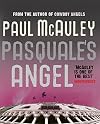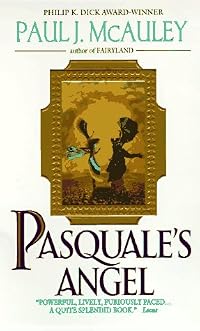
Pasquale's Angel
by Paul McAuley
On This Page
Description
Florence in the year 1518 is riven by scientific and sociological change caused b the wonderful devices of the Great Engineer, Leonardo da Vinci. Now he is old and lives as a recluse working behind the walls of his castle. The Raphaelites, artists and anti-technologists led by Raphael of Urbino, call for his excommunication. Pasquale di Cione fiesole, an apprentice painter witnesses an assassination attempt on Raphael at a Cathedral service. The weapon falls into his hands, and he is soon on show more the run from engineers and artists, desperate to prove his innocence. show lessTags
Recommendations












Member Reviews
I first read McAuley's cyberpunk-meets-fantasy-epic trilogy 'Confluence,' liked it a lot, so I got his novel 'Fairyland.' That didn't really do it for me - to the extent that I considered not reading 'Pasquale's Angel' - but I am now very glad that I did read it!
'Pasquale's Angel' is Renaissance-meets-steampunk: in an alternate-history, industrialized Italy, plots and murder are afoot. Pasquale, a young artists' apprentice, is dragged into events when an apprentice of the visiting master Raphael is found murdered. Journalist-cum-private-investigator Niccolo Machiavegli hires him to help with etchings for broadsheets, and next thing he knows, he's at the heart of things. Could the guilty party be Raphael's rival, Michaelangelo? Or show more possibly the cuckolded husband of the fascinating Lady Lisa Giacondo? Or could a trail lead back to the secretive hermit known as the Great Engineer (Leonardo DaVinci) or the artificer Copernicus?
The novel starts out as if it will be a fairly straightforward murder mystery, but things rapidly get more complicated than that... the murder was just the top layer of plots that may lead to the city of Florence's downfall.
Weird, steam-driven machines, a trained ape, the Pope, satanic rituals, and more figure in before all is said and done...
I don't usually enjoy books which insert historical figures into fiction - but this was definitely an exception, probably because the characters really bore so little actual resemblance to the historical figures bearing their names that there was absolutely no conflict with historical truth going on at all... I found it very entertaining. show less
'Pasquale's Angel' is Renaissance-meets-steampunk: in an alternate-history, industrialized Italy, plots and murder are afoot. Pasquale, a young artists' apprentice, is dragged into events when an apprentice of the visiting master Raphael is found murdered. Journalist-cum-private-investigator Niccolo Machiavegli hires him to help with etchings for broadsheets, and next thing he knows, he's at the heart of things. Could the guilty party be Raphael's rival, Michaelangelo? Or show more possibly the cuckolded husband of the fascinating Lady Lisa Giacondo? Or could a trail lead back to the secretive hermit known as the Great Engineer (Leonardo DaVinci) or the artificer Copernicus?
The novel starts out as if it will be a fairly straightforward murder mystery, but things rapidly get more complicated than that... the murder was just the top layer of plots that may lead to the city of Florence's downfall.
Weird, steam-driven machines, a trained ape, the Pope, satanic rituals, and more figure in before all is said and done...
I don't usually enjoy books which insert historical figures into fiction - but this was definitely an exception, probably because the characters really bore so little actual resemblance to the historical figures bearing their names that there was absolutely no conflict with historical truth going on at all... I found it very entertaining. show less
This novel is set against the background of 16th century Florence, a time of great progress. The new manufactories are turning out mass-produced clothing and products, artists great and unknown walk the streets, debate in taverns, engage in politics and vendettas, and turn their hands to new and innovative techniques, such as 'painting with light' and there is talk of 'moving pictures'. Meanwhile, steamboats ply the Arno and pedestrians have to be sharp on their feet to avoid the steam carriages....
We are, of course, in an alternate Florence, one where Leonardo da Vinci - here simply known as 'The Great Engineer' - turned away from art to more practical pursuits, and kicked off the Industrial revolution some 250 years early. Florence show more has become a great political and exploratory power, with trade routes to the New World and the empires of the Americas; the Pope is on his way to make his peace with the city, but a Spanish fleet is lurking offshore. Plots and counter-plots are rife. The central character, Pasquale, is apprenticed to an artist and dreams of developing his skill to be able to capture the ineffable beauty of an angel. But he is overtaken by plots and falls in with disgraced politician, turned investigative journalist-cum-private detective Niccolo Machiavegli. Danger and excitement follows....
The Florentine scene is shown in great detail; possibly too great if the reader isn't vaguely familiar with the setting and era. The action flags a little in places, and some of the characters' motivations remain a bit obscure on a first reading. And the denouement may not satisfy all readers as there are loose ends left untied. But the sense of place and era is strong, and possibly the loose ends look untied to us because McAulay's characters act as 16th century people most likely would. Their sense of the immediacy of religion is strong, as it would be; and in a society of rumour and gosssip and vendetta, people's choices of action are not what ours would be in similar circumstances.
Still, this book kept me reading for its setting. Interestingly, part of the plot relies on the discovery and significance of a photographic negative; it's intriguing to think that future readers are as likely to be puzzled by this artefact and the role it plays in the plot as the characters. The difference is that in the novel, this is new and unknown technology, whereas in the future, it will be old and unknown technology! show less
We are, of course, in an alternate Florence, one where Leonardo da Vinci - here simply known as 'The Great Engineer' - turned away from art to more practical pursuits, and kicked off the Industrial revolution some 250 years early. Florence show more has become a great political and exploratory power, with trade routes to the New World and the empires of the Americas; the Pope is on his way to make his peace with the city, but a Spanish fleet is lurking offshore. Plots and counter-plots are rife. The central character, Pasquale, is apprenticed to an artist and dreams of developing his skill to be able to capture the ineffable beauty of an angel. But he is overtaken by plots and falls in with disgraced politician, turned investigative journalist-cum-private detective Niccolo Machiavegli. Danger and excitement follows....
The Florentine scene is shown in great detail; possibly too great if the reader isn't vaguely familiar with the setting and era. The action flags a little in places, and some of the characters' motivations remain a bit obscure on a first reading. And the denouement may not satisfy all readers as there are loose ends left untied. But the sense of place and era is strong, and possibly the loose ends look untied to us because McAulay's characters act as 16th century people most likely would. Their sense of the immediacy of religion is strong, as it would be; and in a society of rumour and gosssip and vendetta, people's choices of action are not what ours would be in similar circumstances.
Still, this book kept me reading for its setting. Interestingly, part of the plot relies on the discovery and significance of a photographic negative; it's intriguing to think that future readers are as likely to be puzzled by this artefact and the role it plays in the plot as the characters. The difference is that in the novel, this is new and unknown technology, whereas in the future, it will be old and unknown technology! show less
Last week I read Pasquale's Angel, Paul McAuley's alternate history of a renaissance Florence in which Leonardo DaVinci poured his genius into engineering instead of art. A nice touch is Florence's exploration of the New World, where they do not conquer as the Spanish would, but instead establish trade and diplomatic relations with the native population. The characterisation of Niccolo Machiavegli, who in this reality is not exiled from Florence but is instead a sort of journalist/sleuth, is marvelous. Paul McAuley is among the greatest of SF worldbuilders I've encountered. This is steam-powered alternate history at its best.
This was a disappointment, sad to say. I've read and enjoyed many of McAuley's books, but this one was quite mediocre. Too bad, since it was such a promising premise. The politics, the factions, the motivations of the characters, were unclear. Never could figure out what was going on in the tower when the guy was killed. Why was he there? No idea. The story would come into focus now and then, but mostly it was a blur. It takes real doing to make Leonardo Da Vinci a boring character. A little background on the Artificers and so forth would have helped a lot. But then again, Pasquale was not a sympathetic character, so maybe nothing would have helped here.
I have a suspicion that while most critics liked this book, most readers will not if they are not previously acquainted with Renaissance History, or the History of the Medici or Florence. It seems to me that the author relies a lot on reader knowledge of the period about which he's writing, so if you aren't up on your history, this may cause a problem. Lucky for me Savaronola is one of my favorite historical bad guys and that I love reading about Renaissance history.
But this book is not just another rehash of novelized history. It is set in a Florence that really never existed: in this Florence, there's obviously been some kind of industrialization that's taken place -- there are the "manufactories" (factories) that never sleep and the show more throngs of workers who keep the machines going. There is also smog, steam-driven vehicles, people are smoking cigarettes, dope; artists are in competition with "artificers", who compete to sell their versions of reality. Leonarda da Vinci, in this story known as The Great Engineer, has brought all of this about, for better or for worse. It is in short, an Alternate Florence. I've read some reviews that note this novel as a form of steampunk as well as an alternate history. However, it is also somewhat of a mystery story, with young Pasquale, an artist and pupil of Giovanni Battista Rosso (whose pet is a very human-like Barbary ape) with help from Niccolo Machiavelli (Machiavegli in the book) looking into a series of deaths which begin with the killing of the assistant to the great artist Raphael. The motive I won't give away in case someone is interested in reading this book, but Pasquale finds himself caught in a situation where he's not sure who to trust, and he realizes there's only one person in all of Florence who can help him.
I enjoyed this book, because it was one of those quirky stories that I really like; probably not one for the masses. I did not like the ending, though; it just didn't fit really well with the rest of the book; maybe he had to throw in a heavy dose of action to satisfy a publisher or something.
There's a great quotation in here that rings so true, ascribed to Machiavelli:
'War was simply commercial competition carried to extremes..." (17).
If you're looking for something really different and you can do a brief look at the history of Florence in the 15th/16th centuries, you might enjoy this one. show less
But this book is not just another rehash of novelized history. It is set in a Florence that really never existed: in this Florence, there's obviously been some kind of industrialization that's taken place -- there are the "manufactories" (factories) that never sleep and the show more throngs of workers who keep the machines going. There is also smog, steam-driven vehicles, people are smoking cigarettes, dope; artists are in competition with "artificers", who compete to sell their versions of reality. Leonarda da Vinci, in this story known as The Great Engineer, has brought all of this about, for better or for worse. It is in short, an Alternate Florence. I've read some reviews that note this novel as a form of steampunk as well as an alternate history. However, it is also somewhat of a mystery story, with young Pasquale, an artist and pupil of Giovanni Battista Rosso (whose pet is a very human-like Barbary ape) with help from Niccolo Machiavelli (Machiavegli in the book) looking into a series of deaths which begin with the killing of the assistant to the great artist Raphael. The motive I won't give away in case someone is interested in reading this book, but Pasquale finds himself caught in a situation where he's not sure who to trust, and he realizes there's only one person in all of Florence who can help him.
I enjoyed this book, because it was one of those quirky stories that I really like; probably not one for the masses. I did not like the ending, though; it just didn't fit really well with the rest of the book; maybe he had to throw in a heavy dose of action to satisfy a publisher or something.
There's a great quotation in here that rings so true, ascribed to Machiavelli:
'War was simply commercial competition carried to extremes..." (17).
If you're looking for something really different and you can do a brief look at the history of Florence in the 15th/16th centuries, you might enjoy this one. show less
This is an extravagant, colourful tale of intrigue and adventure in Florence, in the year 1518 of a history not our own, in which Leonardo da Vinci remained in Florence, turning his energies fully to science and technology for the defence and prosperity of the city, and bringing the industrial revolution early to Italy.
The story is told from the viewpoint of Pasquale de Cione Fiesole, a young artist who gets accidentally caught up in the struggle for power between Florence, Rome, and Spain.
Pasquale is befriended by Niccolò Machiavegli, who is down on his luck and working as a journalist, and the two of them investigate murders, uncover secrets, and are pursued by those with secrets to hide. Whenever he has time, Pasquale attempts to show more continue his promising career as an artist.
There’s still plenty of rubbish churned out in the name of sf, but the average standard of writing in the field has been rising steadily for decades, and a book such as this is evidence of it. It’s no longer necessary to apologize for the quality of writing or characterization in a good modern sf novel: they’ve reached the levels normally found in other branches of literature.
And McAuley seems to have done his homework, researching not only history and science but also the history of art and the techniques used by artists in those days. A lot of work has gone into this book, one way and another.
Something about the feel of McAuley’s Florence reminds me slightly of Terry Pratchett’s Discworld city of Ankh-Morpork. Perhaps just because they’re both vaguely mediæval.
After reading this book for the first time, I expected to reread it sometime, but not often: it didn’t really grab me, despite its good qualities. As it happens, I still haven’t felt motivated to reread it, hence my rating. show less
The story is told from the viewpoint of Pasquale de Cione Fiesole, a young artist who gets accidentally caught up in the struggle for power between Florence, Rome, and Spain.
Pasquale is befriended by Niccolò Machiavegli, who is down on his luck and working as a journalist, and the two of them investigate murders, uncover secrets, and are pursued by those with secrets to hide. Whenever he has time, Pasquale attempts to show more continue his promising career as an artist.
There’s still plenty of rubbish churned out in the name of sf, but the average standard of writing in the field has been rising steadily for decades, and a book such as this is evidence of it. It’s no longer necessary to apologize for the quality of writing or characterization in a good modern sf novel: they’ve reached the levels normally found in other branches of literature.
And McAuley seems to have done his homework, researching not only history and science but also the history of art and the techniques used by artists in those days. A lot of work has gone into this book, one way and another.
Something about the feel of McAuley’s Florence reminds me slightly of Terry Pratchett’s Discworld city of Ankh-Morpork. Perhaps just because they’re both vaguely mediæval.
After reading this book for the first time, I expected to reread it sometime, but not often: it didn’t really grab me, despite its good qualities. As it happens, I still haven’t felt motivated to reread it, hence my rating. show less
Dec 17, 2024 (Edited)English (UK)
Dans cette uchronie, suite à l'assassinat -réussi ici- de Laurent le Magnifique, Léonard de Vinci abandonne les "gribouillages" pour devenir le Grand Ingénieur et donner vie à toutes ses idées. C'est dans ce monde résolument steampunk peuplé de vaporetto et d'armes redoutables que Pasquale, jeune peintre passionné par les anges, et le célèbre Nicolas Machiavel, ici journaliste, vont essayer de voir clair dans une conspiration qui va peut-être les dépasser. Mais quel plaisir de démabuler à leur côtés dans cette Florence uchronique où l'auteur a su magistralement restituer le génie artistique de la renaissance et le génie scientifique nouveau qui va tout bouleverser. Mais l'époque ne peut échapper aux intrigues et show more aux intriguants, et l'art comme l'artifice serviront les plus malins, et ce n'est pas moins d'une douzaine de personnages historiques, de Raphaël au pape Léon X, qui se croisent dans ce roman très réussi, à l'ambiance dense comme les fumées des usines de cette renaissance industrielle.
La nouvelle qui suit cette édition est plaisante, mais ne tire pas vraiment parti du même monde dans lequel elle est censée se dérouler. show less
La nouvelle qui suit cette édition est plaisante, mais ne tire pas vraiment parti du même monde dans lequel elle est censée se dérouler. show less
Aug 2, 2009French
Members
- Recently Added By
Lists

Arthur C. Clarke Award Winners and Shortlisted Books
219 works; 14 members
Author Information

138+ Works 6,598 Members
Some Editions
Awards and Honors
Series
Belongs to Publisher Series
Gallimard, Folio SF (194)
Common Knowledge
- Original publication date
- 1994
- People/Characters
- Niccolò Machiavelli; Michelangelo Buonarroti; Raphael; Giovanni Battista Rosso; Giulio Romano; Leon X (show all 13); Leonardo da Vinci; Mona Lisa del Giocondo; Gerolamo Cardano; Giulio di Giuliano de' Medici; Salaì (Gian Giacomo Caprotti da Orena); Nicolas Copernic; Piero di Cosimo
- Important places
- Florence, Tuscany, Italy
- Dedication*
- Pour V.
- First words*
- Le matin, peu après l'aube.
*Some information comes from Common Knowledge in other languages. Click "Edit" for more information.
Classifications
Statistics
- Members
- 341
- Popularity
- 91,533
- Reviews
- 8
- Rating
- (3.33)
- Languages
- English, French, German, Portuguese
- Media
- Paper, Ebook
- ISBNs
- 13
- ASINs
- 3