Polystom
by Adam Roberts
On This Page
Description
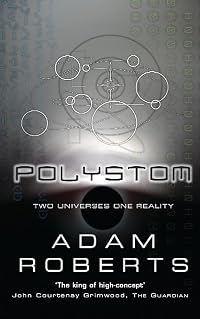
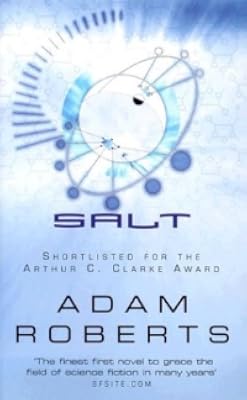
Adam Roberts¿ fourth novel is his most ambitious yet. In a feat of extraordinary world building he creates a universe where a breathable atmosphere extends out between the planets, where aristocrats cruise interstellar space in biplanes, and skywhals make mysterious distant orbits. Then, with bravura plotting he undermines our own notions of reality and leaves the reader unsure which universe to believe. Gaining a reputation as one of the UK¿s leading SF stylists and masters of the show more high-concept Roberts, shortlisted for the Arthur C. Clarke award with his debut novel SALT, confirms his extraordinary potential with POLYSTOM. show lessTags
Recommendations















Member Reviews
Another of Roberts' books that has me puzzled. We start out with a premise, that the distances between the worlds of the solar system are not insurmountable, that there is atmosphere from world to world, and it is possible to travel between moons and planets by conventional means, such as biplanes. We are then introduced to a series of characters who are at the pinnacle of their society. The eponymous character in the book, Polystom, is a dissolute young man who exists in a world of plenty. Think of Wodehouse - except we see that the society is feudal, a Tory wet dream of privilege, chauvinism and control.
So far, then, we have Wodehouse mixed with fairly crude propaganda, with overtones of Philip Mann's 'Master of Paxwax' and Bob Shaw's show more 'Ragged Astronauts' thrown in for good measure. Then we are introduced to Polystom's uncle, a great scientist who is prepared to consider the possibility of other worlds being impossibly distant and there only being vacuum between the planets.
Now, perhaps I was being misled by the jacket blurb; but I was expecting some sort of mystery ending in conceptual breakthrough. Instead, we get a series of social observations that end with Polystom taking a platoon of his faithful estate retainers to a savage and endless war on 'Mudworld' which has an unexpected outcome. Once again, we get another face of the savage society; this time, we are pitched into World War I-style trench warfare and see fairly stock situations showing us that War Is Hell.
Then suddenly, we are given the denouement, Polystom finally gets his conceptual breakthrough, and we are faced with a key question of reality. This is quite a turnaround for us as readers, just as it is for Polystom. The challenge to his world-view is total in the final pages of the book, and his understanding of his world is inverted (though how much it changes him as a character is unclear).
Overall, then, for me an unsettling book. show less
So far, then, we have Wodehouse mixed with fairly crude propaganda, with overtones of Philip Mann's 'Master of Paxwax' and Bob Shaw's show more 'Ragged Astronauts' thrown in for good measure. Then we are introduced to Polystom's uncle, a great scientist who is prepared to consider the possibility of other worlds being impossibly distant and there only being vacuum between the planets.
Now, perhaps I was being misled by the jacket blurb; but I was expecting some sort of mystery ending in conceptual breakthrough. Instead, we get a series of social observations that end with Polystom taking a platoon of his faithful estate retainers to a savage and endless war on 'Mudworld' which has an unexpected outcome. Once again, we get another face of the savage society; this time, we are pitched into World War I-style trench warfare and see fairly stock situations showing us that War Is Hell.
Then suddenly, we are given the denouement, Polystom finally gets his conceptual breakthrough, and we are faced with a key question of reality. This is quite a turnaround for us as readers, just as it is for Polystom. The challenge to his world-view is total in the final pages of the book, and his understanding of his world is inverted (though how much it changes him as a character is unclear).
Overall, then, for me an unsettling book. show less
While I found the story quite interesting from the start, I didn't find it particularly captivating and I struggled to generate much feeling for the eponymous protagonist. However, the final 50 pages or so (out of about 340) introduced several major twists and made for a very thought-provoking ending. I certainly didn't regret the time spent reading this book.
Ratings
Members
- Recently Added By
Author Information

123+ Works 6,451 Members
Common Knowledge
- Canonical title
- Polystom
- Original publication date
- 2003-05
- First words*
- Eines Morgens bestieg Polystom seinen Doppeldecker, da er beschlossen hatte, zum Mond zu fliegen.
- Last words*
- (Click to show. Warning: May contain spoilers.)Und dann wird er endlich wissen, ob seine Frau ihn wirklich liebt.
- Blurbers*
- Baxter, Stephen (Ger, Heyne) (Ger, Heyne)
*Some information comes from Common Knowledge in other languages. Click "Edit" for more information.
Classifications
Statistics
- Members
- 242
- Popularity
- 135,123
- Reviews
- 3
- Rating
- (3.13)
- Languages
- English, German
- Media
- Paper, Ebook
- ISBNs
- 6
- ASINs
- 2