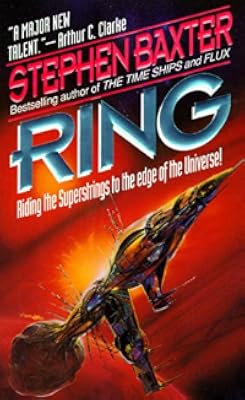
On This Page
Description
Wormhole technology has revealed that our sun will die in 5,000,000 years. A race of superbeings, the fabulous Xeelee, owners of the universe, are thought to be responsible. The bizarre and wealthy cult, the Superet, funds two projects aimed at combatting the force that will murder the sun.Tags
Recommendations





Member Reviews
There's an old, not-all-that-funny joke that goes like this: A woman attends an astronomy lecture, and afterwards she approaches the speaker, looking agitated. "Did I hear you correctly?" she says. "Did you say the sun was going to die?"
"Yes," the astronomer replies. "In about five billion years."
"Oh, five billion!," says the woman. "Thank goodness! I thought you said five million!"
Turn those figures around, and you basically have the plot of this book. Thanks to a little wormhole-assisted time travel, humanity discovers that the sun, and every other star around us, is evolving a thousand times faster than it's supposed to, and in five million years the universe will be nearly uninhabitable, at least for our form of life. So they send show more a ship into the future the slow way to try to do something about the survival of the human species.
It's pretty much a typical Stephen Baxter novel: extremely hard hard SF with some interesting, cosmic-scale ideas, coupled with a painfully thin and slow-paced plot, immense amounts of clunky exposition that fails to properly capture the wonder of the scientifically nifty things he's describing, and one-dimensional characters whose only significant form of interaction with each other consists of physics lectures.
Oh, and I never realized just how unbelievably annoying it is when someone, real or fictional, repeats the name of the person they're talking to every two sentences until I had to put up with about a hundred pages in a row of one character constantly doing that to another -- who, of course, had a stupid and unwieldy name, just to make things maximally irritating. It got to the point where I was fantasizing about killing the offending character slowly and painfully while repeating her own name to her every thirty seconds just to see how she liked it. Probably this would have lowered the odds of the human race's survival significantly, but, damn it, it would have been worth it.
Sigh. I don't know why I keep reading Baxter's stuff. Or, no, really, I do. Partly it's that I've already accumulated a bunch of his books somewhere and keep thinking, well, I have them, so I should read them. But mostly it's because the first book of his I read was The Time Ships, and, man, that one captured that good, old-fashioned sense of wonder for me just perfectly. I keep longing for a repeat of that reading experience from Baxter, and just keep not getting it. Whether that's because he only had one really good book in him, or because I read it when I was much younger and more easily satisfied, I don't know. But I think it is finally time to give up on him now. Well, except maybe for that Doctor Who novel...
Rating: 2/5. Although, man, I was seriously tempted to dock it another half star just for Ms. I Am Going To Keep Calling You By Name Even Though You Are Literally the Only Person in a Million Light-Years That I Could Be Talking To. show less
"Yes," the astronomer replies. "In about five billion years."
"Oh, five billion!," says the woman. "Thank goodness! I thought you said five million!"
Turn those figures around, and you basically have the plot of this book. Thanks to a little wormhole-assisted time travel, humanity discovers that the sun, and every other star around us, is evolving a thousand times faster than it's supposed to, and in five million years the universe will be nearly uninhabitable, at least for our form of life. So they send show more a ship into the future the slow way to try to do something about the survival of the human species.
It's pretty much a typical Stephen Baxter novel: extremely hard hard SF with some interesting, cosmic-scale ideas, coupled with a painfully thin and slow-paced plot, immense amounts of clunky exposition that fails to properly capture the wonder of the scientifically nifty things he's describing, and one-dimensional characters whose only significant form of interaction with each other consists of physics lectures.
Oh, and I never realized just how unbelievably annoying it is when someone, real or fictional, repeats the name of the person they're talking to every two sentences until I had to put up with about a hundred pages in a row of one character constantly doing that to another -- who, of course, had a stupid and unwieldy name, just to make things maximally irritating. It got to the point where I was fantasizing about killing the offending character slowly and painfully while repeating her own name to her every thirty seconds just to see how she liked it. Probably this would have lowered the odds of the human race's survival significantly, but, damn it, it would have been worth it.
Sigh. I don't know why I keep reading Baxter's stuff. Or, no, really, I do. Partly it's that I've already accumulated a bunch of his books somewhere and keep thinking, well, I have them, so I should read them. But mostly it's because the first book of his I read was The Time Ships, and, man, that one captured that good, old-fashioned sense of wonder for me just perfectly. I keep longing for a repeat of that reading experience from Baxter, and just keep not getting it. Whether that's because he only had one really good book in him, or because I read it when I was much younger and more easily satisfied, I don't know. But I think it is finally time to give up on him now. Well, except maybe for that Doctor Who novel...
Rating: 2/5. Although, man, I was seriously tempted to dock it another half star just for Ms. I Am Going To Keep Calling You By Name Even Though You Are Literally the Only Person in a Million Light-Years That I Could Be Talking To. show less
I was browsing the sci-fi section in the local library and came across an old paperback with a familiar name on the spine: Stephen Baxter. I’m most familiar with Baxter’s collaboration with the late Arthur C. Clarke on the Manifold trilogy, but have enjoyed a few of his solo works as well. This one looked to be a bit older (there was a quote on the cover from Clarke hailing Baxter as “a major new talent”), but I figured it was worth a try.
Ring finds humanity in the Third Millennium traveling through space, having learned some fantastic tricks of physics (including controlling wormholes that access the future) from alien races. Having also achieved “anti-senesence” technology (i.e. they can stop aging), a group of explorers show more decide to undertake a million-year trip at relativistic speeds, keeping a wormhole open the whole way so that they can communicate from the future back to the past.
What unfolds is a fascinating story of space and time, on a scale of megayears. Baxter is at his best when he’s dealing with the hard science, describing the aging process of stars, but he holds his own, too, with the softer side - imagining what a hyperspace trip across the universe might feel like from the perspective of the solitary human piloting the ship, recognizing that even millions of years of “progress” won’t change human nature.
If you’re into hard sci-fi, Ring is worth picking up, a very enjoyable read. show less
Ring finds humanity in the Third Millennium traveling through space, having learned some fantastic tricks of physics (including controlling wormholes that access the future) from alien races. Having also achieved “anti-senesence” technology (i.e. they can stop aging), a group of explorers show more decide to undertake a million-year trip at relativistic speeds, keeping a wormhole open the whole way so that they can communicate from the future back to the past.
What unfolds is a fascinating story of space and time, on a scale of megayears. Baxter is at his best when he’s dealing with the hard science, describing the aging process of stars, but he holds his own, too, with the softer side - imagining what a hyperspace trip across the universe might feel like from the perspective of the solitary human piloting the ship, recognizing that even millions of years of “progress” won’t change human nature.
If you’re into hard sci-fi, Ring is worth picking up, a very enjoyable read. show less
This really is one of the best science fiction books I have EVER read, and this is also my first book by this author. I've read books by other wonderful science fiction authors like Heinlein, Asimov, and Herbert, and this just... blew me away. I'm not even kidding you. I was sucked into this story with the tale of Lieserl, and I kept looking forward to the parts which had her in it.
The story and plot are fantastic, imaginative, and well-written. The amount of creativity and thought that went into this is just... wow. Seriously, WOW. I got a bit lost when the author talked about hard science, but I was able to keep up well. I will never forget this book for as long as I live, and the ending was incredible. I gotta say, I did feel bad for show more poor Uvarov, though... show less
The story and plot are fantastic, imaginative, and well-written. The amount of creativity and thought that went into this is just... wow. Seriously, WOW. I got a bit lost when the author talked about hard science, but I was able to keep up well. I will never forget this book for as long as I live, and the ending was incredible. I gotta say, I did feel bad for show more poor Uvarov, though... show less
Hard science fiction authors are often criticized for writing prosaic prose and an inability to create believable, complex characters. Sci-fi legends like [a:Isaac Asimov|16667|Isaac Asimov|https://d202m5krfqbpi5.cloudfront.net/authors/1341965730p2/16667.jpg] and [a:Arthur C. Clarke|7779|Arthur C. Clarke|https://d202m5krfqbpi5.cloudfront.net/authors/1357191481p2/7779.jpg] did not escape such criticism yet their works remain immensely popular to this day and never go out of print. This begs the question of whether we really need high literary value in hard sf. I think this style of writing is quite suitable to convey the type of story being told. The type where the story and concepts are bigger than the individual characters. What I show more expect from hard sf and space operas are wild ideas and epic plots on an intergalactic scale. Never mind the lyrical prose and passages of poetry I will look for those in the next book I read (or the one after that). As long as I am not limited to reading this kind of fiction to the exclusion of everything else I am fine with the more workmanlike writing style.
Which (finally) brings me to Stephen Baxter. You would have to be crazy to claim that Mr. Baxter is a literary writer, you could make the claim about a few sf authors like [a:Ursula K. Le Guin|874602|Ursula K. Le Guin|https://d202m5krfqbpi5.cloudfront.net/authors/1244291425p2/874602.jpg], [a:Jack Vance|5376|Jack Vance|https://d202m5krfqbpi5.cloudfront.net/authors/1207604643p2/5376.jpg] or [a:Gene Wolfe|23069|Gene Wolfe|https://d202m5krfqbpi5.cloudfront.net/authors/1207670073p2/23069.jpg] but if you are looking for a sci-fi / lit-fic combo Stephen Baxter is not your man. What he can offer the reader is the escapism and flight of imagination we often crave, backed up by a solid foundation in known physics to render the story much more believable than simple handwavium.
At this point a synopsis seems appropriate and I did write one but it collided with a cosmic string and can only be found in a neighboring universe. I can tell you this, it feature the Sun's energy being drained away by some weird "photino birds" aliens, a group of characters' attempt to save it. We also get to see the end of our universe which is a very cool scene, and the entrance into another universe "next door" to ours. The process involves the eponymous Ring woven by the Xeelee from cosmic strings and some time travelling, for the sake of verisimilitude everything is explained by impenetrable super science. Now you know why I didn't want to summarize the plot.
Baxter’s writing style reminds me of [a:Arthur C. Clarke|7779|Arthur C. Clarke|https://d202m5krfqbpi5.cloudfront.net/authors/1357191481p2/7779.jpg] more than anyone else. To his credit I think Baxter made more of a stab at character development (with limited success) but Clarke’s science expositions are much more accessible, and more seamlessly integrated into the narrative. Having said that, while a lot of the science in Ring is beyond my comprehension Baxter did well enough to narrate the story is such a way that at least the gist of the plot can be inferred.
The characters in Ring tend to spend a lot of time explaining rather arcane science to each other. They talk about the Pauli Exclusion Principle, event horizons, maser convections etc. like I would talk about flavors of ice cream. Also, all the characters also seem to "growl" a lot when they are irritated. These characters are generally pancake-like in term of depth, yet Baxter did manage to create one sympathetic character called Lieserl who has one of the best backstories ever. Lieserl is an AI character who starts off as a human engineered to age very rapidly and just before the moment of death her consciousness is digitized, stored in some kind of media and dispatched into the Sun to investigate an anomaly. All this so they can create an AI with real human personality and empathy. Ingenious and immoral, reminds of me of works by [a:Greg Egan|32699|Greg Egan|https://d202m5krfqbpi5.cloudfront.net/authors/1375595103p2/32699.jpg] and [a:Ted Chiang|130698|Ted Chiang|https://d202m5krfqbpi5.cloudfront.net/authors/1208187207p2/130698.jpg] where the theme of our moral responsibility to the AI beings we create is explored in much greater depth.
I read Ring as part of the [b:Xeelee|6575201|Xeelee|Stephen Baxter|https://d202m5krfqbpi5.cloudfront.net/books/1347336042s/6575201.jpg|6768426] omnibus which contains four volumes of the Xeelee Sequence, namely Raft, Timelike Infinity, Flux, and Ring. If you are in possession of this omnibus I recommend reading [b:Timelike Infinity|66795|Timelike Infinity|Stephen Baxter|https://d202m5krfqbpi5.cloudfront.net/books/1346403688s/66795.jpg|64769] first then Ring, the other two volumes are standalone stories set in the same universe. So far I have read Timelike Infinity and Ring; I think Baxter told a tighter, more exciting story with “Timelike” but Ring is still a worthwhile read, just don’t expect any poems and songs. show less
Which (finally) brings me to Stephen Baxter. You would have to be crazy to claim that Mr. Baxter is a literary writer, you could make the claim about a few sf authors like [a:Ursula K. Le Guin|874602|Ursula K. Le Guin|https://d202m5krfqbpi5.cloudfront.net/authors/1244291425p2/874602.jpg], [a:Jack Vance|5376|Jack Vance|https://d202m5krfqbpi5.cloudfront.net/authors/1207604643p2/5376.jpg] or [a:Gene Wolfe|23069|Gene Wolfe|https://d202m5krfqbpi5.cloudfront.net/authors/1207670073p2/23069.jpg] but if you are looking for a sci-fi / lit-fic combo Stephen Baxter is not your man. What he can offer the reader is the escapism and flight of imagination we often crave, backed up by a solid foundation in known physics to render the story much more believable than simple handwavium.
At this point a synopsis seems appropriate and I did write one but it collided with a cosmic string and can only be found in a neighboring universe. I can tell you this, it feature the Sun's energy being drained away by some weird "photino birds" aliens, a group of characters' attempt to save it. We also get to see the end of our universe which is a very cool scene, and the entrance into another universe "next door" to ours. The process involves the eponymous Ring woven by the Xeelee from cosmic strings and some time travelling, for the sake of verisimilitude everything is explained by impenetrable super science. Now you know why I didn't want to summarize the plot.
Baxter’s writing style reminds me of [a:Arthur C. Clarke|7779|Arthur C. Clarke|https://d202m5krfqbpi5.cloudfront.net/authors/1357191481p2/7779.jpg] more than anyone else. To his credit I think Baxter made more of a stab at character development (with limited success) but Clarke’s science expositions are much more accessible, and more seamlessly integrated into the narrative. Having said that, while a lot of the science in Ring is beyond my comprehension Baxter did well enough to narrate the story is such a way that at least the gist of the plot can be inferred.
The characters in Ring tend to spend a lot of time explaining rather arcane science to each other. They talk about the Pauli Exclusion Principle, event horizons, maser convections etc. like I would talk about flavors of ice cream. Also, all the characters also seem to "growl" a lot when they are irritated. These characters are generally pancake-like in term of depth, yet Baxter did manage to create one sympathetic character called Lieserl who has one of the best backstories ever. Lieserl is an AI character who starts off as a human engineered to age very rapidly and just before the moment of death her consciousness is digitized, stored in some kind of media and dispatched into the Sun to investigate an anomaly. All this so they can create an AI with real human personality and empathy. Ingenious and immoral, reminds of me of works by [a:Greg Egan|32699|Greg Egan|https://d202m5krfqbpi5.cloudfront.net/authors/1375595103p2/32699.jpg] and [a:Ted Chiang|130698|Ted Chiang|https://d202m5krfqbpi5.cloudfront.net/authors/1208187207p2/130698.jpg] where the theme of our moral responsibility to the AI beings we create is explored in much greater depth.
I read Ring as part of the [b:Xeelee|6575201|Xeelee|Stephen Baxter|https://d202m5krfqbpi5.cloudfront.net/books/1347336042s/6575201.jpg|6768426] omnibus which contains four volumes of the Xeelee Sequence, namely Raft, Timelike Infinity, Flux, and Ring. If you are in possession of this omnibus I recommend reading [b:Timelike Infinity|66795|Timelike Infinity|Stephen Baxter|https://d202m5krfqbpi5.cloudfront.net/books/1346403688s/66795.jpg|64769] first then Ring, the other two volumes are standalone stories set in the same universe. So far I have read Timelike Infinity and Ring; I think Baxter told a tighter, more exciting story with “Timelike” but Ring is still a worthwhile read, just don’t expect any poems and songs. show less
The end of the Xeelee sequence of novels. very good tie up of the series.
As with all Stephen Baxter, the characterisation is somewhat lacking, but for me the rest of the book more than made up for it. Some interesting concepts for the characters, such as the 5 million year old AI, or the immortality experiments going on made it a worthwhile read just for those. However the big thing about this book being that it brings together all other threads that had been hinted at or suggested in other novels and gives it some meaning.
I couldn't however recommend this book unless you have a reasonable background in physics, or at least a computer nearby and the willingness to do some research on some of the physics theory he relies upon. None of it show more is really needed for the plot, but it otherwise would make it hard reading. Then again the physics he delves into is one of the greatest strengths of this book and if you're not following it I imagine you wouldn't get anything out of this book.
So overall, highly recommended if you like your science fiction heavy on the science and don't worry too much about the characters. Stay clear if you need to empathise with your characters show less
As with all Stephen Baxter, the characterisation is somewhat lacking, but for me the rest of the book more than made up for it. Some interesting concepts for the characters, such as the 5 million year old AI, or the immortality experiments going on made it a worthwhile read just for those. However the big thing about this book being that it brings together all other threads that had been hinted at or suggested in other novels and gives it some meaning.
I couldn't however recommend this book unless you have a reasonable background in physics, or at least a computer nearby and the willingness to do some research on some of the physics theory he relies upon. None of it show more is really needed for the plot, but it otherwise would make it hard reading. Then again the physics he delves into is one of the greatest strengths of this book and if you're not following it I imagine you wouldn't get anything out of this book.
So overall, highly recommended if you like your science fiction heavy on the science and don't worry too much about the characters. Stay clear if you need to empathise with your characters show less
Baxter must have been in a terrible mood while writing this, every character is a raging, gaping asshole, who snaps and snipes and generally complains at every opportunity. The only thing that kept me reading was the plot and even that was a bit of a let-down. Oh well, it was good while it lasted. Flux was decent at least!
A truly horrible book. It claims to be "very, very hard SF", but almost all important features of the plot are completely implausible. A lot of buzzwords are thrown around, and basic understanding of certain principles is demonstrated, but real understanding of the fundamentals is completely lacking. The characters are completely flat and have no depth or complexity. The dialogue is easy to read, but not realistic at all. Most aspects of the book simply didn't make sense. I'm still not sure why I forced myself to read the whole thing.
Members
- Recently Added By
Author Information

260+ Works 43,820 Members
Some Editions
Series

Belongs to Publisher Series
Work Relationships
Is contained in
Common Knowledge
- Original title
- Ring
- Original publication date
- 1994
- Dedication
- For my nephew Thomas Baxter
- First words
- Even at the moment she was born she knew something was wrong.
- Last words
- (Click to show. Warning: May contain spoilers.)The river of time flowed,unmarked, toward the endless seas of timelike infinity.
- Blurbers
- Clarke, Arthur C.
- Original language
- English
Classifications
Statistics
- Members
- 1,009
- Popularity
- 25,970
- Reviews
- 11
- Rating
- (3.78)
- Languages
- 7 — Czech, Dutch, English, French, German, Italian, Polish
- Media
- Paper, Ebook
- ISBNs
- 12
- ASINs
- 7