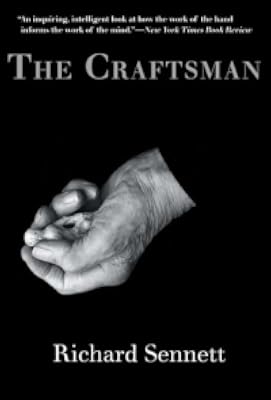
The Craftsman
by Richard Sennett
On This Page
Description
The Craftsman explores the relation between the hand and the head. Richard Sennett argues that working with physical things stimulates people to think. Craftsmanship, says Sennett, names the basic human impulse to do a job well for its own sake, and good craftsmanship involves developing skills and focusing on the work rather than ourselves. The computer programmer, the doctor, the artist, and even the parent and citizen all engage in a craftsman's work. In this thought-provoking book, show more Sennett explores the work of craftsmen past and present, identifies deep connections between material consciousness and ethical values, and challenges received ideas about what constitutes good work in today's world. The Craftsman engages the many dimensions of skill-from the technical demands to the obsessive energy required to do good work. Craftsmanship leads Sennett across time and space, from ancient Roman brickmakers to Renaissance goldsmiths to the printing presses of Enlightenment Paris and the factories of industrial London; in the modern world he explores what experiences of good work are shared by computer programmers, nurses and doctors, musicians, glassblowers, and cooks. Unique in the scope of his thinking, Sennett expands previous notions of crafts and craftsmen and apprises us of the surprising extent to which we can learn about ourselves through the labor of making physical things. show lessTags
Recommendations






Member Reviews
I thought I would like this but no, I found it slightly annoying and I'm not quite sure why. While Mr Sennett has played music and cooks he doesn't really get craftwork. It was possibly on page 58 when he mentioned a chef d'oeuvre eleve which is known in English speaking countries as a Masterpiece, or sometimes Master Piece. There is no reason to use the French term, when there is a used serviceable term, one known by craftsmen and I would know, my dad is a master cabinetmaker and carpenter and my brother a master carpenter and I have a cousin a master glass worker. To add to my crafty roots my mother is a domestic science teacher and I am an accomplished knitter, embroiderer and dabbler in other crafts. He doesn't get the beauty of the show more mundane, the mind-restfulness of the garter stitch scarf, probably worked simultaneously with a complex piece of lace; or the accomplishment of a simple facecloth while the piece you've been working on is seemingly at an impasse, and crafty sorts do this all the time, while amazing pieces with detail and ornamentation are immensely satisfying and sing, there is also something about watching the simple task of knitting each stitch, intensely. He glorifies the innovative and the work of hands but seems to miss the fact that the plodding workers are what allowed that artist the luxury of time to do their work.
Interesting but I think he misses some points. show less
Interesting but I think he misses some points. show less
A wonderful paean to craftsmanship in all forms, a plea for work well-done for the sake of the self rather than following the dictates of others or by rote (although he points out that learning by rote can lead to craftsmanship) Easier said than done, but lovingly written.
Sennett's book treats an important question. The skilled manual worker who has been crucial in and to the development of civilization does not fare well today, Instead of repairing goods, we simply replace them. The tailors of yore who mended garments has been replaced by H & M's one season wear, produced by robots and cheap labor. IKEA's self-assembled furniture pushes cabinetmakers and joiners into an upmarket niche. CAD and office software suites have made the skills of most draftsmen and desk warriors obsolete. Even Sennett's own former colleagues, musicians face stiff competition from computers that can double as a complete orchestra. So it is both timely and important to discuss what happens to the craftsmen.
The first part of show more Sennett's book is the one where its main value lies. It is both a history of the craftsman and a discussion of the importance of tacit knowledge sharing in the workshop. The shared community, organized in guilds, is one of the important elements modern successor jobs lack. This pushes the homo faber back towards the animal laborans, Countries with a craft culture such as Jaoan and Germany treat their skilled workers much better than countries without a craft culture (UK, US) with their emphasis on unskilled jobs.
Unfortunately, Sennett then removes himself from the real discussion in the next two parts, preferring to elaborate on the theme of the craftsman as artist. This is valid only for a minority of craftsmen. While the price for most services performed by craftsmen approaches the level one pays for artwork, what is wanted and what is delivered mostly isn't art but a competent, adequate job, Redefining the craftsman as an artist is certainly a solution to the problem, but the limited number of artists required will never be adequate to replace the legion of redundant craftsmen. On the other hand, there is a quaint picture book about the numerous professions that never made it into the 20th century. Is it just that the hand-based crafts are disappearing, replaced by head-based/symbolic crafts such as systems engineers and project managers?
Most architects are not even close to the mastery of an Adolf Loos. They design and build (cheap) offices and houses. Prefab elements and configuration kits challenge even those highly skilled crafts. Sennett contrasts the houses built by pro Loos and the amateur Wittgenstein, a difference in skill and constraints. I took the occasion to visit the Wittgenstein House here in Vienna, now occupied by the Bulgarian cultural embassy. Its main flaw is its failure to respect a Palladian hierarchy of room sizes. The door handles set at around 1,70 m aren't helpful either. In a deeper sense, it shows that architecture is a social craft. Deep-pocketed autodidacts such as Thomas Jefferson and Ludwig Wittgenstein may remodel their houses to eliminate their mistakes. Learning a craft means absorbing the lessons of the successes and mistakes of countless forebears, the essence of a craft, a knowledge all too quickly lost.
The book unfortunately doesn't answer the question about the future of the craftsman. The good first part is marred by the cop-out of the next two parts. Craft is more than delivering quality work. show less
The first part of show more Sennett's book is the one where its main value lies. It is both a history of the craftsman and a discussion of the importance of tacit knowledge sharing in the workshop. The shared community, organized in guilds, is one of the important elements modern successor jobs lack. This pushes the homo faber back towards the animal laborans, Countries with a craft culture such as Jaoan and Germany treat their skilled workers much better than countries without a craft culture (UK, US) with their emphasis on unskilled jobs.
Unfortunately, Sennett then removes himself from the real discussion in the next two parts, preferring to elaborate on the theme of the craftsman as artist. This is valid only for a minority of craftsmen. While the price for most services performed by craftsmen approaches the level one pays for artwork, what is wanted and what is delivered mostly isn't art but a competent, adequate job, Redefining the craftsman as an artist is certainly a solution to the problem, but the limited number of artists required will never be adequate to replace the legion of redundant craftsmen. On the other hand, there is a quaint picture book about the numerous professions that never made it into the 20th century. Is it just that the hand-based crafts are disappearing, replaced by head-based/symbolic crafts such as systems engineers and project managers?
Most architects are not even close to the mastery of an Adolf Loos. They design and build (cheap) offices and houses. Prefab elements and configuration kits challenge even those highly skilled crafts. Sennett contrasts the houses built by pro Loos and the amateur Wittgenstein, a difference in skill and constraints. I took the occasion to visit the Wittgenstein House here in Vienna, now occupied by the Bulgarian cultural embassy. Its main flaw is its failure to respect a Palladian hierarchy of room sizes. The door handles set at around 1,70 m aren't helpful either. In a deeper sense, it shows that architecture is a social craft. Deep-pocketed autodidacts such as Thomas Jefferson and Ludwig Wittgenstein may remodel their houses to eliminate their mistakes. Learning a craft means absorbing the lessons of the successes and mistakes of countless forebears, the essence of a craft, a knowledge all too quickly lost.
The book unfortunately doesn't answer the question about the future of the craftsman. The good first part is marred by the cop-out of the next two parts. Craft is more than delivering quality work. show less
Philosopher writes about how doing things with one’s hands is important to thinking. I ordered this because I’m interested in things like the art v. craft dichotomy, but I ended up uninterested, and the nods to gender and race dynamics did not correct the universalization of the Western white male experience. A parenthetical from the prologue: “Man does not, clearly, mean just men. … I’ll try to make clear when man refers generically to human beings and when it applies only to males.” Yeah, not so much: that “clearly” (and its placement) is telling. Later, Sennett posits a distinction between replicants and robots, the former of which substitute for humans and the latter of which are better than us at something. Now show more watch: “The perfect women created in Ira Levin’s novel The Stepford Wives are also replicants. … All these artifices mirror us by mimicking us.” Hmm—I thought the point of the Stepford Wives was that real women were irritatingly not “perfect” from the male perspective. The false universalization leads his analysis to be confused about what counts as “mimicking” and what counts as human attributes. show less
Even someone who has never heard the name Richard Sennett or read one of his books is familiar with his thoughts. Sociologists are rarely famous, even if they are better thought of as “public intellectuals,” as in Sennett’s case. He belongs to the small group of thinkers who coin terms that make it into our regular vocabulary and are essential to describe the modern world. In The Craftsman, Sennett looks for solutions to the problems of modern work organization while everyone is still dreaming of the inexhaustible possibilities of the Internet. Sennett returns to major subjects: experience, authority, and autonomy. It also reads prophetically when Sennett points out that we need to radically question ourselves if sustainability show more and resource-conserving treatment of our planet are not to remain hollow phrases.
For TOC Publishing, from the founding to today, Sennett’s reflections in The Craftsman have been cornerstones of our approach. TOC follows the desire to make books excellent in every way, to value people’s knowledge and skills, but also to give ourselves room: for dedication – an old-fashioned but beautiful word. It is, therefore, no surprise that TOC was founded between printing presses and typesetting boxes. show less
For TOC Publishing, from the founding to today, Sennett’s reflections in The Craftsman have been cornerstones of our approach. TOC follows the desire to make books excellent in every way, to value people’s knowledge and skills, but also to give ourselves room: for dedication – an old-fashioned but beautiful word. It is, therefore, no surprise that TOC was founded between printing presses and typesetting boxes. show less
Reading this book was frustrating. Richard Sennett's prose, and the examples he gives of craftsmanship and how it grows, and what it means as part of a life well lived, are satisfying. But this book is so badly proofread, so full of typographical errors, that I started to suspect these had been deliberately introduced to show what a miserable world we would live in if people (like publishers) did not take any pride in their work. I have never read a book (or bought one!) with more errors. Does this matter? It was mentioned in a couple of the newspaper reviews but mostly glossed over in the praise of the ideas. Surely in this of all books, the physical manifestation should have been held to a higher standard.
Sento (ma forse mi sbaglio) che Sennett non ha saputo rispondere con questo libro a una domanda che non credo di essere l'unico a percepire come urgente: che rapporto c'è fra l'uomo flessibile (titolo di una delle sue opere più incisive) e l'uomo artigiano? Ho avuto l'occasione di porre questa domanda dal vivo, a una presentazione a fine 2008, ma me la sono lasciata scappare. In questo libro non trovo nessuna risposta (se non un paio di pagine in cui si ripetono cose già dette sull'uomo flessibile). Vi trovo solo molte e lunghe digressioni (alcune apprezzabili, soprattutto quelle su musica e architettura) sulla natura dell'uomo artigiano, colme di disambiguazioni senza dubbio utili ma per niente nuove o illuminanti. Il libro manca show more inoltre di proporre nuove modalità di realizzazione dell'artigianalità negli anni 2000 (l'esempio di Linux evidentemente non è sufficiente). Il testo si pone come primo di una trilogia sulla cultura materiale, quindi forse tutto è ancora da vedere (anche se non so se avrò voglia di leggere altre cose nuove di Sennett, dato che trovo ancora più incisive quelle vecchie). show less
Members
- Recently Added By
Lists

Works cited in Palimpsest: A History of the Written Word by Matthew Battles
79 works; 2 members
Author Information

47+ Works 4,962 Members
Richard Sennett founded and served as first director of the New York Institute of the Humanities and is now a professor of sociology at both New York University and the London School of Economies.
Some Editions
Classifications
Statistics
- Members
- 997
- Popularity
- 26,130
- Reviews
- 21
- Rating
- (3.50)
- Languages
- 11 — Chinese, Danish, Dutch, English, French, German, Italian, Polish, Portuguese, Spanish, Turkish
- Media
- Paper, Audiobook, Ebook
- ISBNs
- 28
- ASINs
- 6