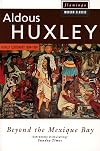
Beyond the Mexique Bay
by Aldous Huxley  , Hernán Lara Zavata (Preface)
On This Page
Tags
Recommendations






















Member Reviews
Disappointing, by far the worst book I´ve read of Huxley´s.
It´s his travelogue of a trip he took to Guatemala and Mexico in the early 30s. His observations of the culture and people are occasionally interesting, but on the whole shockingly arrogant, condescending and patronizing. He repeatedly emphasizes the ugliness of the Indians, their goods, and their buildings, often treating them as if they were sub-human. One of the most egregious passages: "Indian men are often handsome; but I hardly ever saw a woman or young girl who was not extremely ugly." Later he describes the contestants in a beauty pageant as "oxen."
He spends a lot of time describing the architecture, especially the churches, almost all of which bored me. Worse, he show more seems to fancy himself a type of expert on the subject, so he describes it with the full force of his British snobbery. Apparently he´s also an expert on poetry (criticizing Milton and Pope), music, religion, and sociology.
He also seems to possess a disturbing perspective of science, technology and state control. I would not expect the man who wrote Brave New World to advocate the state control of emotional pleasure, which he un-ironically does here. Elsewhere he claims that the only way to combat the evils of science is to further develop science.
Most shocking is that as I was nearing the end I discovered that this was actually written *after* Brave New World. I had been assuming for most of the book that it was a young and immature Huxley that I was reading. Nothing else explained the sheer arrogance and priggishness that seep forth from almost every page. How disappointing to find out that these were the mature thoughts of a nearly 40-year-old man. . . Maybe eating all that mescaline in the 50s mellowed him out some. show less
It´s his travelogue of a trip he took to Guatemala and Mexico in the early 30s. His observations of the culture and people are occasionally interesting, but on the whole shockingly arrogant, condescending and patronizing. He repeatedly emphasizes the ugliness of the Indians, their goods, and their buildings, often treating them as if they were sub-human. One of the most egregious passages: "Indian men are often handsome; but I hardly ever saw a woman or young girl who was not extremely ugly." Later he describes the contestants in a beauty pageant as "oxen."
He spends a lot of time describing the architecture, especially the churches, almost all of which bored me. Worse, he show more seems to fancy himself a type of expert on the subject, so he describes it with the full force of his British snobbery. Apparently he´s also an expert on poetry (criticizing Milton and Pope), music, religion, and sociology.
He also seems to possess a disturbing perspective of science, technology and state control. I would not expect the man who wrote Brave New World to advocate the state control of emotional pleasure, which he un-ironically does here. Elsewhere he claims that the only way to combat the evils of science is to further develop science.
Most shocking is that as I was nearing the end I discovered that this was actually written *after* Brave New World. I had been assuming for most of the book that it was a young and immature Huxley that I was reading. Nothing else explained the sheer arrogance and priggishness that seep forth from almost every page. How disappointing to find out that these were the mature thoughts of a nearly 40-year-old man. . . Maybe eating all that mescaline in the 50s mellowed him out some. show less
Huxley's account of his journey to Guatemala and southern Mexico via the West Indies. This is an idiosyncratic piece of travel writing by a great novelist. Worth reading, though his perspective is very much of its times (the early 1930s) and needs to be taken with care.
> Croisière d'hiver by Aldous Huxley
Se reporter au compte rendu de Roger PICARD
In: Revue d'histoire économique et sociale, Vol. 22, No. 3/4 (1934-1935), p. 446
Se reporter au compte rendu de Roger PICARD
In: Revue d'histoire économique et sociale, Vol. 22, No. 3/4 (1934-1935), p. 446
Jan 17, 2021 (Edited)French
Ratings
Members
- Recently Added By
Lists

The Works of Aldous Huxley
49 works; 1 member
Author Information

298+ Works 105,346 Members
Aldous Huxley was born on July 26, 1894, in Surrey, England, into a distinguished scientific and literary family; his grandfather was the noted scientist and writer, T.H. Huxley. Following an eye illness at age 16 that resulted in near-blindness, Huxley abandoned hope of a career in medicine and turned instead to literature, attending Oxford show more University and graduating with honors. While at Oxford, he published two volumes of poetry. Crome Yellow, his first novel, was published in 1927 followed by Antic Hay, Those Barren Leaves, and Point Counter Point. His most famous novel, Brave New World, published in 1932, is a science fiction classic about a futuristic society controlled by technology. In all, Huxley produced 47 works during his long career, In 1947, Huxley moved with his family to southern California. During the 1950s, he experimented with mescaline and LSD. Doors of Perception and Heaven and Hell, both works of nonfiction, were based on his experiences while taking mescaline under supervision. In 1959, Aldous Huxley received the Award of Merit for the Novel from the American Academy of Arts and Letters. He died on November 22, 1963. (Bowker Author Biography) show less
Aldous Huxley has a Legacy Library. Legacy libraries are the personal libraries of famous readers, entered by LibraryThing members from the Legacy Libraries group.
Awards and Honors
Notable Lists
Series
Belongs to Publisher Series
Work Relationships
Is contained in
Common Knowledge
- Original publication date
- 1934
- People/Characters
- Aldous Huxley
- Important places
- Mexico; Guatamala
- Quotations
- To associate with other like-minded people in small, purposeful groups is for the great majority of men and women a source of profound psychological satisfaction. Exclusiveness will add to the pleasure of being several, but a... (show all)t one; and secrecy will intensify it almost to ecstasy.
Classifications
- Genres
- Travel, Nonfiction
- DDC/MDS
- 917.2 — History & geography Geography & travel Geography of and travel in North America Mexico, Central America, And The Caribbean
- LCC
- F2171 .H8 — Local History of the United States, Canada and Latin America Latin America. Spanish America Caribbean area. Caribbean Sea
- BISAC
Statistics
- Members
- 156
- Popularity
- 210,842
- Reviews
- 3
- Rating
- (3.07)
- Languages
- 6 — Danish, English, French, Italian, Spanish, Swedish
- Media
- Paper, Ebook
- ISBNs
- 9
- ASINs
- 21