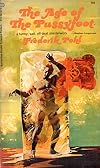
The Age of the Pussyfoot
by Frederik Pohl
On This Page
Tags
Recommendations















Member Reviews
(Original Review, 1980-12-01)
Egads! We have met the Joymaker and it is us! While my Teleray terminal has not (yet) begun dispensing contraceptives, the rest of the parallel is strikingly clear. It brings up some interesting questions concerning how a WORLDNET will function. With the amount of netmail, messages, informational data and similar niceties flying about this VERY LIMITED POPULATION network, what would a "real" WORLDNET be like? Clearly we would NEED "Joymakers" to filter things out, and if they did not do a REALLY good job of NOT filtering out the WRONG things, alot of people could get fouled up very fast! It brings up an interesting question of whether a "bad" filter is better than no filter at all in such a situation. One show more thing's for sure, if we have a true WORLDNET and no good filtering mechanisms, we definitely WILL need our "Joymakers" to spray the tranquilizer around!
For several years, there has been sitting on a shelf in my SF collection a book called "The Age of the Pussyfoot", by Frederik Pohl (1969). Somehow I never got around to reading it, but I saw it sitting there pouting and decided to give it a run through. The story was rather amusing. It involves a man "frozen" in 1969 after dying in a fire, who is brought back to life 500 years later. Everyone (well, almost everyone) in this society carries around little units called "Joymakers". These gadgets are actually little super-terminals that connect by radio to a massive computer complex in each metropolitan area. They are something of a mixed blessing. They are continually telling you that you have 3 priority messages, 2 personal messages, a pending communication, a request to play tennis, a solicitation from a law firm, an impending personal visit, an overdrawn bank account, etc., etc... They are the only way to organize the MASSES of data that this society has available; you'd never even be able to figure out what to watch on television without a Joymaker to filter out the stuff it knows you want from the umpteen thousand channels. They even spray you with tranquilizers and dispense contraceptive pills when required -- and can deliver realistic kisses and hugs to you from remote callers via direct neural stimulation. Quite a gadget. Note that they are nothing in themselves but a link to a central facility. Many of the various servo-mechanisms are telling our hero throughout the book that "we are all the same" -- that is, talking to any of them is the same as talking to your own unit -- they all connect with the same machine buried in the central city somewhere. As I worked my way through the novel, I began to feel oddly uncomfortable. This poor guy is continuously being bombarded with messages, communication requests, data inputs, etc., and you have to be an expert just to tell the Joymaker how to filter out the stuff you WANT to know about. In fact, our hero is rather inexpert at this, and gets killed as a consequence (no matter, he gets brought back again, too). As I sat trying to figure out exactly what it was that was bothering me, my nearby terminal flashed with three [You have new mail] messages, a SEND message delivered directly to my terminal from an ITS system, a local user requesting communication via a local link... and two of my phone lines started ringing.
P.S. There is one more element to this novel that must be mentioned. At the end of the story, there is a note from the author concerning the genesis of the book. He tells how the basic idea of the "Joymaker" was derived from some (limited) exposure he had to the MIT Project MAC in 1969! He goes on to describe the amazing 7090 systems (cough, wheeze, gasp) with their remote terminals dialing in on (amazing!) phone lines! One can only imagine what he'd say if he saw what that technology has "evolved" into [2018 EDIT: Almost 40 years on, I just wish I had, at the time, a Time-Machine to play with…WORLDNET indeed!].
Where's my Joymaker? ...
[2018 EDIT: This review was written at the time as I was running my own personal BBS server. Much of the language of this and other reviews written in 1980 reflect a very particular kind of language: what I call now in retrospect a “BBS language”.] show less
Egads! We have met the Joymaker and it is us! While my Teleray terminal has not (yet) begun dispensing contraceptives, the rest of the parallel is strikingly clear. It brings up some interesting questions concerning how a WORLDNET will function. With the amount of netmail, messages, informational data and similar niceties flying about this VERY LIMITED POPULATION network, what would a "real" WORLDNET be like? Clearly we would NEED "Joymakers" to filter things out, and if they did not do a REALLY good job of NOT filtering out the WRONG things, alot of people could get fouled up very fast! It brings up an interesting question of whether a "bad" filter is better than no filter at all in such a situation. One show more thing's for sure, if we have a true WORLDNET and no good filtering mechanisms, we definitely WILL need our "Joymakers" to spray the tranquilizer around!
For several years, there has been sitting on a shelf in my SF collection a book called "The Age of the Pussyfoot", by Frederik Pohl (1969). Somehow I never got around to reading it, but I saw it sitting there pouting and decided to give it a run through. The story was rather amusing. It involves a man "frozen" in 1969 after dying in a fire, who is brought back to life 500 years later. Everyone (well, almost everyone) in this society carries around little units called "Joymakers". These gadgets are actually little super-terminals that connect by radio to a massive computer complex in each metropolitan area. They are something of a mixed blessing. They are continually telling you that you have 3 priority messages, 2 personal messages, a pending communication, a request to play tennis, a solicitation from a law firm, an impending personal visit, an overdrawn bank account, etc., etc... They are the only way to organize the MASSES of data that this society has available; you'd never even be able to figure out what to watch on television without a Joymaker to filter out the stuff it knows you want from the umpteen thousand channels. They even spray you with tranquilizers and dispense contraceptive pills when required -- and can deliver realistic kisses and hugs to you from remote callers via direct neural stimulation. Quite a gadget. Note that they are nothing in themselves but a link to a central facility. Many of the various servo-mechanisms are telling our hero throughout the book that "we are all the same" -- that is, talking to any of them is the same as talking to your own unit -- they all connect with the same machine buried in the central city somewhere. As I worked my way through the novel, I began to feel oddly uncomfortable. This poor guy is continuously being bombarded with messages, communication requests, data inputs, etc., and you have to be an expert just to tell the Joymaker how to filter out the stuff you WANT to know about. In fact, our hero is rather inexpert at this, and gets killed as a consequence (no matter, he gets brought back again, too). As I sat trying to figure out exactly what it was that was bothering me, my nearby terminal flashed with three [You have new mail] messages, a SEND message delivered directly to my terminal from an ITS system, a local user requesting communication via a local link... and two of my phone lines started ringing.
P.S. There is one more element to this novel that must be mentioned. At the end of the story, there is a note from the author concerning the genesis of the book. He tells how the basic idea of the "Joymaker" was derived from some (limited) exposure he had to the MIT Project MAC in 1969! He goes on to describe the amazing 7090 systems (cough, wheeze, gasp) with their remote terminals dialing in on (amazing!) phone lines! One can only imagine what he'd say if he saw what that technology has "evolved" into [2018 EDIT: Almost 40 years on, I just wish I had, at the time, a Time-Machine to play with…WORLDNET indeed!].
Where's my Joymaker? ...
[2018 EDIT: This review was written at the time as I was running my own personal BBS server. Much of the language of this and other reviews written in 1980 reflect a very particular kind of language: what I call now in retrospect a “BBS language”.] show less
Pohl, Frederik. The Age of the Pussyfoot. Ballantine, 1969.
When he was preparing his 1966 magazine serial, The Age of the Pussyfoot, for book publication, Frederik Pohl wrote an afterword that said he probably set the story too far in the future, that 50 rather than 500 years, might have been more reasonable for some of his prognostications. He had seen some emergency medical resuscitations and had been shown one of the early time-sharing computers. He was also aware of the sexual revolution of the 1960s and the growing drug culture. From these few real-world elements, he constructed a future with easy cryogenic storage and unlimited medical life extension, an online culture that has portable devices that resemble web-connected cell show more phones that also deliver mood-altering drugs. Charles Forrester, a twentieth-century guy who died in a fire, has insurance that puts him in the freezer for 500 years until he can be resurrected. Because death is not considered permanent, dueling and contract murder have been legalized. Charles discovers that stepping on a Martian’s fragile foot can get you back in the freezer if you are not careful, or even start an interplanetary war. Still fun after all these years. 4 stars. show less
When he was preparing his 1966 magazine serial, The Age of the Pussyfoot, for book publication, Frederik Pohl wrote an afterword that said he probably set the story too far in the future, that 50 rather than 500 years, might have been more reasonable for some of his prognostications. He had seen some emergency medical resuscitations and had been shown one of the early time-sharing computers. He was also aware of the sexual revolution of the 1960s and the growing drug culture. From these few real-world elements, he constructed a future with easy cryogenic storage and unlimited medical life extension, an online culture that has portable devices that resemble web-connected cell show more phones that also deliver mood-altering drugs. Charles Forrester, a twentieth-century guy who died in a fire, has insurance that puts him in the freezer for 500 years until he can be resurrected. Because death is not considered permanent, dueling and contract murder have been legalized. Charles discovers that stepping on a Martian’s fragile foot can get you back in the freezer if you are not careful, or even start an interplanetary war. Still fun after all these years. 4 stars. show less
Sharp and funny satire of a future where mankind has become over-reliant on machines. That part was convincing enough, but how hunting humans had become legal escaped me,
charles /forrester was a technical writer but he was cryogenically preserved, and awakes in 2527. he needs work, but the only thing available is as a translator for a captive alien here on earth. Neither the human or alien group regard him with much favour, and events transpire. light-hearted work for the man who eventually wrote the Gateway series.
I usually don't like satire but I read this because it is by one of the best authors from the Golden Age of SF. The book is better then I expected.
I like Frederick Pohl. His "Gateway" is one of the best SF books I have read.
I like Frederick Pohl. His "Gateway" is one of the best SF books I have read.
I read this because it supposedly had one of the earliest examples of a portable computer along the lines of a smartphone, in the guise of the "joymaker". I can't remember much else about the story though lol
Ratings
Members
- Recently Added By
Author Information

Frederik Pohl was born in New York City on November 26, 1919. More interested in writing than in school, he dropped out of high school in his senior year and took a job with a publishing company. After serving as a public relations officer in the United States Army from 1943 to 1945, he returned to publishing as copywriter for Popular Science, a show more literary agent for several sci-fi writers, and the editor for the magazines Galaxy and If from 1959 until 1969, with If winning three successive Hugo awards. His first published work, a poem entitled Elegy to a Dead Satellite: Luna, was printed in Amazing Stories magazine in 1937 under the pen name Elton Andrews. His first science fiction novels were published in the mid 1960's, some written in collaboration with other writers, others created alone. During his lifetime, he won over 16 major awards for his writing (much of which was published pseudonymously) including six Hugo Awards and three Nebula Awards. His works include Gateway, which won the Campbell Memorial, Hugo, Locus SF, and Nebula Awards, Beyond the Blue Event Horizon, and Jem, which won the National Book Award in 1979. He also embraced blogging in his later years, using his online journal as an ongoing sequel to his autobiography, The Way the Future Was. He died on September 2, 2013 at the age 93. (Bowker Author Biography) show less
Some Editions
Series
Belongs to Publisher Series
Work Relationships
Is contained in
Common Knowledge
- Canonical title
- The Age of the Pussyfoot
- Original publication date
- 1969
- People/Characters
- Adne Bensen; Charles Forrester; Heinzlichen Jura de Syrtis Major; Kevin O'Rourke na Solis Lacis; Dr. Alin Hara; Taiko Hironibi (show all 7); Jerry Whitlow
- Important places
- Shoggo
- First words
- Over everyone in the room, or perhaps it was a park, the lighting cast shapes and symbols of color.
- Last words
- (Click to show. Warning: May contain spoilers.)For he lived happily ever after. And so did they all.
- Original language
- English
Classifications
Statistics
- Members
- 403
- Popularity
- 76,899
- Reviews
- 6
- Rating
- (3.39)
- Languages
- 7 — Dutch, English, French, German, Italian, Portuguese, Turkish
- Media
- Paper, Ebook
- ISBNs
- 14
- ASINs
- 9