On This Page
Description
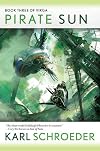
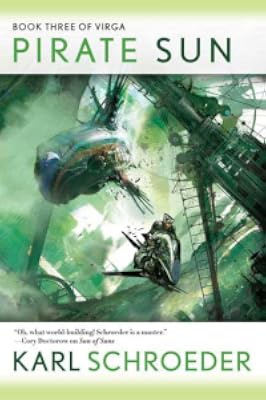
Return to Virga, a bubble universe artificially separated from our own future universe, and the setting of Sun of Suns and Queen of Candesce. Chaison Fanning, the admiral of a fleet of warships, has been captured and imprisoned by his enemies, but is suddenly rescued and set free. He flees through the sky to his home city to confront the ruler who betrayed him. And perhaps even to regain his lovely, powerful, and subversive wife, Venera, who he has not seen since she fled with the key to show more the artificial sun at the center of Virga, Candesce. Schroeder sets a whole new standard for hard SF space opera. show lessTags
Recommendations





















Member Reviews
Chaison Fanning, the principal character in this part of the series, is a much more sympathetic figure than his wife, Venera, who was the focus of the previous book. Consequently, I enjoyed this episode more than the 2nd book. And it was good to catch glimpses of what Artificial Nature means outside the planet-sized balloon Virga. If this seems like damning with faint praise, that is unintentional. Both of these books are good, solid reads. But neither has the impact of the first in the series, [b:Sun of Suns|77887|Sun of Suns (Virga, #1)|Karl Schroeder|http://d.gr-assets.com/books/1312030230s/77887.jpg|75218], simply because the first book introduced the jaw-dropping engineering ideas that establish the setting for all that follows. show more (Much like the way the [b:Ringworld|61179|Ringworld|Larry Niven|http://d.gr-assets.com/books/1348622769s/61179.jpg|924711] sequels are good enough tales, but don't stick in one's mind the way the first book does.] show less
I thought highly of the first two books in Karl Schroeder’s Virga series. Unfortunately, my pleasure reading those books did not carry through the third, Pirate Sun. Schroeder’s created an amazing physical place and an interesting political world in Virga. For example, there’s an epic weightless battle in part two that would be heaven to see on the big screen. However, the plotting and characterization are all over the map in the last book of the series. The aforementioned space battle is superfluous to the plot, serving only to illustrate how one might fight a weightless battle.
(Full review at my blog)
(Full review at my blog)
This is the third book in a series about Virga, an enormous balloon in space, containing a low-tech human civilisation based around small artificial suns. Chaison Fanning, the Admiral of Slipstream, is in prison after destroying the fleet of the feared Falcon Formation. He is broken out by a member of the Home Guard, who protect Virga against unspecified dangers from the outside. However, she has other motives and an escalating tale of chaos and rebellion sparked by a small group, lead by Channing, eventually reveals more about things outside of Virga. It seems the series might move into a different gear from its steampunk crossed with space opera roots : inventive, exciting and well-written, it has the potential to become a classic.
Karl Schroeder concludes this otherworldly adventure trilogy with Pirate Sun, in which we find Admiral Chaison Fanning, suddenly released from captivity. In this final novel, we follow this noble character, which was introduced in Sun of Suns, but only briefly mentioned in Queen of Candesce.
The fallen admiral must now find a way to return home to confront the Pilot of Slipstream, who has somehow betrayed him, and possibly reunite with Venera, whose fate of which he is ignorant. In so doing, he meets Antaea Argyre, who has a mission of her own. Her reasons for accompanying Fanning and his group of fugitives are entirely her own, although they are explained throughout the book.
This trilogy, and particularly this conclusion, has amazed me show more from beginning to end. Again, Schoeder's universe is detailed to the point where one could almost find him- or herself in the midst of it, floating in freefall, where artificial, centrifugal gravity is only existant in nation cities.
The characters themselves have a certain depth to them, and all of them develop in their own way. When we first meet Antaea, she is a distrusting, manipulative person, a woman on a mission. Over the course of the story, she comes to trust Fanning, at the very least, especially when her own people betray her. Fanning, on the other hand, discovers that he cannot be the hero that others made him out to be, although he stays true to his nature, and adheres to his principles and morals all through the book.
Furthermore, there is never a dull moment, even when it seems to be calmer at times. The pacing is flawless, and the build-up to important events is perfectly calculated, to the point where it is difficult to put the book down.
All in all, this is a extraordinary conclusion to an amazing trilogy, where the universe and characters are amply developed and described, where science-fiction, steampunk, and a great swashbuckling adventure flawlessly merge to make a beautiful story involving much politics, loyalty and betrayal. show less
The fallen admiral must now find a way to return home to confront the Pilot of Slipstream, who has somehow betrayed him, and possibly reunite with Venera, whose fate of which he is ignorant. In so doing, he meets Antaea Argyre, who has a mission of her own. Her reasons for accompanying Fanning and his group of fugitives are entirely her own, although they are explained throughout the book.
This trilogy, and particularly this conclusion, has amazed me show more from beginning to end. Again, Schoeder's universe is detailed to the point where one could almost find him- or herself in the midst of it, floating in freefall, where artificial, centrifugal gravity is only existant in nation cities.
The characters themselves have a certain depth to them, and all of them develop in their own way. When we first meet Antaea, she is a distrusting, manipulative person, a woman on a mission. Over the course of the story, she comes to trust Fanning, at the very least, especially when her own people betray her. Fanning, on the other hand, discovers that he cannot be the hero that others made him out to be, although he stays true to his nature, and adheres to his principles and morals all through the book.
Furthermore, there is never a dull moment, even when it seems to be calmer at times. The pacing is flawless, and the build-up to important events is perfectly calculated, to the point where it is difficult to put the book down.
All in all, this is a extraordinary conclusion to an amazing trilogy, where the universe and characters are amply developed and described, where science-fiction, steampunk, and a great swashbuckling adventure flawlessly merge to make a beautiful story involving much politics, loyalty and betrayal. show less
As the tale of Virga unfolds, the focus moves from Venera Fanning (villain of the first book and heroine of the second) to her husband Chaison, admiral on the run from his nation of Slipstream. We get more swashbuckling action as political turmoil unfolds between the nations floating in air-filled space, exposition of Virga's role in larger transhuman conflicts, and setup for the next volume in the series. Schroeder does a good job of keeping each novel self-contained while slowly building up the larger story.
I really liked the first two in this series (as well as other books I've read by Schroeder) but this one really just didn't do it for me.
It picks up a character that I was never particularly enthralled by in the other books (Chaison Fanning) and puts him front and center. However, even though he's the main character in this book, I still never got a good sense of who he is as a person. I can't even picture him clearly.
The story starts with a prison break - Admiral Fanning's bad-ass wife, Venera, has planned his escape - but things go wrong, and they don't connect. (And we don't see Venera again until the end, blah.)
Instead, Fanning is picked up by an enigmatic woman who is genetically modified to look like an anime character show more (double-blah; that really turned me off).
Lots of completely forgettable running around occurs. The fate of the (very conceptually interesting) world of Virga is at stake. Unfortunately, I got bored.
I still may move on to the next one in the series, in the hopes that it picks up again - because I really want it to. But I'd recommend giving this one a miss. show less
It picks up a character that I was never particularly enthralled by in the other books (Chaison Fanning) and puts him front and center. However, even though he's the main character in this book, I still never got a good sense of who he is as a person. I can't even picture him clearly.
The story starts with a prison break - Admiral Fanning's bad-ass wife, Venera, has planned his escape - but things go wrong, and they don't connect. (And we don't see Venera again until the end, blah.)
Instead, Fanning is picked up by an enigmatic woman who is genetically modified to look like an anime character show more (double-blah; that really turned me off).
Lots of completely forgettable running around occurs. The fate of the (very conceptually interesting) world of Virga is at stake. Unfortunately, I got bored.
I still may move on to the next one in the series, in the hopes that it picks up again - because I really want it to. But I'd recommend giving this one a miss. show less
Since it's been years since I've read the first two books I probably should have gone back and skimmed them before picking this volume, but the thing to know is that one is still essentially on the trajectory set in the second book with Admiral Fanning trying to get back to his home polity to deal with a bigger game; the events set in motion by his wife Venera which has allowed the beings kept at bay by the main artificial sun of Virga to penetrate the megastructure's defenses. If you liked the first two books you will certainly like this one.
Members
- Recently Added By
Author Information

48+ Works 4,054 Members
Awards and Honors
Awards
Distinctions
Series

Common Knowledge
- Canonical title
- Pirate Sun
- People/Characters
- Chaison Fanning; Antaea Argyre
- Important places
- Virga
- Epigraph
- Nothing is more difficult, and therefore nothing more precious, than to be able to decide. - Napoleon Bonaparte
- Dedication
- To the Tuesday night group, for years of excellent conversation.
- First words
- "One thing I can guarantee," said Venera Fanning. "There has never been a prison break like this one."
- Last words
- (Click to show. Warning: May contain spoilers.)"You and I, Miss 'Thrace-Guiles,'" he said as he laughed, "clearly have a lot of catching up to do."
- Publisher's editor
- Hartwell, David G.
Classifications
Statistics
- Members
- 264
- Popularity
- 123,155
- Reviews
- 13
- Rating
- (3.63)
- Languages
- English, German
- Media
- Paper, Audiobook, Ebook
- ISBNs
- 7
- ASINs
- 5