On This Page
Description
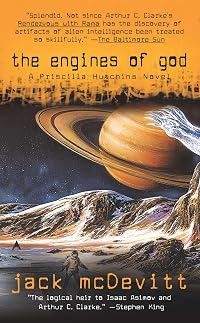
Humans call them Monument-Makers. An unknown race, they left stunning, alien statues encoded with strange inscriptions that defy translation scattered on distant planets throughout the galaxy. Searching for clues about the Monument-Makers, teams of twenty-third-century linguists, historians, engineers, and archaeologists have been excavating the enigmatic alien ruins on a number of planets, uncovering strange, massive false cities made of solid rock. But their time is running out: Earth's show more ravaged environment is quickly making it unlivable, and colonizers want to begin terraforming these abandoned worlds for human habitation. Only interstellar archaeologist Richard Wald and starship pilot Priscilla Hutchins are convinced that uncovering the secrets of the monuments may be the key to survival for the entire human race.. show less
Tags
Recommendations



Member Recommendations
Member Reviews
My reactions to reading this novel in 1995. Spoilers follow.
This book, at 419 pages, was a relatively quick read, a compelling mystery of the best sf type: mysterious alien ruins and monuments which ultimately point the way towards a destructive force that periodically comes out of the galactic center to lay waste to urban civilizations and a race of monument makers who try to deflect this force away from themselves and other alien races. The solution to this mystery leaves a lot of questions. Is the Omega cloud really some sort of cosmic balancing force that prevents an urban species – at least one that builds right angle structures – from dominating a planet? Did the Monument Makers flee it into the galactic center? Did the Omega show more cloud visit Earth and destroy Sodom? A shorter sequel would be in order to, among other things, explore the boost the Omega cloud gives religious fundamentalism.
McDevitt’s style mixes archival memoirs, future histories (relating the events of the novel), ship’s logs in an effective matter that foreshadows events without spoiling suspense, and the plot is full of tense moments when archaeology becomes lethal or, at least, hazardous: desperately pulling artifacts out of the Temple of the Winds before it is destroyed by terraforming generated earthquakes, a band of archaeologists huddling in a ship with crippled life support and waiting for death and another band bearing the brunt of an Omega cloud hitting a planet, and an attack by lethal and all too intelligent crabs. (I wish there would have been more exploration of the idea they are sentinels for the ruins of the Monument Makers.)
McDevitt’s world is much like ours with a few high tech accoutrements like ftl ships and “Flickinger fields”. He gets away with this (nanotech is mentioned a couple of times but only as an alien technology) by postulating a Collapse (with a “Great Famine”) so that the world of 2197 seems much like ours (including pending environmental disasters and ethnic hostilities) with some high tech goodies to propel a space opera plot. (The technology seems to have no effect on life on Earth.)
Generally, I didn’t find McDevitt’s characters all that compelling, but the group interactions were good – particularly when characters – when sober and angry – blamed each other for getting colleagues killed. I suppose, all things considered, McDevitt, as in his The Hercules Text, wrote himself into a corner, and the solution to the archaeological mystery was bound to be disappointing. Perhaps an air of mystery is good.
There were a couple of mistakes. The Monument Makers are first described as having six digit hands then later as having five digit hand. show less
This book, at 419 pages, was a relatively quick read, a compelling mystery of the best sf type: mysterious alien ruins and monuments which ultimately point the way towards a destructive force that periodically comes out of the galactic center to lay waste to urban civilizations and a race of monument makers who try to deflect this force away from themselves and other alien races. The solution to this mystery leaves a lot of questions. Is the Omega cloud really some sort of cosmic balancing force that prevents an urban species – at least one that builds right angle structures – from dominating a planet? Did the Monument Makers flee it into the galactic center? Did the Omega show more cloud visit Earth and destroy Sodom? A shorter sequel would be in order to, among other things, explore the boost the Omega cloud gives religious fundamentalism.
McDevitt’s style mixes archival memoirs, future histories (relating the events of the novel), ship’s logs in an effective matter that foreshadows events without spoiling suspense, and the plot is full of tense moments when archaeology becomes lethal or, at least, hazardous: desperately pulling artifacts out of the Temple of the Winds before it is destroyed by terraforming generated earthquakes, a band of archaeologists huddling in a ship with crippled life support and waiting for death and another band bearing the brunt of an Omega cloud hitting a planet, and an attack by lethal and all too intelligent crabs. (I wish there would have been more exploration of the idea they are sentinels for the ruins of the Monument Makers.)
McDevitt’s world is much like ours with a few high tech accoutrements like ftl ships and “Flickinger fields”. He gets away with this (nanotech is mentioned a couple of times but only as an alien technology) by postulating a Collapse (with a “Great Famine”) so that the world of 2197 seems much like ours (including pending environmental disasters and ethnic hostilities) with some high tech goodies to propel a space opera plot. (The technology seems to have no effect on life on Earth.)
Generally, I didn’t find McDevitt’s characters all that compelling, but the group interactions were good – particularly when characters – when sober and angry – blamed each other for getting colleagues killed. I suppose, all things considered, McDevitt, as in his The Hercules Text, wrote himself into a corner, and the solution to the archaeological mystery was bound to be disappointing. Perhaps an air of mystery is good.
There were a couple of mistakes. The Monument Makers are first described as having six digit hands then later as having five digit hand. show less
First of eight novels featuring spaceship pilot Priscilla Hutchins, who usually winds up flying people to and from the exploration of various space artifacts.
This story is built largely around The Monuments, a group of about a dozen large carvings and statues found scattered throughout the galaxy. They are tens of thousands of years old, and we know practically nothing about who created them or why.
A group of archaeologists exploring the relics of the now-extinct civilization on the planet Quraqua are surprised to discover evidence that Quraqua may be connected to the making of the monuments. Investigating the newly uncovered sites could take years.
But they don't have years, because humanity, desperate to find a possible new home now show more that Earth is on the verge of being climate-changed to death (*), is about to start terraforming Quraqua, which will destroy the archeaological sites, and the companies responsible for that terraforming refuse to delay.
(* -- This novel was published in 1994, and is set in the early 23rd century; things have deteriorated so badly in only thirty years that McDevitt now looks wildly optimistic about how much time we'd have left before we completely trashed the planet.)
That conflict between archaeologists and terraformers could easily provide enough material for an entire novel. Here, it's only the beginning, as McDevitt spins the fallout into a much vaster story that takes place on and around multiple planets. The mystery of the Monuments is solved (at least partially) in a way that raises new questions and potential plotlines for later novels in the series.
If anything, the book is perhaps too overstuffed. Some of the action feels rushed -- the last act of the book is another "this could be a whole novel" sequence -- and McDevitt is so busy cramming plot into the book that the characters don't always get enough room to breathe.
I didn't enjoy this as much as McDevitt's other space archaeology series, featuring Alex Benedict, finder and seller of rare artifacts. But I liked it enough that I will eventually pick up the next Hutchins book to see where things go. show less
This story is built largely around The Monuments, a group of about a dozen large carvings and statues found scattered throughout the galaxy. They are tens of thousands of years old, and we know practically nothing about who created them or why.
A group of archaeologists exploring the relics of the now-extinct civilization on the planet Quraqua are surprised to discover evidence that Quraqua may be connected to the making of the monuments. Investigating the newly uncovered sites could take years.
But they don't have years, because humanity, desperate to find a possible new home now show more that Earth is on the verge of being climate-changed to death (*), is about to start terraforming Quraqua, which will destroy the archeaological sites, and the companies responsible for that terraforming refuse to delay.
(* -- This novel was published in 1994, and is set in the early 23rd century; things have deteriorated so badly in only thirty years that McDevitt now looks wildly optimistic about how much time we'd have left before we completely trashed the planet.)
That conflict between archaeologists and terraformers could easily provide enough material for an entire novel. Here, it's only the beginning, as McDevitt spins the fallout into a much vaster story that takes place on and around multiple planets. The mystery of the Monuments is solved (at least partially) in a way that raises new questions and potential plotlines for later novels in the series.
If anything, the book is perhaps too overstuffed. Some of the action feels rushed -- the last act of the book is another "this could be a whole novel" sequence -- and McDevitt is so busy cramming plot into the book that the characters don't always get enough room to breathe.
I didn't enjoy this as much as McDevitt's other space archaeology series, featuring Alex Benedict, finder and seller of rare artifacts. But I liked it enough that I will eventually pick up the next Hutchins book to see where things go. show less
This was an impulse buy. A scruffy old copy I found in a charity shop. I’d never heard of the author and thought it might be a bit B-movie-ish, but I liked what it said on the back cover, spelling error and all. Turns out it’s a very good novel.
The themes are time and death.
The background is that humanity has reached the stars and found the archeological remains of two extinct human-like species. Big timespans are bandied about. 19,000 BC, 1,000 BC (“Dates are rendered in the standard language of the Christian epoch, out of respect for everyone’s sanity”). McDevitt really brings out the sadness of those near misses. Such a long time in human terms, just a moment in astronomical terms.
In the foreground is the narrative, each show more chapter located in time to the minute. It’s really impressive how many things that move the plot along also express the themes. The choices we make about how to fill the little time we have left, the fury with which we rush to get things done under that pressure and the sacrifices we make for what we really want.
It’s in that intersection between second and light year, species and individual, that this novel finds something to say.
There are also some flaws, but they’re not that important. show less
The themes are time and death.
The background is that humanity has reached the stars and found the archeological remains of two extinct human-like species. Big timespans are bandied about. 19,000 BC, 1,000 BC (“Dates are rendered in the standard language of the Christian epoch, out of respect for everyone’s sanity”). McDevitt really brings out the sadness of those near misses. Such a long time in human terms, just a moment in astronomical terms.
In the foreground is the narrative, each show more chapter located in time to the minute. It’s really impressive how many things that move the plot along also express the themes. The choices we make about how to fill the little time we have left, the fury with which we rush to get things done under that pressure and the sacrifices we make for what we really want.
It’s in that intersection between second and light year, species and individual, that this novel finds something to say.
There are also some flaws, but they’re not that important. show less
The Engines of God is the first novel in the Priscilla Hutchins series. Reputed to be a good pilot, this series demonstrates just how unlucky she is in life.
In the 1st chapter we learn that we're not alone, at least we weren't at one time. A monument has been found on Iapetus, a moon of Saturn. A large portion of the novel is spent trying to figure out who they were and if they're still alive.
We learn that by 2200 Earth's climate has degraded to the point where a distant world is to be terraformed in order to make way for colonists. Priscilla has been sent to ferry a noted archaeologist from Earth to Quraqua, the world designated for terraforming, where a team of archaeologists are working against a deadline to finish excavating a show more temple submerged beneath the sea. It is hoped that the dig will provide the necessary clues to discover the fate of the Quraquans and perhaps the Monument Makers as well.
Deadline you ask? Well it seems that corporate terraformers have a schedule to keep and granting the archaeologists more time is unacceptable. Why another week is a big deal in a 40-year process eludes me but I don't recall it being reasonable. The terraforming process involves nuking the ice caps to unleash a cataclysmic flood of water resulting in tsunamis over a 1000 meters high, so once the button is pushed there's no turning back. Of course, the archaeological team makes a discovery that compels them to work past the deadline...
Of course there's also this strange city that's been carved into Quraqua's moon. It's not really a city, just rocks that have been carved to resemble one. What makes it stranger is that there's no evidence that the Quraquans ever developed the technology necessary for space flight!
My one complaint would be that the characterization comes across a little weak (probably due to the large number of characters presented). Some characters take a couple hundred pages before you really get a good feel for them. However, the characters' attempt to solve the mysteries presented, all the while escaping from one life threatening situation after another, makes up for it. I never thought that a story based on archaeology could be so captivating (without resorting to ripping off Indiana Jones) but McDevitt pulls it off. It's a splendid genre melding sci-fi mystery! show less
In the 1st chapter we learn that we're not alone, at least we weren't at one time. A monument has been found on Iapetus, a moon of Saturn. A large portion of the novel is spent trying to figure out who they were and if they're still alive.
We learn that by 2200 Earth's climate has degraded to the point where a distant world is to be terraformed in order to make way for colonists. Priscilla has been sent to ferry a noted archaeologist from Earth to Quraqua, the world designated for terraforming, where a team of archaeologists are working against a deadline to finish excavating a show more temple submerged beneath the sea. It is hoped that the dig will provide the necessary clues to discover the fate of the Quraquans and perhaps the Monument Makers as well.
Deadline you ask? Well it seems that corporate terraformers have a schedule to keep and granting the archaeologists more time is unacceptable. Why another week is a big deal in a 40-year process eludes me but I don't recall it being reasonable. The terraforming process involves nuking the ice caps to unleash a cataclysmic flood of water resulting in tsunamis over a 1000 meters high, so once the button is pushed there's no turning back. Of course, the archaeological team makes a discovery that compels them to work past the deadline...
Of course there's also this strange city that's been carved into Quraqua's moon. It's not really a city, just rocks that have been carved to resemble one. What makes it stranger is that there's no evidence that the Quraquans ever developed the technology necessary for space flight!
My one complaint would be that the characterization comes across a little weak (probably due to the large number of characters presented). Some characters take a couple hundred pages before you really get a good feel for them. However, the characters' attempt to solve the mysteries presented, all the while escaping from one life threatening situation after another, makes up for it. I never thought that a story based on archaeology could be so captivating (without resorting to ripping off Indiana Jones) but McDevitt pulls it off. It's a splendid genre melding sci-fi mystery! show less
Even though I had read books 3-6 in the series previously, this novel which effectively sets up the entire universe of the story, still had me on the edge of my seat.
Nobody does xenoarchaeology like Jack McDevit, yet somehow the massive scale of the story never retracted from fully realized characters.
It drags slightly in 3rd quarter, but massively delivers in the 4th. This guy can write one hell of a conclusion.
Nobody does xenoarchaeology like Jack McDevit, yet somehow the massive scale of the story never retracted from fully realized characters.
It drags slightly in 3rd quarter, but massively delivers in the 4th. This guy can write one hell of a conclusion.
I've always heard great things about Jack McDevitt. Among them, I've heard lots of comparisons between his work and Star Trek. I don't know how apt that is, but overall this is rally quite good intellectual rather than action packed semi- hard scifi. And in that sense, I suppose tonally, its more similar to Trek than some other scifi, but there are definitely socio-political machinations going on as well as human/environmental problems that don't feel particularly Trek. But overall, you have a slower paced scifi story focused on exploration, investigation, and discovery by primarily scientists and experts. Quite good, I'm likely both to continue on with this series and try his others that are supposed to be similar in tone.
OK McDevitt, but very much like many of his other novels. Though far enough in the future to have faster than light travel, people and technology not otherwise very different. Bureaucrats appear about as often as adventurers. Much of the action is planetary, where the usual unsuspectedly deadly creatures do in a handful of explorers. There's a nice sequence aboard a spaceship with failing power and falling temperatures, where rescue is on the way but looks to be a few days too late.
Members
- Recently Added By
Lists

Arthur C. Clarke Award Winners and Shortlisted Books
219 works; 14 members

hypatian_kat to-read
429 works; 3 members

Books Read in 2026
1,919 works; 66 members

Academia in Fiction
158 works; 23 members

Female Protagonist
1,056 works; 57 members

Survey of Classic Science Fiction
171 works; 48 members
Author Information

124+ Works 20,889 Members
Jack McDevitt (born 1935) is an American science fiction author whose novels frequently deal with attempts to make contact with alien races, and with archaeology or xenoarchaeology. He attended La Salle University, where a short story of his won the annual Freshman Short Story Contest and was published in the school's literary magazine, Four show more Quarters. He received a Master's degree in literature from Wesleyan University in 1971. Before becoming a full-time author, he was an English teacher, naval officer, Philadelphia taxi driver, customs officer and motivational trainer. His first published story was The Emerson Effect in The Twilight Zone Magazine in 1981. Two years later, he published his first novel, The Hercules Text, which won the Philip K. Dick Special Award. He won the 2006 Nebula Award for Best Novel for Seeker, the UPC International Prize for his novella Ships in the Night in 1991, and the John W. Campbell Memorial Award for best SF novel for Omega in 2003. (Bowker Author Biography) show less
Some Editions
Awards and Honors
Awards
Series

Belongs to Publisher Series
Common Knowledge
- Canonical title*
- Gods werken
- Original title
- The Engines of God
- Original publication date
- 1994
- People/Characters
- Priscilla 'Hutch' Hutchins
- Epigraph*
- Wonderlijke artefacten op verre werelden dwingen de mensheid tot het opnieuw stellen van de grote levensvragen....
- Dedication
- For Maureen
with love - First words
- The thing was carved of ice and rock.
- Last words
- (Click to show. Warning: May contain spoilers.)That comes later.
- Blurbers
- Benford, Gregory
*Some information comes from Common Knowledge in other languages. Click "Edit" for more information.
Classifications
Statistics
- Members
- 2,050
- Popularity
- 10,156
- Reviews
- 51
- Rating
- (3.64)
- Languages
- 8 — Czech, Dutch, English, French, German, Hungarian, Polish, Spanish
- Media
- Paper, Audiobook, Ebook
- ISBNs
- 24
- ASINs
- 9