On This Page
Description
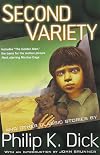
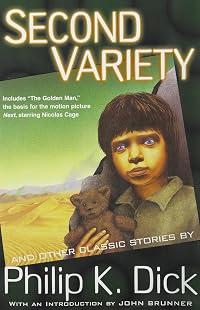
Influential American science fiction writer Philip K. Dick was fascinated by the idea of nuclear warfare and the dire aftermath of such an event. This scenario preoccupied Dick throughout much of his career and served as the backdrop to many of his stories and novels. In the short story Second Variety, the human population has been decimated by nuclear war, and small tribes of survivors are forced to battle a species of lethal robot soldiers..
Tags
Recommendations










Member Reviews
There would be little point in giving a synopsis of each of the 24 stories in this book. That would give a false sense of repetition since many feature images of ash and overturned bathtubs -- the aftermath of nuclear war -- or struggles between mutants and normal humans, each fearing their extinction. But they don't seem any more repetitious than a skilled musician working variations on a theme for that is what many are. These stories, written in 1953 and 1954 -- with one exception, are arranged chronologically, so the student of Dick can see him play with an idea for two or three stories in a row.
Along the way we get the humor, intricate plotting, and sudden reversals in our moral sympathies characteristic of Dick. And there are the show more machines that so often are a force of death in Dick though they behave more and more like life. Such is the case with the title story, one of Dick's most paranoid and basis for the movie Screamers. When sophisticated weapons take on human guise and began to stalk man, what Dick calls his grand theme, knowing who is human and who only pretends to be, is starkly exhibited.
Other famous stories are "The Golden Man" with its purging of mutants before they infect the human gene pool, "The Father-Thing" which is what a boy realizes has replaced his real father, and "Sales Pitch", a story which anticipates, with its all purpose android advertising its virtues through rather thuggish means, the work of Ron Goulart.
There are some memorable stories not so well known. "Foster, You're Dead" was originally conceived as a protest against a remark by President Eisenhower that citizens should be responsible for their own bomb shelters. Its young hero lives terrified in a world where making knives from scratch and digging underground shelters are parts of the school curriculum and each new year brings the newest model of bomb shelter, terrified because his father can't afford to buy one for the family. "War Veteran" reads like a futuristic _Mission Impossible_ episode. The spirit of Charles Fort may be at work in "Null-O", a satire on the absurd philosophy that no distinctions between things are valid, a philosophy practiced by "perfect paranoids". (Fort may have inspired the weakest and first story in the collection, "Fair Game", with its van Vogtian plotting giving way at the end to a silly twist.)
Dick fans will see "Shell Game", with its colony of paranoids, as sort of a test run for Dick's Clans of the Alphane Moon, and the time jumping child of "A World of Talent" is reminiscent of Manfred Steiner in Dick's Martian Time-Slip. This collection also features one of Dick's occasional fantasies, "Upon the Dull Earth".
Any admirer of Dick will want to read this collection, and those needing an introduction to his work will find no bad stories in this exhibit of 14 months in Dick's career. show less
Along the way we get the humor, intricate plotting, and sudden reversals in our moral sympathies characteristic of Dick. And there are the show more machines that so often are a force of death in Dick though they behave more and more like life. Such is the case with the title story, one of Dick's most paranoid and basis for the movie Screamers. When sophisticated weapons take on human guise and began to stalk man, what Dick calls his grand theme, knowing who is human and who only pretends to be, is starkly exhibited.
Other famous stories are "The Golden Man" with its purging of mutants before they infect the human gene pool, "The Father-Thing" which is what a boy realizes has replaced his real father, and "Sales Pitch", a story which anticipates, with its all purpose android advertising its virtues through rather thuggish means, the work of Ron Goulart.
There are some memorable stories not so well known. "Foster, You're Dead" was originally conceived as a protest against a remark by President Eisenhower that citizens should be responsible for their own bomb shelters. Its young hero lives terrified in a world where making knives from scratch and digging underground shelters are parts of the school curriculum and each new year brings the newest model of bomb shelter, terrified because his father can't afford to buy one for the family. "War Veteran" reads like a futuristic _Mission Impossible_ episode. The spirit of Charles Fort may be at work in "Null-O", a satire on the absurd philosophy that no distinctions between things are valid, a philosophy practiced by "perfect paranoids". (Fort may have inspired the weakest and first story in the collection, "Fair Game", with its van Vogtian plotting giving way at the end to a silly twist.)
Dick fans will see "Shell Game", with its colony of paranoids, as sort of a test run for Dick's Clans of the Alphane Moon, and the time jumping child of "A World of Talent" is reminiscent of Manfred Steiner in Dick's Martian Time-Slip. This collection also features one of Dick's occasional fantasies, "Upon the Dull Earth".
Any admirer of Dick will want to read this collection, and those needing an introduction to his work will find no bad stories in this exhibit of 14 months in Dick's career. show less
PKD is a master of a certain kind of paranoid vision. He was obsessed with the aftermath of World War 3, self-replicating weapons, the reality of a man. All these themes come together in what I believe is his best short story, a taut thriller of soldiers surviving in an atomic wasteland inhabited by autonomous robot Claws. I won't spoil the ending, but it is short, most excellent, and available for free at www.manybooks.net. Why haven't you read it already?
The setting in Second Variety is a scorched earth. Cities are reduced to rubble and slag. The bones of buildings and people have become part of the drab, desolate land. The sky turned into a swirling grey ash. Soldiers and survivors live in underground bunkers.
We are introduced early to the opposing forces, Russians versus Americans. The latter built automated killing machines, the Claws: They burrow under the ash ground, waiting for anybody who isn't wearing a radioactive deterrent tab, rushing toward their target with sharp, rotating blades.
Well written and recommended for science fiction fans.
We are introduced early to the opposing forces, Russians versus Americans. The latter built automated killing machines, the Claws: They burrow under the ash ground, waiting for anybody who isn't wearing a radioactive deterrent tab, rushing toward their target with sharp, rotating blades.
Well written and recommended for science fiction fans.
Awesome- This book is a short story collection by P K. Dick. P.K. Dick has been the writer who inspired all sorts of sci-fi movies. This book claimed to have the story that inspired the movie "Next" in it. (I haven't seen the movie so I couldn't tell you if the story fit or not.) It amazed me how many different types of dystopia he came up with. Dick has imagined the end of civilization probably hundreds of different ways (and disturbing ways.) Some of his stories have a haunting quality that keep me thinking long after I've read them.
A Phillip K. Dick story I hadn't read before. A quick read with a real 50's feel without being dated that left me wanting more.
The Rosetta added intro and authour material was well done and interesting, like the front piece often inserted by the editor in a short story collection.
The Rosetta added intro and authour material was well done and interesting, like the front piece often inserted by the editor in a short story collection.
Ratings
Members
- Recently Added By
Lists

Best Post-Apocalyptic Stories
143 works; 88 members
Author Information

669+ Works 146,585 Members
Phillip Kindred Dick was an American science fiction writer best known for his psychological portrayals of characters trapped in illusory environments. Born in Chicago, Illinois, on December 16, 1928, Dick worked in radio and studied briefly at the University of California at Berkeley before embarking on his writing career. His first novel, Solar show more Lottery, was published in 1955. In 1963, Dick won the Hugo Award for his novel, The Man in the High Castle. He also wrote a series of futuristic tales about artificial creatures on the loose; notable of these was Do Androids Dream of Electric Sheep?, which was later adapted into film as Blade Runner. Dick also published several collections of short stories. He died of a stroke in Santa Ana, California, in 1982. (Bowker Author Biography) show less
Some Editions
Awards and Honors
Awards
Series

Belongs to Publisher Series
Work Relationships
Contains
Common Knowledge
- Canonical title
- Second Variety
- Original title
- The Collected Stories of Philip K. Dick, Volume 3, Second Variety; Second Variety
- Original publication date
- 1952 - 1954 (short stories) (short stories); 1989
- Related movies
- Screamers (1995 | IMDb); Next (2007 | IMDb)
- First words
- Professor Anthony Douglas lowered gratefully into his red-leather easy chair and sighed.
- Last words
- (Click to show. Warning: May contain spoilers.)They were already beginning to design weapons to use against each other.
- Disambiguation notice
- This is the 1991 US version of Volume 3 of the Collected Short Stories of Philip K. Dick. It contains 24 stories, including Second Variety.
It should not be combined with any of these:
2. Second Variety (Collected Stories: Vol 2) which was the original 1987 volume 2 and is almost completely different from the work on this page.
3. Second Variety [short story].
Classifications
- Genres
- Fiction and Literature, Science Fiction
- DDC/MDS
- 813.0876208 — Literature & rhetoric American literature in English American fiction in English By type Genre fiction Adventure fiction Speculative fiction Science fiction Collections and anthologies Anthologies
- LCC
- PS3554 .I3 .A15 — Language and Literature American literature American literature Individual authors 1961-
- BISAC
Statistics
- Members
- 713
- Popularity
- 39,740
- Reviews
- 5
- Rating
- (4.04)
- Languages
- English, Polish, Swedish
- Media
- Paper, Audiobook, Ebook
- ISBNs
- 35
- ASINs
- 10