
Norman Spinrad
Author of The Iron Dream
About the Author
Image credit: Utopiales, Nantes, photo by Cory Doctorow
Series
Works by Norman Spinrad
The Weed of Time [short fiction] 7 copies
Galaxy, Teil 5: Eine Auswahl der besten Stories aus dem amerikanischen Science Fiction Magazin Galaxy (1966) — Contributor — 5 copies
The National Pastime {short story} 4 copies
Deathwatch [short story] 4 copies
Norman Spinrad 2 copies
The Helping Hand {short story} 2 copies
The Rules of the Road 2 copies
The Fat Vampire 1 copy
Condizione Venere 1 copy
Continent Perdu 1 copy
Big Jack Barrow 1 copy
Jeździec na pochodni 1 copy
Blackout 1 copy
What Eats You {novelette} 1 copy
Equalizer [short story] 1 copy
A Night In Elf Hill 1 copy
A Man of the Theater 1 copy
The Nanny Bubble 1 copy
Out There 1 copy
Short Fiction Collection 1 copy
Associated Works
Nebula Awards 32: SFWA's Choices for the Best Science Fiction and Fantasy of the Year (1998) — Contributor — 98 copies, 1 review
Isaac Asimov's Wonderful Worlds of Science Fiction, Volume 2: The Science Fictional Olympics (1984) — Contributor — 98 copies, 1 review
Boarding the Enterprise: Transporters, Tribbles, and the Vulcan Death Grip in Gene Roddenberry's Star Trek (2006) — Contributor — 91 copies, 5 reviews
Solaris Rising 2: The New Solaris Book of Science Fiction (2013) — Contributor — 75 copies, 6 reviews
Nebula Awards 29: SFWA's Choices For The Best Science Fiction And Fantasy Of The Year (Nebula Awards Showcase) (1995) — Contributor — 57 copies
Light Years and Dark: Science Fiction and Fantasy of and for Our Time (1984) — Contributor — 37 copies
Nebula Awards 20: SFWA's Choices for the Best Science Fiction and Fantasy 1984 (1985) — Contributor — 28 copies
Analog Science Fiction/Science Fact: Vol. XCIV, No. 2 (October 1974) (1974) — Contributor — 27 copies
Analog Science Fiction/Science Fact: Vol. XC, No. 1 (September 1972) (1972) — Contributor — 27 copies
Analog Science Fiction/Science Fact: Vol. XCV, No. 10 (October 1975) (1975) — Contributor — 26 copies, 2 reviews
Asimov's Science Fiction: Vol. 35, No. 10 & 11 [October/November 2011] (2011) — Contributor — 25 copies, 2 reviews
Analog Science Fiction/Science Fact: Vol. XCV, No. 7 (July 1975) (1975) — Contributor — 24 copies, 1 review
Asimov's Science Fiction: Vol. 41, No. 11 & 12 [November/December 2017] (2017) — Contributor — 22 copies, 3 reviews
Asimov's Science Fiction: Vol. 41, No. 9 & 10 [September/October 2017] (2017) — Contributor — 17 copies, 2 reviews
Isaac Asimov's Science Fiction Magazine: Vol. 11, No. 7 [July 1987] (1987) — Contributor — 16 copies
Asimov's Science Fiction: Vol. 23, No. 10 & 11 [October/November 1999] (1999) — Contributor — 14 copies
Isaac Asimov's Science Fiction Magazine: Vol. 13, No. 12 [December 1989] (1989) — Contributor — 14 copies
Isaac Asimov's Science Fiction Magazine: Vol. 12, No. 1 [January 1988] (1988) — Contributor — 13 copies
Isaac Asimov's Science Fiction Magazine: Vol. 13, No. 7 [July 1989] (1989) — Contributor — 13 copies
Asimov's Science Fiction: Vol. 33, No. 10 & 11 [October/November 2009] (2009) — Contributor — 13 copies, 2 reviews
Isaac Asimov's Science Fiction Magazine: Vol. 9, No. 3 [March 1985] (1985) — Contributor — 12 copies
Isaac Asimov's Science Fiction Magazine: Vol. 15, No. 15 [Mid-December 1991] (1991) — Contributor — 12 copies
Isaac Asimov's Science Fiction Magazine: Vol. 16, No. 4 & 5 [April 1992] (1992) — Contributor — 12 copies
Analog Science Fact/Science Fiction: Vol. LXXII, No. 5 (January 1964) (1964) — Contributor — 11 copies
Isaac Asimov's Science Fiction Magazine: Vol. 7, No. 13 [Mid-December 1983] (1983) — Author — 10 copies
Asimov's Science Fiction: Vol. 24, No. 10 & 11 [October/November 2000] (2000) — Book Reviewer — 10 copies, 1 review
Analog Science Fact/Science Fiction: Vol. LXXIV, No. 4 (December 1964) (1964) — Contributor — 9 copies
Analog Science Fiction and Fact: Vol. CXLI, Nos. 1 & 2 (January/February 2021) (2020) — Contributor — 7 copies
The Profession of Science Fiction: SF Writers on Their Craft and Ideas (1992) — Contributor — 6 copies
Asimov's Science Fiction: Vol. 47, No. 1 & 2 [January/February 2023] — Contributor — 5 copies, 2 reviews
10 Lost Vintage Sci-Fi Masterpieces for Hardcore Fans Only! (2009) — Contributor — 4 copies, 1 review
Tagged
Common Knowledge
- Legal name
- Spinrad, Norman Richard
- Birthdate
- 1940-09-15
- Gender
- male
- Education
- City College of New York (B.Sc.) (pre-law)(1961)
- Occupations
- radio show host
vocal artist
literary agent
screenwriter
novelist - Organizations
- Science Fiction and Fantasy Writers of America
- Relationships
- Wood, N. Lee (wife 1990, div. 2005)
- Nationality
- USA
- Birthplace
- New York, New York, USA
- Places of residence
- San Francisco, California, USA
Los Angeles, California, USA
Paris, France
New York, New York, USA (birth) - Associated Place (for map)
- USA
Members
Discussions
Atheistic SF story, generation ships in Name that Book (December 2012)
Reviews

Back in the late 1980s, a friend of mine who worked for HM Customs & Excise (now HMRC) went to Moscow as part of an EU delegation to talk to the Soviets about harmonising trade tariffs. This was a part of Mikhail Gorbachev's long-term plan to position the Soviet Union to join the European Union, in furtherance of his soft power policy of promoting "our common European home". This in turn was shown to be possible because of the umbrage the West Germans took over the NATO exercise Able Archer, show more which the Soviets interpreted as a Cuba-style attempt to place nuclear missiles on German territory, and which the Germans saw as an attempt by America to keep a nuclear war off their doorstep. Having been bombed almost back to the Stone Age a generation before, they were rather upset at a proposal that might see it happening again, only this time much more permanently. Gorbachev saw this opportunity and was prepared to take it. However, his opponents within the Soviet establishment weren't prepared to wait that long, saw it as a personal threat to their own positions, and acted accordingly. The rest really is history.
Norman Spinrad was working on this novel, taking those events forward into the near future, at the time that the entire balance of world power was changing. He started writing it in 1988; by the time it was published in 1991, the August Coup had happened and the book was (so he thought) obsolete.
Reading it some thirty years later, at about the time that the book was set, I'm not so sure. America has descended further and further into authoritarianism, diverting massive sums of money into the military-industrial complex and taking increasingly repressive measures to stifle dissent and opposition at home. Americans need exit visas to travel outside the country. The nation has been involved in a number of counter-insurgency wars in Latin America and is quite prepared to deploy force to bring about regime change in countries such as Mexico. Meanwhile, exotic weaponry has been deployed into low earth orbit under the general project title of 'Battlestar America'.
Meanwhile, the Soviet Union has become much more commercialised, with many more freedoms for its people - free elections with a choice of candidates, the streets of Moscow bright with Western multi-national storefronts, and a major Russian trading company, Red Star, operating in Western Europe, trading in raw materials in one direction and consumer goods in the other. There are no shortages and Russia holds its head high in international relations. In space, the Russians were first to Mars, have a permanent base on the Moon and a number of permanent space stations - Cosmograds - in orbit. There are Russian sub-orbital passenger liners - Concordskis - monopolising intercontinental travel, except to North America.
Europe is Common Europe, pretty well the same as now, save that the European Space Agency (ESA) is a major player in space industries. The novel concerns the story of one Jerry Reed, born 1965, who was captivated by the Apollo landings as a child and grew up with a vision of space travel. He devoted his life to aeronautical and astronautical engineering; but all the Americans are interested in is getting him to design missile platforms. He would sooner beat his swords into ploughshares and adapt those designs for civilian and exploratory use, but there is no interest in that. And so he accepts an offer to go to work for the ESA, even though it means turning his back on a country he loves, for once he has left America, he will not be allowed back and indeed will be considered a traitor. This substantial novel is his story, told through the eyes of his family and their involvement with the politics of spaceflight and international affairs.
After all that, i have to say that I found the book to be a sorry mess. The first 120 pages consist of Jerry Reed's departure from America and his decision to take up the ESA's job offer. The ESA throw money at him in a way which I find difficult to credit, and he, and his girlfriend, an equally driven Russian who uses her position working for Red Star to live the high life in the west, playing the tourist, travelling all around Europe on the ESA's expense account for what seems like ages, and having a lot of rampant sex along the way. (There is a lot of sex in this book. This may have been shocking and controversial back when Spinrad wrote Bug Jack Barron in 1969; now, it's treated as commonplace and indeed even becomes just a little boring. And very nearly all heterosexual, as well.)
Spinrad's vision of Europe is very much the tourist's. Reed's French ESA colleagues are all stereotypes, and you wouldn't know that the ESA has anything much to do with Germany, as it does in real life. Common Europe has no immigration issues or social problems, it has apparently seamlessly absorbed Switzerland and Norway, and for some reason everything centres around Strasbourg when we're not sitting in Parisian pavement cafés. I did boggle a bit when the ESA offered Reed healthcare on his contract - as all of continental Europe has perfectly adequate socialised healthcare, this is not a feature of ESA employment contracts in the real world. It would have been a nicer touch if Reed had had to ask for it as a US citizen.
Of course, there has been no 9/11, no Iraq wars, no al-Qaeda or Afghan adventures (Spinrad seems to have overlooked the Russians' war in Afghanistan, and unrest in the Caucasus is only vaguely hinted at) and Saddam Hussein only gets a name check. The author is silent on the subject of Israel.
There is a lot he gets right; his Russia is essentially ours, though with added Politburo and a less strong leader who has to balance political machinations at home. And in the latter third of the novel, pressure rises amongst various unrepresented peoples across Europe - Basques, Scots, Welsh, Slovaks, Bavarians and Ukrainians, to name but a few, and the crisis at the end of the novel is precipitated when the Ukrainian SSR elects a president who was a comedy star before getting into politics by accident. Life imitates art. And America? Five years ago, a reading of Spinrad's depiction of jingoistic, bigoted Gringo America would have looked like overcooked, broad-brush satire from the writer of The Iron Dream and Bug Jack Barron. Now? In many ways, Trump's America looks more extreme, more detached from reality than Spinrad's. And in the course of the story, when Reed's son (born and brought up in Paris) hitches across the Midwest to find himself and the real America, he discovers what really makes America great - the warmth of the people and their underlying generosity of spirit, though Spinrad's vision of the media landscape still seems rooted in the manipulation he wrote about in the 1960s rather than the embrace of fantasy and mistruth in the real 2020.
Like so many novels of this era, the technology remains stuck in the 1980s; no mobile phones, Internet or large-scale miniaturisation. The space technology is way in advance of what we have in the real world, though there is nothing in the novel that would be technically impossible, just politically impossible. And the ending of the novel descends into a breadth of vision that is tinged with sentimentality. Reed's son has a sentimental streak a mile wide for America, and Spinrad wraps himself and his characters in the Stars and Stripes at regular intervals. The Russians are no less sentimental for their own national iconography, but at least they are portrayed honestly, their own personal and national ambitions shown to be no less valid than the Americans'.
It's a thick, dense novel to get through - around 650 pages - and given that we have to acknowledge it as representing what is now an alternate history, it might be seen as a curiosity now. But the picture of world politics, albeit a US-centric one, is remarkable for how much prescience Spinrad shows, if only accidentally. But I was ready to give up by the time Reed accepted the ESA job, as there was little in the first 120 pages that was new to me and a lot that looked like a tourist's eye view only. Definitely a product of its times. show less
Norman Spinrad was working on this novel, taking those events forward into the near future, at the time that the entire balance of world power was changing. He started writing it in 1988; by the time it was published in 1991, the August Coup had happened and the book was (so he thought) obsolete.
Reading it some thirty years later, at about the time that the book was set, I'm not so sure. America has descended further and further into authoritarianism, diverting massive sums of money into the military-industrial complex and taking increasingly repressive measures to stifle dissent and opposition at home. Americans need exit visas to travel outside the country. The nation has been involved in a number of counter-insurgency wars in Latin America and is quite prepared to deploy force to bring about regime change in countries such as Mexico. Meanwhile, exotic weaponry has been deployed into low earth orbit under the general project title of 'Battlestar America'.
Meanwhile, the Soviet Union has become much more commercialised, with many more freedoms for its people - free elections with a choice of candidates, the streets of Moscow bright with Western multi-national storefronts, and a major Russian trading company, Red Star, operating in Western Europe, trading in raw materials in one direction and consumer goods in the other. There are no shortages and Russia holds its head high in international relations. In space, the Russians were first to Mars, have a permanent base on the Moon and a number of permanent space stations - Cosmograds - in orbit. There are Russian sub-orbital passenger liners - Concordskis - monopolising intercontinental travel, except to North America.
Europe is Common Europe, pretty well the same as now, save that the European Space Agency (ESA) is a major player in space industries. The novel concerns the story of one Jerry Reed, born 1965, who was captivated by the Apollo landings as a child and grew up with a vision of space travel. He devoted his life to aeronautical and astronautical engineering; but all the Americans are interested in is getting him to design missile platforms. He would sooner beat his swords into ploughshares and adapt those designs for civilian and exploratory use, but there is no interest in that. And so he accepts an offer to go to work for the ESA, even though it means turning his back on a country he loves, for once he has left America, he will not be allowed back and indeed will be considered a traitor. This substantial novel is his story, told through the eyes of his family and their involvement with the politics of spaceflight and international affairs.
After all that, i have to say that I found the book to be a sorry mess. The first 120 pages consist of Jerry Reed's departure from America and his decision to take up the ESA's job offer. The ESA throw money at him in a way which I find difficult to credit, and he, and his girlfriend, an equally driven Russian who uses her position working for Red Star to live the high life in the west, playing the tourist, travelling all around Europe on the ESA's expense account for what seems like ages, and having a lot of rampant sex along the way. (There is a lot of sex in this book. This may have been shocking and controversial back when Spinrad wrote Bug Jack Barron in 1969; now, it's treated as commonplace and indeed even becomes just a little boring. And very nearly all heterosexual, as well.)
Spinrad's vision of Europe is very much the tourist's. Reed's French ESA colleagues are all stereotypes, and you wouldn't know that the ESA has anything much to do with Germany, as it does in real life. Common Europe has no immigration issues or social problems, it has apparently seamlessly absorbed Switzerland and Norway, and for some reason everything centres around Strasbourg when we're not sitting in Parisian pavement cafés. I did boggle a bit when the ESA offered Reed healthcare on his contract - as all of continental Europe has perfectly adequate socialised healthcare, this is not a feature of ESA employment contracts in the real world. It would have been a nicer touch if Reed had had to ask for it as a US citizen.
Of course, there has been no 9/11, no Iraq wars, no al-Qaeda or Afghan adventures (Spinrad seems to have overlooked the Russians' war in Afghanistan, and unrest in the Caucasus is only vaguely hinted at) and Saddam Hussein only gets a name check. The author is silent on the subject of Israel.
There is a lot he gets right; his Russia is essentially ours, though with added Politburo and a less strong leader who has to balance political machinations at home. And in the latter third of the novel, pressure rises amongst various unrepresented peoples across Europe - Basques, Scots, Welsh, Slovaks, Bavarians and Ukrainians, to name but a few, and the crisis at the end of the novel is precipitated when the Ukrainian SSR elects a president who was a comedy star before getting into politics by accident. Life imitates art. And America? Five years ago, a reading of Spinrad's depiction of jingoistic, bigoted Gringo America would have looked like overcooked, broad-brush satire from the writer of The Iron Dream and Bug Jack Barron. Now? In many ways, Trump's America looks more extreme, more detached from reality than Spinrad's. And in the course of the story, when Reed's son (born and brought up in Paris) hitches across the Midwest to find himself and the real America, he discovers what really makes America great - the warmth of the people and their underlying generosity of spirit, though Spinrad's vision of the media landscape still seems rooted in the manipulation he wrote about in the 1960s rather than the embrace of fantasy and mistruth in the real 2020.
Like so many novels of this era, the technology remains stuck in the 1980s; no mobile phones, Internet or large-scale miniaturisation. The space technology is way in advance of what we have in the real world, though there is nothing in the novel that would be technically impossible, just politically impossible. And the ending of the novel descends into a breadth of vision that is tinged with sentimentality. Reed's son has a sentimental streak a mile wide for America, and Spinrad wraps himself and his characters in the Stars and Stripes at regular intervals. The Russians are no less sentimental for their own national iconography, but at least they are portrayed honestly, their own personal and national ambitions shown to be no less valid than the Americans'.
It's a thick, dense novel to get through - around 650 pages - and given that we have to acknowledge it as representing what is now an alternate history, it might be seen as a curiosity now. But the picture of world politics, albeit a US-centric one, is remarkable for how much prescience Spinrad shows, if only accidentally. But I was ready to give up by the time Reed accepted the ESA job, as there was little in the first 120 pages that was new to me and a lot that looked like a tourist's eye view only. Definitely a product of its times. show less
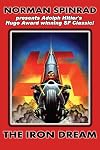
Think Atlas Shrugged but instead of objectivism, the subject is fascism. Also, the story is not written by Ayn Rand but rather, by Adolf Hitler. What?!? Read on for a few mild spoilers...
In this alternate-history tale, Hitler served in WWI and then briefly joined the National Socialist Party before quitting in disgust at their ineffectiveness. He then decides to emigrate to the United States where he becomes a celebrated science-fiction author. His most successful book being 'Lord of the show more Swastika', which won him a posthumous Hugo.
This is a great premise for a story so imagine my disappointment as I found myself reading another lengthy and heartfelt rant in the same vein as Atlas Shrugged; repetitious, bombastic, fetishistic, racist, and nearly unbearably tedious. From around the halfway point I skimmed to the end. I'm sure I missed nothing of importance because the outcome was never in question and none of the details really matter much to the fervent ideals splashed across each and every page.
By contrast, the afterword brilliantly deconstructs Hitler's strengths and failings as an author. Unflinchingly exposing and expanding on every single issue I had with the preceding meta-tale. Spinrad essentially rips the book - and its author - to shreds. Yet he does it in the most backhanded complimentary fashion imaginable. Spinrad has accomplished an interesting thing here; He writes as Hitler, expanding on many known aspects of his personality but translated from a powerful and influential national leader that united most of the world against him, to a frustrated author expounding those same ideas via his fictional writings. I have much admiration for how well Spinrad constructed and executed the idea of this novel. It's unfortunate that "Hitler's" fascist ramblings don't make for very compelling fiction. show less
In this alternate-history tale, Hitler served in WWI and then briefly joined the National Socialist Party before quitting in disgust at their ineffectiveness. He then decides to emigrate to the United States where he becomes a celebrated science-fiction author. His most successful book being 'Lord of the show more Swastika', which won him a posthumous Hugo.
This is a great premise for a story so imagine my disappointment as I found myself reading another lengthy and heartfelt rant in the same vein as Atlas Shrugged; repetitious, bombastic, fetishistic, racist, and nearly unbearably tedious. From around the halfway point I skimmed to the end. I'm sure I missed nothing of importance because the outcome was never in question and none of the details really matter much to the fervent ideals splashed across each and every page.
By contrast, the afterword brilliantly deconstructs Hitler's strengths and failings as an author. Unflinchingly exposing and expanding on every single issue I had with the preceding meta-tale. Spinrad essentially rips the book - and its author - to shreds. Yet he does it in the most backhanded complimentary fashion imaginable. Spinrad has accomplished an interesting thing here; He writes as Hitler, expanding on many known aspects of his personality but translated from a powerful and influential national leader that united most of the world against him, to a frustrated author expounding those same ideas via his fictional writings. I have much admiration for how well Spinrad constructed and executed the idea of this novel. It's unfortunate that "Hitler's" fascist ramblings don't make for very compelling fiction. show less

Bug Jack Barron is a trip to an alternate, drug-soaked 1994, courtesy of a cynical 1969.
Merely calling Barron a media celebrity is inadequate: the host of the influential 'Bug Jack Barron' show (where 'bug' is read as a verb), Barron has gained enough respect and power to topple minor power-brokers and VIPs with his cynical wit and sharp tongue. Considered by the masses as their everyday hero and spokesperson, Barron encourages viewers with gripes to 'bug' him, after which he doggedly 'bugs' show more their antagonist on his or her behalf, exposing lies and conspiracies.
However, Barron is not a hero that evokes sympathy in the reader. Though we learn that he was an activist in his youth - a natural and charismatic leader, he was seen as a presidential candidate, someone to take ideals all the way to the highest office. Instead, the Jack Barron as hero of this story is cynical, womanising, egotistical and self serving, balanced on maximising his wealth and popularity whilst appearing to be the champion of his viewing public.
The antagonist, Benedict Howards, is of a similar type. Incredibly wealthy, he heads up the Foundation, a cryogenic group that, for a fee, will freeze a person until the group's ultimate goal of human immortality is realised. Of course, Howards's personal goal is to secure immortality for himself using the funds of others, by whatever means necessary.
Their conspiratorial and increasingly jaded battle is fought against a backdrop of intense racial tension and political dysfunction.
The themes of racial balkanisation in the USA (remember: this is viewed from the dying days of the 60s), corporate greed and media control are all prevalent, and do make quite an interesting read. The book was hailed as a classic of the genre, controversial adult oriented science fiction.
Time hasn't been kind to Bug Jack Barron: it's not an easy book to read, or even like anymore, for a number of reasons:
Derogatory terms for African-Americans - indeed, almost all races present in a modern western society are labeled with derogatory words at some point through the novel by one character or another. I understand the point-of-view that Spinrad was maintaining by doing this: in his novel, whole states have become single race, and his fictional American society is one of increasing racial tension - but the heavy-handedness makes it clumsy - the words lose their impact so that they become a hindrance to the reading of the novel. What would certainly have been shocking in 1969 simply sickeningly detracts from the power of the ideas in 2008.
The female characters are very poorly drawn - Sara, the main female character, seems to simply be the external embodiment of Barron's misplaced conscience (and his former lover). Other female characters just want to jump into bed with him.
The danger of crystal-ball science fiction is that, sooner or later, the future catches up to you: even in 1994 (well before the internet splintered the singular power of a talkback host) there was no single television host that could topple powers-that-be with little more than sarcasm and a probing mind. Jack Barron never came to be.
The dialogue is awful. Other writers from the late sixties (Philip K. Dick and Robert Sheckly, for example) managed to leave out all the cool, hip, happening (dig-it, man?) ultra long sentences that any cat in the 60s would have been speaking while on a drug-hazed high? What? There are so many 60s phrases and terms loaded into the dialogue that at times it's impossible to understand what the characters are talking about. And the narrative sometimes verges on stream-of-consciousness. Its typical late 60s prose and it is hard to read for those of us schooled on shorter and more direct sentence structure.
It sounds as though I hate this book - not at all, its still hard-hitting and enjoyable. In parts.
But time will continue to diminish its relevance, and I think its enjoyable parts will be fewer and fewer in years to come.
A book of a specific place and time: an acerbic caricature of late 60s USA.
--Costa show less
Merely calling Barron a media celebrity is inadequate: the host of the influential 'Bug Jack Barron' show (where 'bug' is read as a verb), Barron has gained enough respect and power to topple minor power-brokers and VIPs with his cynical wit and sharp tongue. Considered by the masses as their everyday hero and spokesperson, Barron encourages viewers with gripes to 'bug' him, after which he doggedly 'bugs' show more their antagonist on his or her behalf, exposing lies and conspiracies.
However, Barron is not a hero that evokes sympathy in the reader. Though we learn that he was an activist in his youth - a natural and charismatic leader, he was seen as a presidential candidate, someone to take ideals all the way to the highest office. Instead, the Jack Barron as hero of this story is cynical, womanising, egotistical and self serving, balanced on maximising his wealth and popularity whilst appearing to be the champion of his viewing public.
The antagonist, Benedict Howards, is of a similar type. Incredibly wealthy, he heads up the Foundation, a cryogenic group that, for a fee, will freeze a person until the group's ultimate goal of human immortality is realised. Of course, Howards's personal goal is to secure immortality for himself using the funds of others, by whatever means necessary.
Their conspiratorial and increasingly jaded battle is fought against a backdrop of intense racial tension and political dysfunction.
The themes of racial balkanisation in the USA (remember: this is viewed from the dying days of the 60s), corporate greed and media control are all prevalent, and do make quite an interesting read. The book was hailed as a classic of the genre, controversial adult oriented science fiction.
Time hasn't been kind to Bug Jack Barron: it's not an easy book to read, or even like anymore, for a number of reasons:
Derogatory terms for African-Americans - indeed, almost all races present in a modern western society are labeled with derogatory words at some point through the novel by one character or another. I understand the point-of-view that Spinrad was maintaining by doing this: in his novel, whole states have become single race, and his fictional American society is one of increasing racial tension - but the heavy-handedness makes it clumsy - the words lose their impact so that they become a hindrance to the reading of the novel. What would certainly have been shocking in 1969 simply sickeningly detracts from the power of the ideas in 2008.
The female characters are very poorly drawn - Sara, the main female character, seems to simply be the external embodiment of Barron's misplaced conscience (and his former lover). Other female characters just want to jump into bed with him.
The danger of crystal-ball science fiction is that, sooner or later, the future catches up to you: even in 1994 (well before the internet splintered the singular power of a talkback host) there was no single television host that could topple powers-that-be with little more than sarcasm and a probing mind. Jack Barron never came to be.
The dialogue is awful. Other writers from the late sixties (Philip K. Dick and Robert Sheckly, for example) managed to leave out all the cool, hip, happening (dig-it, man?) ultra long sentences that any cat in the 60s would have been speaking while on a drug-hazed high? What? There are so many 60s phrases and terms loaded into the dialogue that at times it's impossible to understand what the characters are talking about. And the narrative sometimes verges on stream-of-consciousness. Its typical late 60s prose and it is hard to read for those of us schooled on shorter and more direct sentence structure.
It sounds as though I hate this book - not at all, its still hard-hitting and enjoyable. In parts.
But time will continue to diminish its relevance, and I think its enjoyable parts will be fewer and fewer in years to come.
A book of a specific place and time: an acerbic caricature of late 60s USA.
--Costa show less

Lord of the Swastika - Like a thick layer of stinking hot asphalt poured out on a driveway, a thick layer of racism and jingoism coats every single page of this appalling novel spun from the cramped, warped mind of an upstart writer of science fiction, a scribbler by the name of Adolf Hitler. What the hell was this clown thinking?!! To write such garbage is an act of complete irresponsibility and an insult to the reading public. We can only raise our eyes to heaven and give thanks Adolf show more Hitler’s vision never became reality.
I trust it is abundantly clear the above paragraph is what an outraged reviewer might have written in the alternative world author Norman Spinrad created in his 1972 novel within a novel. And what a novel! The Iron Dream was banned in Germany for eight years, from 1982 to 1990, prompting Spinrad to report how both the political left and right railed against his book – the left claiming it promotes fascism and the right asserting the novel was denigrating to a great man (Adolf Hitler). Now there’s an author who can’t win!
Turning to Spinrad's The Iron Dream itself, on the surface we are given a kitschy bit of pulp, post-apocalypse melodrama entitled Lord of the Swastika written as alternative history by one Adolf Hitler, an illustrator and hack science fiction writer who emigrated from Germany to the United States after World War 1.
Lord of the Swastika opens more than a thousand years following global nuclear war, a cataclysm which brought about the end of civilization as we know it. The gene pool of nearly all forms of human life are corrupted by radioactive fallout - humans possessing complete physical and mental health are rare; most of humanity have blue skin, lizard scales or parrot beaks, or, even more insidious, are wizened half-breed mutants or subhuman "Dominators" desiring to hold sway over the earth by their powerful mind-controlling psychic powers.
What this sorry world needs is a charismatic leader who will ruthlessly eliminate all those malignant subhumans and rid the planet forever of their odious, subversive stench. Enter Ferric Jagger. The tall, blonde, robust Jaggar takes on the role of Führer and Heldon, the land of genetically pure humans, begins to bear a striking resemblance to Nazi Germany.
Why write such a novel? Norman Spinrad tells us he wanted to demonstrate the close connection ideology of the fascist Nazi variety has with archetypal hero myths and much science fiction and fantasy - created worlds where good guys courageously combat evildoing bad guys, where the shining light of truth and justice eventually overcomes all the loathsome forces of darkness no matter where they are found - Middle Earth, Mars, or the middle of one's very own country.
And to make absolutely, positively sure even the least sophisticated, unlettered clod of a reader understood his intent, Norman informs us: “I appended a phony critical analysis of Lord of the Swastika, in which the psychopathology of Hitler's saga was spelled out by a tendentious pedant in words of one syllable.” Unfortunately, even with this laborious literary effort to reach the lowest possible readerly denominator, a number of those muddleheaded clods didn’t get it – one reviewer even took the book as an exciting action story and complained how Spinrad spoiled all the fun by adding a whole bunch of crap about Adolf Hitler.
Alas, this has always been the risk for an author of satire - even a number of jaws dropped in stunned disbelief back in the 1700s after reading Jonathan Swift’s A Modest Proposal. Sad fact: masterfully constructed satire requires a degree of subtle understanding beyond the capacity of many readers. And I can assure you The Iron Dream is one such satire masterfully constructed. And much of the pleasure in reading Spinrad’s novel is to suspend critical judgement and wholeheartedly support Ferric Jagger in his quest to conquer the world.
The Iron Dream is an intensely aesthetic dream, where every pore of Helder purebred skin tingles with excitement beholding the immense power, speed, dash and style of their new society, a land where every true human vows fanatical allegiance to Ferric Jagger. Here’s an example of the glowing rhetoric enlivening nearly every page: “Behind this elite guard were first the ranks of Knight motocyclists, and then the massed might of thousands of Knights of the Swastika, all heroic figures swaggering grandly in their uniforms of brown leather, most of which were liberally spattered with the blood of the enemy.”
But, but, but . . . similar to other more famous tales of adventure and conquest from Iliad and Odyssey to Lord of the Rings and Star Wars, at some point we are obliged to close the book and return to the everyday. How much do we really want our own world to resemble that of a conquering superhero forever in the right, taking aim to blast away the forces of darkness? Is life so simple? In my modest view, The Iron Dream is a key novel for our time. Highly recommended.
"The base of the tower was a circular grandstand of steps fifty feet high upon which stood a thousand SS purebreds, the absolute cream of the elite: none under six and a half feet tall, all with flaxen hair and piercing blue eyes, and decked out in spotless tight black leather uniforms, the chrome fittings of which had been polished to the point where the setting sun flashed orange fire off thousands of diamondlike facets. Each of these superhuman specimens held a flaming torch, the crimson brilliance of which matched the hue of their flowing swastika capes." - Norman Spinrad, The Iron Dream
Norman Spinrad, Born 1940, American critic, essayist and author of more than two dozen science fiction novels. show less
Lists
Awards


You May Also Like


Associated Authors
Statistics
- Works
- 110
- Also by
- 126
- Members
- 6,775
- Popularity
- #3,609
- Rating
- 3.6
- Reviews
- 117
- ISBNs
- 288
- Languages
- 12
- Favorited
- 18