
A. E. van Vogt (1912–2000)
Author of Slan
About the Author
born Alfred Elton Van Vogt
A Variant Title of the work The Rogue Ship is The Twisted Men. The Twisted Men is also the title of a Collection containing the above.
Many works by van Vogt were published with Variant Titles:
Abdication=The Invisibility Gambit
The Pawns of Null-A=The Players of Null-A
The Voyage of the Space Beagle=Mission: Interplanetary
The Weapon Makers=One Against Eternity
The Book of Ptath=200 Million A. D.
The House That Stood Still=The Mating Cry=The Undercover Aliens
The Mixed Men=Mission to the Stars
The Beast=The Moonbeast
Future Glitter= Tyranopolis
The Secret Galactics=Earth Factor X
Computerworld=Computer Eye=La Machine Ultime
Out of the Unknown=The Sea Thing and Other Stories
Monsters=Science Fiction Monsters=The Blal
The Book of van Vogt=Lost: Fifty Suns
Many short fiction and omnibus works were also published with Variant Titles. Please see listing in the Internet Speculative Fiction Database for more details.
Series
Works by A. E. van Vogt
Associated Works
Tagged
Common Knowledge
- Canonical name
- van Vogt, A. E.
- Legal name
- van Vogt, Alfred Elton
- Other names
- Vogt, Alfred (birth)
- Birthdate
- 1912-04-26
- Date of death
- 2000-01-26
- Gender
- male
- Education
- University of Ottawa (BA|1928)
- Organizations
- Science Fiction and Fantasy Writers of America
Canadian Department of National Defence - Awards and honors
- SFWA Grand Master (1995)
Prix Aurora Award (Lifetime Achievement, 1980)
SF Hall Of Fame (Living Inductee, 1996) - Relationships
- Hull, E. Mayne (wife)
Van Vogt, Lydia (wife) - Short biography
- Alfred Elton van Vogt was a Canadian born American science fiction writer of the mid 20th century. He's most famous for his Voyage of the Space Beagle, Null-A and Slan novels, as well as a number of short stories.
- Cause of death
- Alzheimer's disease
- Nationality
- Canada (birth)
USA (naturalized 1945) - Birthplace
- Gretna, Manitoba, Canada
- Places of residence
- Los Angeles, California, USA
Winnipeg, Manitoba, Canada (birth) - Place of death
- Los Angeles, California, USA
- Disambiguation notice
- born Alfred Elton Van Vogt
A Variant Title of the work The Rogue Ship is The Twisted Men. The Twisted Men is also the title of a Collection containing the above.
Many works by van Vogt were published with Variant Titles:
Abdication=The Invisibility Gambit
The Pawns of Null-A=The Players of Null-A
The Voyage of the Space Beagle=Mission: Interplanetary
The Weapon Makers=One Against Eternity
The Book of Ptath=200 Million A. D.
The House That Stood Still=The Mating Cry=The Undercover Aliens
The Mixed Men=Mission to the Stars
The Beast=The Moonbeast
Future Glitter= Tyranopolis
The Secret Galactics=Earth Factor X
Computerworld=Computer Eye=La Machine Ultime
Out of the Unknown=The Sea Thing and Other Stories
Monsters=Science Fiction Monsters=The Blal
The Book of van Vogt=Lost: Fifty Suns
Many short fiction and omnibus works were also published with Variant Titles. Please see listing in the Internet Speculative Fiction Database for more details. - Associated Place (for map)
- Manitoba, Canada
Members
Discussions
Reviews
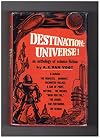
The ten stories in Destination: Universe! provide a good sample of van Vogt’s magazine writing in the 1940s, which could be used to support both sides of the debate. Knight cites “A Can of Paint” for its ignorance of orbital mechanics. But in “A Pen Pal,” in which an alien with plans to conquer Earth transfers his consciousness into someone who will not live long enough for it to succeed, the coincidences in the plot might support PKD’s view.
“Far Centaurus,” the first story in Destination, has more drama than its plot plausibly can hold. A slower-than-light spacecraft with its crew in cryogenic stasis suffers a mechanical failure that kills one of the crew. Another may have gone homicidally insane. When they get to Centaurus, they find it already inhabited by people who arrived via FTL, which was invented while they were underway. They are told they won’t be happy colonists because nobody on Centaurus will be able to stand their old-school body odor. Sadly, van Vogt does not treat this event for humor. Then, by a lucky piece of timing, a wormhole opens that will take them back to Earth before they left. Whew. All problems solved. Bad writing or the weirdness of reality? You decide, but I am with Damon on this one. show less


The world of Null-a was serialised in 1945 in the Astounding Science Fiction magazine and its original idea and inventive storyline certainly turned heads at the time. It is set in the year 2560 when a benevolent machine effectively governs earth and each year a competition is held to establish people most suited to be transported to Venus where a democratic society live in a glorious world of logical thought and action described as non- Aristotelian. Gosseyn a highly intelligent man takes part in the competition expecting to do well only to discover that the machine rejects his entry out of hand because he is not who he claims to be. The problem is that he has an additional brain and he spends the rest of the novel trying to ascertain who he really is and how he got the extra brain. There is a plot to destroy the machine hatched by a gang controlled by alien minds and they capture Gosseyn, thinking he is an important player, they then let him go, recapture him again, kill him, but he is reincarnated in another body on Venus and so it goes on..........
Damon Knight criticised the novel under four main headings; Plot, Characterisations, Background and Prose. He claimed the plot was "muddled and self-contradictory" and this is self evident from any reading of it today. Van Vogt attempted to close some of the loop holes for the 1970 edition, but only succeeded in interrupting any original flow the novel might have had. Knight said that the characters were "inconsistent"; I would say that they were interchangeable and of the most absurdly cardboard variety. It was never clear who or why characters were taking action, which at times was reduced to people coming into a room and either capturing Gosseyn, or trying to kill him or giving him clues as to how to proceed. I suppose Van Vogt might claim he was trying to represent the confused state of Gosseyn's mind, but you can't do this if there is no mind to confuse. Knight said that the background to the story was "haphazardly and perfunctorily developed" and while there is no attempt at detailed world building, I think there is enough here to make the novel work, but this is the problem. Once the story gets started then the background is filled in as the plot dictates and there are some glorious inconsistences: as it is a stretch of the imagination to believe that characters in 2560 with video technology would rely on written notes and telephone calls as preferred methods of communication. Knight said that the prose was "fumbling and insensitive". I think insensitive goes with the territory in 1945 science fiction and there are times when the prose is reduced to 'he did that and then he did this' kind of simplicity. There are however some good passages, the book starts off with an imaginative scenario and a real sense of mystery. there are some good atmospheric descriptions of the terraformed Venus and the destruction of the machine has it's moments, but they are too few and far between some acres of pedestrian writing.
The world of Null-a no longer appears amongst the acknowledged classics of science fiction. Although it has not aged particularly well, this was not the whole problem, I felt it was a botched attempt to put an original idea and storyline into practice. The book needed characters, it needed more coherence and above all it needed better writing. The 1970 edition is a case where the authors introduction is more entertaining than the novel. An inglorious two stars. show less
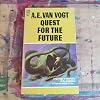
The protagonist, the person we are supposed to be rooting for, is mildly racist, definitely a misogynist, and a self-proclaimed paranoid with psychotic tendencies. And, particularly for that last trait, we are supposed to side with him in his convoluted travel through time to achieve, I guess, immortality. And to be, in a show more way, a savior of time and multiple universes.
When they are handing out mortality, I hope he misses the announcement.
[Warning: spoilers follow. But to be honest, they aren’t that big a deal. You’re worried? Read the book first. (Although, as you will see, I’m not sure I’d recommend you do that.)]
I instantly questioned the mindset of the author in the second paragraph when the author (not in the voice of the protagonist) says “…he watched the other with the curious, speculative intentness of the Latin.” Wow! Okay. Casual racism of the 40s. Let’s try to move on.
Our protagonist is introduced as a womanizing conniver who is not above using anyone to further his professorial ambitions. We do not like him. He fails, but it is not his fault; it is always everyone else’s fault. And he then becomes enmeshed between two factions of time travelers.
But that only scratches the misogyny surface. Throughout the novel there are constant references to his need for women – where he will find them and how he can get any woman he wants. As an example of his mindset, one of his biggest concerns in the future is that his foul order drives women away. If I may repeat myself, a misogynist and a conniving paranoid. (As is constantly pointed out throughout the book. Hang onto that thought.)
Bouncing back and forth in time, he is thrown into the past (17th Century Western America) with a scientist and his daughter. He assumes he will be the hunter and provider, and that the woman will take care of the house. He is taken aback when she starts hunting, supplying, and cooking. Yeah, once a misogynist, always a misogynist.
The happy ending of the book (remember, I warned of spoilers) is when he gets together with the woman, not because he has seen the error of his ways but, apparently, because she has seen the error of her own ways. She has become the demure mate he expected all along.
And, about that happy ending. We find out that all the time travel paraphernalia (and it gets a bit confusing; I won't go into it all here) has come about because of him. Yes, he is the hero of the story. And that future was only able to come about because of his paranoia and psychosis. (Told you that was going to come back to haunt us.)
Now there’s a happy ending for you.
I mentioned that the details get a little confusing. Part of this may be because the novel is cobbled together from three of the author’s stories. And the plot is just as convoluted. Again, probably the same cause. The protagonist gets thrown between times at the author’s whim. Deus ex machina seems to be working overtime here.
Yes, there are a lot of interesting ideas thrown into the story. But they die behind the personalities of the people involved and convolutions in the story that seem more related to the author being paid per word than actually moving the plot along.
Look, A. E Van Vogt is an icon of the “golden age” of science fiction. He has written some classics. And I have enjoyed some of his work. But this is not one of them. The casual racism, the misogyny, and a protagonist for which I found myself rooting against wreak havoc on this book.
Turn away. Find others of Van Vogt’s works. And within them find the enjoyment I expected in this novel. show less
Lists
Awards


You May Also Like


Associated Authors
Statistics
- Works
- 334
- Also by
- 162
- Members
- 22,368
- Popularity
- #950
- Rating
- 3.5
- Reviews
- 312
- ISBNs
- 578
- Languages
- 15
- Favorited
- 53


