

E. E. Smith (1890–1965)
Author of Triplanetary
About the Author
Series
Works by E. E. Smith
The Skylark of Space / Skylark Three / Skylark of Valeron / Skylark DuQuesne (2003) 105 copies, 1 review
The Second E. E. 'Doc' Smith Omnibus: The Galaxy Primes; The Robot Nemesis & Other Stories; Spacehounds of I.P.C. (2009) 7 copies, 1 review
Il secondo impero: Lensmen 3 6 copies
Herois Galáticos 3 copies
Imperial Stars, Stranglers' Moons, The Clockwork Traitor, Getaway World (The Family D'Alembert Series, Volumes 1 - 4) (1976) 3 copies
Det tomme rums gåde 2 copies
Søn af stjernerne 2 copies
The Collected Science Fiction of E. E. Smith: Classic Science Fiction Masterworks (Illustrated) 2 copies
El espía interplanetario 1 copy
Children Of The Lens 4 1 copy
Children Of The Lens 3 1 copy
To the Far Reaches of Space 1 copy
Children of the Vortex 1 copy
A Lei do Espaço Livro 1 1 copy
Os Filhos do Cosmos Livro 1 1 copy
Associated Works
The Prentice Hall Anthology of Science Fiction and Fantasy (2000) — Contributor — 100 copies, 2 reviews
Tagged
Common Knowledge
- Canonical name
- Smith, E. E.
- Legal name
- Smith, Edward Elmer
- Other names
- Smith, Edward E.
- Birthdate
- 1890-05-02
- Date of death
- 1965-08-31
- Gender
- male
- Education
- University of Idaho (BS|1914)
George Washington University (MS|1917) - Occupations
- science fiction writer
food engineer
chemist - Organizations
- National Fantasy Fan Federation [N3F] (cofounder)
National Bureau of Standards
F. W. Stock & Sons
Dawn Donut Co.
Kingsbury Ordnance Plant
Allis-Chalmers (show all 7)
J. W. Allen & Co. - Awards and honors
- First Fandom Hall of Fame award (1963)
Science Fiction and Fantasy Hall of Fame (2004) - Short biography
- Sometimes called the father of space opera
- Nationality
- USA
- Birthplace
- Sheboygan, Wisconsin, USA
- Places of residence
- Spokane, Washington, USA
Seneaquoteen, Idaho, USA
Washington, D.C., USA
Clearwater, Florida, USA
Seaside, Oregon, USA - Place of death
- Seaside, Oregon, USA
- Burial location
- River View Cemetery, Portland, Oregon, USA
- Associated Place (for map)
- USA
Members
Discussions
Two Guns, Will Travel in Good Show Sir! — bad science fiction and fantasy covers (March 2025)
Perspective Problematic! in Good Show Sir! — bad science fiction and fantasy covers (December 2024)
Unsure of Intended Protagonist in Good Show Sir! — bad science fiction and fantasy covers (December 2024)
***Group Read: The Lensman Series (Spoiler-free) in 75 Books Challenge for 2010 (June 2010)
Reviews

There is a Brian Aldiss story, ‘Confluence’ - I’ve referenced it a number of times in reviews - which consists of amusing dictionary definitions of words from an alien language. Such as “SHAK ALE MAN: the struggle that takes place in the night between the urge to urinate and the urge to continue sleeping”. And, “YUP PA: a book in which everything is understandable except the author’s purpose in writing it”. Sadly there’s no word that means “a book in which everything is show more understandable except a person’s reason for reading it”. Which is certainly true when it comes to the works of EE 'Doc' Smith, and most especially Subspace Explorers, published in 1965. It was a reread for me, but I last read it when I was twelve or thirteen, and I remembered pretty much nothing of it. Sadly, I cannot go back to that state of blissful ignorance.
Several centuries from now - exactly when is impossible to tell as the world-building is extremely poor - the Earth is split into a WestHem and EastHem: the first is a corrupt democracy controlled by corrupt unions, and the second is a tyranny masquerading as communism. In fact, the entire political set-up of the novel is cobbled together from US knee-jerk right-wing myths: communism evil! unions bad! politicians corrupt! big government bad! monopolistic corporations good! There are also colonies on a number of other worlds, all of which were settled, and are run, by corporations. Spaceships travel through subspace to journey between these worlds and “Tellus” (the Latin name for Earth, which Smith, bizarrely, used in all his fiction).
A spaceship, the Procyon, suffers some sort of catastrophe in subspace. There are only five survivors - the first officer, the astrogator, the daughter of the owner of the biggest oil company in existence and wed to the first officer only hours earlier, her friend who is also the girlfriend of the astrogator, and a scientist who later turns out to be the giantest brain in all of human history. The oil magnate’s daughter is an oil dowser, and the subspace wreck has given her super mind powers, which she then teaches to the other four…
Meanwhile, the nasty old unions in WestHem are trying to break the corporations, who want to automate everything in order to keep down inflation (er, what?). The copper miners threaten to strike, because copper is apparently vital in the future. But the psionic five can dowse for metal, and they find a huge copper deposit on another planet for GalMet, the mining monopoly, also based offworld. The copper miners’ strike fails, so the milk truck drivers go on strike, because centuries in the future milk is once again delivered to people’s homes in bottles and this is so vital to life on Earth that a strike could cause society to collapse… The corporations break the strike using giant-sized battle tanks to deliver the milk (yes, really).
Anyway, the corporations defeat the nasty unions, inadvertently triggering a nuclear war, but never mind, the corporations’ “superdreanought” spaceships manage to destroy the missiles before they cause any important damage. The corporations trigger a WestHem election, but lose it to a coalition of all the political parties - which are all corrupt and evil, of course. But never mind. “Enlightened self-interest”, AKA unregulated corporate operations, will win out eventually. Then the corporations' blockade of Earth Tellus is broken by a mysterious fleet of superdreadnoughts from an unknown planet.
Then it turns out one corporation, previously unmentioned in the novel, has for more than 200 years been running a secret world with a strictly-regimented "feudal" society (it's not feudal, of course, because Smith clearly doesn't know what feudalism is). That’s where the mysterious fleet came from. (The Company Agents are all electrically-charged, and they wear rubber-soled boots, so if anyone touches them - which is just, no, just too fucking stupid for words.) Our hardy heroes, the five from the shipwreck mentioned earlier, with the amazing mind powers, who by now have taught pretty much everyone on the corporation-run planets their amazing mind powers, free the Company serfs on The Company World. But the Company serfs had been infiltrated by agents from a secret world settled by the USSR! And with only five pages to go our hardy heroes defeat them too!
I went into Subspace Explorers with low expectations. It not only failed to meet them, it dug a bottomless pit and then dived into it. Reading the infantile take on politics and economics used by Smith, his hatred of unions and valorisation of unregulated corporations, the implication inflation is more dangerous to a nation than nuclear war, I can only wonder how many of the techbros responsible for the shit state of the world today were influenced by it. We may mock sf and its “Torment Nexus”, but right-leaning politics as understood by a five-year-old such as that described in Smith’s novel, has probably caused more damage. Subspace Explorers is not just bad, it can cause brain damage. Techbros may well name-drop the Culture, but it wouldn’t surprise me to learn Musk, Altman, Andressen, Thiel et al have read and assimilated this novel.
If you ever meet anyone who claims to like Subspace Explorers, back away slowly from them. Then turn around.
And run. show less
Several centuries from now - exactly when is impossible to tell as the world-building is extremely poor - the Earth is split into a WestHem and EastHem: the first is a corrupt democracy controlled by corrupt unions, and the second is a tyranny masquerading as communism. In fact, the entire political set-up of the novel is cobbled together from US knee-jerk right-wing myths: communism evil! unions bad! politicians corrupt! big government bad! monopolistic corporations good! There are also colonies on a number of other worlds, all of which were settled, and are run, by corporations. Spaceships travel through subspace to journey between these worlds and “Tellus” (the Latin name for Earth, which Smith, bizarrely, used in all his fiction).
A spaceship, the Procyon, suffers some sort of catastrophe in subspace. There are only five survivors - the first officer, the astrogator, the daughter of the owner of the biggest oil company in existence and wed to the first officer only hours earlier, her friend who is also the girlfriend of the astrogator, and a scientist who later turns out to be the giantest brain in all of human history. The oil magnate’s daughter is an oil dowser, and the subspace wreck has given her super mind powers, which she then teaches to the other four…
Meanwhile, the nasty old unions in WestHem are trying to break the corporations, who want to automate everything in order to keep down inflation (er, what?). The copper miners threaten to strike, because copper is apparently vital in the future. But the psionic five can dowse for metal, and they find a huge copper deposit on another planet for GalMet, the mining monopoly, also based offworld. The copper miners’ strike fails, so the milk truck drivers go on strike, because centuries in the future milk is once again delivered to people’s homes in bottles and this is so vital to life on Earth that a strike could cause society to collapse… The corporations break the strike using giant-sized battle tanks to deliver the milk (yes, really).
Anyway, the corporations defeat the nasty unions, inadvertently triggering a nuclear war, but never mind, the corporations’ “superdreanought” spaceships manage to destroy the missiles before they cause any important damage. The corporations trigger a WestHem election, but lose it to a coalition of all the political parties - which are all corrupt and evil, of course. But never mind. “Enlightened self-interest”, AKA unregulated corporate operations, will win out eventually. Then the corporations' blockade of Earth Tellus is broken by a mysterious fleet of superdreadnoughts from an unknown planet.
Then it turns out one corporation, previously unmentioned in the novel, has for more than 200 years been running a secret world with a strictly-regimented "feudal" society (it's not feudal, of course, because Smith clearly doesn't know what feudalism is). That’s where the mysterious fleet came from. (The Company Agents are all electrically-charged, and they wear rubber-soled boots, so if anyone touches them - which is just, no, just too fucking stupid for words.) Our hardy heroes, the five from the shipwreck mentioned earlier, with the amazing mind powers, who by now have taught pretty much everyone on the corporation-run planets their amazing mind powers, free the Company serfs on The Company World. But the Company serfs had been infiltrated by agents from a secret world settled by the USSR! And with only five pages to go our hardy heroes defeat them too!
I went into Subspace Explorers with low expectations. It not only failed to meet them, it dug a bottomless pit and then dived into it. Reading the infantile take on politics and economics used by Smith, his hatred of unions and valorisation of unregulated corporations, the implication inflation is more dangerous to a nation than nuclear war, I can only wonder how many of the techbros responsible for the shit state of the world today were influenced by it. We may mock sf and its “Torment Nexus”, but right-leaning politics as understood by a five-year-old such as that described in Smith’s novel, has probably caused more damage. Subspace Explorers is not just bad, it can cause brain damage. Techbros may well name-drop the Culture, but it wouldn’t surprise me to learn Musk, Altman, Andressen, Thiel et al have read and assimilated this novel.
If you ever meet anyone who claims to like Subspace Explorers, back away slowly from them. Then turn around.
And run. show less

I first discovered E.E. 'Doc' Smith's Lensman books at the age of 14, on holiday in the Cumbrian fells in the early 1970s; in fact, my first copy of Grey Lensman came from the station bookstall on Carlisle Citadel station. I was first drawn in by the Chris Foss cover art, possibly the first UK paperback to show his work (though he had made professional sales already). Over the years, I read and re-read everything of Smith's that was published in the UK, but the Lensman novels remained my show more go-to for sf adventure, even though I quickly realised that they occupied a particular historical niche in the evolution of the genre. And then, as I matured, I turned away from these books as other people I knew and whose opinions I respected pointed out Smith's many flaws.
But with time came a different perspective. I kept reading histories of the genre that put Smith in context; and I read other so-called "Golden Age" sf that stacked up badly against Smith. Well, as Theodore Sturgeon said, "90% of everything is crap". So in the end, I decided that I should attempt a re-read, after something like fifty years. I knew what I was going to find; my question was going to be, "Just how bad is this?"
Then just a few days before I embarked on this task, I read a 1993 issue of the journal of the UK's academic Science Fiction Foundation, Foundation 59. Apart from finding some remarkably apposite comments in reviews of books set in the impossibly distant future year of 2021, I came across the following quote in an article by Czech fan/academic Cyril Simsa on the probably little-remembered US author Henry Slesar, and it put me in an interesting frame of mind for the upcoming re-read:
"A lot of [Slesar's] stories are perfectly respectable examples of the way sf was written in the '50s, and may even have seemed well above average for their day. But so much has changed in the genre in the interim: plot-lines which may once have seemed agreeably adventurous now seem trite and melodramatic, ideas which were part of sf's stock-in-trade are now unbearable clichés, the little philosophical homilies with which so many '50s sf writers liked to finish off their stories (the "moral", if you like) seem dated and prevent the story reaching a proper conclusion. In a world where fascism and civil war have come back to the streets of Europe, where naked manipulation of the political process by the mass media has become the norm, where rival drug gangs regularly shoot at one another with Uzi machine-pistols in the ruins of Los Angeles and computer networks will soon be offering us sex in cyberspace for real, it's difficult to read a story about a mad scientist with a beautiful blond daughter, or a solitary genius who invents a new variety of domestic robot, or indeed any story in which the moral turns out to be (in the words of the '50s B-feature) that "there are things man isn't meant to know", without disguising a smirk behind the palm of one's hand. (Then again, in fairness to Slesar, one has to ask whether the second-generation cyberpunks like Walter Jon Williams will seem any less ridiculous in 2022, and whether we won't perhaps be just as incapable of taking seriously anything with voguish references to "ice", "jacks", designer drugs, artificial intelligence, multinational corporations, computer voodoo, banghramuffin orbital rave platforms, elephants in mirrorshades and so on, in an age no doubt as unimaginably different from where we are now, as the '80s were to the writers of the '50s.)"
So, armed with that thought, I tackled, not Grey Lensman but the book immediately before it in the sequence, Galactic Patrol, on the grounds that it was written first and forms the basis of the whole series. I quickly found the authorial style familiar, because Smith adopted a slightly portentous fake archaic style for the text, which immediately put me in mind of William Hope Hodgson's The Night Land, though nowhere near as extreme as Hodgson. I suspect Smith used that style to try to lend some sort of maturity and gravitas to the text, possibly to make his 14-year-old readership feel that they were in the presence of an adult.
We are pitched into the story of the Galactic Patrol, who provide law and justice throughout the galaxy (does this sound familiar yet?). At the apex of the Patrol are the Lensmen (and they are all men), who wear the Lens, a piece of bio-engineered super-science from the mysterious Arisians that confers various telepathic powers on the wearer. We are then shown the conflict between the Patrol and the pirates of Boskone who are preying on the space shipping lanes. Again, this feels very familiar territory; the theme of an eons-long conflict between two ancient and powerful races, played out through proxies, was the background for Joe Straczynski's 1990s television series Babylon 5, although in the case of that series, the motives of the two races were less clear-cut. In Smith's case, the Arisians are Good and Boskone is Evil.
Smith describes Boskone in terms that immediately made me think of the idea that the modern corporation is a dysfunctional organisation, where the ends justify the means, and progress up the corporate ladder is achieved through back-stabbing, lies, deceit and trampling on those who are not strong enough to stand up against such naked ambition. We now recognise this as typical of Type A personalities and organisations which show a tendency towards the psychopathic; the worrying thing is that having set up the Patrol in general and the Lensmen in particular as the Good Guys, Smith then allows his elite, the Grey Lensmen, full freedom of thought and action. They can determine truth through the use of the Lens, and so can act as judge, jury and executioner because they are all so incorruptible that their word of law is incontrovertible. And they can employ any means to achieve their end - just the trait that Smith originally laid at the feet of Boskone. But there is no room in Smith's universe for ambiguity (it was just this ambiguity and the conflict it gives rise to in the real world that made Babylon 5 such an engaging piece of sf drama).
The dialogue in the novel is excruciating 1930s slang, extrapolated forward. I skimmed as much of the dialogue as I could. Interestingly, the minions of Boskone have dialogue that is far less purple, in line with the depiction of the organisation as cold, ruthless and efficient. I found myself taking to them, though some of the lesser Boskonians sound like 1940s RAF pilots.
Modern commentators brand Smith's work as sexist and racist. Sexist it certainly is: there are no female Lensmen, and the one female character, though feisty, is as stereotypical as a 1940s pin-up poster (and not Rosie the Riveter, either). On the racism, though, things are not quite so clear-cut. True, there do not seem to be any black Lensmen; but Smith introduces a variety of alien races who have unpleasant or strange appearances but who have many good qualities - intelligence, nobility, and honour - and who are put into the classification of "Good Guys". This was perhaps Smith's contribution to the genre; he depicted aliens who were not just nasty monsters who abducted the girl in the brass bikini, to be blasted into oblivion because they were obscene to our eyes, but who were worthy to be called Civilised. Smith wasn't the first to do this - Stanley Weinbaum usually takes that honour with the Martian Tweel in A Martian Odyssey - but within the context of blood-and-thunder space opera, his depiction of the good alien was out of the ordinary. Even the villains of Boskone were given the credit for having intelligence and morals, even if they were the wrong sort of morals.
After all this, if you can cope with the outdated slang, the purple prose and the propensity of the heroes to pull new advances in super-science out of thin air with each new chapter, the story itself holds up reasonably well, only really lapsing when Kimball Kinnison, the Grey Lensman, subverts an entire base of Boskone through mental manipulation, and allows many of their personnel to live - and indeed, receive a pardon for any crimes - because they are all basically Good People Who Have Gone Wrong. Amongst all the action, such an act that is almost out of Gilbert and Sullivan feels out of place. After all, the villains of Boskone are usually gunned or hacked down to a man, without quarter.
In the end, I emerged from the (rather abrupt) end of the novel intact. I read little that makes me want to re-read more, especially as the later Lensman novels keep upping the stakes in the evil-doing of the villains and the goodness and ingenuity of the good guys; whilst the prequels (Triplanetary and First Lensman) did a lot of plot gymnastics to arrive at the universe of Galactic Patrol. I feel myself more likely to go back to Dave Langford's Doc Smith pastiche Sex Pirates of the Blood Asteroid. But at least I have had my re-read, and I can put that particular demon to rest. show less
But with time came a different perspective. I kept reading histories of the genre that put Smith in context; and I read other so-called "Golden Age" sf that stacked up badly against Smith. Well, as Theodore Sturgeon said, "90% of everything is crap". So in the end, I decided that I should attempt a re-read, after something like fifty years. I knew what I was going to find; my question was going to be, "Just how bad is this?"
Then just a few days before I embarked on this task, I read a 1993 issue of the journal of the UK's academic Science Fiction Foundation, Foundation 59. Apart from finding some remarkably apposite comments in reviews of books set in the impossibly distant future year of 2021, I came across the following quote in an article by Czech fan/academic Cyril Simsa on the probably little-remembered US author Henry Slesar, and it put me in an interesting frame of mind for the upcoming re-read:
"A lot of [Slesar's] stories are perfectly respectable examples of the way sf was written in the '50s, and may even have seemed well above average for their day. But so much has changed in the genre in the interim: plot-lines which may once have seemed agreeably adventurous now seem trite and melodramatic, ideas which were part of sf's stock-in-trade are now unbearable clichés, the little philosophical homilies with which so many '50s sf writers liked to finish off their stories (the "moral", if you like) seem dated and prevent the story reaching a proper conclusion. In a world where fascism and civil war have come back to the streets of Europe, where naked manipulation of the political process by the mass media has become the norm, where rival drug gangs regularly shoot at one another with Uzi machine-pistols in the ruins of Los Angeles and computer networks will soon be offering us sex in cyberspace for real, it's difficult to read a story about a mad scientist with a beautiful blond daughter, or a solitary genius who invents a new variety of domestic robot, or indeed any story in which the moral turns out to be (in the words of the '50s B-feature) that "there are things man isn't meant to know", without disguising a smirk behind the palm of one's hand. (Then again, in fairness to Slesar, one has to ask whether the second-generation cyberpunks like Walter Jon Williams will seem any less ridiculous in 2022, and whether we won't perhaps be just as incapable of taking seriously anything with voguish references to "ice", "jacks", designer drugs, artificial intelligence, multinational corporations, computer voodoo, banghramuffin orbital rave platforms, elephants in mirrorshades and so on, in an age no doubt as unimaginably different from where we are now, as the '80s were to the writers of the '50s.)"
So, armed with that thought, I tackled, not Grey Lensman but the book immediately before it in the sequence, Galactic Patrol, on the grounds that it was written first and forms the basis of the whole series. I quickly found the authorial style familiar, because Smith adopted a slightly portentous fake archaic style for the text, which immediately put me in mind of William Hope Hodgson's The Night Land, though nowhere near as extreme as Hodgson. I suspect Smith used that style to try to lend some sort of maturity and gravitas to the text, possibly to make his 14-year-old readership feel that they were in the presence of an adult.
We are pitched into the story of the Galactic Patrol, who provide law and justice throughout the galaxy (does this sound familiar yet?). At the apex of the Patrol are the Lensmen (and they are all men), who wear the Lens, a piece of bio-engineered super-science from the mysterious Arisians that confers various telepathic powers on the wearer. We are then shown the conflict between the Patrol and the pirates of Boskone who are preying on the space shipping lanes. Again, this feels very familiar territory; the theme of an eons-long conflict between two ancient and powerful races, played out through proxies, was the background for Joe Straczynski's 1990s television series Babylon 5, although in the case of that series, the motives of the two races were less clear-cut. In Smith's case, the Arisians are Good and Boskone is Evil.
Smith describes Boskone in terms that immediately made me think of the idea that the modern corporation is a dysfunctional organisation, where the ends justify the means, and progress up the corporate ladder is achieved through back-stabbing, lies, deceit and trampling on those who are not strong enough to stand up against such naked ambition. We now recognise this as typical of Type A personalities and organisations which show a tendency towards the psychopathic; the worrying thing is that having set up the Patrol in general and the Lensmen in particular as the Good Guys, Smith then allows his elite, the Grey Lensmen, full freedom of thought and action. They can determine truth through the use of the Lens, and so can act as judge, jury and executioner because they are all so incorruptible that their word of law is incontrovertible. And they can employ any means to achieve their end - just the trait that Smith originally laid at the feet of Boskone. But there is no room in Smith's universe for ambiguity (it was just this ambiguity and the conflict it gives rise to in the real world that made Babylon 5 such an engaging piece of sf drama).
The dialogue in the novel is excruciating 1930s slang, extrapolated forward. I skimmed as much of the dialogue as I could. Interestingly, the minions of Boskone have dialogue that is far less purple, in line with the depiction of the organisation as cold, ruthless and efficient. I found myself taking to them, though some of the lesser Boskonians sound like 1940s RAF pilots.
Modern commentators brand Smith's work as sexist and racist. Sexist it certainly is: there are no female Lensmen, and the one female character, though feisty, is as stereotypical as a 1940s pin-up poster (and not Rosie the Riveter, either). On the racism, though, things are not quite so clear-cut. True, there do not seem to be any black Lensmen; but Smith introduces a variety of alien races who have unpleasant or strange appearances but who have many good qualities - intelligence, nobility, and honour - and who are put into the classification of "Good Guys". This was perhaps Smith's contribution to the genre; he depicted aliens who were not just nasty monsters who abducted the girl in the brass bikini, to be blasted into oblivion because they were obscene to our eyes, but who were worthy to be called Civilised. Smith wasn't the first to do this - Stanley Weinbaum usually takes that honour with the Martian Tweel in A Martian Odyssey - but within the context of blood-and-thunder space opera, his depiction of the good alien was out of the ordinary. Even the villains of Boskone were given the credit for having intelligence and morals, even if they were the wrong sort of morals.
After all this, if you can cope with the outdated slang, the purple prose and the propensity of the heroes to pull new advances in super-science out of thin air with each new chapter, the story itself holds up reasonably well, only really lapsing when Kimball Kinnison, the Grey Lensman, subverts an entire base of Boskone through mental manipulation, and allows many of their personnel to live - and indeed, receive a pardon for any crimes - because they are all basically Good People Who Have Gone Wrong. Amongst all the action, such an act that is almost out of Gilbert and Sullivan feels out of place. After all, the villains of Boskone are usually gunned or hacked down to a man, without quarter.
In the end, I emerged from the (rather abrupt) end of the novel intact. I read little that makes me want to re-read more, especially as the later Lensman novels keep upping the stakes in the evil-doing of the villains and the goodness and ingenuity of the good guys; whilst the prequels (Triplanetary and First Lensman) did a lot of plot gymnastics to arrive at the universe of Galactic Patrol. I feel myself more likely to go back to Dave Langford's Doc Smith pastiche Sex Pirates of the Blood Asteroid. But at least I have had my re-read, and I can put that particular demon to rest. show less
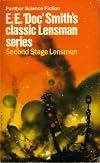
E.E. "Doc" Smith probably thought he was a feminist, and I guess for the late 1940's and early 1950's, the Lensmen series isn't too bad, and I can kind of look past it in most of the series. But in this one, which features the first (and only) female lensman, his whole "different but equal" shtick kind of gets a bit more in your face. There's also a lot less other interesting stuff going on to balance it out.
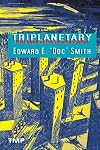
The pulp-era history of space opera is complicated, but E. E. “Doc” Smith is undoubtedly one of its icons. His Triplanetary is one of two prequels to the Lensman series. When its first version was published in 1934, the Buck Rogers radio series was in the middle of its run, and the comic strip had been out for five years. And, of course, the kid genius Tom Swift had been busy defeating bad guys with clever inventions since 1910. In 1948, a clunky, expanded fixup version of Triplanetary show more brought the beginning of the series into the Atomic Age. Reading the novel almost ninety years on, I was struck by the shifting style that veers from wartime slang to prose so purple it would make Bulwer-Lytton blush. At the heart of it all is the adoration of technology devoted to speed and power—especially force fields and beamed transmissions. Smith is especially fond of tractor beams, a term he may have coined as early as 1931.
Smith makes giant technological leaps seem easy. How about an inertialess tractor beam? “A tractor—inertialess?” Cleveland wondered. “Sure, why not?” Even fish, deep in the oceans of a distant planet, can do it because “those high-pressure boys were no fools.”
But my favorite bit of Smithian prose comes when the Nevians first appear in Tellurian space: “Space became suffused with a redly impenetrable opacity, and through that indescribable pall there came reaching huge arms of force incredible; writhing, coruscating beams of power which glowed a baleful, although almost imperceptible, red.”
Kids, they don’t write ‘em like that anymore. show less
Smith makes giant technological leaps seem easy. How about an inertialess tractor beam? “A tractor—inertialess?” Cleveland wondered. “Sure, why not?” Even fish, deep in the oceans of a distant planet, can do it because “those high-pressure boys were no fools.”
But my favorite bit of Smithian prose comes when the Nevians first appear in Tellurian space: “Space became suffused with a redly impenetrable opacity, and through that indescribable pall there came reaching huge arms of force incredible; writhing, coruscating beams of power which glowed a baleful, although almost imperceptible, red.”
Kids, they don’t write ‘em like that anymore. show less
Lists
Favorite Series (1)
Awards


You May Also Like


Associated Authors
Statistics
- Works
- 88
- Also by
- 19
- Members
- 19,671
- Popularity
- #1,106
- Rating
- 3.4
- Reviews
- 228
- ISBNs
- 636
- Languages
- 9
- Favorited
- 27
