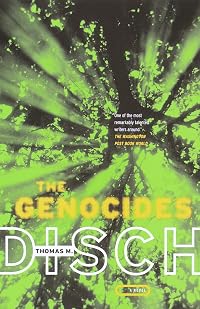
The Genocides
by Thomas M. Disch
On This Page
Description
This spectacular novel established Thomas M. Disch as a major new force in science fiction. First published in 1965, it was immediately labeled a masterpiece reminiscent of the works of J.G. Ballard and H.G. Wells In this harrowing novel, the world's cities have been reduced to cinder and ash and alien plants have overtaken the earth.nbsp;nbsp;The plants, able to grow the size of maples in only a month and eventually reach six hundred feet, have commandeered the world's soil and are sucking show more even the Great Lakes dry. In northern Minnesota, Anderson, an aging farmer armed with a Bible in one hand and a gun in the other, desperately leads the reduced citizenry of a small town in a daily struggle for meager existence. Throw into this fray Jeremiah Orville, a marauding outsider bent on a bizarre and private revenge, and the fight to live becomes a daunting task. show lessTags
Recommendations



















Member Recommendations
Member Reviews
At one point in this novel a character expresses the view, "I'm not sure if we've been invaded or if they're just spraying the garden." Aliens have seeded the Earth with giant Plants that tend to eliminate all other plants by out-competing them for basic resources such as water and sunlight. Machines are systematically wiping out not merely humans, but all mammals. A band of survivors in the former USA struggle against Plants, aliens and - themselves. Despite the likely imminent extinction of the species, people still can't stop themselves from getting involved in destructive power politics and personal rivalries. It feels depressingly realistic.
The story is interesting and the bleak but realistic idea that if aliens with interstellar show more travel technology turned up here and didn't like us we wouldn't stand an - Earthly? - chance is in stark contrast to the much more commonplace scenario that the aliens will be defeated by their own hubris e.g. [b:The War of the Worlds|8909|The War of the Worlds|H.G. Wells|http://photo.goodreads.com/books/1320391644s/8909.jpg|3194841] or humanity's intrinsic superior adaptability and inventiveness e.g. nigh-on every alien invader story from the 1950s on. But that isn't really what this book is about. It is in fact about spraying the garden - with dodgy chemicals. And turning over huge land areas to mono-culture crop growth. And global climate change - this has the earliest reference to the Greenhouse Effect of any piece of fiction I've read, as far as I can remember. Really, this is the fictional equivalent of the extra-ordinarily influential popular science work, [b:Silent Spring|27333|Silent Spring|Rachel Carson|http://photo.goodreads.com/books/1167880280s/27333.jpg|880193]. Other SF writers were working on the general environmental theme and the problems of bio-accumulating insecticides specifically back then, [b:The Green Brain|53727|The Green Brain|Frank Herbert|http://photo.goodreads.com/books/1312041560s/53727.jpg|3634593] being a prime example. Other major problems facing humanity and indeed, much of life on Earth, were also being tackled back then, for instance population control, in [b:A Torrent of Faces|2324240|A Torrent of Faces|James Blish|http://www.goodreads.com/assets/nocover/60x80.png|2330764], a lesser known but tremendously fun [a:James Blish|43625|James Blish|http://photo.goodreads.com/authors/1227585761p2/43625.jpg] novel in which a society trying to cope with a human population of one trillion is examined.
So, all those problems, understood back in the sixties - how many of them have we solved? And how many have got worse? show less
The story is interesting and the bleak but realistic idea that if aliens with interstellar show more travel technology turned up here and didn't like us we wouldn't stand an - Earthly? - chance is in stark contrast to the much more commonplace scenario that the aliens will be defeated by their own hubris e.g. [b:The War of the Worlds|8909|The War of the Worlds|H.G. Wells|http://photo.goodreads.com/books/1320391644s/8909.jpg|3194841] or humanity's intrinsic superior adaptability and inventiveness e.g. nigh-on every alien invader story from the 1950s on. But that isn't really what this book is about. It is in fact about spraying the garden - with dodgy chemicals. And turning over huge land areas to mono-culture crop growth. And global climate change - this has the earliest reference to the Greenhouse Effect of any piece of fiction I've read, as far as I can remember. Really, this is the fictional equivalent of the extra-ordinarily influential popular science work, [b:Silent Spring|27333|Silent Spring|Rachel Carson|http://photo.goodreads.com/books/1167880280s/27333.jpg|880193]. Other SF writers were working on the general environmental theme and the problems of bio-accumulating insecticides specifically back then, [b:The Green Brain|53727|The Green Brain|Frank Herbert|http://photo.goodreads.com/books/1312041560s/53727.jpg|3634593] being a prime example. Other major problems facing humanity and indeed, much of life on Earth, were also being tackled back then, for instance population control, in [b:A Torrent of Faces|2324240|A Torrent of Faces|James Blish|http://www.goodreads.com/assets/nocover/60x80.png|2330764], a lesser known but tremendously fun [a:James Blish|43625|James Blish|http://photo.goodreads.com/authors/1227585761p2/43625.jpg] novel in which a society trying to cope with a human population of one trillion is examined.
So, all those problems, understood back in the sixties - how many of them have we solved? And how many have got worse? show less
This 1965 novelette has held up remarkably well to the test of time.
Earth has been ‘seeded' with mysterious spores from space. Everywhere, giant alien plants are growing, resistant to every herbicide that research labs and governments have been able to produce. Destroying ecodiversity and crowding out every native species, the plants seem to have no nutritional value to humans or animals. Without farmland, massive famine results. The cities, dependent on farms for food, are first to collapse.
The last pockets of civilization may be farm villages...
In one such Minnesota village, a farmer rules his family and the survivors from his village as a dictatorial patriarch... harsh, but with survival at heart. But he is old, and in ill-health, show more and times are hard and getting harder. As the characters vie with each other over power and relationships, we see that even desperation is not enough to overcome human pettiness and just plain stupidity.
There's definitely some Biblical allusions going on... although the patriarch is also a religious leader, we see his ‘flock' violate pretty much every one of the Ten Commandments, and commit pretty much every one of the Seven Deadly Sins. They believe they may be being punished by God – but the reality is that humanity itself may be simply beneath the notice of who- or what-ever has caused this destruction.
Very bleak – very, very bleak. But also quite witty and entertaining show less
Earth has been ‘seeded' with mysterious spores from space. Everywhere, giant alien plants are growing, resistant to every herbicide that research labs and governments have been able to produce. Destroying ecodiversity and crowding out every native species, the plants seem to have no nutritional value to humans or animals. Without farmland, massive famine results. The cities, dependent on farms for food, are first to collapse.
The last pockets of civilization may be farm villages...
In one such Minnesota village, a farmer rules his family and the survivors from his village as a dictatorial patriarch... harsh, but with survival at heart. But he is old, and in ill-health, show more and times are hard and getting harder. As the characters vie with each other over power and relationships, we see that even desperation is not enough to overcome human pettiness and just plain stupidity.
There's definitely some Biblical allusions going on... although the patriarch is also a religious leader, we see his ‘flock' violate pretty much every one of the Ten Commandments, and commit pretty much every one of the Seven Deadly Sins. They believe they may be being punished by God – but the reality is that humanity itself may be simply beneath the notice of who- or what-ever has caused this destruction.
Very bleak – very, very bleak. But also quite witty and entertaining show less
A unique and grim apocalyptic tale. While the premise of alien plants overtaking the world may seem a bit ridiculous, the author makes the idea palpable and sinister. I definitely plan to delve into some of his other works.
This was my first book by Thomas Disch. I had heard and read much about his classic SF works. Am I a fan? To early to say.
This book was well written and interesting. I didn't like the story or the depressing and dreadful ending. Yes, he is a good writer. But I have to like the story. This didn't work for me. I will read other works by this author.
This book was well written and interesting. I didn't like the story or the depressing and dreadful ending. Yes, he is a good writer. But I have to like the story. This didn't work for me. I will read other works by this author.
De Planten komen iedere dag dichterbij. Kleiner en kleiner wordt het groepje mensen dat stand weet te houden. Kleiner en kleiner wordt hun akker. De Planten groeien welig genoeg en hun sap is voedzaam en onuitputtelijk. Hoog rijzen hun vreemde stengels over de kleine nederzetting. Het lieflijke beeld uit het begin van dit verhaal krijgt allengs een dreigende tint. Geruchten over zinloze verbrandingen verspreiden zich. Mensen en dieren worden verzengd aangetroffen; de daders zijn onbekend. Een aartsvaderlijke boer vlucht met zijn gemeenschap weg van de verschroeingsdood, naar een beschermende grot. Vandaar dringen zij door in de onderwereld van de plantenwortels, en belanden in een duister doolhof waarin zij jammerlijk dreigen om te show more komen. Maar de hel verkeert in een luilekkerland. Het kleverig webwerk, die witte draden, het is een overvloed van zoete suikerspin. De mens lijkt opnieuw overwinnaar. Maar waar komen die planten vandaan? En die branden? show less
Mar 18, 2025Dutch
Un livre étrange, déroutant par son point de vue sur une apocalypse discrète et silencieuse, avec une humanité pathétique vivant ses derniers instants en s'accrochant à des espoirs bien ténus... Le roman pourrait constituer une forme de préambule lointain au Monde vert d'Aldiss, c'en est assez troublant.
Jul 26, 2023French
Members
- Recently Added By
Lists

Dystopian and Apocalyptic Literature
350 works; 74 members

Post Apocalyptic Novels
41 works; 1 member
Talk Discussions
Past Discussions
Earth invaded, conquered & terraformed in Name that Book (August 2012)
Author Information

165+ Works 8,134 Members
Thomas Disch was a popular & prolific poet, playwright, essayist, & novelist. He is the author of many works of science fiction & the poetry collections "Dark verses & Light" & "Yes, Let's: New & Selected Poems". (Publisher Provided) Thomas M. Disch was born in Des Moines, Iowa on February 2, 1940. He dropped out of the architecture program at show more Cooper Union, and then left New York University after he sold a short story entitled The Double Timer. His first novel, The Genocides, was published in 1965. His other novels include The House That Fear Built, 334, The M.D., The Priest, The Word of God: Or, Holy Writ Rewritten, and Clara Reeve written under the pseudonym Leonie Hargreave. He won several awards including the 1969 Ditmar Award for Camp Concentration, the O. Henry Award in 1975 for Getting into Death and in 1977 for Xmas, the 1980 John W. Campbell, Jr. Memorial Award for On Wings of Song, and the 1981 British Science Fiction Award for The Brave Little Toaster: A Bedtime Story for Small Appliances. He was also wrote poetry, opera librettos, plays, and criticism of theater, films and art. His collections of poetry include Here I Am, There You Are, Where Are We; The Dark Old House; Yes, Let's: New and Selected Poetry; and Dark Verses and Light. He won the 1999 biennial Michael Braude Award for Light Poetry for A Child's Garden of Grammar, the Locus and Hugo Awards for 1999 for The Dreams Our Stuff is Made Of: How Science Fiction Conquered the World, and the Puschcart Prize for The First Annual Performance Art Festival at Slaughter Rock Battlefield. His criticism appeared in several publications including The Nation, The New York Daily News, and The New York Sun. In 1987, he wrote a script for the television series Miami Vice. He shot himself on July 4, 2008 at the age of 68. (Bowker Author Biography) show less
Some Editions
Awards and Honors
Awards
Notable Lists
Series
Belongs to Publisher Series
Work Relationships
Common Knowledge
- Canonical title
- The Genocides
- Original title
- The Genocides
- Original publication date
- 1965
- People/Characters
- Anderson; Jeremiah Orville
- First words*
- Le stelle, prima le meno luminose e poi via via anche le più brillanti, scomparvero nella luce sempre più intensa dell'alba, ma la massa scura della foresta che limitava il campo di granturco trattenne, ancora per un poco, ... (show all)le ombre della notte.
- Last words*
- (Click to show. Warning: May contain spoilers.)E del figlio dell'uomo, che è un piccolo verme?
- Original language*
- Inglés
*Some information comes from Common Knowledge in other languages. Click "Edit" for more information.
Classifications
Statistics
- Members
- 621
- Popularity
- 47,130
- Reviews
- 8
- Rating
- (3.47)
- Languages
- 5 — Dutch, English, French, German, Spanish
- Media
- Paper, Ebook
- ISBNs
- 14
- ASINs
- 12