
On This Page
Description
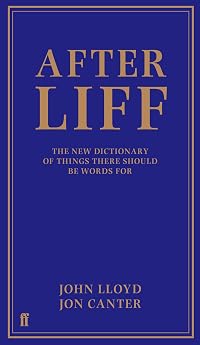
A rollicking, thought-provoking dictionary for the modern age, featuring definitions for those things we don't have words for, from the New York Times bestselling author behind The Hitchhiker's Guide to the Galaxy, Douglas Adams, and TV producer John Lloyd.Does the sensation of Tingrith(1) make you yelp? Do you bend sympathetically when you see someone Ahenny(2)? Can you deal with a Naugatuck(3) without causing a Toronto(4)? Will you suffer from Kettering(5) this summer?
Probably. You are show more almost certainly familiar with all these experiences but just didn’t know that there are words for them. Well, in fact, there aren’t—or rather there weren’t, until Douglas Adams and John Lloyd decided to plug these egregious linguistic lacunae(6). They quickly realized that just as there are an awful lot of experiences that no one has a name for, so there are an awful lot of names... show less
Tags
Recommendations






Member Reviews
A dictionary for things that don't have classifications or words. This is the book I read when I get home from work and need to just lie down and read the most ridiculous but hilarious shit. Love Douglas Adams.
Grobister: One who continually and publicly rearranges the position of his genitals.
Ossining: Trying to see past the person sitting in front of you at the cinema.
Darvel: To hold out hope for a better invitation until the last possible moment.
Grobister: One who continually and publicly rearranges the position of his genitals.
Ossining: Trying to see past the person sitting in front of you at the cinema.
Darvel: To hold out hope for a better invitation until the last possible moment.
Abilene (adj.) Descriptive of the pleasing coolness on the reverse side of the pillow.
Alcoy (adj.) Wanting to be bullied into having another drink.
Hobbs Cross (n.) The awkward leaping manoeuvre a girl has to go through in bed in order to make him sleep on the wet patch.
Ozark (n.) One who offers to help after all the work is done.
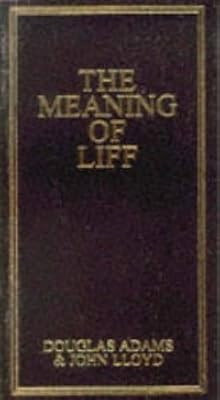
Take two humourists, a wealth of human experiences for which there are no words (inexplicable given their commonality), and a world full of place names that just sit around on signposts; mix well; turn out the first edition, The Meaning of Liff; sell lots of copies; reprint with some extra definitions and an index and voila – The Deeper Meaning of Liff.
I finished this with a Beppu [(n.) the triumphant show more slamming shut of a book after reading the final page], albeit ill-deserved as it's a very easy read even with a mate's effort at Dalmilling [(ptcpl.vb.) continually making small talk to someone who is trying to read a book]. Leaving her standing ahenny [(adj.) the way people stand when examining other people's bookshelves] in the other room and before finding my next Ballycumber [(n.) one of the six half-read books lying somewhere in the bed], I'm popping in to declare that this is the ideal way to avoid Great Wakering [(ptcpl.vb.) panic which sets in when you badly need to go to the lavatory and cannot make up your mind about what book or magazine to take with you]. There are no Frithams [(n.) a paragraph that you get stuck on in a book; the more you read it the less it means to you] to worry you nor any need to Bathel [(vb.) to pretend to have read the book under discussion when in fact you've only seen the T.V. series]. You'll end up smiling and with a few favourites that you'll endeavour to use as often as possible. show less
Alcoy (adj.) Wanting to be bullied into having another drink.
Hobbs Cross (n.) The awkward leaping manoeuvre a girl has to go through in bed in order to make him sleep on the wet patch.
Ozark (n.) One who offers to help after all the work is done.
Take two humourists, a wealth of human experiences for which there are no words (inexplicable given their commonality), and a world full of place names that just sit around on signposts; mix well; turn out the first edition, The Meaning of Liff; sell lots of copies; reprint with some extra definitions and an index and voila – The Deeper Meaning of Liff.
I finished this with a Beppu [(n.) the triumphant show more slamming shut of a book after reading the final page], albeit ill-deserved as it's a very easy read even with a mate's effort at Dalmilling [(ptcpl.vb.) continually making small talk to someone who is trying to read a book]. Leaving her standing ahenny [(adj.) the way people stand when examining other people's bookshelves] in the other room and before finding my next Ballycumber [(n.) one of the six half-read books lying somewhere in the bed], I'm popping in to declare that this is the ideal way to avoid Great Wakering [(ptcpl.vb.) panic which sets in when you badly need to go to the lavatory and cannot make up your mind about what book or magazine to take with you]. There are no Frithams [(n.) a paragraph that you get stuck on in a book; the more you read it the less it means to you] to worry you nor any need to Bathel [(vb.) to pretend to have read the book under discussion when in fact you've only seen the T.V. series]. You'll end up smiling and with a few favourites that you'll endeavour to use as often as possible. show less
This book has proved enormously useful in convincing people that I am stark raving nutter. When I use words such as "grimbister", "skagway" or "Mavis Enderby", people know I am a person to be reckoned with.
I've read this book cover to cover numerous times, it is a wonderful "bathroom reader", always finding new words for things I already knew but didn't know there was a word for.
I wish DNA were about today to provide sequels to this wonderful bit of silliness.
I've read this book cover to cover numerous times, it is a wonderful "bathroom reader", always finding new words for things I already knew but didn't know there was a word for.
I wish DNA were about today to provide sequels to this wonderful bit of silliness.
I can read this book with a straight face. But not for long. Sooner or later one of the definitions will make me laugh. This one seems apposite:
"Ripon (vb.) (Of literary critics) To include all the best jokes from the book in the review to make it look as though the critic thought of them."
And everyone should instantly start using this one, at least as a tribute to the author:
"Scethrog (n.) One of those peculiar beards-without-moustaches worn by religious Belgians and American scientists which help them look like trolls."
MB 1-x-2007
"Ripon (vb.) (Of literary critics) To include all the best jokes from the book in the review to make it look as though the critic thought of them."
And everyone should instantly start using this one, at least as a tribute to the author:
"Scethrog (n.) One of those peculiar beards-without-moustaches worn by religious Belgians and American scientists which help them look like trolls."
MB 1-x-2007
We have a dictionary full of perfectly good words, yet there are so many common things that don't have words. What do you call that hardened bit of food sometimes found between the prongs of forks in restaurants or that wheel on a supermarket cart that simply refuses to function?
And so we are forced to find a lot of words to decribe whatever we are talking about or else employ all-purpose words like watchamacallit or thingamajig.
The late Douglas Adams of "The Hitchhikers Guide to the Galaxy" fame co-authored with John Lloyd a 1990 book called "The Deeper Meaning of Liff" in which they proposed new words for those kind of situations. They suggest calling that fork crud henstridge, for example, and that faulty cart wheel a motspur.
They show more also have new words for:
— the triumphant slamming shut of a book after reading the final page — beppu.
— the faint taste of dishwashing liquid in a cup of tea — salween.
— a remote aquaintance passed off as "a very good friend of mine" by someone trying to impress people — ardcrony.
— the instinctive resentment of people younger than you — trunch.
I don't know of any of words proposed by Adams and Lloyd that have actually come into common usage. This is a book intended to be humorous, after all. Still the book serves as a reminder that, as large as an unabridged dictionary may be, there will always be a need for stilll more words.
And by the way, a liff is a common object or experience for which no word yet exists. show less
And so we are forced to find a lot of words to decribe whatever we are talking about or else employ all-purpose words like watchamacallit or thingamajig.
The late Douglas Adams of "The Hitchhikers Guide to the Galaxy" fame co-authored with John Lloyd a 1990 book called "The Deeper Meaning of Liff" in which they proposed new words for those kind of situations. They suggest calling that fork crud henstridge, for example, and that faulty cart wheel a motspur.
They show more also have new words for:
— the triumphant slamming shut of a book after reading the final page — beppu.
— the faint taste of dishwashing liquid in a cup of tea — salween.
— a remote aquaintance passed off as "a very good friend of mine" by someone trying to impress people — ardcrony.
— the instinctive resentment of people younger than you — trunch.
I don't know of any of words proposed by Adams and Lloyd that have actually come into common usage. This is a book intended to be humorous, after all. Still the book serves as a reminder that, as large as an unabridged dictionary may be, there will always be a need for stilll more words.
And by the way, a liff is a common object or experience for which no word yet exists. show less
I’m surprised that I didn’t love Douglas Adams’ THE DEEPER MEANING OF LIFF: A Dictionary of Things That There Aren’t Any Words For Yet. I certainly adored his Hitchhiker's Guide to the Galaxy series.
Ely (n.) The first, tiniest inkling that something, somewhere, has gone terribly wrong.
It seems that this book was really aimed at adolescent boys who find bodily functions amusing. There were many definitions that I laughed at but it was disheartening to find that there were outdated references and all the silly juvenile witticisms.
Wembly (n.) The hideous moment of confirmation that the disaster presaged in the ely (q.v.) has actually struck.
What Adams did, along with John Lloyd, was to take actual place names from around the world show more and give them phony definitions of ostensibly amusing quality.
Godalming (n.) Wonderful rush of relief on discovering that the ely (q.v.) and the wembly (q.v.) were in fact false alarms.
It took me years to find a copy of this book and I’m glad I did track it down, I’m just a little bit disappointed. There were plenty of giggles but this wouldn’t be a book I’d choose to take with me to a deserted island. It’s not a keeper. show less
Ely (n.) The first, tiniest inkling that something, somewhere, has gone terribly wrong.
It seems that this book was really aimed at adolescent boys who find bodily functions amusing. There were many definitions that I laughed at but it was disheartening to find that there were outdated references and all the silly juvenile witticisms.
Wembly (n.) The hideous moment of confirmation that the disaster presaged in the ely (q.v.) has actually struck.
What Adams did, along with John Lloyd, was to take actual place names from around the world show more and give them phony definitions of ostensibly amusing quality.
Godalming (n.) Wonderful rush of relief on discovering that the ely (q.v.) and the wembly (q.v.) were in fact false alarms.
It took me years to find a copy of this book and I’m glad I did track it down, I’m just a little bit disappointed. There were plenty of giggles but this wouldn’t be a book I’d choose to take with me to a deserted island. It’s not a keeper. show less
I’m surprised that I didn’t love Douglas Adams’ THE DEEPER MEANING OF LIFF: A Dictionary of Things That There Aren’t Any Words For Yet. I certainly adored his Hitchhiker's Guide to the Galaxy series.
Ely (n.) The first, tiniest inkling that something, somewhere, has gone terribly wrong.
It seems that this book was really aimed at adolescent boys who find bodily functions amusing. There were many definitions that I laughed at but it was disheartening to find that there were outdated references and all the silly juvenile witticisms.
Wembly (n.) The hideous moment of confirmation that the disaster presaged in the ely (q.v.) has actually struck.
What Adams did, along with John Lloyd, was to take actual place names from around the world show more and give them phony definitions of ostensibly amusing quality.
Godalming (n.) Wonderful rush of relief on discovering that the ely (q.v.) and the wembly (q.v.) were in fact false alarms.
It took me years to find a copy of this book and I’m glad I did track it down, I’m just a little bit disappointed. There were plenty of giggles but this wouldn’t be a book I’d choose to take with me to a deserted island. It’s not a keeper. show less
Ely (n.) The first, tiniest inkling that something, somewhere, has gone terribly wrong.
It seems that this book was really aimed at adolescent boys who find bodily functions amusing. There were many definitions that I laughed at but it was disheartening to find that there were outdated references and all the silly juvenile witticisms.
Wembly (n.) The hideous moment of confirmation that the disaster presaged in the ely (q.v.) has actually struck.
What Adams did, along with John Lloyd, was to take actual place names from around the world show more and give them phony definitions of ostensibly amusing quality.
Godalming (n.) Wonderful rush of relief on discovering that the ely (q.v.) and the wembly (q.v.) were in fact false alarms.
It took me years to find a copy of this book and I’m glad I did track it down, I’m just a little bit disappointed. There were plenty of giggles but this wouldn’t be a book I’d choose to take with me to a deserted island. It’s not a keeper. show less
Members
- Recently Added By
Lists

Books Read in 2025
4,128 works; 98 members
Author Information

91+ Works 190,662 Members
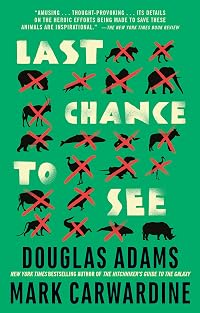
Douglas Noel Adams (sometimes referred to Bop Ad because of his distinctive signature) was born in Cambridge, England, on March 11, 1952 and educated at St. John's College at Cambridge University. He graduated with honors in English Literature in 1974. In addition to being a writer/editor for radio, television, and stage, Adams has worked as a show more hospital reporter, barn builder, and radio producer. The Hitchhiker's Guide to the Galaxy, 1979, one of his bestselling humor and science fiction novels, was originally a radio series. It was the first in a four-book series that includes The Restaurant at the End of the Universe; Life, the Universe, and Everything, and So Long, and Thanks for All the Fish. He once stated that the idea for his first novel came while he was "lying drunk in a field in Innsbruck and gazing at the stars." He pokes fun at humanity by mixing science fiction with humor. Adams's additional books include The Meaning of Liff; The Deeper Meaning of Liff; Dirk Gently's Holistic Detective Agency; The Long Dark Tea-time of the Soul; and Mostly Harmless. He has also co-authored the book Last Chance to See, about endangered species. Douglas Adams died May 11, 2001 of a heart attack in Santa Barbara, California at the age of 49. (Bowker Author Biography) show less

55+ Works 10,666 Members
John Lloyd produced Not the Nine O'Clock New, the Blackadders, and Spitting Image. (Publisher Provided)
Some Editions
Series

Work Relationships
Is contained in
Is an expanded version of
Common Knowledge
- Canonical title
- The Deeper Meaning of Liff
- Original title
- The Deeper Meaning of Liff
- Original publication date
- 1990
- Epigraph
- A dictionary of things that there aren't any words for yet
- First words
- Aalast (n.) One who changes his name to be nearer the front.
- Quotations
- Liff (n.) A common object or experience for which no word yet exists.
- Last words
- (Click to show. Warning: May contain spoilers.)Zumbo (n.) One who pretends not to know the exhaust has fallen off his car.
- Original language
- English
Classifications
Statistics
- Members
- 1,728
- Popularity
- 12,848
- Reviews
- 20
- Rating
- (3.74)
- Languages
- English, Finnish, German
- Media
- Paper, Ebook
- ISBNs
- 12
- ASINs
- 12