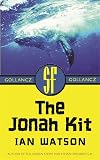
The Jonah Kit
by Ian Watson
On This Page
Description
A young Russian boy, accompanied by his devoted minder, turns up in Japan and presents a problem to the American security officials who take on his case. For the boy appears to be part of a sophisticated Soviet experiment and to have the mind of a dead astronaut imperfectly imprinted on his own. If the boy is to be believed, then the experiment has been extended to a whale... And in Mexico, ground-breaking research by Nobel Prize winner Paul Hammond and his disparate team has shown that what show more we perceive as the Universe is no more than the ghost of the real thing. Signals received by his radio telescope show that the Universe God created no longer exists. Then the whales start singing their death-yantra throughout the oceans of the world. show lessTags
Recommendations















Member Reviews
Dense sci-fi from the lost age of Big Ideas. An astrophysicist named Hammond makes a disturbing discovery (or is it premature?) about the origin of the universe. The idea goes like this: Our universe is just a decaying echo of the Big Bang. The "real" universe (whatever this means, exactly) popped into existence in another, fundamentally inaccessible dimension that runs parallel to ours, but enjoys a more substantive existence, at least compared with the inescapably entropic nature of our own. Popularized by the media (after being pushed by the relentlessly self-promoting Hammond), this discovery causes political chaos worldwide. Meanwhile, the Soviets have been learning how to copy minds into machine codes using electromagnetic show more psychotronics. Unfortunately, this results in the original minds being erased. Their prime test subject is a cosmonaut, severely disabled after a harsh re-entry, and they've been experimenting (successfully) with injecting copies of the mind into various other subjects: a sperm whale named "Jonah" and a child. The whale is like a vehicle, whose navigations of the sea are now accompanied by echoes of the cosmonaut's broken mind. In fact, whales are sapient creatures (only toothed whales, however), with deeply alien minds and a fantastically abstruse language that takes shape as glyphic abstractions within the spermaceti. Ultimately, some in government decide to broadcast Hammond's theorem to the "whale computer" (a pod of whales with which Jonah has been interfacing) in order to falsify or validate it. Promptly, every toothed whale on the planet horrifyingly beaches itself in a collective act of mass suicide. Running through the novel, there dialogues between Hammond and a disillusioned Italian journalist (formerly a Marxist, now a eunuch), who militates against the inherent nihilism of Hammond's theorem and, instead, advocates for a somewhat ambivalent version of the many-worlds interpretation. Maybe from the whales' perspective, it's the humans who've all died, and now they swim undisturbed in an oceanic universe split off from ours. An especially striking image: Watson writes that toothed whales (sapient) have been "programming" baleen whales (non-sapient) to broadcast messages through their songs, which carry vast distances. Now the ocean echoes with Hammond's theorem, but no toothed whales remain to understand its import, or to change the channel. show less
One of my all time favourite SF novels. Its bold idea of a Universe discarded by God makes for fascinating reading. What truly makes this stand apart is the unusual narrative of a human mind blended onto that of a whale's. This is perhaps Watson's greatest triumph and pulls it off with rich imagination and originality, with much of what he has theorised about whale communication, being realised today.
To be honest this was a difficult novel for me to like. Perhaps this was because of the underlying current of negativity throughout the novel. To me Watson was projecting some of the more developments of the 1970s forward in a way that was similar to what Wilson Tucker did in [b:The Year of the Quiet Sun|845489|The Year of the Quiet Sun|Wilson Tucker|https://d.gr-assets.com/books/1362179288s/845489.jpg|831015]. It's a helpful reminder of what that decade was like, when it seemed that societal institutions were crumbling before the pressure of youth and the onslaught of new ideas. The ecological subtext added to the sense of this as a novel of its time, as it had something of a [b:Jonathan Livingston Seagull|71728|Jonathan Livingston show more Seagull|Richard Bach|https://d.gr-assets.com/books/1422401277s/71728.jpg|1743336] vibe in places. The negativity might not have been as off-putting had it been balanced out by interesting characters, but the unappealing nature of nearly all of them just added to the sense of pessimism that pervaded its pages. It's definitely worth reading, but it's not a book I would recommend for someone seeking to be entertained and distracted, as in the end there's little room for it between its covers. show less
Bleh. This book is 1/3 interesting Sci Fi, 1/3 political drama, 1/3 the author exploring the 'human condition.' All the characters are purposefully unlikable, and the plot gets lost in the soul searching. The only interesting part was the Sci Fi, and in the end, probably unsurprisingly, it only ended up servicing the other parts. This wasn't a sci fi book, it was a dull and dreary philosophical parable. Bleh.
This is a fascinating novel in many ways and deals with some large ideas but on a relatively small scale, which was refreshing. Too many times I have found myself overwhelmed by the scale of a hard-sf novel crumbling around my ears as the story suffers. Not so here as the chapters are short and the general progress of the book is interspersed with passages of Whale-speak, which are puzzling at first but seem to work quite well.
Unfortunately, the general prose is extremely 'hard-sf'-esque: there is never a moment when any of the characters talk or think about anything other than the topic at hand (except for the occasional bit of chauvinistic voyeurism or copulation). The characters themselves are nothing more than ideas attached to show more names either.
Despite this, and the succinct nature of The Jonah Kit, the threads of discovery that the author draws out of the story, although a little dated in places, are quite powerful. The ending in particular is a real triumph and one of the best that I have come across in SF recently. show less
Unfortunately, the general prose is extremely 'hard-sf'-esque: there is never a moment when any of the characters talk or think about anything other than the topic at hand (except for the occasional bit of chauvinistic voyeurism or copulation). The characters themselves are nothing more than ideas attached to show more names either.
Despite this, and the succinct nature of The Jonah Kit, the threads of discovery that the author draws out of the story, although a little dated in places, are quite powerful. The ending in particular is a real triumph and one of the best that I have come across in SF recently. show less
http://nwhyte.livejournal.com/2470668.html
I'm sorry to say that I bounced off this 1977 BSFA Award winner pretty thoroughly. The basic scientific hook, imprinting a dead cosmonaut's mind onto the brain of a child, is interesting enough, but the general setting of decaying contemporary civilisation is depressing without being completely convincing; whereas the characters are convincingly nasty unpleasant people who it is difficult to get interested in. I bounced off The Miracle Visitors too. Well, I have two more Watsons on the shelf, so we'll see if they can pull me round.
I'm sorry to say that I bounced off this 1977 BSFA Award winner pretty thoroughly. The basic scientific hook, imprinting a dead cosmonaut's mind onto the brain of a child, is interesting enough, but the general setting of decaying contemporary civilisation is depressing without being completely convincing; whereas the characters are convincingly nasty unpleasant people who it is difficult to get interested in. I bounced off The Miracle Visitors too. Well, I have two more Watsons on the shelf, so we'll see if they can pull me round.
I can't really give a summary of this one, because I never could figure out what the heckin' heck was going on. There was a whale with, I think?, a man's mind in it, and a runaway boy, and some deeply unlikable other characters doing other stuff that I couldn't manage to care about in the slightest.
So this one was a big NOPE for me.
So this one was a big NOPE for me.
Members
- Recently Added By
Author Information

221+ Works 5,580 Members
British science fiction author Ian Watson was born in 1943. He received a first class Honors degree in English Literature in 1963 and a research degree in English and French 19th Century literature in 1965 from Balliol College, Oxford. After lecturing in literature and Futures Studies, he became a full-time author in 1976. His first novel, The show more Embedding, won the John W. Campbell Memorial Award and the French Prix Apollo. His novel The Jonah Kit won the British Science Fiction Association Award and the Orbit Award. He worked with Stanley Kubrick on story development for the movie A.I. Artificial Intelligence from 1990 to 1991. His poem True Love won the 2002 Rhysling Award from the Science Fiction Poetry Association. (Bowker Author Biography) show less
Some Editions
Awards and Honors
Notable Lists
Series
Belongs to Publisher Series
Common Knowledge
- Canonical title*
- Der programmierte Wal
- Original title
- The Jonah Kit
- Original publication date
- 1975
- People/Characters
- Professor Kapelka; Georgi Nilin, a small boy; Katya Tarsky; Pavel Chirikov, an invalid; Paul Hammond; Richard Kimble (show all 26); Ruth Hammond; Baby Alice; Max Berg; Orville Parr; Gerry Mercer; Mikhail, a Big Dumb Russian; Bob Pasko; Tom Winterburn; Captain Enozawa; Gianfranco Morelli; Ivor; Father Luis; Chloe Patton; Herb Flynn; Danny, a Hell's Angel; Dr. Kato; Comrade Orlov, a Big Dumb Russian; Commander; Donaldson; Fat Hell's Angel
- Important places
- San Diego, California, USA; Ciudad Juárez, Mexico; Tokyo, Japan
- Epigraph
- ich spreche von euerm nicht,
ich spreche vom ende der eulen.
ich spreche von butt und wal . . .
ich spreche nicht mehr von euch.
planern der spurlosen tat . . .
ich spreche von dem was nicht spricht,
von den sprachlosen zeugen . . .
i do not speak of what's yours,
i speak of the end of owls.
i speak of turbot and whale . . .
i don't speak of you any more,
planners of vanishing actions . . .
i speak of that without speech,
of the unspeaking witnesses . . .
--Hans Magnus Enzensberger
(translated by Michael Hamburger) - Dedication
- To Jessica
- First words
- H swims across the mountain range.
- Last words
- (Click to show. Warning: May contain spoilers.)As they sat staring at the verandah of the house, the hunched figure in the wheelchair was pushed out, by Mikhail, to soak up the late autumn patch of sunshine.
- Original language*
- Englisch
*Some information comes from Common Knowledge in other languages. Click "Edit" for more information.
Classifications
Statistics
- Members
- 262
- Popularity
- 123,943
- Reviews
- 9
- Rating
- (2.90)
- Languages
- 7 — Czech, English, French, German, Japanese, Portuguese, Spanish
- Media
- Paper, Ebook
- ISBNs
- 15
- ASINs
- 8