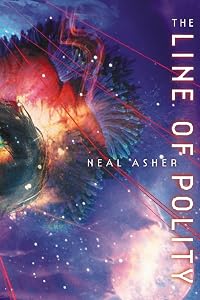
The Line of Polity
by Neal Asher 
Polity: Ian Cormac (2), Polity Universe - Publication Order (3), Polity Universe (Reading Order) (5.2)
On This Page
Description
Outlink station Miranda has been destroyed by a nanomycelium, and the very nature of this sabotage suggests that the alien bioconstruct Dragon - a creature as untrustworthy as it is gigantic - is somehow involved. Sent out on a titanic Polity dreadnought, the Occam Razor, agent Cormac must investigate the disaster. Meanwhile, on the remote planet Masada, the long-term rebellion can never rise above-ground, as the slave population is subjugated by orbital laser arrays controlled by the show more Theocracy in their cylinder worlds, and by the fact that they cannot safely leave their labour compounds. For the wilderness of Masada lacks breathable air ... and out there roam monstrous predators called hooders and siluroynes, not to mention the weird and terrible gabbleducks. show lessTags
Recommendations



























Member Reviews
There is a certain ineffable quality to Neal Asher's books. They are first and formost high tech, far future adventure stories. The rare scenes of an idyllic worldscape are usually shattered in moments by explosions, nanomanipulating alien technology, or the occasional AI trying to make the world a safer place. Line of Polity carries that burden well. Following shortly after the events of Gridlinked, Line of Polity continues to follow Ian Cormac, along with a small cast of characters working with and against him. Outlink station Miranda has been destroyed in a way that hints at Dragon, and if anyone is going to go after something related to the moonsized alien, it's Ian Cormac. Asher writes an action packed story well, and this book is show more no exception. There is a point about 3/4 of the way through that the action began to feel repetitive, but the last 1/4 of the book elevates the crescendo - and the stakes - bringing the book to a most satisfactory conclusion (read: couldn't put the book down for the last 100 pages, really dissapointed it was over).
Beware the gabbleduck, friends. show less
Beware the gabbleduck, friends. show less
I'm really impressed by what Neal Asher has done with the series. I've read a few of his other novels by now but this one, even more than Prador Moon, captured my imagination best. Gridlinked had some good moments, but Line of Polity, overall, is the superior read.
First thing I noticed was how deep and detailed the worldbuilding was. I loved the whole mixture of the Theocracy, all the huge amounts of biotech and symbiotes that allowed the benighted locals live on the planet, and the idea that there needed to be a real rebellious element established and kicking for the Polity to step in and knock the bad guys off the world.
Sound like America the Police Force, anyone? lol I kept expecting a nod or two to Central American nations, but no, show more Asher keeps it relatively clean. The idea that America is run by immense AIs is actually a sobering and enlightening idea compared to what we've got now. :)
SO, back to the story. It's all great action! Some intrigue, a lot of rebellious insurgents we want to root for, Cormac mostly on the outside trying to force the issue and free the peoples down below, and plenty of surprises in between. His friends are mightily interesting. And I might be able to swing a certain Dragon in that category as long as I use the term very broadly. :)
Overall, I see tones and shades of Iain M. Banks and a number of other Space Opera authors, but interestingly enough, Asher seems to have better overall action sequences and focus than all the others I've read.
Nice, huh? Space Opera for Space Opera enthusiasts. Fewer politics, more blaze, a ton more varied tech and nearly singularity-level situations, especially with a certain mycelium. :) That s*** is powerfully interesting. :) Much better villain this time around.
I can honestly say the stories are only getting better. :) show less
First thing I noticed was how deep and detailed the worldbuilding was. I loved the whole mixture of the Theocracy, all the huge amounts of biotech and symbiotes that allowed the benighted locals live on the planet, and the idea that there needed to be a real rebellious element established and kicking for the Polity to step in and knock the bad guys off the world.
Sound like America the Police Force, anyone? lol I kept expecting a nod or two to Central American nations, but no, show more Asher keeps it relatively clean. The idea that America is run by immense AIs is actually a sobering and enlightening idea compared to what we've got now. :)
SO, back to the story. It's all great action! Some intrigue, a lot of rebellious insurgents we want to root for, Cormac mostly on the outside trying to force the issue and free the peoples down below, and plenty of surprises in between. His friends are mightily interesting. And I might be able to swing a certain Dragon in that category as long as I use the term very broadly. :)
Overall, I see tones and shades of Iain M. Banks and a number of other Space Opera authors, but interestingly enough, Asher seems to have better overall action sequences and focus than all the others I've read.
Nice, huh? Space Opera for Space Opera enthusiasts. Fewer politics, more blaze, a ton more varied tech and nearly singularity-level situations, especially with a certain mycelium. :) That s*** is powerfully interesting. :) Much better villain this time around.
I can honestly say the stories are only getting better. :) show less
This review is written with a GPL 4.0 license and the rights contained therein shall supersede all TOS by any and all websites in regards to copying and sharing without proper authorization and permissions. Crossposted at WordPress, Blogspot, Booklikes & Librarything by Bookstooge’s Exalted Permission
Title: The Line of Polity
Series: Polity: Agent Cormac #2
Author: Neal Asher
Rating: 4 of 5 Stars
Genre: SF
Pages: 676
Format: Scanned Digital Edition
Synopsis:
A rogue scientist begins working for the Separatists that Cormac had a runin with in the previous book. Skellor, said rogue scientist, has discovered a stash of Jain technology. Jain tech is forbidden by the Polity and as the book goes on, we learn why. Cormac is sent out after Skellor show more before he can become catastrophically dangerous.
At the same time, a rebellion is brewing on the planet Masada. Under the control of rigid belief system that is against A.I. Rule, the theocrats have been in communication with the dragon. With predictable results. The Polity gets involved, the dragon gets pissed off and a lot of people are going to die.
When Skellor takes over the Masada system, it appears that things have indeed gone “Catastrophic”. With a whole planet to loot and play with, Skellor has grown into something beyond human and his abilities are just beginning. It is up to Agent Cormac to deal with Skellor, deal with the theocrats and deal with the offspring of the dead dragon: thousands or millions of dracomen.
Thankfully, Cormac is a Prime Agent indeed.
My Thoughts:
I enjoyed this just as much as my previous read in '10. I kept the 4star rating, instead of raising it, because it is evident that Asher is as much a fundamental zealot as I am, but his god is Science and he hates any other belief system. The main difference is that he writes books and interjects that zealotry into his books while I just interject my fundamentalism into small blog posts. So that might not even cross your radar at all.
This is what I like about Asher's Polity books. Monstrous inhumanity preying upon everything. In later books we found out how terrifying Jain tech truly is. Whole stellar civilizations destroyed by it. Here we see it gaining a foothold in humanity's playground. It might not be sentient, but it has a Directive. We are also introduced to some alien species, namely, Gabbleducks and Hooders. Gabbleducks roam the surface of Masada eating whatever and babbling words. Hooders eat everything, are impervious to most weaponry and eat their victims alive and by slowly dissecting them with a whole arsenal of claws, blades, etc.
Another thing I like about the Polity books is the exploration of the bounds of what it means to be alive. One character who died in the last book comes back as a golem, ie, a recording of the brainwaves put into a near-indestructable metal body. He thinks about what it means for him to have gone from human to golem and how that affects things. Even if I disagree with Asher's conclusions, I am fascinated by the questions and how the questions even come about.
In conclusion, I enjoyed this and have no problems recommending this series to anyone looking for a bloody good time. Emphasis on bloody.
★★★★☆ show less
Title: The Line of Polity
Series: Polity: Agent Cormac #2
Author: Neal Asher
Rating: 4 of 5 Stars
Genre: SF
Pages: 676
Format: Scanned Digital Edition
Synopsis:
A rogue scientist begins working for the Separatists that Cormac had a runin with in the previous book. Skellor, said rogue scientist, has discovered a stash of Jain technology. Jain tech is forbidden by the Polity and as the book goes on, we learn why. Cormac is sent out after Skellor show more before he can become catastrophically dangerous.
At the same time, a rebellion is brewing on the planet Masada. Under the control of rigid belief system that is against A.I. Rule, the theocrats have been in communication with the dragon. With predictable results. The Polity gets involved, the dragon gets pissed off and a lot of people are going to die.
When Skellor takes over the Masada system, it appears that things have indeed gone “Catastrophic”. With a whole planet to loot and play with, Skellor has grown into something beyond human and his abilities are just beginning. It is up to Agent Cormac to deal with Skellor, deal with the theocrats and deal with the offspring of the dead dragon: thousands or millions of dracomen.
Thankfully, Cormac is a Prime Agent indeed.
My Thoughts:
I enjoyed this just as much as my previous read in '10. I kept the 4star rating, instead of raising it, because it is evident that Asher is as much a fundamental zealot as I am, but his god is Science and he hates any other belief system. The main difference is that he writes books and interjects that zealotry into his books while I just interject my fundamentalism into small blog posts. So that might not even cross your radar at all.
This is what I like about Asher's Polity books. Monstrous inhumanity preying upon everything. In later books we found out how terrifying Jain tech truly is. Whole stellar civilizations destroyed by it. Here we see it gaining a foothold in humanity's playground. It might not be sentient, but it has a Directive. We are also introduced to some alien species, namely, Gabbleducks and Hooders. Gabbleducks roam the surface of Masada eating whatever and babbling words. Hooders eat everything, are impervious to most weaponry and eat their victims alive and by slowly dissecting them with a whole arsenal of claws, blades, etc.
Another thing I like about the Polity books is the exploration of the bounds of what it means to be alive. One character who died in the last book comes back as a golem, ie, a recording of the brainwaves put into a near-indestructable metal body. He thinks about what it means for him to have gone from human to golem and how that affects things. Even if I disagree with Asher's conclusions, I am fascinated by the questions and how the questions even come about.
In conclusion, I enjoyed this and have no problems recommending this series to anyone looking for a bloody good time. Emphasis on bloody.
★★★★☆ show less
If you liked Gridlinked, you will want to read this book. If you had not read it, you better go and read it before you continue with this one - not that the story does not stand on its own but a lot of details are too sparse if you did not have the backstory.
The first novel in the universe showed us the Polity. The second showed us the life on a planet so alien and different that it was almost as if it was not in the same world. This one is set on the line between the Polity and the non-Polity world - a line drawn between the stars and constantly shifting. The Polity always follows its rules - it never invades a planet unless if the people on it ask for it or if things are going really badly.
Welcome to Masada. The planet is not show more inhabitable really but due to a symbiosis people are able to live on the surface. The planet is ruled by a Theocracy and the only ones actually on the surface are the workers (which are more similar to slaves than anything else), everyone important lives in cylindrical worlds in orbit around the planet. As with any similar setup, the slaves have something of a resistance organized which does not have much of a chance but still exists. And the revolution is close.
It sounds like yet another revolution in space story until you account for a few other things - a crazy scientist that managed to find some Jain technology and got even crazier (and really do not want the Polity to know about him), another part of Dragon (the second sphere) and a space station called Miranda that gets destroyed. Get the survivors of all disasters that all this can cause and throw them at Masada. Then add Ian Cormac and his merry band - Mika and Skar, Gant and Thorn. Account for the fact that Masada is John Stanton's home world and he is coming back to help the revolution (with Jarvellis and her ship) and things cannot be boring. Add to all this a cyborg, a boy from Miranda, a girl that used to be a slave, some genetic engineering on a huge scale and a local life on Masada that is more nightmarish than anyone really can imagine and the story starts feeling overcrowded. The emergence of a new race and a new species of... things almost gets lost in the shuffle.
Asher's imagination keeps surprising me - both in his world building and his description of the technology in the universe. Although the story is a bit too long around the fighting scenes and does sound a bit repetitive. On the other hand they brought us character like Mulat - who is a pure comedic relief in otherwise dark novel - not because he is funny or does anything funny - simply because of what is happening to him. And somewhere amongst the revolution, humanity proves to be the same everywhere.
I really enjoyed this entry into the universe - it was a bit annoying that every time when someone needed a special change in order to live, they got it almost by miracle but none of it was really surprising - it came as part of the story. show less
The first novel in the universe showed us the Polity. The second showed us the life on a planet so alien and different that it was almost as if it was not in the same world. This one is set on the line between the Polity and the non-Polity world - a line drawn between the stars and constantly shifting. The Polity always follows its rules - it never invades a planet unless if the people on it ask for it or if things are going really badly.
Welcome to Masada. The planet is not show more inhabitable really but due to a symbiosis people are able to live on the surface. The planet is ruled by a Theocracy and the only ones actually on the surface are the workers (which are more similar to slaves than anything else), everyone important lives in cylindrical worlds in orbit around the planet. As with any similar setup, the slaves have something of a resistance organized which does not have much of a chance but still exists. And the revolution is close.
It sounds like yet another revolution in space story until you account for a few other things - a crazy scientist that managed to find some Jain technology and got even crazier (and really do not want the Polity to know about him), another part of Dragon (the second sphere) and a space station called Miranda that gets destroyed. Get the survivors of all disasters that all this can cause and throw them at Masada. Then add Ian Cormac and his merry band - Mika and Skar, Gant and Thorn. Account for the fact that Masada is John Stanton's home world and he is coming back to help the revolution (with Jarvellis and her ship) and things cannot be boring. Add to all this a cyborg, a boy from Miranda, a girl that used to be a slave, some genetic engineering on a huge scale and a local life on Masada that is more nightmarish than anyone really can imagine and the story starts feeling overcrowded. The emergence of a new race and a new species of... things almost gets lost in the shuffle.
Asher's imagination keeps surprising me - both in his world building and his description of the technology in the universe. Although the story is a bit too long around the fighting scenes and does sound a bit repetitive. On the other hand they brought us character like Mulat - who is a pure comedic relief in otherwise dark novel - not because he is funny or does anything funny - simply because of what is happening to him. And somewhere amongst the revolution, humanity proves to be the same everywhere.
I really enjoyed this entry into the universe - it was a bit annoying that every time when someone needed a special change in order to live, they got it almost by miracle but none of it was really surprising - it came as part of the story. show less
Aliens, technology, vast space ships, warfare and politics - this belongs in the guilty pleasure category for me. This is my second Asher novel I think - and while I enjoy the pacy action, multiple plot lines, impossibly cool gadgets and mind-bending extraterrestrial phenomena, it isn't quite up to Iain Banks' genius. In particular, the cast of thousands becomes very difficult to keep track of, and the technologies and concepts are sometimes introduced with little explanation or reminder. And I suppose I'm also starting to want a little more development and depth of character from Asher's hero, Agent Cormac - perhaps that comes in later books in the series. All minor complaints, but they add up to minus one star.
I seriously disliked Gridlinked, the first of the Agent Cormac series, and after giving up halfway through, decided I wouldn't be reading any more about Agent Cormac. I only picked up Line of Polity because I loved Neal Asher's "The Skinner" and another one of his novels "The Technician" was highly recommended. However, I was advised to read Line of Polity first as The Technician takes place on the planet Masada, 20 years after the events in Line of Polity.
So with a gnashing of teeth I prepared myself for the awful agent Cormac and was pleasantly surprised that he didn't take center stage. Instead we have various other interesting characters sharing the limelight and chapters dedicated to their view of events, without uber-superhero show more Cormac around to spoil things. Though I would have liked to have seen some of the characters fleshed out a bit more, I genuinely enjoyed the story, it was fun, fast paced, and contained loads of mind-boggling alien lifeforms. As another reviewer mentioned, it compares to an entertaining but undemanding action flick and that's just fine, take it for what is and enjoy the ride.
Am I going to read the rest of the Cormac series? I just might. show less
So with a gnashing of teeth I prepared myself for the awful agent Cormac and was pleasantly surprised that he didn't take center stage. Instead we have various other interesting characters sharing the limelight and chapters dedicated to their view of events, without uber-superhero show more Cormac around to spoil things. Though I would have liked to have seen some of the characters fleshed out a bit more, I genuinely enjoyed the story, it was fun, fast paced, and contained loads of mind-boggling alien lifeforms. As another reviewer mentioned, it compares to an entertaining but undemanding action flick and that's just fine, take it for what is and enjoy the ride.
Am I going to read the rest of the Cormac series? I just might. show less
I find it so ironic that the ancient technology that is destructrive is called Jain technology, after Jainists. Who are preservers of life, even insects, which seems to be completely opposite of what is in the novel.
A violent, fast paced, scary in its implications scifi thriller. I find myself becoming enthralled by this universe Asher has created and am looking forward to exploring it more and more.
A violent, fast paced, scary in its implications scifi thriller. I find myself becoming enthralled by this universe Asher has created and am looking forward to exploring it more and more.
Members
- Recently Added By
Lists

Library Fantasy/Science Fiction
158 works; 2 members
Author Information

95+ Works 14,576 Members
Neal Asher is a LibraryThing Author, an author who lists their personal library on LibraryThing.
Some Editions
Awards and Honors
Distinctions
Series


Common Knowledge
- Original publication date
- 2003
- People/Characters
- Ian Cormac; Skellor; Asselis Mika; Patran Thorn; Brezhoy Gant (Golem); Cento (show all 22); Aiden; John Stanton; Jarvellis; Horace Blegg; Occam Razor (AI); Cormac Stanton; Eldene; Apis Coolant; Dragon (second sphere); Scar; Noscar; Lellan Stanton; Lyric II (AI); Loman Dorth; Fethan; Aphran
- Important places
- Cheyne III; Masada; Occam Razor (ship); Miranda; Elysium; Callorum
- Original language
- English; English UK
Classifications
Statistics
- Members
- 926
- Popularity
- 28,695
- Reviews
- 20
- Rating
- (3.87)
- Languages
- Czech, English, German, Lithuanian
- Media
- Paper, Audiobook, Ebook
- ISBNs
- 16
- ASINs
- 6