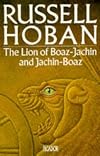
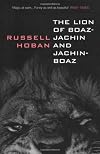
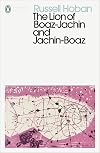
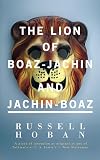
The Lion of Boaz-Jachin and Jachin-Boaz
by Russell Hoban
On This Page
Description
Hoban's first book for adults mixes playful fantasy with an insightful meditation on fathers and sons'I have gone to look for a lion.' In a world where lions have become extinct, the map-maker Jachin-Boaz nevertheless abandons his wife and son to find one, leaving just this note. But his decision has unexpected consequences. He will be pursued by his son, Boaz-Jachin, and by something else- a tawny-skinned, amber-eyed beast from another place and time, a bringer of life and death.Tags
Recommendations









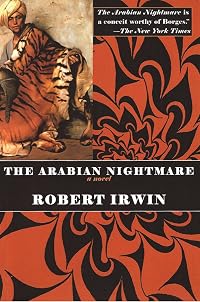



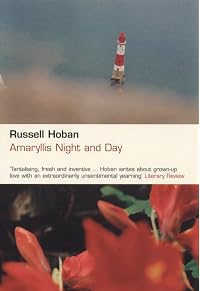
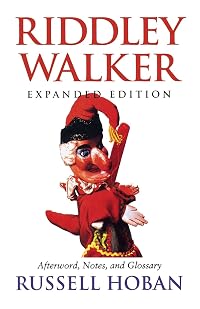


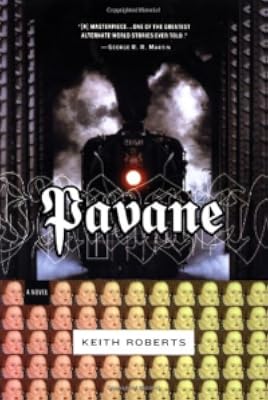








Member Reviews
This novel turned out to be a thought-provoking, if somewhat mystifying read: the first half full of poignant comments on belonging, self-direction and the relationship between fathers and sons; the second half verging on hallucinogenic self-indulgence. Realising that it was first published in 1973, I wondered if parts might have made more sense if I’d been smoking something not entirely legal. And yet there’s one irresistible aspect: it’s inspired by the magnificent Lion Hunt reliefs at the British Museum. Hoban’s story takes place in a world both ours and not ours. It has the same relationship with reality as Paolo Coelho’s Alchemist or Gabriel García Márquez’s novels: not exactly fantasy, but solidly within the realm of show more magical realism. In a Middle Eastern city, near a king’s ancient palace, the mapmaker Jachin-Boaz makes a living by selling dreams to other people. For that’s what maps are: catalogues of alluring possibilities. Jachin-Boaz has spent twenty years helping others to fulfil their dreams, but he has neglected his own. He lives on the edge of things, with a wife who no longer excites him and a teenage son who shows little interest in the map trade, funnelling all of his passion into creating a master map for that same son. Jachin-Boaz wants to give his son all his wisdom and knowledge of the world, to help him become a better man. But he doesn’t understand that sons don’t necessarily want their fathers to lay everything out for them. They want to make their own maps. And Jachin-Boaz’s son, Boaz-Jachin, one day makes a demand that he believes impossible: he wants his father to tell him where to find a lion... For the full review, please see my blog: https://theidlewoman.net/2018/01/07/the-lion-of-boaz-jachin-and-jachin-boaz-russ... show less
The Lion of Boaz-Jachin and Jachin-Boaz starts out in the style of a fairy tale or myth, which tends to irk me: real fairy tales and myths are stories worn smooth by a hundred thousand retellings over the course of centuries, which is how they get their primordial feel. Attempts to copy that feeling usually result in an affect that strikes me as cheap and unearned. Luckily, The Lion of Boaz-Jachin and Jachin-Boaz turns into something more interesting before its end.
The book gives us two main tales, one focusing on a father and the other focusing on his son, who both are struggling to answer the question of what they want out of life. The two tales share symbols between them, with lions and wheels abounding in the largely physical show more journey of the son and the largely mental journey of the father. The tale of the son was fine, but gives us a coming of age story where a young man strikes out into the world on his own and likewise is introduced to sexual experiences along the way. In short, it's a story you've read before. It reminded me heavily of As I Walked Out One Midsummer Morning by Laurie Lee, right down to the young man playing a musical instrument for room and board as he travelled, but Lee's story taken from his actual life eclipses this book's fictional version. The father's tale holds up much better, refusing to fall into the standard clichés of a mid-life crisis story even as the father abandons his family and takes a much younger blonde lover. He feels some guilt about his actions (which, in an interesting way, manifest physically) but this isn't a story of a man realizing what he had before and returning to it. There are no platitudes so tired and boring here. Even when the manifested specter of his past appears in the form of a lion which most people cannot see, the book avoids the usual boring practice of relegating the lion to a status of a simple hallucination, instead making the vision capable of physical actions that make the situation much more tense and interesting to both the father and the other characters involved.
This short book even manages to develop some other characters as well in just a few pages, like the abandoned wife who you can tell is going to make the same mistakes all over again, or the fishing boat captain that maligns restaurant owners while clearly wanting to be one himself. Hoban's writing worked in general, but unfortunately his setting descriptions sometimes failed to land. I bet it will completely work for some people, but that wasn't the case with me. This is one of those books that I rate 3 stars but which I think is very interesting. Unfortunately, with a beginning written in an off-putting style, writing that failed to floor me, and only one of the two main story lines being a stand-out I can't categorize this as a very good or great book, but it has its moments and is, overall, still well worth your time. show less
The book gives us two main tales, one focusing on a father and the other focusing on his son, who both are struggling to answer the question of what they want out of life. The two tales share symbols between them, with lions and wheels abounding in the largely physical show more journey of the son and the largely mental journey of the father. The tale of the son was fine, but gives us a coming of age story where a young man strikes out into the world on his own and likewise is introduced to sexual experiences along the way. In short, it's a story you've read before. It reminded me heavily of As I Walked Out One Midsummer Morning by Laurie Lee, right down to the young man playing a musical instrument for room and board as he travelled, but Lee's story taken from his actual life eclipses this book's fictional version. The father's tale holds up much better, refusing to fall into the standard clichés of a mid-life crisis story even as the father abandons his family and takes a much younger blonde lover. He feels some guilt about his actions (which, in an interesting way, manifest physically) but this isn't a story of a man realizing what he had before and returning to it. There are no platitudes so tired and boring here. Even when the manifested specter of his past appears in the form of a lion which most people cannot see, the book avoids the usual boring practice of relegating the lion to a status of a simple hallucination, instead making the vision capable of physical actions that make the situation much more tense and interesting to both the father and the other characters involved.
This short book even manages to develop some other characters as well in just a few pages, like the abandoned wife who you can tell is going to make the same mistakes all over again, or the fishing boat captain that maligns restaurant owners while clearly wanting to be one himself. Hoban's writing worked in general, but unfortunately his setting descriptions sometimes failed to land. I bet it will completely work for some people, but that wasn't the case with me. This is one of those books that I rate 3 stars but which I think is very interesting. Unfortunately, with a beginning written in an off-putting style, writing that failed to floor me, and only one of the two main story lines being a stand-out I can't categorize this as a very good or great book, but it has its moments and is, overall, still well worth your time. show less
The Lion of Boaz-Jachin and Jachin Boaz by Russell Hoban
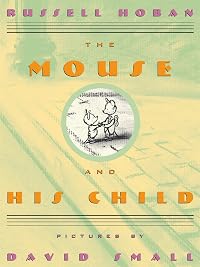
The book jacket of my edition (Jonathan Cape 1973) states this is Hoban’s “First adult novel.” Fans of “The Mouse and His Child” may dispute that. I have always called Mouse “A book for children and intelligent adults.” But let’s not split hairs.
Like “Mouse” this book requires intelligent adults. Hoban set the bar very high by naming father and son with mirror names. Although I have read it many times I still must stay alert ( p.147 actually used wrong name!) Each rereading, however, increases my appreciation of its beauty.
Rather than try to give a synopsis I urge adventurous readers to find the book, and follow the trail(s) that lead to London’s embankment show more where a constable, a young woman, a telephone booth, a father and son AND a lion (?) collide. show less
The book jacket of my edition (Jonathan Cape 1973) states this is Hoban’s “First adult novel.” Fans of “The Mouse and His Child” may dispute that. I have always called Mouse “A book for children and intelligent adults.” But let’s not split hairs.
Like “Mouse” this book requires intelligent adults. Hoban set the bar very high by naming father and son with mirror names. Although I have read it many times I still must stay alert ( p.147 actually used wrong name!) Each rereading, however, increases my appreciation of its beauty.
Rather than try to give a synopsis I urge adventurous readers to find the book, and follow the trail(s) that lead to London’s embankment show more where a constable, a young woman, a telephone booth, a father and son AND a lion (?) collide. show less
Rather baffling. Hoban seems to write each book in a different genre, and here he does symbolic not-quite-magic realism in a form which falls somewhere between Eastern Europe and the Latin America of Marquez or Borges. I couldn't get a grip on it.
MB 26-iii-2011
MB 26-iii-2011
An enthralling tale of a journey into the transformative power of mystery and love. This is [surprisingly] Hoban's first "adult" novel and it defies classification.
See What I Have Been Reading, July 2010 at From Word to Word
Ratings
Members
- Recently Added By
Lists

Reading LIst
648 works; 1 member
Author Information

111+ Works 30,727 Members
Russell Hoban was born in Lansdale, Pennsylvania on February 4, 1925. He attended art school in Philadelphia and during World War II, he served in the Army and earned a Bronze Star. He taught art in New York and Connecticut, and also worked as an advertising copywriter and a freelance illustrator before beginning his career as a writer. He began show more publishing children's books in the late 1950s, including What Does It Do and How Does It Work?, Bedtime for Frances and the six other books featuring Frances, The Story of Hester Mouse Who Became a Writer, What Happened When Jack and Daisy Tried to Fool the Tooth Fairies, and The Mouse and His Child, which was adapted as an animated film in 1977. In 1973, he published his first adult novel, The Lion of Boaz-Jachin and Jachin-Boaz. His other books for adults include Turtle Diary, Pilgermann, and Ridley Walker. He received the John W. Campbell Memorial Award and the Australian Science Fiction Achievement Award for Ridley Walker. He died on December 13 at the age of 86. In 2015 he made the Kate Greenaway Medal shortlist for his title Jim's Lion wth illlustrator Alexis Deacon. (Bowker Author Biography) show less
Some Editions
Work Relationships
Is contained in
Common Knowledge
- Canonical title
- The Lion of Boaz-Jachin and Jachin-Boaz
- Original publication date
- 1973
- People/Characters
- Boaz-Jachim; Jachim-Boaz; Gretel
- Epigraph
- Thou huntest me as a fierce lion:
and again thou shewest thyself
marvellous upon me.
Job x: 16 - Dedication
- To Gundel
- First words
- There were no lions any more.
- Last words
- (Click to show. Warning: May contain spoilers.)He nodded to the superintendent, passed through the circle as it parted on either side of him, and walked away down the street in his shirtsleeves.
- Original language
- English
Classifications
Statistics
- Members
- 343
- Popularity
- 92,810
- Reviews
- 6
- Rating
- (3.68)
- Languages
- English, German, Italian, Spanish
- Media
- Paper, Ebook
- ISBNs
- 15
- ASINs
- 7