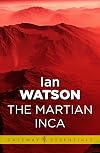
The Martian Inca
by Ian Watson
On This Page
Description
After salvaging a wrecked Russian spacecraft, recently crashed on a remote Bolivian mountainside, Julio Capac and his beloved Angelina are rendered comatose. They awake believing themselves reborn as terrible godlike creatures - the Inca and his Queen. By the author of Stalin's Teardrops.Tags
Recommendations














Member Reviews
https://nwhyte.livejournal.com/3069387.html
One of Ian Watson’s early books, with parallel narratives in which a virus in Martian soil causes spiritual transformation both among the inhabitants of the Bolivian village where a Soviet sample return mission crash lands, and among the crew of an American space mission to the planet. I felt that the message was rather heavily laid on; two decades later, KSR did a much better job of Mars as agent of spiritual transformation. I didn’t dislike it as much as Stanisław Lem, who wrote:
"It is a pity that even highly talented, well-read, and intelligent writers of the younger generation, such as Ian Watson, fail to recognize the difference between the delusion of mysticism and what is really the show more case. He has erroneously yoked his considerable erudition to the wrong purpose of passing off a shallow fairy-tale for the lost redemption of our civilization. His novel tells much more about the confusion that currently holds captive even the brightest young people than about the real state of things on Earth and in the heavens, from which Mars shines down upon us as a challenge. About the genuine mysteries of the universe that we have yet to solve in the years to come, Watson's novel tells us nothing." show less
One of Ian Watson’s early books, with parallel narratives in which a virus in Martian soil causes spiritual transformation both among the inhabitants of the Bolivian village where a Soviet sample return mission crash lands, and among the crew of an American space mission to the planet. I felt that the message was rather heavily laid on; two decades later, KSR did a much better job of Mars as agent of spiritual transformation. I didn’t dislike it as much as Stanisław Lem, who wrote:
"It is a pity that even highly talented, well-read, and intelligent writers of the younger generation, such as Ian Watson, fail to recognize the difference between the delusion of mysticism and what is really the show more case. He has erroneously yoked his considerable erudition to the wrong purpose of passing off a shallow fairy-tale for the lost redemption of our civilization. His novel tells much more about the confusion that currently holds captive even the brightest young people than about the real state of things on Earth and in the heavens, from which Mars shines down upon us as a challenge. About the genuine mysteries of the universe that we have yet to solve in the years to come, Watson's novel tells us nothing." show less
Ratings
Members
- Recently Added By
Author Information

221+ Works 5,580 Members
British science fiction author Ian Watson was born in 1943. He received a first class Honors degree in English Literature in 1963 and a research degree in English and French 19th Century literature in 1965 from Balliol College, Oxford. After lecturing in literature and Futures Studies, he became a full-time author in 1976. His first novel, The show more Embedding, won the John W. Campbell Memorial Award and the French Prix Apollo. His novel The Jonah Kit won the British Science Fiction Association Award and the Orbit Award. He worked with Stanley Kubrick on story development for the movie A.I. Artificial Intelligence from 1990 to 1991. His poem True Love won the 2002 Rhysling Award from the Science Fiction Poetry Association. (Bowker Author Biography) show less
Some Editions
Series
Belongs to Publisher Series
Common Knowledge
- Canonical title*
- マーシャン・インカ
- Original publication date
- 1997
- Epigraph
- Before me floats an image, man or shade,
Shade more than man, more image than a shade;
For Hades' bobbin bound in mummy-cloth
May unwind the winding path;
A mouth that has no moisture and n... (show all)o breath
Breathless mouths may summon;
I hail the superhuman;
I call it death-in-life and life-in-death.
W.B. Yeats, Byzantium - Dedication
- To Sheila
- First words
- Thirty thousand kilometres out in space, the returning probe Zayits raced toward re-entry.
- Last words
- (Click to show. Warning: May contain spoilers.)The Sun rose and set a hundred times a day, transiting the self-dimming windows; and Weaver stared towards the Sun, towards Earth and Venus. Inwards but not inward.
*Some information comes from Common Knowledge in other languages. Click "Edit" for more information.
Classifications
Statistics
- Members
- 230
- Popularity
- 142,193
- Reviews
- 1
- Rating
- (2.88)
- Languages
- 6 — English, French, German, Italian, Japanese, Spanish
- Media
- Paper, Ebook
- ISBNs
- 8
- ASINs
- 9