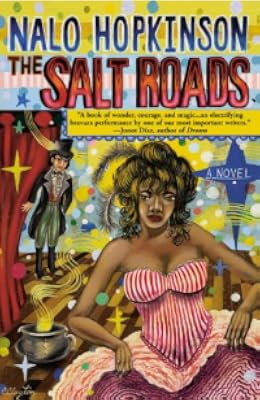
The Salt Roads
by Nalo Hopkinson
On This Page
Description
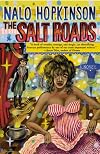
In 1804, shortly before the Caribbean island of Saint Domingue is renamed Haiti, a group of women gather to bury a stillborn baby. Led by a lesbian healer and midwife named Mer, the women's lamentations inadvertently release the dead infant's "unused vitality" to draw Ezili-the Afro-Caribbean goddess of sexual desire and love-into the physical world. As Ezili explores her newfound powers, she travels across time and space to inhabit the midwife's body-as well as those of Jeanne, a mixed-race show more dancer and the mistress of Charles Baudelaire living in 1880s Paris, and Meritet, an enslaved Greek-Nubian prostitute in ancient Alexandria. Bound together by Ezili and "the salt road" of their sweat, blood, and tears, the three women struggle against a hostile world, unaware of the goddess's presence in their lives. Despite her magic, Mer suffers as a slave on a sugar plantation until Ezili plants the seeds of uprising in her mind. Jeanne slowly succumbs to the ravages of age and syphilis when her lover is unable to escape his mother's control. And Meritet, inspired by Ezili, flees her enslavement and makes a pilgrimage to Egypt, where she becomes known as Saint Mary. show lessTags
Recommendations

























Member Reviews
A powerful work of magical realism, The Salt Roads follows four connected stories of black queer women across time and space. Metante Mer is a medicine woman and slave in what would become Haiti, trying to survive. Jeanne Duval is the (historical) mistress and muse of poet Charles Baudelaire in 19th century Paris. Thais is a 4th century Egyptian prostitute and slave who goes on a pilgrimage. Between them all, in fragmentary BEATS and BREAKS is the African goddess Lasirén or Ezili, of water and love, who possesses characters and influences events.
There's a lot of style here, and a lot of power in the characters, even if the Lasirén sections are a little overwrought. There's a keen urgency to the loves and lusts of her characters. Yet, show more I can't help but shake the sense that this is a premise without a conclusion. The deconstruction of Jeanne and Thais (historical personages, even if in some cases scantily documented), works at cross purposes to the construction of Mer-as wise, as powerful, as good. This book says "Wouldn't it be cool if these people existed?", and then having created their existence, ends. show less
There's a lot of style here, and a lot of power in the characters, even if the Lasirén sections are a little overwrought. There's a keen urgency to the loves and lusts of her characters. Yet, show more I can't help but shake the sense that this is a premise without a conclusion. The deconstruction of Jeanne and Thais (historical personages, even if in some cases scantily documented), works at cross purposes to the construction of Mer-as wise, as powerful, as good. This book says "Wouldn't it be cool if these people existed?", and then having created their existence, ends. show less
This book was my first exposure to Nalo Hopkinson and it won't be my last. Told from four different POVs, in different times and different places, this book is seamless, the transitions flowing like the water Hopkinson writes about. Their narratives twine about each other, braiding each woman's experiences into the single story of a goddess.
It's about women and their goddesses. It's about slavery, colonialism, and racism. It's about love and hate and fear and hope. And it is astounding. (Provided by publisher)
It's about women and their goddesses. It's about slavery, colonialism, and racism. It's about love and hate and fear and hope. And it is astounding. (Provided by publisher)
In Saint Domingue prior to the revolution, a woman named Mer is a slave and doing her best as a healer for the people there, including her lover Tipingee, and Georgine who comes to her when she is pregnant. Georgine's baby is stillborn, but in the women's mourning for her an aspect of Ezili is born. Ezili has the ability to join her consciousness with other women, including Jeanne Duval, the mistress of Charles Baudelaire in 1840s Paris, and Thais, an enslaved Greek-Nubian prostitute in 300s Alexandria.
I enjoyed the writing and the characters, but didn't entirely get what Hopkinson was doing bringing these three narratives together. Any of them could have been expanded into a strong story of its own. Ezili - and I had to look this up show more while reading - is a pantheon of Vodou goddesses that show up in different aspects, so the connection to Haiti (Saint Domingue still in Mer's story) and salt (Jeanne's nickname is Lemer and Thais is also Meritet, and both the salt of the sea and the connection to the Virgin Mary come in to play) is played with throughout. Each of the stories are heartbreaking but also about the resilience and love of the three women. There's a fair amount of violence as you might expect from a book that deals with slavery, and also sex - several characters are queer, some of the sex is, well, sexy and some of it very much is not, but desire is not shied away from here. It had some interesting qualities, but even at the end I'm not entirely sure where the story was going. show less
I enjoyed the writing and the characters, but didn't entirely get what Hopkinson was doing bringing these three narratives together. Any of them could have been expanded into a strong story of its own. Ezili - and I had to look this up show more while reading - is a pantheon of Vodou goddesses that show up in different aspects, so the connection to Haiti (Saint Domingue still in Mer's story) and salt (Jeanne's nickname is Lemer and Thais is also Meritet, and both the salt of the sea and the connection to the Virgin Mary come in to play) is played with throughout. Each of the stories are heartbreaking but also about the resilience and love of the three women. There's a fair amount of violence as you might expect from a book that deals with slavery, and also sex - several characters are queer, some of the sex is, well, sexy and some of it very much is not, but desire is not shied away from here. It had some interesting qualities, but even at the end I'm not entirely sure where the story was going. show less
Undoubtedly, a tour-de-force of magical realism.
Here, Hopkinson does not merely aim to tell a story. She aims to create a collage illuminating the experiences of black women throughout history.
The first, and perhaps the primary character introduced is Mer, a slave in Haiti, shortly before the revolution. She faces hard decisions when faced with choices about whether to seek her own freedom or to stay and try to help the other slaves (she's the closest thing to a doctor they have). Love and loyalty are complex things to negotiate, for her, and her actions are not always appreciated or understood by those around her.
The narrative also closely focuses on an actual historical character: Jeanne Duval, known as the mistress of Charles show more Baudelaire. As a mixed-race woman in 19th-century Paris, in a relationship with a wealthy white man, she also has a minefield to negotiate through life.
The third, (and strangely much smaller) story here is that of Thais, an Ethiopian prostitute in Egypt. In search of a better life (and adventure) she and her best friend embark on a journey to Greece. Her fate is to be remembered by history as Saint Mary of Egypt.
There are many parallels between the lives of these three women, even separated as they are by time, geography and circumstance. Each is caught on a low rung of the social hierarchy due to circumstances beyond her control. Each ends up in a land far from that of her birth. And each must make choices about who to love and who to cleave to.
Tying together these three disparate stories is the 'magical' aspect of the novel: the African goddess Lasirén or Ezili, a goddess of water and love, a rival to the spirit of war. The spirit observes, possesses, influences the turn of events.
I've read a few things by Hopkinson, and I would say this is her most notable work.
Many thanks to NetGalley and Open Road Media for the opportunity to read the new ebook edition of this book. As always, my opinions are my own.
show less
Here, Hopkinson does not merely aim to tell a story. She aims to create a collage illuminating the experiences of black women throughout history.
The first, and perhaps the primary character introduced is Mer, a slave in Haiti, shortly before the revolution. She faces hard decisions when faced with choices about whether to seek her own freedom or to stay and try to help the other slaves (she's the closest thing to a doctor they have). Love and loyalty are complex things to negotiate, for her, and her actions are not always appreciated or understood by those around her.
The narrative also closely focuses on an actual historical character: Jeanne Duval, known as the mistress of Charles show more Baudelaire. As a mixed-race woman in 19th-century Paris, in a relationship with a wealthy white man, she also has a minefield to negotiate through life.
The third, (and strangely much smaller) story here is that of Thais, an Ethiopian prostitute in Egypt. In search of a better life (and adventure) she and her best friend embark on a journey to Greece. Her fate is to be remembered by history as Saint Mary of Egypt.
There are many parallels between the lives of these three women, even separated as they are by time, geography and circumstance. Each is caught on a low rung of the social hierarchy due to circumstances beyond her control. Each ends up in a land far from that of her birth. And each must make choices about who to love and who to cleave to.
Tying together these three disparate stories is the 'magical' aspect of the novel: the African goddess Lasirén or Ezili, a goddess of water and love, a rival to the spirit of war. The spirit observes, possesses, influences the turn of events.
I've read a few things by Hopkinson, and I would say this is her most notable work.
Many thanks to NetGalley and Open Road Media for the opportunity to read the new ebook edition of this book. As always, my opinions are my own.
show less
James Morrow's Only Begotten Daughter made me question whether a book with a divine main character could satisfy this bitter old atheist reader.
Nalo Hopkinson's The Salt Roads answered that question with a resounding yes.
In a way it's not fair to compare them. Ezili of The Salt Roads is the kind of goddess I can understand - part of an infinite whole, she nevertheless has her limitations both in vision and power, and those bound the story in a reasonable way, keep it from the trap of the Problem of Evil even as Ezili, like Julie Katz, struggles with the question of how and when to intervene in the affairs of 'her' mortals. Furthermore, while Only Begotten Daughter shows the bottomless pit of potential evil under middle-class, modern New show more Jersey, The Salt Roads shows a struggle to transcend in more obviously horrific circumstances - slavery on a sugar plantation in Haiti, an uncertain life of insecurity, illness, and objectification as a dance hall girl-cum-poet's muse in France, prostitution under the Roman Empire at the dawn of Christianity. Both are important messages, but it was The Salt Roads that nailed me straight in the heart.
At least one reviewer (http://www.sfsite.com/05a/sr175.htm) seem to feel that the book was unbalanced, but I honestly think that the non-traditional shape is a plus. Meritet/Thais's story is exactly as long as it will bear to be, which is shorter than the other two. The story of Mer doesn't tie up into a neat bow for her as an individual, but it fades into the larger narrative of Haiti's revolution. This may seem awkward to the reader who is thoroughly steeped in the individualist outlook of the so-called 'Western Novel' but it actually makes sense in light of the theme of Ezili's many-faceted nature and involvement in history.
Another reviewer (http://www.strangehorizons.com/2004/20040816/saltroads-r.shtml) finds the women in this book hard to believe. I found them a refreshing change from Julie Katz-style 'realistic' women - but even more than that, I trust in Hopkinson's research (which was clearly extensive) and her skill. In a world where governments sometimes failed to make laws against lesbianism because people didn't believe it existed, where women made Boston marriages in stuffy Boston, it's not too hard for me to believe that a group of slaves who are trying to survive in the sugar-cane fields and plotting revolt might have bigger things on their minds than the fact that two older women have settled into a companionship with a sexual component - and that slave owners who don't even see these women as human wouldn't pick up on it. Frankly, although I don't wish to impugn the reviewer, I feel as though I catch a faint whiff of surprise at female characters whose sex lives are about them, even when 'about them' means 'a tool for fulfilling their material needs.' show less
Nalo Hopkinson's The Salt Roads answered that question with a resounding yes.
In a way it's not fair to compare them. Ezili of The Salt Roads is the kind of goddess I can understand - part of an infinite whole, she nevertheless has her limitations both in vision and power, and those bound the story in a reasonable way, keep it from the trap of the Problem of Evil even as Ezili, like Julie Katz, struggles with the question of how and when to intervene in the affairs of 'her' mortals. Furthermore, while Only Begotten Daughter shows the bottomless pit of potential evil under middle-class, modern New show more Jersey, The Salt Roads shows a struggle to transcend in more obviously horrific circumstances - slavery on a sugar plantation in Haiti, an uncertain life of insecurity, illness, and objectification as a dance hall girl-cum-poet's muse in France, prostitution under the Roman Empire at the dawn of Christianity. Both are important messages, but it was The Salt Roads that nailed me straight in the heart.
At least one reviewer (http://www.sfsite.com/05a/sr175.htm) seem to feel that the book was unbalanced, but I honestly think that the non-traditional shape is a plus. Meritet/Thais's story is exactly as long as it will bear to be, which is shorter than the other two. The story of Mer doesn't tie up into a neat bow for her as an individual, but it fades into the larger narrative of Haiti's revolution. This may seem awkward to the reader who is thoroughly steeped in the individualist outlook of the so-called 'Western Novel' but it actually makes sense in light of the theme of Ezili's many-faceted nature and involvement in history.
Another reviewer (http://www.strangehorizons.com/2004/20040816/saltroads-r.shtml) finds the women in this book hard to believe. I found them a refreshing change from Julie Katz-style 'realistic' women - but even more than that, I trust in Hopkinson's research (which was clearly extensive) and her skill. In a world where governments sometimes failed to make laws against lesbianism because people didn't believe it existed, where women made Boston marriages in stuffy Boston, it's not too hard for me to believe that a group of slaves who are trying to survive in the sugar-cane fields and plotting revolt might have bigger things on their minds than the fact that two older women have settled into a companionship with a sexual component - and that slave owners who don't even see these women as human wouldn't pick up on it. Frankly, although I don't wish to impugn the reviewer, I feel as though I catch a faint whiff of surprise at female characters whose sex lives are about them, even when 'about them' means 'a tool for fulfilling their material needs.' show less
I think I'm finally just going to call it on this title and move on. I've made two attempts to read it and I'm about halfway through at this point. I love the characters, time jumps, and connections between them but the plot just doesn't move enough for me. I never tend to like slice of life even when the lives are really interesting and this, despite the cool structure and lyrical style, just reads slice of life to me.
This is an example of a book where taking different stories and weaving them together works, for me. There is Jeanne, Baudelaire's mistress in 19th century France; Mer, a plantation slave on Haiti in the late 18th century and Thais, a prostitute in 4th century Alexandria. The experiences of these women's lives are often hard and brutal but still there is love. Linking them through the story of the goddess Ezili, Nalo Hopkinson has created a glimpse into the history of African slaves. Very readable, an interesting book.
Members
- Recently Added By
Lists

Top Five Books of 2020
982 works; 350 members

Diversity in Fantasy and Science Fiction
219 works; 33 members

Wish List
4 works; 1 member

LGBTQ+ Speculative Fiction
821 works; 51 members

Myth (Reuse and Retelling)
188 works; 24 members
Author Information

81+ Works 6,265 Members
Some Editions
Awards and Honors
Awards
Distinctions
Notable Lists
Common Knowledge
- Original publication date
- 2003
- First words
- “It went in white, but it will come out a mulatto in a few months' time, yes?”
Classifications
- Genres
- Fiction and Literature, Fantasy, General Fiction, LGBTQ+, Historical Fiction
- DDC/MDS
- 813.54 — Literature & rhetoric American literature in English American fiction in English 1900-1999 1945-1999
- LCC
- PR9199.3 .H5927 .S25 — Language and Literature English English Literature English literature: Provincial, local, etc.
- BISAC
Statistics
- Members
- 633
- Popularity
- 46,070
- Reviews
- 18
- Rating
- (3.96)
- Languages
- English
- Media
- Paper, Audiobook, Ebook
- ISBNs
- 9
- ASINs
- 7