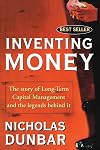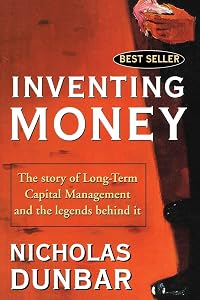
Inventing Money: The Story of Long-Term Capital Management and the Legends Behind It
by Nicholas Dunbar
On This Page
Description
LTCM was the fund that was too big to fail, the brightest star in the financial world. Built on genius, by legends of Wall Street and two Nobel laureates, it spiralled to ever greater heights, commanding unimaginable wealth. When it fell to earth in September 1998 it shook the world. This is the story of the rise and fall of LTCM and the legends behind it. A brave and ambitious work, Inventing Money was written by leading financial journalist Nicholas Dunbar.Tags
Recommendations


Member Reviews
I was prompted into buying this book after seeing a truly hopeless Channel 4 documentary about the LTCM collapse which attempted - but failed entirely - to explain what LTCM was all about: What the Black/Scholes formula did, how Meriwether and cohorts used it to make money, and how they managed to singlehandedly bring western world as we know it to the brink of financial collapse with a formula which is supposed to completely eliminate risk.
Dunbar's very readable book scores on two fronts: firstly, it succeeds in explaining how these putatively "risk free" trades manage to make profit and be (to 'all' intents and purposes) perfectly hedged, when conventional wisdom would suggest that a perfectly hedged position must by definition be show more 'flat', and secondly, it serves as an excellent primer for anyone wanting to understand how the debt markets in general, and credit derivatives in particular, work. And all this in a little over 200 pages. Great going!
The subject matter isn't easy, but nor (at the level to which Dunbar takes it) is it rocket science, and to his immense credit Dunbar manages to resist the temptation to write it off as 'baffling rocket science by Harvard Graduates which is far too hard for the stupid reader to understand' (which is what said Channel 4 documentary did) or to insert unpenetrable graphs, equations and formulae to show just how clever he and the LTCM sort of person is.
Still, while the casual observer of the Stock Market (you know, the sort who watches the news each night to see if it went up or down) might find little in this book to light their candle, those in the industry and short on specific knowledge, or with aspirations of getting into it, could hardly find a better place to start. show less
Dunbar's very readable book scores on two fronts: firstly, it succeeds in explaining how these putatively "risk free" trades manage to make profit and be (to 'all' intents and purposes) perfectly hedged, when conventional wisdom would suggest that a perfectly hedged position must by definition be show more 'flat', and secondly, it serves as an excellent primer for anyone wanting to understand how the debt markets in general, and credit derivatives in particular, work. And all this in a little over 200 pages. Great going!
The subject matter isn't easy, but nor (at the level to which Dunbar takes it) is it rocket science, and to his immense credit Dunbar manages to resist the temptation to write it off as 'baffling rocket science by Harvard Graduates which is far too hard for the stupid reader to understand' (which is what said Channel 4 documentary did) or to insert unpenetrable graphs, equations and formulae to show just how clever he and the LTCM sort of person is.
Still, while the casual observer of the Stock Market (you know, the sort who watches the news each night to see if it went up or down) might find little in this book to light their candle, those in the industry and short on specific knowledge, or with aspirations of getting into it, could hardly find a better place to start. show less
Inventing Money tells the story of the rise and fall of Long Term Capital Management and its main characters. In parallel, it chronicles the development of much of modern finance theory, including the development of the Black-Scholes formula for option pricing.
Although I didn’t understand all the trading strategies described in the book, I think Dunbar did a great job explaining many of the concepts and technique, often with analogies, like “the garden of forking paths”. Therefore, this book is a good compliment to more technical books on option pricing etc.
It was also very interesting to see how seemingly foolproof trading strategies could unravel very quickly when underlying fine-print assumptions (like the assumption of liquid show more markets) were violated, and how liquidity problems could have severe consequences.
Also, the counterparties didn't know about the offsetting trades (because of secrecy from LTCM), so they thought the risk was higher than it actually was. Once there is a rumor that you are in trouble, you are in much more trouble. Everybody wants more collateral, and nobody wants to lend to you. It becomes a self-fulfilling prophecy.
All in all an interesting and educational read. show less
Although I didn’t understand all the trading strategies described in the book, I think Dunbar did a great job explaining many of the concepts and technique, often with analogies, like “the garden of forking paths”. Therefore, this book is a good compliment to more technical books on option pricing etc.
It was also very interesting to see how seemingly foolproof trading strategies could unravel very quickly when underlying fine-print assumptions (like the assumption of liquid show more markets) were violated, and how liquidity problems could have severe consequences.
Also, the counterparties didn't know about the offsetting trades (because of secrecy from LTCM), so they thought the risk was higher than it actually was. Once there is a rumor that you are in trouble, you are in much more trouble. Everybody wants more collateral, and nobody wants to lend to you. It becomes a self-fulfilling prophecy.
All in all an interesting and educational read. show less
Note: I read this after reading "When Genius Failed" by Roger Lowenstein.
Pros: good effort into layman's explanations of basic derivative concepts; good history perspective on the evolution of the theory.
Cons: a little bit lack of dramatic account of the key events; not very exciting; actually, the background knowledge does break the flow occasionally.
Pros: good effort into layman's explanations of basic derivative concepts; good history perspective on the evolution of the theory.
Cons: a little bit lack of dramatic account of the key events; not very exciting; actually, the background knowledge does break the flow occasionally.
Brick by brick, the editor of Risk magazine, builds the origin of the option and bond models, and introduces the cast of Nobel winning and big-buck trading characters. Well-researched, and worth reading for the novice as well as for the expert, it lays clear the pitfalls and benefits of derivatives and the manmade dangers that complacency can bring during that feared tail-risk event. I have never read such fascinating mini-biographies of Scholes, Markowitz, Merton, Samuelson, Fama, or other academics elsewhere, although I have been familiar with their contributions.
Of the two books, both well written, on this subject, this is the more academic, yet written with a physicist's eye for detail.
Absolutely brilliant. Five stars.
Of the two books, both well written, on this subject, this is the more academic, yet written with a physicist's eye for detail.
Absolutely brilliant. Five stars.
See also papers in SH Archive Financial Institutions box 2.
Long-Term Capital Management (Subject)
Ratings
Members
- Recently Added By
Author Information
3 Works 168 Members
Classifications
Statistics
- Members
- 125
- Popularity
- 254,908
- Reviews
- 6
- Rating
- (3.94)
- Languages
- English
- Media
- Paper, Ebook
- ISBNs
- 3
- ASINs
- 3