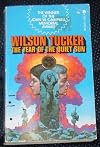
The Year of the Quiet Sun
by Wilson Tucker
On This Page
Description
Unavoidably, David Cheney becomes part of the future, in which a nuclear war has weakened both East and West, and in which America is torn by a race war. Yet among this desolate world, he discovers reasons for living.Tags
Recommendations



















Member Reviews
2.5/5
Some important context for The Year of the Quiet Sun is that the author, Wilson Tucker, was primarily a fan of the SF genre during the 1950's through the 1970's. He ran some clubs and was generally involved in the early scene. This novel is his most well known work, and he didn't produce much else, though one of his others works also was published in the first run of Ace science fictions specials. Why I point all of this out is that my main sticking point with The Year of the Quiet Sun is that it doesn't feel like it was written with an experienced hand. The quality is mixed at best, and even if the time travel element is interesting, I don't know that the writing itself is good enough to make this a super worth while read. It very show more much reads like higher quality fan fiction.
In terms of plot, we follow an anthropologist named Brian Chaney who recently uncovered and translated several ancient scrolls near Jerusalem that he believes points to the bible being a work of fiction. Because of this work, and another previous work of his that predicts the events of the near future, he is selected for a secret government team of men to test and use a recently developed time machine. First they are sent only 2 years ahead to see if the current president gets elected, and then they are sent 20 years forward to see if Chaney's predictions are true. This is set against the backdrop of a slightly embellished version of a 1970's United States, where racial tensions are high, and there is the looming threat of war with the USSR, China, and a brewing conflict in the Middle East. He mentions Ronald Reagan (though not by name), and envisions a future US in which cronyism and corruption lead us to an apocalyptic demise.
For some odd reason, Tucker writes a lot of the dialogue like he's writing a stage play with directions, starting lines of dialogue with an emotion or name of the charter followed by a colon and then the words they speak. It's comically lazy at worst, and a stylistic choice that makes for bad writing at best. Tucker also has the classic lecherous writing of women, as two of the time travel group consistently fawn over the director of the program. Tucker is pretty flippant about this, detouring from the action of the plot to mention some physical attribute of hers for no reason other than to be horny. This also speaks to the poor editing of the novel. Large passages of the text could've been removed without a tangible effect to the book, especially during the bloated and slow first half, in which there is no time traveling at all.
The second half of the book, which focuses completely on the three men venturing 20 years into the future is much more readable and interesting. If the whole book had been like that it would be much improved. The paradox involved with time traveling, and the constraints of the vehicle itself were fun to think about. I also like getting the perspective of all three men sequentially as they went forward in time. It's just such a bummer that Tucker doesn't get around to any of this until he wasted my time with the first 100 pages, because it's not like that time was spent making realistic characters or developing interesting themes.
I find it hard to get rid of a book with this cool of cover art (I'm a sucker for this era of Ace Science Fiction Special), but jeez, I can't really see myself reading it ever again despite the much improved second half of the novel. It's teetering on the edge of getting voted off the island. show less
Some important context for The Year of the Quiet Sun is that the author, Wilson Tucker, was primarily a fan of the SF genre during the 1950's through the 1970's. He ran some clubs and was generally involved in the early scene. This novel is his most well known work, and he didn't produce much else, though one of his others works also was published in the first run of Ace science fictions specials. Why I point all of this out is that my main sticking point with The Year of the Quiet Sun is that it doesn't feel like it was written with an experienced hand. The quality is mixed at best, and even if the time travel element is interesting, I don't know that the writing itself is good enough to make this a super worth while read. It very show more much reads like higher quality fan fiction.
In terms of plot, we follow an anthropologist named Brian Chaney who recently uncovered and translated several ancient scrolls near Jerusalem that he believes points to the bible being a work of fiction. Because of this work, and another previous work of his that predicts the events of the near future, he is selected for a secret government team of men to test and use a recently developed time machine. First they are sent only 2 years ahead to see if the current president gets elected, and then they are sent 20 years forward to see if Chaney's predictions are true. This is set against the backdrop of a slightly embellished version of a 1970's United States, where racial tensions are high, and there is the looming threat of war with the USSR, China, and a brewing conflict in the Middle East. He mentions Ronald Reagan (though not by name), and envisions a future US in which cronyism and corruption lead us to an apocalyptic demise.
For some odd reason, Tucker writes a lot of the dialogue like he's writing a stage play with directions, starting lines of dialogue with an emotion or name of the charter followed by a colon and then the words they speak. It's comically lazy at worst, and a stylistic choice that makes for bad writing at best. Tucker also has the classic lecherous writing of women, as two of the time travel group consistently fawn over the director of the program. Tucker is pretty flippant about this, detouring from the action of the plot to mention some physical attribute of hers for no reason other than to be horny. This also speaks to the poor editing of the novel. Large passages of the text could've been removed without a tangible effect to the book, especially during the bloated and slow first half, in which there is no time traveling at all.
The second half of the book, which focuses completely on the three men venturing 20 years into the future is much more readable and interesting. If the whole book had been like that it would be much improved. The paradox involved with time traveling, and the constraints of the vehicle itself were fun to think about. I also like getting the perspective of all three men sequentially as they went forward in time. It's just such a bummer that Tucker doesn't get around to any of this until he wasted my time with the first 100 pages, because it's not like that time was spent making realistic characters or developing interesting themes.
I find it hard to get rid of a book with this cool of cover art (I'm a sucker for this era of Ace Science Fiction Special), but jeez, I can't really see myself reading it ever again despite the much improved second half of the novel. It's teetering on the edge of getting voted off the island. show less
Time travel ranks as the most difficult of science fiction genres. Though there are numerous stories featuring characters voyaging into the past to change history or venturing into the future to see what will become of humanity, most break down on various points of logic. As a result, in spite of the numerous novels, short stories, movies, and television series which incorporate time travel into the plot, there are only a few in which it is done well enough to deserve to be remembered.
Wilson Tucker’s novel ranks among the few in this category. In it, a demographer and biblical scholar is recruited to join a government team surveying the future. As they do so, they witness a deteriorating world torn apart by racial and political strife show more thanks to weak and egotistical leaders. Here Tucker establishes time travel using a series of consistent rules that work very effectively, allowing him to focus on the plot and characters. These are the true strengths of the novel, for while the future he extrapolates seems a dated product of its times thanks to the luxury of hindsight, it is just the background for a poignant inquiry into the fate of society as seen through the lives of five very different people. This results in a thoughtful tale that is a must-read for any fan of science fiction, one that demonstrates how best to tell a time travel story that works. show less
Wilson Tucker’s novel ranks among the few in this category. In it, a demographer and biblical scholar is recruited to join a government team surveying the future. As they do so, they witness a deteriorating world torn apart by racial and political strife show more thanks to weak and egotistical leaders. Here Tucker establishes time travel using a series of consistent rules that work very effectively, allowing him to focus on the plot and characters. These are the true strengths of the novel, for while the future he extrapolates seems a dated product of its times thanks to the luxury of hindsight, it is just the background for a poignant inquiry into the fate of society as seen through the lives of five very different people. This results in a thoughtful tale that is a must-read for any fan of science fiction, one that demonstrates how best to tell a time travel story that works. show less
My reactions upon reading this book in 1990 -- with a huge spoiler.
This is one of those minor sf classics that has not aged well. (It did win the John W. Campbell Memorial Award.).
I’m sure that, in 1970, a future of race war and conflict with China leading to apocalypse seemed imminently plausible. It seems very ... quaint now, a charmingly naive nightmare of childhood.
To be sure, the novel does have some points of interest: the tone is lonely and bleak, the time travel mechanism is rather novel, Tucker’s contention that the Book of Revelations is an example of Hebrew ‘biblical fiction”, the poignant last encounter between Brian Chaney and Kathryn van Hise (though their romance and the triangle of them and Arthur Saltus is show more rather dopey and hackneyed).
The book is almost worth reading for an oblique refernce to Ronald Reagan. He is described as that “actor” who lost in a landslide presidential election in 1980 -- the year Reagan won in a landslide.
However, this book commits a monumental literary sin, a colossal cheap shot ending. We find out that our protagonist, Brian Chaney, is black just like the “Ramjets” who, in collusion with China, brought America down. Now the white folk who survived are terrified of him. To withhold, purely for literary shock, an obvious fact which is not concealed for any logical reason and would have been evident if this story were, for instance, a movie, is a massive, unconvincing contrivance.
I think I know why he did it. Given a tale of racial war, Tucker probably wants us to question are values of race. Here is a character treated well all throughout the book by the other characters. He is intelligent, smart, not sexually perverted. At the end, others of the future see him as a monster. It still doesn’t work though. show less
This is one of those minor sf classics that has not aged well. (It did win the John W. Campbell Memorial Award.).
I’m sure that, in 1970, a future of race war and conflict with China leading to apocalypse seemed imminently plausible. It seems very ... quaint now, a charmingly naive nightmare of childhood.
To be sure, the novel does have some points of interest: the tone is lonely and bleak, the time travel mechanism is rather novel, Tucker’s contention that the Book of Revelations is an example of Hebrew ‘biblical fiction”, the poignant last encounter between Brian Chaney and Kathryn van Hise (though their romance and the triangle of them and Arthur Saltus is show more rather dopey and hackneyed).
The book is almost worth reading for an oblique refernce to Ronald Reagan. He is described as that “actor” who lost in a landslide presidential election in 1980 -- the year Reagan won in a landslide.
However, this book commits a monumental literary sin, a colossal cheap shot ending. We find out that our protagonist, Brian Chaney, is black just like the “Ramjets” who, in collusion with China, brought America down. Now the white folk who survived are terrified of him. To withhold, purely for literary shock, an obvious fact which is not concealed for any logical reason and would have been evident if this story were, for instance, a movie, is a massive, unconvincing contrivance.
I think I know why he did it. Given a tale of racial war, Tucker probably wants us to question are values of race. Here is a character treated well all throughout the book by the other characters. He is intelligent, smart, not sexually perverted. At the end, others of the future see him as a monster. It still doesn’t work though. show less
Brian Chaney, a Dead Sea Scrolls scholar and think-tank thinker, finds himself volunteered, along with two other men plucked from military ranks, for a government-funded mission to test a Time Displacement Vehicle. Their first field study is an order from the president to go ahead two years to discover whether he wins re-election (yoicks), and, well, they find so much more than that.
Ooof, this one was surprisingly good. And disturbingly relevant. There are a couple of really good twists sprinkled in for good measure, too. Definitely recommended.
Ooof, this one was surprisingly good. And disturbingly relevant. There are a couple of really good twists sprinkled in for good measure, too. Definitely recommended.
A Time Travel story. While this book was written in the Vietnam War period, yet here we are in the 2010+ period still dealing with the recurring themes of Presidential Ego, and racial unrest. But increasingly readable book, as time goes by. there is an amusing reference to Ronald Reagan as "An actor who was defeated in 1980" the year in which Reagan won his resounding Presidential victory, sadly to the detriment of civilization since. {2019 ed.]
A novel about a government sponored experimental time travel project for travel into the near future. The novel starts out a little laconic with a lot of flirty dated dialogue and character interaction, but the second part is about the time travel trips, and is gripping, suspenseful and well written.
There is a discussion of racial issues as an important backdrop to the story, of which the very premise today, might not be regarded as PC, but I didn't feel there was anything suspect in the proceedings, and the subject matter is handled with a great deal of sensitivity and tact. There is also some ancient historical background research to the novel that is of interest.
It might be one of the great time travel novels and I highly recommend show more it. Wilson "Bob" Tucker is an important figure in the history of the fan SF community. Do yourself a favor and check this one out. A Pringle Top 100 pick. show less
There is a discussion of racial issues as an important backdrop to the story, of which the very premise today, might not be regarded as PC, but I didn't feel there was anything suspect in the proceedings, and the subject matter is handled with a great deal of sensitivity and tact. There is also some ancient historical background research to the novel that is of interest.
It might be one of the great time travel novels and I highly recommend show more it. Wilson "Bob" Tucker is an important figure in the history of the fan SF community. Do yourself a favor and check this one out. A Pringle Top 100 pick. show less
[Minor Spoilers]
Year of the Quiet Sun by Wilson Tucker is a sci fi adventure that unfortunately didn’t really get going until page 75 or so! The characterization was slow and yet created an intriguing narrator, Brian Chaney, an archeologist of sorts who is controversial (yeah, a controversial archeologist, go figure) who is brought in as part of a special team to travel through time.
Plots & Characters:
Except for Brian and Kathryn (one of the people in charge of this time travel project), it’s hard to care for the rest. We don’t really know much about the rest of the team except in a superficial way. And the political scene is vague as well. We spend pages on the Congressional Record and other statistics. Sigh.
Many pages are spent show more meeting his military buds on the team, the lovely Kathryn and how corrupt the government is, its current secrets and what’s going on in the Asian war theater. Apparently Tucker is predicting what if Vietnam continued and how the president and Congress are heading towards corruption.
That’s fine, I mean authors have used science fiction as a back drop for their own theories be they political or whatever. I was not expecting a race war to occur somewhere in Chicago! The men go forward in time two years and see things are getting bad: riots, a takeover of Chicago by the poor and desperate, and a president who cares more about re-election and has a major ego problem.
Bottom Line:
The ending was disappointing. I was expecting Brian to come through but that did not really happen. There were a few surprises regarding Brian that helped save it for me. But would it not have been cool to have him return to the present, stop the riots and the insane government and save the day?
Oh well! show less
Year of the Quiet Sun by Wilson Tucker is a sci fi adventure that unfortunately didn’t really get going until page 75 or so! The characterization was slow and yet created an intriguing narrator, Brian Chaney, an archeologist of sorts who is controversial (yeah, a controversial archeologist, go figure) who is brought in as part of a special team to travel through time.
Plots & Characters:
Except for Brian and Kathryn (one of the people in charge of this time travel project), it’s hard to care for the rest. We don’t really know much about the rest of the team except in a superficial way. And the political scene is vague as well. We spend pages on the Congressional Record and other statistics. Sigh.
Many pages are spent show more meeting his military buds on the team, the lovely Kathryn and how corrupt the government is, its current secrets and what’s going on in the Asian war theater. Apparently Tucker is predicting what if Vietnam continued and how the president and Congress are heading towards corruption.
That’s fine, I mean authors have used science fiction as a back drop for their own theories be they political or whatever. I was not expecting a race war to occur somewhere in Chicago! The men go forward in time two years and see things are getting bad: riots, a takeover of Chicago by the poor and desperate, and a president who cares more about re-election and has a major ego problem.
Bottom Line:
The ending was disappointing. I was expecting Brian to come through but that did not really happen. There were a few surprises regarding Brian that helped save it for me. But would it not have been cool to have him return to the present, stop the riots and the insane government and save the day?
Oh well! show less
Members
- Recently Added By
Lists

David Pringle's Science Fiction: The 100 Best Novels
101 works; 9 members

Hugo Award Winners and Nominees
6 works; 1 member

Books Read in 2023
5,638 works; 147 members
Author Information

52+ Works 1,833 Members
Some Editions
Awards and Honors
Awards
Notable Lists
Series
Belongs to Publisher Series
Work Relationships
Common Knowledge
- Canonical title*
- El Año del Sol Tranquilo
- Original title
- The Year of the Quiet Sun
- Original publication date
- 1970
- Original language
- English
*Some information comes from Common Knowledge in other languages. Click "Edit" for more information.
Classifications
Statistics
- Members
- 469
- Popularity
- 65,123
- Reviews
- 14
- Rating
- (3.48)
- Languages
- 5 — English, French, German, Italian, Spanish
- Media
- Paper
- ISBNs
- 14
- ASINs
- 15