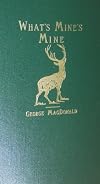
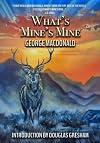
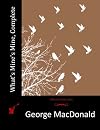
What's Mine's Mine
by George MacDonald
On This Page
Description
This Scottish masterpiece of 1886 contains wonderfully descriptive passages of the Scottish highlands. The story centers around two families-the English Palmers and that of clan chief Alister Macruadh-and Mr. Palmer's cruel removal of Clan Ruadh from its traditional lands. This portrait of the Highland Clearances poignantly captures how and why the clan way of life disappeared from the highlands in the 18th and 19th centuries. One of MacDonald's signature tunes, God's revelation in nature, show more is woven throughout the narrative. Along with Robert Falconer, What's Mine's Mine also offers insight into MacDonald's controversial views on the afterlife. The pointed discussions between Calvinist Mrs. Macruadh and her sons Alister and Ian are memorable indeed. In spite of its highland flavor, this intensely Scottish tale did not employ the local dialect, which at the time was primarily Gaelic. show lessTags
Recommendations




















Member Reviews
First published in 1886, this is a story of two brothers that love each other the way David and Jonathan did. It's a story of the vanishing of the highland clans' way of life as their land is bought out by "lowlanders" richer than they. And it's the story of the eldest of those brothers, Alister Macruadh, a young chief who loves his clan with the love of a father and wants above all else to keep his land and keep his people safely with him. But this is a George MacDonald novel, which means it's often less novel than sermon and/or love letter to the beauty of his dear Scotland. What's Mine's Mine is considered one of his "romances," but the love story of Alister and Mercy is less important to MacDonald than all the aforementioned show more elements. (Still, it is a lovely element.)
Trying to explain my recently cultivated love for this author is a difficult thing. No fiction author would today get away with all his "be more like Jesus and this is how you do it!" asides. He was certainly a preacher first and a novelist second; even his greatest fan C.S. Lewis admits this. What he does in these books shouldn't work, especially for a modern reader like myself. Yet the beautiful old language and the open heart of the author, loving his reader as well as his characters right there on the page, are irresistible to me. I understand at last Lewis's description that MacDonald "baptized his imagination," both in the literal sense of that word and the spiritual sense. Funny that this happened for him while reading one of MacDonald's fantasy works and for me while reading one of his romances (me who generally doesn't read them!). This book made me examine myself as a reflection of Christ and showed me ways in which old idolatries still hang on.
And I'm still thinking of Alister and Ian as old friends, missing them now their story is ended, wishing there were a sequel (something like Adventures of Clanruadh in Canada; if I discovered this book existed, I really might cry tears of happiness).
EDIT: Clarifying, since this review also shows up on the page for the Michael Philips abridgment (The Highlander's Last Song), that my review is of the unabridged work. show less
Trying to explain my recently cultivated love for this author is a difficult thing. No fiction author would today get away with all his "be more like Jesus and this is how you do it!" asides. He was certainly a preacher first and a novelist second; even his greatest fan C.S. Lewis admits this. What he does in these books shouldn't work, especially for a modern reader like myself. Yet the beautiful old language and the open heart of the author, loving his reader as well as his characters right there on the page, are irresistible to me. I understand at last Lewis's description that MacDonald "baptized his imagination," both in the literal sense of that word and the spiritual sense. Funny that this happened for him while reading one of MacDonald's fantasy works and for me while reading one of his romances (me who generally doesn't read them!). This book made me examine myself as a reflection of Christ and showed me ways in which old idolatries still hang on.
And I'm still thinking of Alister and Ian as old friends, missing them now their story is ended, wishing there were a sequel (something like Adventures of Clanruadh in Canada; if I discovered this book existed, I really might cry tears of happiness).
EDIT: Clarifying, since this review also shows up on the page for the Michael Philips abridgment (The Highlander's Last Song), that my review is of the unabridged work. show less
Members
- Recently Added By
Author Information

384+ Works 38,928 Members
George MacDonald was born on December 10, 1824 in Huntley, Aberdeenshire, Scotland. He attended University in Aberdeen in 1840 and then went on to Highbury College in 1848 where he studied to be a Congregational Minister, receiving his M. A. After being a minister for several years, he became a lecturer in English literature at Kings College in show more London before becoming a full-time writer. He wrote fiction, non-fiction, and poetry. In 1955, he wrote his first important original work, a long religious poem entitled Within and Without. He is best known for his fantasy novels Phantastes, The Princess and the Goblin, At the Back of the North Wind, and Lilith and fairy tales including The Light Princess, The Golden Key, and The Wise Woman. In 1863, he published David Eiginbrod, the first of a dozen novels that were set in Scotland and based on the lives of rural Scots. He died on September 18. 1905. (Bowker Author Biography) show less
Work Relationships
Is abridged in
Common Knowledge
- Canonical title
- What's Mine's Mine
- Original title
- What’s mine’s mine; What's Mine's Mine
- Alternate titles
- The Highlander's Last Song (republished, updated English) (republished, updated English)
- Original publication date
- 1886
- People/Characters
- Alister Macruadh
- First words
- A large fire blazed in the low round-backed grate.
The room was handsomely furnished, but such as I would quarrel with none for calling common, for it certainly was uninteresting. - Last words
- (Click to show. Warning: May contain spoilers.)There no man would say, "What's mine's mine!" but where all would say to God, "What's mine is yours."
Classifications
Statistics
- Members
- 61
- Popularity
- 504,646
- Reviews
- 1
- Rating
- (5.00)
- Languages
- English
- Media
- Paper, Audiobook, Ebook
- ISBNs
- 17
- ASINs
- 6