On This Page
Description
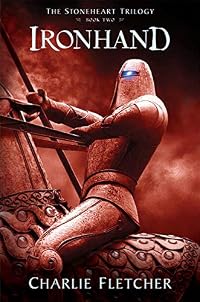
Having upset the balance between the warring statues of London, twelve-year-old George is confronted with new challenges as he tries to free his captured friends Edie and The Gunner from the formidable Walker and deal with the three strange veins of marble, bronze, and stone that have begun to grow out of his hand.Tags
Recommendations


Member Reviews
In the first book of the Stoneheart trilogy, Stoneheart, young George Chapman breaks the head off a small statue in a fit of rage and found himself in an 'unLondon' (As the 'The Story so Far' puts it) where statues can come to life. George was able to break the statue with his hand instead of breaking his hand with the statue because he is a maker -- George inherited his late father's talent at sculpting.
The London statues come in two types. The human-shaped ones are known as 'spits' because they are the 'spit and image' (original form of 'spitting image') of humans. The ones shaped like animals or monsters or mythological creatures are called 'taints'. The sphinxes, being lions with women's heads, are a combination. Abstract statues of show more humans, such as the Grid Man, are taints. As we learn in chapter 37, they're called 'taints' because wherever their shadows fall, the children of light feel the taint of fear from the evil that happened the first time. (Should I bring up tiny 'spits' such as the Venus of Willendorf, which is estimated to be -- at the very least -- 25,000 years old?). It's an ugly origin story.
Taints started attacking George, but he was saved by the Gunner, a bronze World War I soldier, They were joined by Edie Laemmel, a girl who is a glint (women and girls able to see visions of the past by touching stone or metal). The Gunner had thought that glints were dying out naturally. In chapter five we learn why glints are so rare these days. It's a reason that's as ugly as the origin of taints..
The villainous Walker, one of the 'weirded' (cursed men), considers George and Edie his rightful prey. As this book opens, the children no longer have the Gunner to protect them because the Gunner went back on the maker's oath that the Walker made him give. He did it to save Edie. Now the Walker has the Gunner trapped. If the Gunner isn't back on his plinth by midnight, he'll join the dead statues of London.
George decided to make amends the hard way in the first book because he didn't want to desert Edie. He finds out that the hard way was a bit more literal than he expected in chapter six. Two of the duels he must fight will take place in this book and the third in Silvertongue.
We get to see Spout, the cat-headed gargoyle that was supposedly destroyed in the first book. He has an even more interesting role in this one.
We meet the Black Friar and Little Tragedy again, and other spits and taints of London are introduced. I particularly liked the Red Queen, which has nothing to do with Alice's Red Queen from Through the Looking-Glass and What Alice Found There. Icarus may be a taint, but I feel rather sorry for him anyway. As far as the Walker is concerned, I think he deserved what he got. As for Ariel, who is a Minister of Fate, I cry foul because she didn't make sure George understood what was being asked of him by the Last Knight, as well as not giving him a chance to get a weapon. I am not sorry about the outcome of her dealings with George.
Of course there is a way to save the Gunner, but it's not for the faint of heart. I'm sure I wouldn't have had the courage to pull it off.
NOTES:
Chapter 7: "When Adam delved and Eve span, who was then the gentleman?" is a famous quotation by a priest named John Ball, one of the leaders in England's Peasant Revolt in 1381. (He'd already been excommunicated for wanting a classless society.) As his saying rightly points out, there were no upper classes, aristocracy, or royalty during the time of Adam and Eve.
Chapter 17:
a. I believe that Ariel is complaining about the statue of Peter Pan that is in Kensington Gardens. The author of Peter Pan also wrote Peter Pan in Kensington Gardens.
b. 'Send not to know for whom the bell tolls, boy, it tolls for thee.' If 'boy' were left out and 'Therefore' were put at the beginning of the sentence, Ariel would be quoting the last sentence of John Donne's famous poem, 'For Whom the Bell Tolls'. Good one, Mr. Fletcher!
c. The King Edgar mentioned in the inscription for the Last Knight of the Gnihtengild (ke-nik-ten-gild) was known as Edgar the Peaceful.
Chapter 34:
a. 'Wurzel' is being used in the farmers from Southhampton who speak with a strong West Country dialect.
b. A 'Geordie' is someone from '...Tyneside area of North East England'.
So much peril to be escaped, so much suspense to be endured! There's the Frost Fair from the first book now seen from the other side of the girl being chased by the Walker, a brief stint during the Blitz in World War II, and a longer, gruesome scene set during World War I that should have left George with Post Traumatic Stress Disorder (or 'shell shock" as it was known then).
This is definitely an adventure to savor! show less
The London statues come in two types. The human-shaped ones are known as 'spits' because they are the 'spit and image' (original form of 'spitting image') of humans. The ones shaped like animals or monsters or mythological creatures are called 'taints'. The sphinxes, being lions with women's heads, are a combination. Abstract statues of show more humans, such as the Grid Man, are taints. As we learn in chapter 37, they're called 'taints' because wherever their shadows fall, the children of light feel the taint of fear from the evil that happened the first time. (Should I bring up tiny 'spits' such as the Venus of Willendorf, which is estimated to be -- at the very least -- 25,000 years old?). It's an ugly origin story.
Taints started attacking George, but he was saved by the Gunner, a bronze World War I soldier, They were joined by Edie Laemmel, a girl who is a glint (women and girls able to see visions of the past by touching stone or metal). The Gunner had thought that glints were dying out naturally. In chapter five we learn why glints are so rare these days. It's a reason that's as ugly as the origin of taints..
The villainous Walker, one of the 'weirded' (cursed men), considers George and Edie his rightful prey. As this book opens, the children no longer have the Gunner to protect them because the Gunner went back on the maker's oath that the Walker made him give. He did it to save Edie. Now the Walker has the Gunner trapped. If the Gunner isn't back on his plinth by midnight, he'll join the dead statues of London.
George decided to make amends the hard way in the first book because he didn't want to desert Edie. He finds out that the hard way was a bit more literal than he expected in chapter six. Two of the duels he must fight will take place in this book and the third in Silvertongue.
We get to see Spout, the cat-headed gargoyle that was supposedly destroyed in the first book. He has an even more interesting role in this one.
We meet the Black Friar and Little Tragedy again, and other spits and taints of London are introduced. I particularly liked the Red Queen, which has nothing to do with Alice's Red Queen from Through the Looking-Glass and What Alice Found There. Icarus may be a taint, but I feel rather sorry for him anyway. As far as the Walker is concerned, I think he deserved what he got. As for Ariel, who is a Minister of Fate, I cry foul because she didn't make sure George understood what was being asked of him by the Last Knight, as well as not giving him a chance to get a weapon. I am not sorry about the outcome of her dealings with George.
Of course there is a way to save the Gunner, but it's not for the faint of heart. I'm sure I wouldn't have had the courage to pull it off.
NOTES:
Chapter 7: "When Adam delved and Eve span, who was then the gentleman?" is a famous quotation by a priest named John Ball, one of the leaders in England's Peasant Revolt in 1381. (He'd already been excommunicated for wanting a classless society.) As his saying rightly points out, there were no upper classes, aristocracy, or royalty during the time of Adam and Eve.
Chapter 17:
a. I believe that Ariel is complaining about the statue of Peter Pan that is in Kensington Gardens. The author of Peter Pan also wrote Peter Pan in Kensington Gardens.
b. 'Send not to know for whom the bell tolls, boy, it tolls for thee.' If 'boy' were left out and 'Therefore' were put at the beginning of the sentence, Ariel would be quoting the last sentence of John Donne's famous poem, 'For Whom the Bell Tolls'. Good one, Mr. Fletcher!
c. The King Edgar mentioned in the inscription for the Last Knight of the Gnihtengild (ke-nik-ten-gild) was known as Edgar the Peaceful.
Chapter 34:
a. 'Wurzel' is being used in the farmers from Southhampton who speak with a strong West Country dialect.
b. A 'Geordie' is someone from '...Tyneside area of North East England'.
So much peril to be escaped, so much suspense to be endured! There's the Frost Fair from the first book now seen from the other side of the girl being chased by the Walker, a brief stint during the Blitz in World War II, and a longer, gruesome scene set during World War I that should have left George with Post Traumatic Stress Disorder (or 'shell shock" as it was known then).
This is definitely an adventure to savor! show less
Goes at quite a pace and packs in two world wars! Pleased that this time there are (strong-minded) women statues - not very many in London which makes this a bit of a challenge for the author I admit - and the characters are more complicated, although a tad annoyed that the BL continues to be a "bad" place.
"Kivisüdame” triloogia teises fantaasiaküllases raamatus jätkuvad George’i, Edie ning nende sõprade ja vaenlaste seiklused ja võitlused Londoni linna tänavatel. „Raudkäsi” viib lugejad veelgi sügavamale eba-Londoni dimensioonidesse, kus süljed ja räpad ehk head ja kurjad kujud ja monumendid liiguvad ja lahinguid peavad. George ja Edie peavad tasuma Kahurile võla, kui too ennast nende eest oli ohverdanud. Tema päästmiseks tuleb neil aga seista silmitsi järjest hirmsamate ohtudega...
Stoneheart is a wonderful young adult series about a London boy named George who awakens evil forces when he breaks the head off of a stone dragon during a temper tantrum. George enters a new world where statues come to life and are divided into 2 camps - human statues who help George make reparations and try to fix the world and evil animal statues (like dragons and gargoyles). Ironhand is the 2nd book in the trilogy. Although it is not as exciting or captivating as Stoneheart, the fast pace continues with many plot twists. The audio version is superbly narrated by Jim Dale who creates an entire cast of voices from Gargoyles to a stuttering Samuel Johnson. The book takes you all over London and will definitely make you want to get out show more your suitcase and see the famous sites (and their statues) for yourself. Now onto book 3... Silvertongue. show less
George and Edie have to work together and separately against the Walker who appears to be set against them. It's interesting to see the different statues taking sides in the fight and how George has to face up to several fears. Still it's a bridging novel and it's largely setting up what happens in the final novel in the trilogy.
I really enjoyed reading thos book! I like the shortish chapters which makes it easy to read. It had enought action and mystery to make it an iteresting read! I can't wait to see how the series ends!
In this book George has the maker's sign. He accepts three challenges from the Last Knight. As he accepts these challenges three veins start to crawl up his arm to his heart. Spout a gargoyle helps George numerous of times. Eddie goes back in time with the Gunner. They find out whose her and mom annd how she got her heart stone. War is calling and George and Edie are facing life or death. Can they keep themselves alive?
My own opinion of this book is great. George has a rough time but so does Edie. I like how they learn to cope with it. What i really love about this book is that Edie is resurrected. After that i got lost. Edie saves a raven. Overall the book is a 5/5.
My own opinion of this book is great. George has a rough time but so does Edie. I like how they learn to cope with it. What i really love about this book is that Edie is resurrected. After that i got lost. Edie saves a raven. Overall the book is a 5/5.
Members
- Recently Added By
Author Information

11 Works 3,345 Members
Some Editions
Awards and Honors
Awards
Series

Common Knowledge
- Canonical title
- Ironhand
- Original publication date
- 2007
- People/Characters
- George Chapman (a maker); Edie Laemmel (a glint); the Gunner (spit | statue | part of the Royal Artillery Memorial); the Walker (a cursed servant of the stone | John Dee); the Black Friar (spit | statue); the Raven (works for the Walker | Muninn) (show all 29); the Tallyman (a collective use of humans); Spout, the cat-faced gargoyle (taint | statue); Icarus III (taint | statue | the Minotaur's brother); the Red Queen (spit | statue of Queen Boudica | Boudicca | Boadicea | Boudicea | spit | statue of Queen Boudica | Boudicca | Boadicea | Boudicea); the Red Queen's two nameless daughters (spits | statues); the Bull (taint | statue); Ariel (spit | statue of a girl | a minister of Fate); the Little Tragedy (spit | little boy | statue); the Last Knight of the Cnihtengild (pronounced ke-nik-ten-gild | spit | statue); ghostly figures of the Cnihtengild; Newton (taint rather than spit | statue); Big Red (gargoyle | taint | statue); unnamed gargoyles (taints | statues); Westie (spit | statue | part of the Euston Mob); Rifleman South (spit | statue | part of the Euston Mob); Corporal North (spit | statue | part of the Euston Mob); Private East (spit | statue | part of the Euston Mob); Blind glint in the past (slave of the Walker | Frost Fair flashback); the Walker's two brindled mastiff dogs (unfriendly | Frost Fair flashback); the Officer (spit | statue | part of the Royal Artillery Memorial); the Unknown Soldier (spit | statue | part of the Royal Artillery Memorial); the three stone skulls of the Ghastly Grim gate (the crowned one is Majesty | spits | statues); horses (World War I flashback)
- Important places
- London, England, UK; Statue of Mahatma Gandhi, Tavistock Square, London, England, UK; Old Change Court, London, England, UK; Westminster Bridge, London, England, UK; Tate Britain, London, England, UK; Blackfriar Pub, London, UK (show all 16); lost medieval water tank, Tyburn River, under Marylebone, London, England, UK; the King's Library, London, UK; St. Pancras Railway Station, London, England, UK; British Library, London, UK; Euston Road, London, UK; the House of the Lost/House of Pain, London, UK; the Royal Artillery Memorial, Hyde Park Corner, London, UK; Tate Britain, London, England, UK; the Ghastly Grim gate, St. Olave's, Hart Street, London, UK; Frost Fair on the River Thames, London, UK
- Important events
- World War II, British Home Front; World War I; Frost Fair on the Thames, 1814
- Epigraph
- Wounds are for the desperate, blows are for the strong,
Balm and oil for weary hearts all cut and bruised
with wrong.
I forgive thy treason -- I redeem thy fall --
For Iron -- Cold Iron -- must be maste... (show all)r of men all!
'Cold Iron'
-- Rudyard Kipling - Dedication
- With all my love and thanks
to Domenica, without whom
none of this would be possible
or nearly as much fun - First words
- On a school trip, George breaks a fragment from a carving of a dragon on the front of the Natural History Museum. [The story so far]
The Walker and the Gunner fell into the dark, pitched into a deep abyssal blackness beyond the memory of light. [chapter 1] - Quotations
- [After the Black Friar asks the Red Queen what business of hers are glints.]
...'They are strong girls and they live at a peril beyond bearing. We have not seen one in years.'
'Perhaps you are mistaken.' T... (show all)he Friar shrugged.
'Not about that, Friar. Any woman in peril is my charge and care.'
'And why is that, pray?'
She slammed the spear down even harder, making her daughters jump. 'Because I will it so. I have ALWAYS willed it so!' [chapter 9] - Last words
- (Click to show. Warning: May contain spoilers.)'If he's one of us... we're really in trouble.'
Classifications
Statistics
- Members
- 463
- Popularity
- 65,538
- Reviews
- 9
- Rating
- (3.96)
- Languages
- 8 — English, Estonian, French, German, Italian, Portuguese, Croatian, Spanish
- Media
- Paper, Audiobook, Ebook
- ISBNs
- 19
- ASINs
- 6