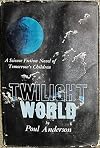
Twilight World
by Poul Anderson
On This Page
Tags
Recommendations














Member Reviews
Another disappointment ... hack work that starts out as something with real promise and then plods into a variant of Heinlein's Rocket Ship Galileo only more puerile if that were possible. It was apparently knocked out in 1961 though this edition has a 1981 copyright attached.
There are two distinct halves that makes it look like a mash-up between two novellas - one with considerable potential and the second not worth reading and which we can summarise as standard rocket to Mars adventure and a Cold War battle with evil post-apocalyptic Soviet-like rivals. Yawn!
This is a shame because the initial core idea is interesting and the writing is often evocative of landscape and character. Anderson postulates that the genetic damage to humanity show more of a nuclear war is far greater to all earthly life than had been envisaged. Mutation becomes normal.
There was a point when I thought I would not be able to put the book down as this idea is developed not only as a story of post-apocalyptic survival but of how a remaining system of governance (a benign military temporary dictatorship) might deal with the problem both practically and ethically.
There appears at one point to be an opportunity for a 'Herrenvolk' to emerge. This is enables a brief and even courageous moral discussion of this option which would still have been touchy only fifteen years after the defeat of the national socialist regime. It is rejected as impractical and wrong.
This could have led to a precursor of Marvel's X-Men series which first appeared in 1963 or, much later, of Darwin's Radio (1999) and Darwin's Children (2002) by Greg Bear but Anderson bottles it. He abandons development for some quick thrills.
The mutant young people might find themselves briefly in a version of the Xavier Institute but their transition is to a simplistic story about building a new world for mutated humanity on Mars. It is crass and poorly thought out. Credible (for 1961) hard genetic science collapses into the incredible.
This is a shame. I can only recommend that you read up to the decision to go to Mars about half way through the book and then just stop unless you like wasting your life as I do on 'completism'. You may get something out of the first half that you will definitely lose in the second.
For Poul Anderson completists this story might have the virtue of being another working out of his frequent obsession with the best forms of governance for human conquest of space. There is a rather touching and well written postscript that 'justifies' his preferred progressive strategy.
His view of earth-based humanity is nevertheless depressingly negative with the attitudes that led to apocalypse leading to the same type of conflict post-apocalypse. One suspects a negative view of the human ability not to resort to violence is in-built somewhere in the American psyche.
The irony of it is that this pessimism is matched to another American trait - a complete inability not to see any other system of human thought as something that can be compromised with to common ends. The 'Siberians' are regarded as simply wrong and so free to be killed.
The 'optimism' in the postscript is essentially based on humanity ceasing to be human as we understand it and to have 'mutated' into something 'better', adapted to new weird environments much as we were supposed to have been mutated from apes. show less
There are two distinct halves that makes it look like a mash-up between two novellas - one with considerable potential and the second not worth reading and which we can summarise as standard rocket to Mars adventure and a Cold War battle with evil post-apocalyptic Soviet-like rivals. Yawn!
This is a shame because the initial core idea is interesting and the writing is often evocative of landscape and character. Anderson postulates that the genetic damage to humanity show more of a nuclear war is far greater to all earthly life than had been envisaged. Mutation becomes normal.
There was a point when I thought I would not be able to put the book down as this idea is developed not only as a story of post-apocalyptic survival but of how a remaining system of governance (a benign military temporary dictatorship) might deal with the problem both practically and ethically.
There appears at one point to be an opportunity for a 'Herrenvolk' to emerge. This is enables a brief and even courageous moral discussion of this option which would still have been touchy only fifteen years after the defeat of the national socialist regime. It is rejected as impractical and wrong.
This could have led to a precursor of Marvel's X-Men series which first appeared in 1963 or, much later, of Darwin's Radio (1999) and Darwin's Children (2002) by Greg Bear but Anderson bottles it. He abandons development for some quick thrills.
The mutant young people might find themselves briefly in a version of the Xavier Institute but their transition is to a simplistic story about building a new world for mutated humanity on Mars. It is crass and poorly thought out. Credible (for 1961) hard genetic science collapses into the incredible.
This is a shame. I can only recommend that you read up to the decision to go to Mars about half way through the book and then just stop unless you like wasting your life as I do on 'completism'. You may get something out of the first half that you will definitely lose in the second.
For Poul Anderson completists this story might have the virtue of being another working out of his frequent obsession with the best forms of governance for human conquest of space. There is a rather touching and well written postscript that 'justifies' his preferred progressive strategy.
His view of earth-based humanity is nevertheless depressingly negative with the attitudes that led to apocalypse leading to the same type of conflict post-apocalypse. One suspects a negative view of the human ability not to resort to violence is in-built somewhere in the American psyche.
The irony of it is that this pessimism is matched to another American trait - a complete inability not to see any other system of human thought as something that can be compromised with to common ends. The 'Siberians' are regarded as simply wrong and so free to be killed.
The 'optimism' in the postscript is essentially based on humanity ceasing to be human as we understand it and to have 'mutated' into something 'better', adapted to new weird environments much as we were supposed to have been mutated from apes. show less
Ratings
Members
- Recently Added By
Author Information

693+ Works 53,538 Members
Poul Anderson, November 25, 1926 - July 31, 2001 Poul Anderson was born on November 25, 1926 in Bristol, Pennsylvania to parents Anton and Astrid. After his father's death, Poul's mother took them first to Denmark and then to Maryland and Minnesota. He earned his degree in Physics from the University of Minnesota, but chose instead to write show more stories for science fiction magazines, such as "Astounding." Anderson is considered a "hard science fiction" writer, meaning that his books have a basis in scientific fact. To attain this high level of scientific realism, Anderson spent many hours researching his topics with scientists and professors. He liked to write about individual liberty and free will, which was a well known theme in many of his books. He also liked to incorporate his love of Norse mythology into his stories, sometimes causing his modern day characters to find themselves in fantastical worlds, such as in "Three Hearts and Three Lions," published in 1961. Anderson has written over a hundred books, his last novel, "Genesis" won the John W. Campbell Award, one of the three major science fiction awards. He is a former president of the Science Fiction and Fantasy Writers of America and won three Nebula awards and nine Hugo Awards. In 1997, Anderson was named a Grandmaster by the Science Fiction and Fantasy Writers of America and was also inducted into the Science Fiction Fantasy Hall of Fame. Poul Anderson died on July 31, 2001 at the age of 74. (Bowker Author Biography) show less
Some Editions
Series
Belongs to Publisher Series
Work Relationships
Is contained in
Contains
Common Knowledge
- Canonical title*
- Skumring over jorden
- Original title
- Twilight World
- Original publication date
- 1961
- Epigraph
- On the world's loom
Weave the Norns doom,
Nor may they guide it nor change.
- Wagner: Siegfried - First words
- Ten miles up, it hardly showed.
- Last words
- (Click to show. Warning: May contain spoilers.)I think I would like to go back inside now.
*Some information comes from Common Knowledge in other languages. Click "Edit" for more information.
Classifications
Statistics
- Members
- 258
- Popularity
- 125,958
- Reviews
- 1
- Rating
- (2.93)
- Languages
- 6 — Dutch, English, German, Italian, Norwegian (Bokmål), Norwegian
- Media
- Paper, Ebook
- ISBNs
- 2
- ASINs
- 8