
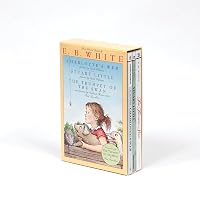
Charlotte's Web / Stuart Little / The Trumpet of the Swan
by E. B. White
On This Page
Description
Collects three classic novellas about animals trying to find friendship, love, and their place in the world.Tags
Recommendations



Member Reviews
A stunning, warm novel that understands exactly how big a small life can feel. It is as close to perfect as children’s literature gets.
A runt pig named Wilbur is spared by a girl named Fern and ends up in Zuckerman’s barn, where he discovers two things at once: how badly he wants to belong, and how quickly that can be taken away. Then Charlotte appears, a spider with a calm mind and a ruthless sense of purpose, and she decides his life is worth the trouble.
The miracle here is character. Wilbur is not cute in a way that feels manufactured. He is needy, sincere, occasionally ridiculous, and painfully real in his hunger for reassurance. Fern’s tenderness has weight because it costs her something, attention, argument, the willingness show more to be the odd one who cares. Charlotte is the book’s quiet triumph. She is practical, intelligent, and unsentimental about the facts of the world, yet deeply capable of love. That combination lands like truth. Even the barn’s supporting cast, including the animals who posture, gossip, and bargain, reads as a sharp little social map of a community.
E. B. White’s prose does that sneaky thing where it looks simple until you realize how controlled it is. The sentences are clean, musical, and completely unshowy. The pacing is equally confident. Nothing drags, but nothing is rushed past the emotional consequences either. When the book turns toward mortality, it does not flinch, and it does not perform darkness. It just tells the truth in a way a child can hold, and an adult can feel in the ribs.
This is also a very American story, not in a flag way, but in its rural texture and its clear eyed view of labor, appetite, and what gets valued. Even compassion has to fight for space.
Beautiful. Check it out. show less
A runt pig named Wilbur is spared by a girl named Fern and ends up in Zuckerman’s barn, where he discovers two things at once: how badly he wants to belong, and how quickly that can be taken away. Then Charlotte appears, a spider with a calm mind and a ruthless sense of purpose, and she decides his life is worth the trouble.
The miracle here is character. Wilbur is not cute in a way that feels manufactured. He is needy, sincere, occasionally ridiculous, and painfully real in his hunger for reassurance. Fern’s tenderness has weight because it costs her something, attention, argument, the willingness show more to be the odd one who cares. Charlotte is the book’s quiet triumph. She is practical, intelligent, and unsentimental about the facts of the world, yet deeply capable of love. That combination lands like truth. Even the barn’s supporting cast, including the animals who posture, gossip, and bargain, reads as a sharp little social map of a community.
E. B. White’s prose does that sneaky thing where it looks simple until you realize how controlled it is. The sentences are clean, musical, and completely unshowy. The pacing is equally confident. Nothing drags, but nothing is rushed past the emotional consequences either. When the book turns toward mortality, it does not flinch, and it does not perform darkness. It just tells the truth in a way a child can hold, and an adult can feel in the ribs.
This is also a very American story, not in a flag way, but in its rural texture and its clear eyed view of labor, appetite, and what gets valued. Even compassion has to fight for space.
Beautiful. Check it out. show less
Review of Charlotte's Web by E.B. White
Charlotte's Web is a poignant narrative that examines themes of friendship, sacrifice, and the cycle of life through the relationship between Wilbur, a pig, and Charlotte, a spider. White's storytelling effectively captures the innocence of childhood while addressing complex concepts such as mortality and the value of love and loyalty.
The novel utilizes a simple yet powerful plot structure, where Charlotte's efforts to save Wilbur from slaughter highlight the themes of selflessness and the impact of genuine friendship. The character development is particularly noteworthy; Charlotte embodies wisdom and compassion, while Wilbur represents vulnerability and growth.
The setting of the farm serves as a show more microcosm for exploring broader themes related to the natural world and human emotions. As a staple in children's literature, Charlotte's Web invites readers to reflect on their relationships and the significance of empathy, making it a timeless and essential read for all ages. show less
Charlotte's Web is a poignant narrative that examines themes of friendship, sacrifice, and the cycle of life through the relationship between Wilbur, a pig, and Charlotte, a spider. White's storytelling effectively captures the innocence of childhood while addressing complex concepts such as mortality and the value of love and loyalty.
The novel utilizes a simple yet powerful plot structure, where Charlotte's efforts to save Wilbur from slaughter highlight the themes of selflessness and the impact of genuine friendship. The character development is particularly noteworthy; Charlotte embodies wisdom and compassion, while Wilbur represents vulnerability and growth.
The setting of the farm serves as a show more microcosm for exploring broader themes related to the natural world and human emotions. As a staple in children's literature, Charlotte's Web invites readers to reflect on their relationships and the significance of empathy, making it a timeless and essential read for all ages. show less
Grade Level: 3-5
Charlotte’s Web is a classic children’s novel by E.B. White that explores themes of friendship, sacrifice, and the cycle of life. The story follows Wilbur, a runt pig who grows from helpless to confident with the help of Charlotte, a wise spider. Through her web messages, Charlotte uses symbolism and the power of words to save Wilbur. The book’s illustrations by Garth Williams enhance its warm, farm setting. As a blend of fantasy and realism, its simple yet emotional storytelling remains relevant for children, teaching them about love, loss, and kindness in a way that’s both gentle and meaningful.
Personally, I have always been touched by this book. Its meaning of true friendship and emotional story have always stuck with me. My show more sister loves pigs, so we often read this book and also watched the movie. show less
Personally, I have always been touched by this book. Its meaning of true friendship and emotional story have always stuck with me. My show more sister loves pigs, so we often read this book and also watched the movie. show less
Charlotte's Web is a classic novel that was very popular in my household when my mom read it to us, and rereading it was amazing and brought back a lot of memories and childhood nostalgia.
The theme of friendship over everything is really touching in this book, and the reality of life and death was heartbreaking as a child, but as covered in Children’s lit, children do need harsh topics to learn and grow as individuals. I think that the odd friendship on the outside perspective of Wilber and Charlotte teaches not to judge a book by it’s cover, and that kindness goes a long way. Overall, the book is popular for a reason, and a bittersweet ending that I think still resonates with me as a young adult.
The theme of friendship over everything is really touching in this book, and the reality of life and death was heartbreaking as a child, but as covered in Children’s lit, children do need harsh topics to learn and grow as individuals. I think that the odd friendship on the outside perspective of Wilber and Charlotte teaches not to judge a book by it’s cover, and that kindness goes a long way. Overall, the book is popular for a reason, and a bittersweet ending that I think still resonates with me as a young adult.
Charlotte’s Web is such a touching story about friendship and loyalty. I really connected with the relationship between Wilbur and Charlotte—the way Charlotte cares for Wilbur and looks out for him is really moving. The story also made me think about kindness, courage, and how even small actions can make a big difference. I think it’s one of those books that sticks with you, no matter how old you are.
"Charlotte's Web" is a classic children's novel with a timeless theme of selflessness and friendship. This theme is brought to life by the characters named Wilbur, who is a pig who is curious and naive, and a spider named Charlotte, who can be identified by her wise and caring personality. The book follows the story of the pig's journey of finding out that the international significance of his life is to be slaughtered. With this horrifying news, Wibur becomes very hopeless about his future; however, Charlotte offers him comfort with loyalty, love, and friendship. E.B. White uses kind and innocent dialogue alongside the vivid descriptions of the farm to offer a comforting atmosphere that allows the reader to feel truly present in the show more book. Another thing that White offers to the readers is the distinct personalities of each farm animal. I think this is very beneficial to the readers because they can understand differences and how to collectively contribute to each other and care for one another.
Overall, Charlotte's Web, written by E.B. White, is a classic children's novel that helps children gain an understanding of what real friendship means, putting others before themselves. I personally can remember reading this book as a grade schooler, and I can still say today that this book is a must-read for any child. show less
Overall, Charlotte's Web, written by E.B. White, is a classic children's novel that helps children gain an understanding of what real friendship means, putting others before themselves. I personally can remember reading this book as a grade schooler, and I can still say today that this book is a must-read for any child. show less
Members
- Recently Added By
Author Information

92+ Works 111,502 Members
Born in Mount Vernon, New York, E. B. White was educated at Cornell University and served as a private in World War I. After several years as a journalist, he joined the staff of the New Yorker, then in its infancy. For 11 years he wrote most of the "Talk of the Town" columns, and it was White and James Thurber who can be credited with setting the show more style and attitude of the magazine. In 1938 he retired to a saltwater farm in Maine, where he wrote essays regularly for Harper's Magazine under the title "One Man's Meat." Like Thoreau, White preferred the woods; he also resembled Thoreau in his impatience and indignation. White received several prizes: in 1960, the gold medal of the American Academy of Arts and Letters; in 1963, the Presidential Medal of Freedom, the nation's highest civilian award (he was honored along with Thornton Wilder and Edmund Wilson); and in 1978, a special Pulitzer Prize. His verse is original and witty but with serious undertones. His friend James Thurber described him as "a poet who loves to live half-hidden from the eye." Three of his books have become children's classics: Stuart Little (1945), about a mouse born into a human family, Charlotte's Web (1952), about a spider who befriends a lonely pig, and The Trumpet of the Swan (1970). Among his best-known and most widely used books is The Elements of Style (1959), a guide to grammar and rhetoric based on a text written by one of his professors at Cornell, William Strunk, which White revised and expanded. White was married to Katherine Angell, the first fiction editor of the New Yorker. (Bowker Author Biography) Elwyn Brooks White was born on July 11, 1899, in Mt. Vernon, New York. After graduating from Cornell University, he worked briefly for an advertising agency and as a newspaper reporter before joining the staff of The New Yorker magazine in 1927. As a columnist for The New Yorker and a contributor to Harper's Magazine, White established a reputation as a prose stylist of exceptional elegance, clarity and wit. His interests, as reflected in his writing, were numerous and varied; his essays touched on such wide-ranging subjects as politics, farm animals, and life in New York City. White married Katharine S. Angell in 1929. They had one son, and in 1957 the family left New York for a farm in North Brookline, Maine. Writings from The New Yorker, 1927-1976 is a compilation of columns and essays produced during White's long relationship with the magazine. One Man's Meat, published in 1942, is a collection of his writings for Harper's. White adapted a short guide to English grammar and usage, The Elements of Style, from a college text written by one of his professors at Cornell, William Strunk Jr. It has sold millions of copies since it was first published in 1959 and has become a cherished resource for guidance in writing. White also co-authored Is Sex Necessary? with the humorist James Thurber, a fellow staff member at The New Yorker. E.B. White died on October 1, 1985 after succumbing to Alzheimer's. His diverse legacy also includes three children's books: Stuart Little, Charlotte's Web, and The Trumpet of the Swan. In 1970 the American Library Association presented White the Laura Ingalls Wilder Award in recognition of his "substantial and lasting contribution to literature for children." He was also awarded the Presidential Medal of Freedom in 1963 and received a special Pulitzer Prize citation for his body of work in 1970. (Bowker Author Biography) show less
Some Editions
Work Relationships
Common Knowledge
- Canonical title
- Charlotte's Web / Stuart Little / The Trumpet of the Swan
- Original publication date
- 1993
- People/Characters
- Charlotte; Wilbur; Templeton the rat; Stuart Little; Louis; Sam (show all 7); Serena
- Related movies
- Charlotte's Web (2006 | IMDb); Charlotte's Web (1973 | IMDb)
Classifications
Statistics
- Members
- 5,274
- Popularity
- 2,575
- Reviews
- 80
- Rating
- (4.22)
- Languages
- English, French
- Media
- Paper
- ISBNs
- 17
- UPCs
- 5
- ASINs
- 12