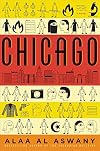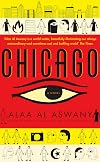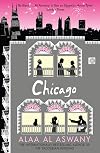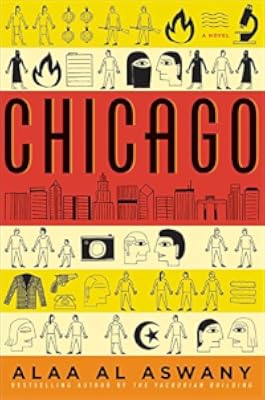
Chicago
by Alaa Al Aswany
On This Page
Description
Post-September 11 Chicago becomes the site of a cultural collision of Egyptian and American lives, including a Ph.D. candidate whose traditional upbringing is challenged by her American experiences, and an émigré whose western values are countered by questions about his daughter's honor.Tags
Recommendations















Member Reviews
Chicago excels when the characters fume, debate, shout, scheme, and fight. The novel is brilliant when characters soliloquize their guilt about leaving Egypt for the Midwestern United States. Unfortunately, the book fails on too many other fronts to truly be a successful novel.
Chicago is unrecognizable as the story's setting. Though Aswany begins the novel with a brief, but dramatic sweep of Chicago's history, the rest of the story might as well be anywhere. Actually, the story feels like it is set in some alternate universe which is not quite the United States but strangely similar; the story simply feels like Aswany doesn't *get* the United States. This is most pronounced when he explores Racism (with a capital R) while following show more Carol, the novel's only black character. Ultimately, the novel feels rootless, which is so strange as the novel is all about rootings and uprootings.
For all of its faults, this book leaves me curious about Aswany. Even though I didn't love Chicago, I look forward to reading more by him. show less
Chicago is unrecognizable as the story's setting. Though Aswany begins the novel with a brief, but dramatic sweep of Chicago's history, the rest of the story might as well be anywhere. Actually, the story feels like it is set in some alternate universe which is not quite the United States but strangely similar; the story simply feels like Aswany doesn't *get* the United States. This is most pronounced when he explores Racism (with a capital R) while following show more Carol, the novel's only black character. Ultimately, the novel feels rootless, which is so strange as the novel is all about rootings and uprootings.
For all of its faults, this book leaves me curious about Aswany. Even though I didn't love Chicago, I look forward to reading more by him. show less
No-one could ever fault this author for his heart-felt commiseration with the oppressed people of Egypt, in particular students and doctors of medicine with careers, be they native Egyptians still living at home, or expatriates in the United States.
It is a parable of the cost of sticking to one's convictions. Even while resisting pressure to cave in by taking a comfy job and/or emigrating. The multiple protagonists face a crushing dilemma. And it presses on the reader's conscience too. I probably wouldn't be any better; I would probably cave in too.
A fine job was done on the translation. Even though I don't know a word of Arabic, the prose style in English was fast-paced and fluently idiomatic. It won't be judged a masterpiece of show more literature, or lead in later years to the author winning the Nobel Prize (as I think one of the blurbs said), but that doesn't matter. What counts is that this novel does the job that the author set for it: he wants readers to wake up to what really happens inside and outside the client states that the United States gets involved with in intimate relationships of which the behind-the-scenes details would shock many, but not all Americans, depending on their moral makeup. show less
It is a parable of the cost of sticking to one's convictions. Even while resisting pressure to cave in by taking a comfy job and/or emigrating. The multiple protagonists face a crushing dilemma. And it presses on the reader's conscience too. I probably wouldn't be any better; I would probably cave in too.
A fine job was done on the translation. Even though I don't know a word of Arabic, the prose style in English was fast-paced and fluently idiomatic. It won't be judged a masterpiece of show more literature, or lead in later years to the author winning the Nobel Prize (as I think one of the blurbs said), but that doesn't matter. What counts is that this novel does the job that the author set for it: he wants readers to wake up to what really happens inside and outside the client states that the United States gets involved with in intimate relationships of which the behind-the-scenes details would shock many, but not all Americans, depending on their moral makeup. show less
I liked this novel in the end, but I wasn't sure at first if I would. The characters do not at first appear to be connected, and it is at first difficult to imagine where the novel is going. What's great about it is that the novel is written and structured so that you want to keep reading and find out what happens to them- after the first half of the book. I put it down for nearly a week about a third of the way through. This novel is much more political than I anticipated, and the characters are almost universally unlikeable. To be fair, everyone has an ugly side, and not everyone reacts to stress and pressure with grace. That said, I also found the American characters strange. They seemed flat, not like real people- it was something show more about the dialog that made them seem like cardboard cut-outs and not real people. They don't talk like any of the Americans I know. It's about Egypt more than Chicago, really. I liked the novel in the end, but only after I thought about it for a day and a half. show less
This novel is about a group of people in and around the medical center at the University of Illinois, many of them, but not all, Egyptian - their troubles, their joys. In some ways, it suggests that as an immigrant you carry your country of origin with you and never quite escape it - whether you spend your live yearning to go back or trying to construct something completely other than where you are from. The individual stories lines are interesting, some even compelling, but nothing is very surprising. I successfully predicted some character trajectories within the first page or two and there was a gun introduced in Chapter 3 which I expect will go off any page now.
I can see why Aswany is popular in Egypt - he doesn't hold back with show more the political commentary and he is very forthright in his critique.
I did wonder if he had ever been to Chicago. It was strangely off about the city, as if he had used an out of date guide book. show less
I can see why Aswany is popular in Egypt - he doesn't hold back with show more the political commentary and he is very forthright in his critique.
I did wonder if he had ever been to Chicago. It was strangely off about the city, as if he had used an out of date guide book. show less
This book as noted is not about Chicago but rather about Egypt.
It is unsparing in its criticism of the modern dictatorship and the corrupt " police " state with its dependence on American aid and goodwill.
The hypocrisy of muslim devoutness is contrasted well with the support religion provides for the faithful.
The undecurrents of Egyptian sectarian strife are touched upon and the author's disenchantment with capitalism is portayed against a background of "60s left-wing idealism --- the noblest charecter is an American vietnam era idealist.
I felt the exploration of the Egyptian psyche and the muslim subjugation of women was handled very well.
This novel was written 4 years before the fall of Hosni Moubarak and has many similarities in show more narrative with Aswani's first important work the " Yakobian Building".
The book will be very much appreciated by Egyptian immigrants to the US.
VM show less
It is unsparing in its criticism of the modern dictatorship and the corrupt " police " state with its dependence on American aid and goodwill.
The hypocrisy of muslim devoutness is contrasted well with the support religion provides for the faithful.
The undecurrents of Egyptian sectarian strife are touched upon and the author's disenchantment with capitalism is portayed against a background of "60s left-wing idealism --- the noblest charecter is an American vietnam era idealist.
I felt the exploration of the Egyptian psyche and the muslim subjugation of women was handled very well.
This novel was written 4 years before the fall of Hosni Moubarak and has many similarities in show more narrative with Aswani's first important work the " Yakobian Building".
The book will be very much appreciated by Egyptian immigrants to the US.
VM show less
Like the Yacoubian Building, Chicago has a huge cast of characters. Most are Egyptian students studying in Chicago. The stories center around their sexual lives, families, and professions. Many of the characters suffer difficult fates. The story is unsparing in its criticism of modern Egypt. It really made me see Egyptian Arabs as real people, struggling through their lives. I like it that the story does end hopefully, with a love story, just as in Yacoubian Building. If Answany keeps this up he will win a Nobel some day.
The first half of the book was really slow, and I almost put it down twice. By the second half, the book became more interesting, and the characters more three-dimensional. Most of the people in this book are unlikable. But it does show an insight into the mental processes of Egyptian immigrants to the US, and how much baggage they brought with them from Egypt.
Members
- Recently Added By
Lists

I Can't Finish This Book
189 works; 22 members
Author Information

28+ Works 3,407 Members
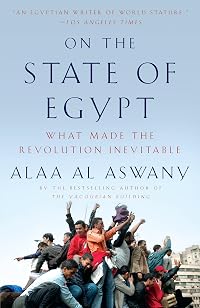
Alaa Al Aswany addresses himself to all the questions being asked within Egypt and beyond: who will be the next president, and how will he be chosen in a land where heretofore only simpletons, opportunists, and stooges involved themselves with elections? What role will the Muslim Brotherhood play? How can democratic reforms be effected among a show more people used to such contradictions as the religiously observant policeman who commits torture? In a candid and controversial assessment of both the potential and limitations that will determine his country's future, Al Aswany reveals why the revolt that surprised the world was destined to happen. show less
Some Editions
Awards and Honors
Awards
Series
Belongs to Publisher Series
Common Knowledge
- Canonical title*
- Chicago
- Original title
- Šīkaǧū
- Original publication date
- 2007
- People/Characters*
- Cheïma Mohammedi; Tarek Hosseïb; Nagui Abd el-Samad; Denis Baker; Raafat Sabet; Ahmed Danana
- Important places
- Chicago, Illinois, USA
- Dedication
- To my mother and father, hoping I haven't disappointed them
- First words
- Chicago, peu de gens le savent, n'est pas un nom anglais.
Many do not know that chicago is not an English word but rather Algonquian, one of several languages that Native Americans spoke. In that language chicago meant "strong smell." The reason for that designation wa... (show all)s that the place occupied by the city today was originally vast fields where the Native Americans grew onions, the strong smell of which gave the place its name. - Last words*
- (Click to show. Warning: May contain spoilers.)Il regarda Cheïma de ses yeux écarquillés, puis un large sourire se dessina sur son visage
- Original language*
- Arabe (Egypte) (Egypte)
*Some information comes from Common Knowledge in other languages. Click "Edit" for more information.
Classifications
- Genres
- General Fiction, Fiction and Literature
- DDC/MDS
- 892.737 — Literature & rhetoric Literatures of other languages Afro-Asiatic literatures Arabic (Egypt, Lebanon, Palestine, Saudi Arabia, Sudan) Arabic fiction 2000–
- LCC
- PJ7814 .S922 — Language and Literature Oriental languages and literatures Oriental philology and literature Arabic Arabic literature Individual authors or works
- BISAC
Statistics
- Members
- 479
- Popularity
- 63,429
- Reviews
- 24
- Rating
- (3.34)
- Languages
- 13 — Arabic, Danish, Dutch, English, Finnish, French, German, Greek, Italian, Norwegian (Bokmål), Russian, Spanish, Swedish
- Media
- Paper, Audiobook, Ebook
- ISBNs
- 33
- ASINs
- 9