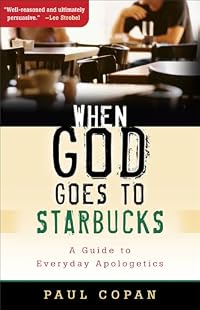
When God Goes to Starbucks: A Guide to Everyday Apologetics
by Paul Copan
On This Page
Description
More than ever, Christians are bombarded with tough faith questions from their pluralistic friends and neighbors. Many of these emerge as "anti-truth claims" and slogans we are all familiar with: - Why not just look out for yourself? - Do what you want--just as long as you don't hurt anyone - Miracles violate the laws of nature - Aren't people born gay? Paul Copan has been answering questions like these for many years. In When God Goes to Starbucks, he offers readers solid and caring show more Christian responses to these and many other concerns that are being discussed in Starbucks, shopping malls, youth groups, and schools. Each chapter provides succinct answers and points for countering the cultural questions believers are faced with today. show lessTags
Recommendations

















Member Reviews
Paul Copan. When God Goes to Starbucks: A Guide to Everyday Apologetics. Grand Rapids: Baker, 2008. 221 pp. $14.99.
Paul Copan, the Pledger Family Chair of Philosophy and Ethics at Palm Beach Atlantic University, has written this latest volume to “guide readers, Christian or not, into practical answers to tough questions” (9). The book has a threefold structure, dividing the work into issues concerning truth and reality, worldviews and Christianity. This book is similar in both structure and content to Copan’s previous works such as True For You, But Not For Me (Bethany 1998) and That’s Just Your Interpretation (Baker 2001).
Section One tackles the egoism of Ayn Rand and the moral relativism of Jack Kevorkian who is quoted as show more saying, “I’m an absolute autonomist. Do and say whatever you want to do and say at any time you want to do or say it, as long as you do not harm or threaten anybody else’s person or property” (22). Copan points out to the reader how ironic it is that many will deny moral absolutes but then qualify their statements with universal standards. For example, Kevorkian’s philosophy of absolute autonomy comes with the qualifier, “Just as long as you don’t hurt anyone.” It is noted how such a philosophy is logically inconsistent and self-destructive. The final chapter argues, “Deception is morally permissible…under certain specific conditions” (29). Scriptural examples are given for clarification (Exod. 1:15-21; Joshua 2; 8:2; 1 Sam. 16:1-5; 2 Kings 6:18-23).
Section Two dedicates two chapters to miracles and three chapters to issues surrounding homosexuality. Chapter 8 asks, “Does the Bible Condemn Loving, Committed Homosexual Relationships?” Copan argues the affirmative while at the same time pointing out how the church has fallen short in reaching out to this ostracized segment of American society. This chapter is carefully laid out, with the exception pederasty is defined four times in nine pages. Chapter 9 asks, “Aren’t People Born Gay?” The author concludes, “Both sides must be careful not to commit the either-or fallacy (‘it’s either biology or environment; either nature or nurture, either determined or a choice’). Regarding homosexuality, it seems wiser—and clearer—to talk about influences rather than causes” (98). The final chapter focuses on gay marriage. Here, Copan argues the traditional definition of marriage should not be changed. Among his nine objections is the point the state cannot be morally neutral about gay marriage. Those asserting what the state ‘ought’ to do involve a moral standard (113).
Section Three contains three chapters on the “Yahweh Wars” of Joshua and Judges. In 25 pages the author points out some of the main differences between the biblical holy wars and Islamic jihad. One of the more significant observations made by Copan in this section was poorly explained. He notes, “The tolerant passages [of the Qur’an] precede the militant ones” (158). In other words exegetes of the Qur’an have adopted a view of progressive revelation in which earlier teachings expire and are overridden by later revelation. Thus, the principle of naskh differentiates between teachings from Mecca and those from Medina.
Furthermore, two chapters focus on the Second Coming where Matthew 24 and parallels are placed within their historical context. The apologist demonstrates exegetical prowess by conducting word studies and checking parallel passages. Copan rejects the popular Pre-millennial approach to eschatology and hermeneutics. For example, he notes how the image of a darkened sun is figurative speech referencing political upheaval (Is. 13:10; 34:4-6; Jer. 4:23; Ezek. 32:7; Joel 2:10; Amos 5:18-20; 8:9). Furthermore, he affirms this imagery denotes the end of national Israel and the beginning of God’s new people, the church, who are the new “Israel.” Thus, Copan rejects interpreting the Bible in a woodenly literal manner. His main point, however, is that Jesus was not mistaken concerning the timing of his yet future return. The book concludes with a chapter on denominational division among Christians—a topic of interest to members of the Stone-Campbell Movement.
This volume is timely with topics such as homosexuality, jihad and eschatology. However, the title may mislead some to believe the book is shallow coffee shop theology. Yet, I question whether this is college freshman material. The book will better serve seminarians and professors as it is demanding at times. It is worth both the price and the effort!
A Ramey show less
Paul Copan, the Pledger Family Chair of Philosophy and Ethics at Palm Beach Atlantic University, has written this latest volume to “guide readers, Christian or not, into practical answers to tough questions” (9). The book has a threefold structure, dividing the work into issues concerning truth and reality, worldviews and Christianity. This book is similar in both structure and content to Copan’s previous works such as True For You, But Not For Me (Bethany 1998) and That’s Just Your Interpretation (Baker 2001).
Section One tackles the egoism of Ayn Rand and the moral relativism of Jack Kevorkian who is quoted as show more saying, “I’m an absolute autonomist. Do and say whatever you want to do and say at any time you want to do or say it, as long as you do not harm or threaten anybody else’s person or property” (22). Copan points out to the reader how ironic it is that many will deny moral absolutes but then qualify their statements with universal standards. For example, Kevorkian’s philosophy of absolute autonomy comes with the qualifier, “Just as long as you don’t hurt anyone.” It is noted how such a philosophy is logically inconsistent and self-destructive. The final chapter argues, “Deception is morally permissible…under certain specific conditions” (29). Scriptural examples are given for clarification (Exod. 1:15-21; Joshua 2; 8:2; 1 Sam. 16:1-5; 2 Kings 6:18-23).
Section Two dedicates two chapters to miracles and three chapters to issues surrounding homosexuality. Chapter 8 asks, “Does the Bible Condemn Loving, Committed Homosexual Relationships?” Copan argues the affirmative while at the same time pointing out how the church has fallen short in reaching out to this ostracized segment of American society. This chapter is carefully laid out, with the exception pederasty is defined four times in nine pages. Chapter 9 asks, “Aren’t People Born Gay?” The author concludes, “Both sides must be careful not to commit the either-or fallacy (‘it’s either biology or environment; either nature or nurture, either determined or a choice’). Regarding homosexuality, it seems wiser—and clearer—to talk about influences rather than causes” (98). The final chapter focuses on gay marriage. Here, Copan argues the traditional definition of marriage should not be changed. Among his nine objections is the point the state cannot be morally neutral about gay marriage. Those asserting what the state ‘ought’ to do involve a moral standard (113).
Section Three contains three chapters on the “Yahweh Wars” of Joshua and Judges. In 25 pages the author points out some of the main differences between the biblical holy wars and Islamic jihad. One of the more significant observations made by Copan in this section was poorly explained. He notes, “The tolerant passages [of the Qur’an] precede the militant ones” (158). In other words exegetes of the Qur’an have adopted a view of progressive revelation in which earlier teachings expire and are overridden by later revelation. Thus, the principle of naskh differentiates between teachings from Mecca and those from Medina.
Furthermore, two chapters focus on the Second Coming where Matthew 24 and parallels are placed within their historical context. The apologist demonstrates exegetical prowess by conducting word studies and checking parallel passages. Copan rejects the popular Pre-millennial approach to eschatology and hermeneutics. For example, he notes how the image of a darkened sun is figurative speech referencing political upheaval (Is. 13:10; 34:4-6; Jer. 4:23; Ezek. 32:7; Joel 2:10; Amos 5:18-20; 8:9). Furthermore, he affirms this imagery denotes the end of national Israel and the beginning of God’s new people, the church, who are the new “Israel.” Thus, Copan rejects interpreting the Bible in a woodenly literal manner. His main point, however, is that Jesus was not mistaken concerning the timing of his yet future return. The book concludes with a chapter on denominational division among Christians—a topic of interest to members of the Stone-Campbell Movement.
This volume is timely with topics such as homosexuality, jihad and eschatology. However, the title may mislead some to believe the book is shallow coffee shop theology. Yet, I question whether this is college freshman material. The book will better serve seminarians and professors as it is demanding at times. It is worth both the price and the effort!
A Ramey show less
Ratings
Members
- Recently Added By
Author Information

44+ Works 4,329 Members
Paul Copan is the Pledger Family Chair of Philosophy and Ethics at Palm Beach Atlantic University, Florida. He has written and edited dozens of books in the area of philosophy of religion, apologetics, and theology, including Is God a Moral Monster? Making Sense of the Old Testament God and An Introduction to Biblical Ethics, which he wrote with show more Robertson McQuilkin. show less
Classifications
Statistics
- Members
- 203
- Popularity
- 160,578
- Reviews
- 1
- Rating
- (3.58)
- Languages
- English
- Media
- Paper, Ebook
- ISBNs
- 3
- ASINs
- 2