On This Page
Description
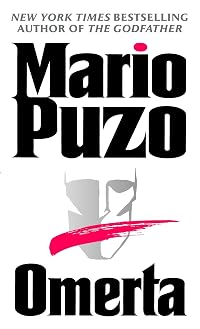
When Don Raymonde Aprile, an old-school Mafia leader who has retired, is killed, it is not his children, who were kept strictly away from their father's business, who seek to avenge him, but his Sicilian-born ward, Astorre, the son of an even greater Mafia chieftain.Tags
Recommendations
Member Reviews
Mario Puzo's Omertà is the third installment in his Godfather-series. The novel's main story is set in New York City while the backstory is set in Sicily. Raymonde Aprile, a New York Don, retires from his active business to live the rest of his life enjoying his family and the wealth and influence he has attained over the years. However, he is assassinated by a hit squad hired by another Don who has set his eyes on the banks Don Aprile still controls. 49% of the Don's banks go to his three children and the controlling majority of 51% go to Astorre Viola, whom the Don adopted when Astorre was still a child. The Don's last wish was for Astorre never to sell the banks and Astorre does exactly that. In the process he is hunted by a show more conglomerate gathered around the last remaining New York Don that wants to use the banks for laundering drug money and establishing a bigger cartel. Another party involved is Kurt Cilke, an FBI agent, who tries to bring down the New York mafia for good. A story of intrigue and double crossing unfolds. At the same time, the reader learns about Astorre Viola's background and how he came to be adopted by Don Raymonde Aprile. Viola is trained in Sicily for the task to succeed Don Aprile, learning what it takes to be the head of his own cosca, that is his own clan.
I have to say that I really enjoyed Omertà and even liked it better than the two previous novels in the series. The parts that reveal the background and training of Astorre Viola are fascinating to read and make the overall story so much richer. The main plot with the fight about dominance in the New York mafia was gripping and made me turn the pages in a breeze. Omertà was published post-humously and criticized by some as Puzo's worst work. Personally, I have to disagree, but then again my reading is often influenced by my current surroundings, my mood and how a particular story clicks with me at a particular point in my life. When I read the novel I was looking for an entertaining story that helped me escape the huge amount of work I recently had and Omertà managed not to do just that, but also to positively surprise me. 5 stars for a highly enjoyable read. show less
I have to say that I really enjoyed Omertà and even liked it better than the two previous novels in the series. The parts that reveal the background and training of Astorre Viola are fascinating to read and make the overall story so much richer. The main plot with the fight about dominance in the New York mafia was gripping and made me turn the pages in a breeze. Omertà was published post-humously and criticized by some as Puzo's worst work. Personally, I have to disagree, but then again my reading is often influenced by my current surroundings, my mood and how a particular story clicks with me at a particular point in my life. When I read the novel I was looking for an entertaining story that helped me escape the huge amount of work I recently had and Omertà managed not to do just that, but also to positively surprise me. 5 stars for a highly enjoyable read. show less
Having absorbed The Godfather a couple of years ago, I was really looking forward to Omerta, only to be disappointed in how flat it was. While Godfather had interesting, multidimensional characters who felt like they had proper motivations for their actions, Omerta feels more like a second-rate TV show in the depiction of its characters. They are drawn as simply and as lazily as possible. Their actions feel strange, though I sometimes felt Puzo was straining to do so.
The story also lacked flair. It was very formulaic, and I felt that it lacked conviction. However, it does feature a lot of forward momentum, as in no scene is wasted. Puzo streamlines the whole narrative into a free flowing experience that may turn off some people, but it show more makes for a fast, decent read.
I simply cannot recommend Omerta to any Puzo fan. If you're looking for the brilliance that can be found in The Godfather, don't look here. This book lacks interesting characters, and its narrative feels flat at best. Get this if you're looking for a quick read. show less
The story also lacked flair. It was very formulaic, and I felt that it lacked conviction. However, it does feature a lot of forward momentum, as in no scene is wasted. Puzo streamlines the whole narrative into a free flowing experience that may turn off some people, but it show more makes for a fast, decent read.
I simply cannot recommend Omerta to any Puzo fan. If you're looking for the brilliance that can be found in The Godfather, don't look here. This book lacks interesting characters, and its narrative feels flat at best. Get this if you're looking for a quick read. show less
This was Puzo's last novel before he died, and I must say it read very much like an old man clinging to an excellent reputation. The Godfather is one of the greatest books I've ever read and the only book to make me cry, and whilst I think the "romance" of the Mafia has faded from my concious slightly, I still find it a trifle exciting. Omerta, however, felt boring and lack-lustre. There felt, even from the first few chapters, to be far too much going on and too many people involved: whilst mafia's certainly do contain more people than first appears on the surface, to work a novel of the mafia, one would have to forget this notion slightly if a reader is to make sense of what is happening. Once the rest of Puzo's works have been read, show more maybe I shall return to this one... show less
I listened to the unabridged audio version of Omerta, and found it an engrossing tale. The characters are interesting and the plot twists keep the listener guessing. Granted, the phrasing is often turgid and clumsy, and the dialogue unreal. However, I found such flaws easy to overlook in audio form. Overall, I found Omerta to be reasonably entertaining to listen to, but might not be so charitable in actually reading it.
Oh dear oh dear oh dear. Puzo practically wrote this from beyond the grave - a new meaning to the term 'ghost writer,' and it feels like it belongs buried with him. I've not had the chance to read the original Godfather books yet, but on this evidence there's little chance that I will; Puzo's prose is clumsy, constipated and troublesome; there's no clear reason why the book should even be called "Omerta," which is the mafiosa's code of silence and not ratting each other out. Which of course they all do. So tiresome.
This is the first book by Mario Puzo that I have read and I was pleasantly satisfied. It is also the last book by Mario Puzo to be published before his death.
Omerta (the Sicilian code of silence) is a true Mafia story. The plot centers on Astorre Viola, the son of an elderly Silcilian Don who dies when the boy is very young and leaves his son to be raised by Don Raymonde Aprile as his own in New York.
Unbeknownst to the Don's own children (who have no actual knowledge of their father's business), Astorre is being groomed as the retired Don's successor. When Don Aprile is assassinated, Astorre must protect the family's assets as well as the Don's children from a group of rival families who will stop at nothing to gain controlling interest show more in the Aprile's banking business to use for their own money laundering schemes.
The book moves along at a brisk pace and, while a bit predictable and stereotypical of the crime genre, kept my interest throughout. There are definite undertones from time to time of events being somewhat similar to the Godfather at times, but overall it's a good story.
I enjoyed Omerta and will definitely move on to Puzo's earlier works.
Oh, and NEVER cross the family! show less
Omerta (the Sicilian code of silence) is a true Mafia story. The plot centers on Astorre Viola, the son of an elderly Silcilian Don who dies when the boy is very young and leaves his son to be raised by Don Raymonde Aprile as his own in New York.
Unbeknownst to the Don's own children (who have no actual knowledge of their father's business), Astorre is being groomed as the retired Don's successor. When Don Aprile is assassinated, Astorre must protect the family's assets as well as the Don's children from a group of rival families who will stop at nothing to gain controlling interest show more in the Aprile's banking business to use for their own money laundering schemes.
The book moves along at a brisk pace and, while a bit predictable and stereotypical of the crime genre, kept my interest throughout. There are definite undertones from time to time of events being somewhat similar to the Godfather at times, but overall it's a good story.
I enjoyed Omerta and will definitely move on to Puzo's earlier works.
Oh, and NEVER cross the family! show less
A good read, but needed more character development
I've always enjoyed Mario Puzo books, and I have read just about all of his books. Omerta is 'The Godfather' set in the early 1990s. Astorre Viola, sets out to find his uncle's killer. While he is doing this the FBI is investigating the family business and there's sections that cover Sicily.
I wanted to give this book 4 stars but while the writing was fine, and the dialogue great, I wanted more character development which made Godfather a classic. So I gave it 3 stars, 3 1/2 would be truer.
Still, the story was a great way to end this saga of murder, crime and family relationships.
I've always enjoyed Mario Puzo books, and I have read just about all of his books. Omerta is 'The Godfather' set in the early 1990s. Astorre Viola, sets out to find his uncle's killer. While he is doing this the FBI is investigating the family business and there's sections that cover Sicily.
I wanted to give this book 4 stars but while the writing was fine, and the dialogue great, I wanted more character development which made Godfather a classic. So I gave it 3 stars, 3 1/2 would be truer.
Still, the story was a great way to end this saga of murder, crime and family relationships.
Members
- Recently Added By
Lists

Wishlist
99 works; 1 member
Author Information

98+ Works 24,500 Members
Mario Puzo, best known as the author of The Godfather, was born on October 15, 1920 in the Hell's Kitchen area of New York City. He served in the U. S. Army during World War II, and when he returned attended New York's School for Social Research and Columbia University. He wrote pulp stories and edited Male magazine before publishing his first show more novel, The Dark Arena (1955). His works were well-received critically, but failed to generate much revenue until he published his most notable work, The Godfather, which was ultimately made into a trilogy of award-winning movies. Puzo continued writing novels, and his final work, Omerta, was finished not long before his death. He won the Academy Award for Best Adapted Screenplay in both 1972, and 1974. Puzo died on July 2, 1999 in Bay Shore, Long Island. (Bowker Author Biography) show less
Awards and Honors
Awards
Distinctions
Series

Work Relationships
Is contained in
Common Knowledge
- Canonical title
- Omerta
- Original title
- Omertà
- Original publication date
- 2000
- People/Characters
- Astorre Viola; Don Raymonde Aprile; Don Vincenzo Zeno; Nicole Aprile; Mr. Pryor; Don Bianco (show all 15); Rosie; Valerius Aprile; Marcantonio Aprile; Timmona Portella; Kurt Cilke; Inzio Tullipa; Aspinella; Franky Sturzo; Stace Sturzo
- Important places
- Sicily, Italy; New York, New York, USA; London, England, UK; San Francisco, California, USA; Las Vegas, Nevada, USA
- Epigraph
- Omerta:a Sicilian code of honor which forbids informing about crimes thought to be the affairs of the persons involved. --World Book Dictionary
- Dedication
- To Evelyn Murphy
- First words
- 1967
In the stone-filled village of Castellammare del Golfo, facing the dark Sicilian Mediterranean, a great Mafia Don lay dying. - Last words
- (Click to show. Warning: May contain spoilers.)One day his son would go to America, a land of vengeance, mercy, and magnificent possibility.
- Original language
- Italian
Classifications
Statistics
- Members
- 1,769
- Popularity
- 12,403
- Reviews
- 29
- Rating
- (3.38)
- Languages
- 26 — Catalan, Czech, Danish, Dutch, English, Estonian, Finnish, French, German, Greek, Hungarian, Indonesian, Italian, Lithuanian, Marathi, Norwegian (Bokmål), Polish, Portuguese, Romanian, Russian, Slovenian, Spanish, Swedish, Turkish, Urdu, Chinese, traditional
- Media
- Paper, Audiobook, Ebook
- ISBNs
- 104
- ASINs
- 18