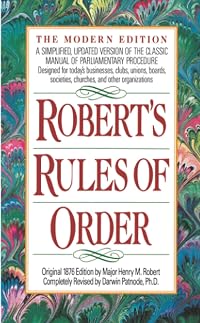
Robert's Rules of Order
by Henry M. Robert
On This Page
Description
The only current authorized edition of the classic work on parliamentary procedure.Tags
Recommendations
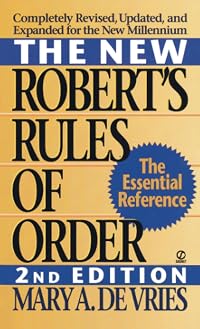
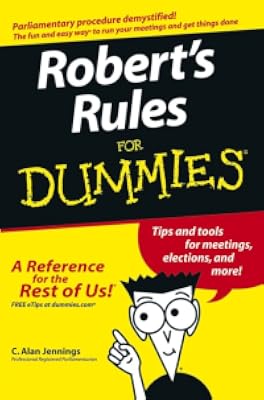
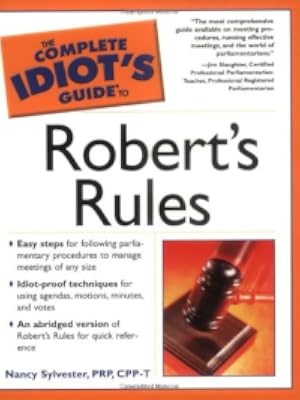
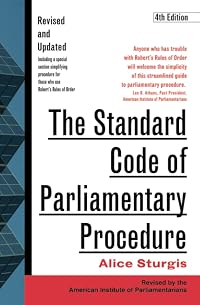














Member Recommendations
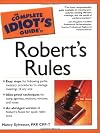
fulner RRooNR is the official parliamentary authority for much of the world. The Complete Idiots guide is absolutely necessary, in my experience, to make any sense out of it. Simply by reading the CIG and speaking with authority I found to gain respect from many colleagues.
20
Member Reviews
If you’re running even a halfway-serious meeting, assembly, or convention, you need some way of bringing order to the proceedings. Without common rules, deliberative assemblies devolve into chaos. First devised in 1876 by U.S. Army Colonel Henry Martyn Robert, these rules help to allow groups of peoples to understand what happens when, when people can speak, when and how motions can be voted on, and how to decide on many complicated matters.
Robert’s Rules of Order are now in their 11th edition and still going strong. My version—the 1943 5th edition—are mainly for consulting and not straight reading. The funny thing is, once you go through them, watch C-SPAN. Many more things make sense. This little book teaches you what each show more position in the chamber entails, how committees are supposed to work, and how to maintain a meaningful flow of discourse in a debate. If you’re looking for a career in politics and haven’t read them, you should get very familiar with Robert’s Rules. show less
Robert’s Rules of Order are now in their 11th edition and still going strong. My version—the 1943 5th edition—are mainly for consulting and not straight reading. The funny thing is, once you go through them, watch C-SPAN. Many more things make sense. This little book teaches you what each show more position in the chamber entails, how committees are supposed to work, and how to maintain a meaningful flow of discourse in a debate. If you’re looking for a career in politics and haven’t read them, you should get very familiar with Robert’s Rules. show less
Yes, this is THE Robert's Rules of Order.
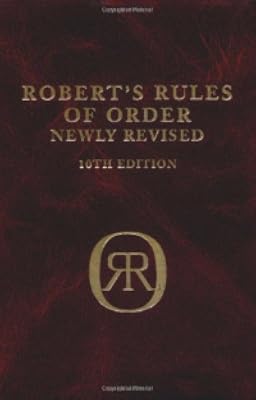
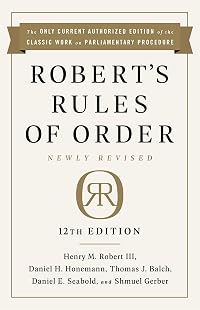
There are lots of books with Robert's Rules in the title. However, most of these books are earlier editions of Robert's or knock-offs. If you're supposed to follow the "latest edition" of Robert's, this is your book--Robert's Rules of Order Newly Revised (11th Edition), published in 2011. Each new edition brings changes to procedure. The latest has 120.
While Robert's Rules may not seem like a "let's cozy up with a book" kind of read, the book is a wonderful resource for anyone who has to spend time in meetings. And this newest edition is essential for groups that follow (or at least claim to follow) Robert's.
There are lots of books with Robert's Rules in the title. However, most of these books are earlier editions of Robert's or knock-offs. If you're supposed to follow the "latest edition" of Robert's, this is your book--Robert's Rules of Order Newly Revised (11th Edition), published in 2011. Each new edition brings changes to procedure. The latest has 120.
While Robert's Rules may not seem like a "let's cozy up with a book" kind of read, the book is a wonderful resource for anyone who has to spend time in meetings. And this newest edition is essential for groups that follow (or at least claim to follow) Robert's.
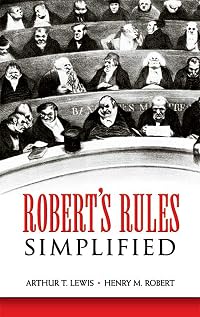
"Robert's Rules of Order in Plain and Simple English" consists of an introduction to parliamentary procedure and then the 1915 edition of Robert's Rules of Order.
There are a number of significant errors in the introductory materials, including:
** The maker of a motion does not always get to speak last
** There is no 20 minute final speech on a motion
** A Division of the Assembly is not counted
** A standard vote is based on those present and voting, not total membership
** The Previous Question is not "a motion to end debate that is only used in The U.S. House of Representatives"
More importantly, except for historical interest, the 1915 edition of Robert's is of little use today. Robert's is regularly updated, and there have been show more many editions since the Revised 1915 version. Each new edition brings changes to procedure (the latest has 120 listed). If you're supposed to follow the "most recent edition" of Robert's, Robert's Rules of Order Newly Revised, 11th edition published in 2011 is your book. show less
There are a number of significant errors in the introductory materials, including:
** The maker of a motion does not always get to speak last
** There is no 20 minute final speech on a motion
** A Division of the Assembly is not counted
** A standard vote is based on those present and voting, not total membership
** The Previous Question is not "a motion to end debate that is only used in The U.S. House of Representatives"
More importantly, except for historical interest, the 1915 edition of Robert's is of little use today. Robert's is regularly updated, and there have been show more many editions since the Revised 1915 version. Each new edition brings changes to procedure (the latest has 120 listed). If you're supposed to follow the "most recent edition" of Robert's, Robert's Rules of Order Newly Revised, 11th edition published in 2011 is your book. show less
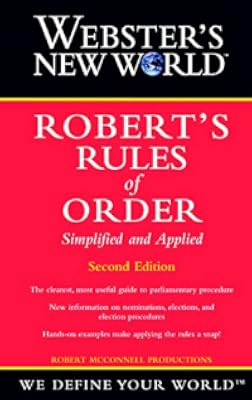
"Robert's Rules of Order: The Standard Guide to Parliamentary Procedure" is a 1982 reprint of the 1893 "Robert's Rules of Order" with added illustrations. While that may be of historical interest, it's not the current "Robert's Rules of Order."
Robert's is regularly updated, and there have been many editions since the 1893 version. Each new edition brings changes to procedure (the latest has 120, with both new practices and names of motions). If you're supposed to follow the "most recent edition" of Robert's, Robert's Rules of Order Newly Revised (11th Edition) published in 2011 is your book.
While some readers find the current manual (at 716 pages) too daunting and complex, there are excellent guides to Robert's. As the author of two of show more them, I’m partial to these: "The Complete Idiot's Guide to Parliamentary Procedure Fast-Track" and "Notes and Comments on Robert's Rules, Fourth Edition." show less
Robert's is regularly updated, and there have been many editions since the 1893 version. Each new edition brings changes to procedure (the latest has 120, with both new practices and names of motions). If you're supposed to follow the "most recent edition" of Robert's, Robert's Rules of Order Newly Revised (11th Edition) published in 2011 is your book.
While some readers find the current manual (at 716 pages) too daunting and complex, there are excellent guides to Robert's. As the author of two of show more them, I’m partial to these: "The Complete Idiot's Guide to Parliamentary Procedure Fast-Track" and "Notes and Comments on Robert's Rules, Fourth Edition." show less
This book addresses the issues involved with meetings. Rules of Order is the recognized guide to smooth, orderly, and fairly conducted meetings. This edition includes "clarified procedures for adopting an agenda, preparing and approving the minutes, and conducting board and committee meetings.", "More fully explained rules for counting ballots and resolving election disputes", "a new subsection on electronic meetings", "clarifications regarding the powers of an organizations executive board in relation to the general membership", "guidance for dealing with misconduct by officers and for holding disciplinary trials".
This book is long and detailed, anyone who holds management/leadership positions in an office that utilizes meetings show more frequently could gain something from it. show less
This book is long and detailed, anyone who holds management/leadership positions in an office that utilizes meetings show more frequently could gain something from it. show less
"Robert's Rules of Order (Illustrated)" is a reprint of the original 1876 Robert's with some additional drawings.
While the book may be of historical interest, the 1876 version of Robert's is not the current edition. Robert's is regularly updated, and each new edition brings changes to procedure (the latest has 120 listed). If you're supposed to follow the "most recent edition" of Robert's, Robert's Rules of Order Newly Revised, 11th edition published in 2011 is your book.
While the book may be of historical interest, the 1876 version of Robert's is not the current edition. Robert's is regularly updated, and each new edition brings changes to procedure (the latest has 120 listed). If you're supposed to follow the "most recent edition" of Robert's, Robert's Rules of Order Newly Revised, 11th edition published in 2011 is your book.
Robert's Rules of Order, Newly Revised, does precisely what it says it will do: it sets out clearly and concisely the distillation of decades of parliamentary procedure.
Members
- Recently Added By
Lists

Books Featured on Gilmore Girls
307 works; 21 members

The Complete Rory Gilmore Reading List
506 works; 5 members
Author Information

42 Works 6,036 Members
Some Editions
Work Relationships
Is abridged in
Common Knowledge
- Canonical title
- Robert's Rules of Order
- Original title
- Pocket Manual of Rules of Order for Deliberative Assemblies (Robert's Rules of Order) (Robert's Rules of Order)
- Original publication date
- 1876
- Epigraph
- Where there is no law, but every man does what is right in his own eyes, there is the least of real liberty. --Henry M. Robert (1990 ed.)
- First words
- Parliamentary Law refers originally to the customs and rules for conducting business in the English Parliament; and thence to the usages of deliberative assemblies in general. (1948 ed)
A work on parliamentary law has long been needed, based, in its general principles, upon the rules and practice of Congress, but adapted, in its details, to the use of ordinary societies. (1877 edition, Preface)
Parliamentary Law refers originally to the customs and rules of conducting business in the English Parliament; and thence to the customs and rules of our own legislative assemblies. (1877 edition, Introduction) - Disambiguation notice
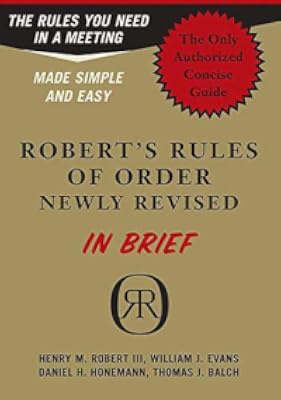
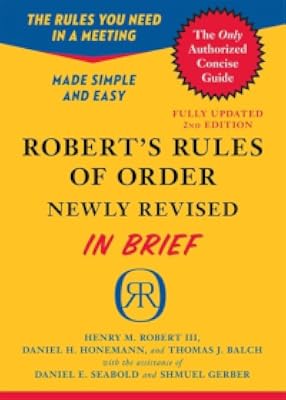
- "Pocket Manual of Rules of Order" was the earlier title of "Robert's Rules of Order"; they are the same work. "Robert's Rules of Order in Brief" is not, as far as I can tell.
Classifications
- Genres
- Politics and Government, Nonfiction, General Nonfiction
- DDC/MDS
- 060.42 — Computer science, information & general works General organisations and museology General organizations and museology Special Topics Parliamentary Procedure
- LCC
- JF515 .R692 — Political Science Political institutions and public administration Political institutions and public administration General. Comparative government Organs and functions of government Legislation. Legislative process. Law-making
- BISAC
Statistics
- Members
- 4,395
- Popularity
- 3,412
- Reviews
- 26
- Rating
- (3.76)
- Languages
- English, Russian
- Media
- Paper, Audiobook, Ebook
- ISBNs
- 99
- UPCs
- 2
- ASINs
- 104