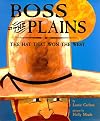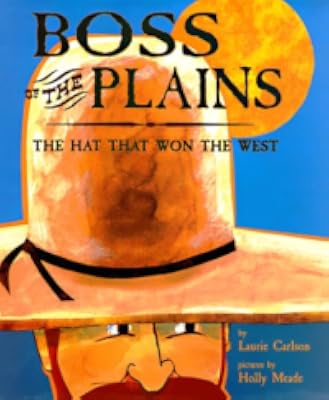
Boss of the Plains
by Laurie Carlson
On This Page
Description
The story of John Stetson and how he came to create the most popular hat west of the Mississippi.Tags
Recommendations



Member Reviews
This endearing book follows the story of John Batterson Stetson. At the beginning of the story, he is only twelve years old working in his father's hatmaker's shop in Orange, New Jersey with his eleven siblings! They were making hats the way they had always been--ordinary. After no success, he relocated and opened up his own hat shop! At first he had no success, but then the hats were off! I love how this book shines the light on failures can still be turned into successes!
Though, at first glance, Mr. Stetson's story may not offer much insight into life today, it is the story of pursing your dreams despite failure. Presenting his story as the story of a hat, offers a unique perspective on the life of an interesting individual.
People say that it's the gold, land and government that started America to it's own uniqueness, but never have we heard of a hat! John Stetson came from a family of hat makers, but he realized the weather was taking a toll on his health. He then decided to head west. He tried finding gold, but soon realized that his hat, the same hat from back home, was not helping him one bit. So, he made and designed his own very hat the helped him in so many ways. After leaving the gold digging business, he started his own hat business. Eventually, he had many people demand for his unique hat. Very soon, his hat became very popular, giving America it's new uniqueness, the Boss of the Plains hat.
Picturesque, short and too the point, this book tells the story of John Batterson Stetson, one of 12 children, who worked in his father's hatmaker's shop in Orange, New Jersey. After becoming sickly in the damp shop, John decided to try his hand at gold mining in the Colorado Territory. After about a year and being no richer, he relocated in Philadelphia and opened up a hat shop. Eventually, he decided to create a hat that differed from all the other hatmakers' wares, and created a broad brimmed hat to shield owners from the fierce sun, wind, and rain. He shipped them west and waited to see how they would be received. The rest is history....
This is a historical fiction book written for children of early primary school ages. It tells the tale of how John Batterson Stetson started making cowboy hats.
John Batterson Stetson's story of how his hats became the hottest accessory because of how useful they were. The hats were called Boss of the Plains, and because of their high demand, Stetson expanded his business. A cute story that helps us have a better understanding of the big hats used in the Wild West.
John B. Stetson designed and made hats that weren't common in the West. In particular, The Boss of the Plains, is a unique, but very different hat that people of the west weren't used to seeing. He had worked in his dad's hat shop in New Jersey all of his life so after moving to different parts of the West, he tried to make money doing all that he knew how to do- making hats. He designed a hat that was wide-brimmed and high-crowned out of rabbit skin. He named it "Boss of the Plains". Stetson mailed one to every clothing store in the West in hopes that he could make profit. People of the West fell in love with this design and orders rolled in faster than he imagined. Boss of the Plains became the most popular hat of the West. This is a show more great story to read aloud for history lessons. Students could research different styles of hats and where they were most likely to be worn geographically. A history lesson could easily turn into a culture lesson involving research and writing. show less
Members
- Recently Added By
Published Reviews
ThingScore 100
Kirkus (Kirkus Reviews, 1998)
Carlson celebrates the crowning (so to speak) achievement of John Batterson Stetson, a Philadelphia hatmaker who went West for his health in the 1850s and invented the emblematic piece of cowboy gear still identified with him, heavy enough to keep off the rain, wide enough to block the sun, tough enough to stand years of abuse--or, as some said, "you can smell it show more across a room, but you just can't wear it out." Meade surrounds this lively odyssey with a kaleidoscope of brightly painted collage cowboy scenes, taking her ruddy-bearded artisan from his boyhood home in New Jersey to the gold fields of Pikes Peak, then back East where he found his fortune at last. Carlson closes her account with a biographical note while a cowboy poet's heartfelt tribute appears on the back of the jacket. Steer readers who want to know more about Stetson, or about western fashion in general, to M. Jean Greenlaw's Ranch Dressing (1993). show less
Carlson celebrates the crowning (so to speak) achievement of John Batterson Stetson, a Philadelphia hatmaker who went West for his health in the 1850s and invented the emblematic piece of cowboy gear still identified with him, heavy enough to keep off the rain, wide enough to block the sun, tough enough to stand years of abuse--or, as some said, "you can smell it show more across a room, but you just can't wear it out." Meade surrounds this lively odyssey with a kaleidoscope of brightly painted collage cowboy scenes, taking her ruddy-bearded artisan from his boyhood home in New Jersey to the gold fields of Pikes Peak, then back East where he found his fortune at last. Carlson closes her account with a biographical note while a cowboy poet's heartfelt tribute appears on the back of the jacket. Steer readers who want to know more about Stetson, or about western fashion in general, to M. Jean Greenlaw's Ranch Dressing (1993). show less
added by kthomp25
Deborah Stevenson (The Bulletin of the Center for Children's Books, July/August 1998 (Vol. 51, No. 11))
John Stetson was a consumptive eastern hatmaker when he decided to go West in 1859, joining an expedition to Colorado. He used his hatmaker’s felting skills to make a tent and then a funny-looking but immensely useful and durable felt hat. When Stetson returned back East, he decided to show more market that hat, which he called “The Boss of the Plains.” The rest is, as they say, history, since the hat we now know as the Stetson became the cowboy’s reliable friend and an icon of the West. Carlson resists the temptation to be cute, but she’s clearly appreciative of this chapeau chapter of history: her brief description of the felting process is simple and lucid, and her enumeration of the many uses for a Stetson (“It shielded a cowpoke’s eyes from blinding sun and caught the rain before it trickled down his back . . . Or came in handy when the sweetest huckleberries were ready to be picked”) is quietly picturesque. Meade’s mixed-media illustrations use cut paper to give the earth-toned scenes an immediacy and grounded gaiety often missing from images of the past, but her careful employment of colored-pencil shading and watercolor highlights gives the spreads more subtlety, unity, and textural blending than pure collage sometimes displays. As well as being an enjoyable story of an American symbol, this is a compact demonstration of the lesser-sung role of entrepreneurship in westward expansion. A brief followup and bibliography cap things off. Review Code: R -- Recommended. (c) Copyright 1998, The Board of Trustees of the University of Illinois. 1998, Kroupa/DK Ink, 32p, $16.95. Grades 2-4. show less
John Stetson was a consumptive eastern hatmaker when he decided to go West in 1859, joining an expedition to Colorado. He used his hatmaker’s felting skills to make a tent and then a funny-looking but immensely useful and durable felt hat. When Stetson returned back East, he decided to show more market that hat, which he called “The Boss of the Plains.” The rest is, as they say, history, since the hat we now know as the Stetson became the cowboy’s reliable friend and an icon of the West. Carlson resists the temptation to be cute, but she’s clearly appreciative of this chapeau chapter of history: her brief description of the felting process is simple and lucid, and her enumeration of the many uses for a Stetson (“It shielded a cowpoke’s eyes from blinding sun and caught the rain before it trickled down his back . . . Or came in handy when the sweetest huckleberries were ready to be picked”) is quietly picturesque. Meade’s mixed-media illustrations use cut paper to give the earth-toned scenes an immediacy and grounded gaiety often missing from images of the past, but her careful employment of colored-pencil shading and watercolor highlights gives the spreads more subtlety, unity, and textural blending than pure collage sometimes displays. As well as being an enjoyable story of an American symbol, this is a compact demonstration of the lesser-sung role of entrepreneurship in westward expansion. A brief followup and bibliography cap things off. Review Code: R -- Recommended. (c) Copyright 1998, The Board of Trustees of the University of Illinois. 1998, Kroupa/DK Ink, 32p, $16.95. Grades 2-4. show less
added by kthomp25
Author Information

Laurie Winn Carlson, PHD, has taught history of medicine classes at several Pacific Northwest universities. She currently teaches at Western Oregon University and is the author of twenty books, including William J. Spillman and the Birth of Agricultural Economics and A Fever in Salem: A New Interpretation of the New England Witch Trials. She lives show more in the Pacific Northwest, where sunlight is fleeting and appreciated. show less
Some Editions
Awards and Honors
Awards
Distinctions
Notable Lists
Common Knowledge
- Original publication date
- 1998
- People/Characters
- John Batterson Stetson
- Important places
- Western States, USA
- Dedication
- At first, settlers and travelers in the American West wore whatever hats they had worn back home.
- Quotations
- It gets so you can smell it across a room, but you just can't wear it out.
- Last words
- (Click to show. Warning: May contain spoilers.)He made his mark with a hat.
Classifications
Statistics
- Members
- 215
- Popularity
- 151,537
- Reviews
- 8
- Rating
- (4.31)
- Languages
- English
- Media
- Paper, Audiobook
- ISBNs
- 4
- UPCs
- 2
- ASINs
- 1