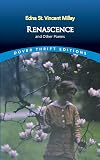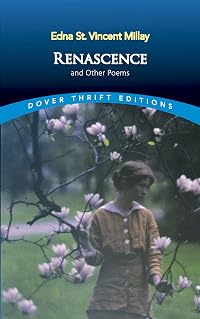
Renascence and Other Poems
by Edna St. Vincent Millay 
On This Page
Description
Treasury of 23 works by American poet renowned for the lyric beauty of her early works. In addition to the title poem, this collection includes ""Interim,"" ""Sorrow,"" ""Ashes of Life,"" ""Three Songs of Shattering,"" ""The Dream,"" ""When the Year Grows Old,"" and others, including 6 sonnets. Alphabetical lists of titles and first lines.
Tags
Recommendations












Member Reviews
[4.5 / 5.0]
A slender volume that contains Millay's "Renascence", which was her first grand step into the limelight. There's definitely some lovely verse contained within.
She ponders all the big stuff--mortality, love, how to live a best life. From "The Suicide"
And there are many a dark metaphor, such as referring to grief as an 'incorporeal bulk', that really hit their mark.
The collection also speaks of the smaller and larger joys of life, of being awake and alive in the world. "O world, I cannot hold thee close enough!".
Though at times in her life, and perhaps even after, she was eclipsed by her sexuality and show more life choices, I came to this collection through another work and only learned of her persona later. She had a reputation as a breaker of hearts... show less
A slender volume that contains Millay's "Renascence", which was her first grand step into the limelight. There's definitely some lovely verse contained within.
She ponders all the big stuff--mortality, love, how to live a best life. From "The Suicide"
Ah, Life, I would have been a pleasant thing
To have about the house when I was grown
If thou hadst left my little joys alone!
And there are many a dark metaphor, such as referring to grief as an 'incorporeal bulk', that really hit their mark.
The collection also speaks of the smaller and larger joys of life, of being awake and alive in the world. "O world, I cannot hold thee close enough!".
Though at times in her life, and perhaps even after, she was eclipsed by her sexuality and show more life choices, I came to this collection through another work and only learned of her persona later. She had a reputation as a breaker of hearts... show less
Millay is a poet I never paid attention to. Perhaps it was her name. "Edna St. Vincent Millay" sounds like one of those high-minded matrons who might cringe if you use the sugar spoon to stir your tea and then put it back in the bowl. When I read Edmund Wilson’s The Twenties, I learned that its author was hopelessly in love with this elusive, willowy red-head; I became curious to read some of her work.
This, her first collection, was where I decided to start. It's a slim volume that took little more than an hour to read, even though I slowly savored it. All of the poems are good, some of them masterpieces. The title piece in particular, with its vivid description of a mystical experience, left me in awe.
This, her first collection, was where I decided to start. It's a slim volume that took little more than an hour to read, even though I slowly savored it. All of the poems are good, some of them masterpieces. The title piece in particular, with its vivid description of a mystical experience, left me in awe.
Like him who day by day unto his draught
Of delicate poison adds him one drop more
Till he may drink unharmed the death of ten,
Even so, inured to beauty, who have quaffed
Each hour more deeply than the hour before,
I drink—and live—what has destroyed some men.
While I enjoyed "Renascence" and the longer poems that constitute the first half of this book, it was the closing six sonnets, especially "Bluebeard," that bumped the collection from three stars to four. Millay's style retains much of the formality and passion of the 19th century Romantics, but interjects perspectives that reflect a Modern aesthetic. In this way, she reminds me of Frost and other poets who bridged Modernism and Romanticism.
Of delicate poison adds him one drop more
Till he may drink unharmed the death of ten,
Even so, inured to beauty, who have quaffed
Each hour more deeply than the hour before,
I drink—and live—what has destroyed some men.
While I enjoyed "Renascence" and the longer poems that constitute the first half of this book, it was the closing six sonnets, especially "Bluebeard," that bumped the collection from three stars to four. Millay's style retains much of the formality and passion of the 19th century Romantics, but interjects perspectives that reflect a Modern aesthetic. In this way, she reminds me of Frost and other poets who bridged Modernism and Romanticism.
RENASCENCE by Edna St. Vincent Millay, was, I know, considered a groundbreaking classic in its time, and a treasured book of my mom's, but sorry, Mom. I read the whole book in about forty minutes. I just couldn't relate to all the gloom and doom, and the stilted, archaic rhyming that, to me, was reminiscent of Poe. For me it was just barely an 'okay.' I have my mother's 1917 hardback (first?) edition of the book, published by Harper & Brothers. Content-wise I couldn't recommend it. But I wonder if it's valuable.
- Tim Bazzett, author of the memoir, BOOKLOVER
- Tim Bazzett, author of the memoir, BOOKLOVER
The earliest poems of Edna St. Vincent Millay.
Renascence: rebirth. In this poem about the freedom of the soul, Millay begins with a narrator who is measuring the limitations of his world and wishing for freedom. But when the restraints are lifted, the narrator wishes for death, and following death, for life again. Millay takes the reader through the experience of these changes, recognizing at last that limitations only exist within the person and can be overcome, even within the confines imposed by the outside world.
The heart can push the sea and land
Farther away on either hand;
The soul can split the sky in two,
And let the face of God shine through.
Interim: A poem of grief and survival that struck at a part of my heart that I show more sometimes try to keep closed. It begins with the poet entering a room that contains a memory of the person lost, “The room is full of you!” and proceeds through the hopeless grief to a kind of faith in tomorrow, the burden of survival.
You are not here. I know that you are gone;
And will not ever enter here again.
And yet it seems to me, if I should speak,
Your silent step must wake across the hall;
And further on:
We were so wholly one I had not thought
That we could die apart. I had not thought
That I could move,--and you be stiff and still!
That I could speak,--and you perforce be dumb!
I believe anyone who has lost a very significant person, particularly a husband or a lover, to death, would understand and feel this poem in a very personal way. And, what is poetry, if not personal?
The Suicide: A sober look at suicide and the consequences on the soul as told from the point of view of the suicide himself.
God’s World: An acclamation of nature.
Afternoon on a Hill: Simple and effective. I quite love it:
I will be the gladdest thing
Under the sun!
I will touch a hundred flowers
And not pick one.
I will look at cliffs and clouds
With quiet eyes,
Watch the wind blow down the grass,
And the grass rise.
And when lights begin to show
Up from the town,
I will mark which must be mine,
And then start down!
The remaining poems are at turns immature, ineffective, maudlin or sweet, but they all show the promise that at length became a great poet. show less
Renascence: rebirth. In this poem about the freedom of the soul, Millay begins with a narrator who is measuring the limitations of his world and wishing for freedom. But when the restraints are lifted, the narrator wishes for death, and following death, for life again. Millay takes the reader through the experience of these changes, recognizing at last that limitations only exist within the person and can be overcome, even within the confines imposed by the outside world.
The heart can push the sea and land
Farther away on either hand;
The soul can split the sky in two,
And let the face of God shine through.
Interim: A poem of grief and survival that struck at a part of my heart that I show more sometimes try to keep closed. It begins with the poet entering a room that contains a memory of the person lost, “The room is full of you!” and proceeds through the hopeless grief to a kind of faith in tomorrow, the burden of survival.
You are not here. I know that you are gone;
And will not ever enter here again.
And yet it seems to me, if I should speak,
Your silent step must wake across the hall;
And further on:
We were so wholly one I had not thought
That we could die apart. I had not thought
That I could move,--and you be stiff and still!
That I could speak,--and you perforce be dumb!
I believe anyone who has lost a very significant person, particularly a husband or a lover, to death, would understand and feel this poem in a very personal way. And, what is poetry, if not personal?
The Suicide: A sober look at suicide and the consequences on the soul as told from the point of view of the suicide himself.
God’s World: An acclamation of nature.
Afternoon on a Hill: Simple and effective. I quite love it:
I will be the gladdest thing
Under the sun!
I will touch a hundred flowers
And not pick one.
I will look at cliffs and clouds
With quiet eyes,
Watch the wind blow down the grass,
And the grass rise.
And when lights begin to show
Up from the town,
I will mark which must be mine,
And then start down!
The remaining poems are at turns immature, ineffective, maudlin or sweet, but they all show the promise that at length became a great poet. show less
I don't know why I bought this book years ago. Maybe because I'd heard the name Edna St. Vincent Millay, and yet had never read or heard a single one of her poems. While skimming through "Books of the Century," this title caught my eye and I remembered that I had "Renascence and Other Poems" somewhere among the thousands of books on my shelves. After some searching it appeared, paper slightly yellowing (it is a $1 Dover edition), I sat down and read the poems--on some I lingered, others were quickly digested.
The general themes are: Death, Loss, Nature. Poetry is a crapshoot for me--either I like a poem immensely, feel it as a tangible thing or I don't get it. That is, I understand the words, even the images, maybe even the idea, but show more just don't feel what is so special about a particular poem. So with this collection--some of the poems resonated as an auditory, visual and emotional thing, others...were just there. At first I thought, "OK, now I've read these poems, I can donate the book and free up some shelf space", but now, the next day, I feel a need to hold on to the book and delve back into the poems that lingered in my subconscience, like a memory-vague, but compelling. show less
The general themes are: Death, Loss, Nature. Poetry is a crapshoot for me--either I like a poem immensely, feel it as a tangible thing or I don't get it. That is, I understand the words, even the images, maybe even the idea, but show more just don't feel what is so special about a particular poem. So with this collection--some of the poems resonated as an auditory, visual and emotional thing, others...were just there. At first I thought, "OK, now I've read these poems, I can donate the book and free up some shelf space", but now, the next day, I feel a need to hold on to the book and delve back into the poems that lingered in my subconscience, like a memory-vague, but compelling. show less
So many of these of are powerful expressions of grievous loss or despair. But they're beautiful. The title poem is too long for me, but the others were accessible and, well, yes, lyrical. I do appreciate Dover Thrift Editions.
Members
- Recently Added By
Lists

Underappreciated little gems
2 works; 2 members

Northern Exposure's Chris in the Morning Reading List
31 works; 1 member

First published in 1917
132 works; 3 members

New York Public Library's Books of the Century - All
170 works; 14 members

Books Read in 2021
5,361 works; 114 members
Author Information

129+ Works 6,692 Members
Edna St. Vincent Millay 1892-1950 Edna St. Vincent Millay, American poet, dramatist, lyricist, lecturer, and playwright, was born on February 22, 1892 in Rockland, Maine, and educated at Barnard College and at Vassar College, where she earned her B. A. (Her poem "Renascence" won fourth place in a contest and was published in The Lyric Year in show more 1912; this resulted in a scholarship to Vassar.) Millay's first volume of poetry, "Renascence and Other Poems," was published in 1917. In 1923, "The Ballad of the Harp-Weaver" won her a Pulitzer Prize in Poetry. Other works include: "A Few Figs from Thistles;" "Sonnets in American Poetry," "A Miscellany," "The Lamp and the Bell" and "There Are No Islands Any More." Millay also wrote the libretto for "The King's Henchman," one of the few American grand operas. Edna St. Vincent Millay married Eugen Jan Boissevain in 1923. Shortly after, they purchased a farm in upstate New York, which they called Steepletop. Millay lived here for the rest of her life, composing some of her finest work in a little shack separate from the main house. Boissevain died in 1949. Millay died of a heart attack in her home on October 19, 1950. (Bowker Author Biography) show less
Edna St. Vincent Millay has a Legacy Library. Legacy libraries are the personal libraries of famous readers, entered by LibraryThing members from the Legacy Libraries group.
Awards and Honors
Series
Belongs to Publisher Series
Project Gutenberg EBook (109)
Work Relationships
Common Knowledge
- Canonical title
- Renascence and Other Poems
- Original publication date
- 1917
Classifications
Statistics
- Members
- 491
- Popularity
- 61,618
- Reviews
- 13
- Rating
- (4.01)
- Languages
- English, Portuguese
- Media
- Paper, Ebook
- ISBNs
- 34
- UPCs
- 2
- ASINs
- 14