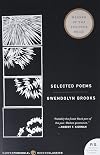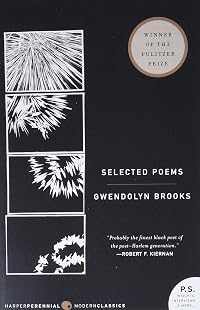
Selected Poems
by Gwendolyn Brooks
On This Page
Description
Contains a selection of poems from three earlier books: "A Street in Bronzeville," "Annie Allen," and "The Bean Eaters" as well as some new selections.Tags
Recommendations








Member Reviews
An excellent selection of poems. As one makes one's way, slowly, through these poems, a feeling of trust envelops the reader; this feeling is a credit to the poet and her masterful use of her tools. Tools like the unity of an idea as found, for example, in 'In Emanuel's Nightmare: Another Coming of Christ' where a surrealist dream depicts humanity's apparent obsession with war - and consequently its rejection of peace. Tools like complex meter and rhyming schemes as found in 'The Anniad' - a delightfully obscure poem that beguiles the heart while it chews up the mind. Shifting perspectives and the roiling emotions of anger, love, madness, and sadness fill these pages, but one is never left in a bad place because the poet's humerous and show more ironic nature is too skilled and too good to take us there. show less
Gwendolyn Brooks should have been our Inaugural poet, if Clinton valued literature more, politics less. There's little comparison between her poetry and her sophomoric colleagues'. "We real cool. We" alone stands as a prosodic and vocal breakthrough in American letters, the voice of the street in spondees, with the line-end punctuating the street pause. Wonderful, and enlightening. Nobody knew you could capture the
street in a brief lyric until she did. Rappers would do well to master Brooks' spondees here.
But that's just the beginning of her accomplishment, as this selection shows.
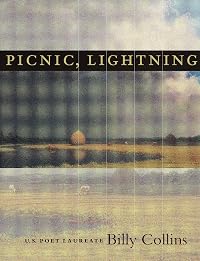
As for inaugural poets, no politician since JFK had the political smarts to appoint an opponent--a lifelong Republican--to the post, perhaps because Frost's show more fame did not deter from the Office of President. Now no one poet dominates like that, though Billy Collins is close. And Gwendolyn Brooks made up in skill what she lacked in fame. show less
street in a brief lyric until she did. Rappers would do well to master Brooks' spondees here.
But that's just the beginning of her accomplishment, as this selection shows.
As for inaugural poets, no politician since JFK had the political smarts to appoint an opponent--a lifelong Republican--to the post, perhaps because Frost's show more fame did not deter from the Office of President. Now no one poet dominates like that, though Billy Collins is close. And Gwendolyn Brooks made up in skill what she lacked in fame. show less
The poems are categorized into A Street in Bronzeville, Annie Allen, The Bean Eaters, and New Poems. The Bean Eaters section resonated the most with me. "We Real Cool" is the only poem that I was previously familiar with, but I loved "The Bean Eaters" and "Old Mary." The connections that could be made between her poems, Langston Hughes's poetry, A Raisin in the Sun, and Fences are vast and encouraging.
"The Lovers of the Poor" touches on attitudes toward the poor and describes the experience of being "helped" from the perspective of the helped. She writes, "Their guild is giving money to the poor./The worthy poor. The very very worthy/And beautiful poor./Perhaps just not too swarthy?/Perhaps just not too dirty nor too dim/Nor-passionate" show more (91). Is this an escapable attitude? show less
"The Lovers of the Poor" touches on attitudes toward the poor and describes the experience of being "helped" from the perspective of the helped. She writes, "Their guild is giving money to the poor./The worthy poor. The very very worthy/And beautiful poor./Perhaps just not too swarthy?/Perhaps just not too dirty nor too dim/Nor-passionate" show more (91). Is this an escapable attitude? show less
I didn't particularly enjoy this collection. I've been teaching "We Real Cool" for years, and I never get tired of it, so I looked forward to a larger sampling of Brooks' work, but I don't really think there is anything here I'll come back to. Undeniably, Brooks knows words and sound, but this honestly came down to feeling like a poet's playtime to me. It seemed heavy on experimentation with sound and very quick scenes, and light on meaning. For someone who is just starting to play with the sound of poetry and explore it's uses, away from the traditional and expected rhymes and rhythms, I could recommend this, but for me---well, I was often bored, and rarely satisfied or drawn into the poems themselves.
Brooks has genuine talent and skill. But her themes and style do not appeal to me, personally.
Brooks' poems are deep, complicated, sometimes hard to understand, but heart-warming, funny and moving. Everyone will like SOMETHING about this collection.
The first African-American to win the Pulitzer Prize (1950).
Poems of war, black community, and life.
We real cool. We
Left school. We
Lurk late. We
Strike straight. We
Sing sin. We
Thin gin. We
Jazz June. We
Die soon.
Poems of war, black community, and life.
We real cool. We
Left school. We
Lurk late. We
Strike straight. We
Sing sin. We
Thin gin. We
Jazz June. We
Die soon.
Members
- Recently Added By
Lists

Zora Canon
100 works; 6 members

The Zora Canon
98 works; 4 members

Poetry
78 works; 1 member

el
1,139 works; 1 member
Author Information

60+ Works 2,623 Members
Gwendolyn Brooks was born on June 17, 1917 in Topeka, Kansas. She graduated from Wilson Junior College in Chicago in 1936 and received her L.H.D. (Doctor of Humane Letters) from Columbia College in 1964. She was the author of more than twenty books of poetry, including Children Coming Home, Blacks, To Disembark, The Near-Johannesburg Boy and Other show more Poems, Riot, In the Mecca, The Bean Eaters, and A Street in Bronzeville. In 1950, she was awarded the Pulitzer Prize in poetry for Annie Allen. She wrote numerous other books including a novel, Maud Martha, Report from Part One: An Autobiography, a book of poetry for children Bronzeville Boys and Girls, and several children's fiction books. She was named Poet Laureate of Illinois in 1968. She also received an American Academy of Arts and Letters award, the Frost Medal, a National Endowment for the Arts award, the Shelley Memorial Award, and fellowships from the Academy of American Poets and the Guggenheim Foundation. She died on December 3, 2000. (Bowker Author Biography) show less
Some Editions
Awards and Honors
Common Knowledge
- Original publication date
- 1963
- Dedication
- To Bob and Alice Cromie
and to the memory of Frank Brown
Classifications
Statistics
- Members
- 887
- Popularity
- 30,450
- Reviews
- 8
- Rating
- (4.13)
- Languages
- English
- Media
- Paper
- ISBNs
- 8
- ASINs
- 7