On This Page
Description
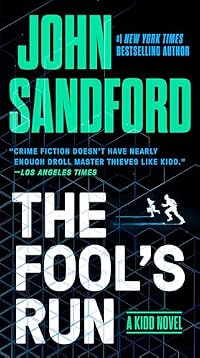
John Sandford, the #1 New York Times bestselling author of the Prey novels gives suspense an ingenious twist as he takes readers into the mind games of two irresistible con artists plotting the perfect sting...Kidd is a computer whiz, artist, and professional criminal. LuEllen is his lover, and his favorite partner in crime. Their playing field in on the cutting edge of high-tech corporate warfare. This time they've been hired by a defense industry corporation to destroy its business rival show more through computer sabotage. If Kidd and LuEllen can pull it off, they'll reap millions. It's the sting of a lifetime. One false move and it's a lifetime sentence. As the takedown unfolds, everything goes according to plan. But their string of successes turns into a noose when the ultimate con artists find themselves on the wrong end of the ultimate con...
. show less
Tags
Recommendations

















Member Reviews
The other day I went to a library book sale and as usual, there were tons of books in boxes waiting to be put on tables. It’s worth it to get down and look through them because I found a first edition of a John Sandford book published under his real name, John Camp. It’s a book I didn’t have, the first in the Kidd series, but even if I had it, I’d have bought it for the Camp name alone.
You can see where his writing is going to go. Kidd dumps the car in parking places. Every move and minute is covered. The action takes place in a short space of time. There are shades of Davenport in Kidd and even, maybe, a bit of Flowers, too. For a fan it’s great. If you’re not a fan though, you might be a bit irritated at the minutiae and show more the fact that so much of the technology is unrecognizable if you’re young. Being that I’m not young and entered the computer industry shortly after this book was published, I enjoyed looking back at what we all thought was amazing and wondrous. And it was. It was. Someday we’ll look back on our first smartphones with nostalgia. Awww. Weren’t they cute?
One thing that struck me was how similar Kidd is to Elvis Cole, a character in another series of books written by Robert Crais. Crais’s books pre-date this one by ½ a dozen years, and I have to wonder if Camp read them. It’s not blatant, but if you know Elvis, you’ll see the signs. I had a hard time remembering that it wasn’t a Crais book though.
The story is pretty great. It’s a caper novel through and through. Kidd is hired to sabotage a company’s rival because they stole technology and would now get an unfair advantage when it comes to a government contract. Just enough ‘right the wrong’ to make Kidd bite. That and the money. Things, of course, don’t turn out quite as expected, and it was a bit done (only because of the fact that so much time has passed and so many stories are similar), but it was fun. And if you’re not having fun reading, why are you doing it? show less
You can see where his writing is going to go. Kidd dumps the car in parking places. Every move and minute is covered. The action takes place in a short space of time. There are shades of Davenport in Kidd and even, maybe, a bit of Flowers, too. For a fan it’s great. If you’re not a fan though, you might be a bit irritated at the minutiae and show more the fact that so much of the technology is unrecognizable if you’re young. Being that I’m not young and entered the computer industry shortly after this book was published, I enjoyed looking back at what we all thought was amazing and wondrous. And it was. It was. Someday we’ll look back on our first smartphones with nostalgia. Awww. Weren’t they cute?
One thing that struck me was how similar Kidd is to Elvis Cole, a character in another series of books written by Robert Crais. Crais’s books pre-date this one by ½ a dozen years, and I have to wonder if Camp read them. It’s not blatant, but if you know Elvis, you’ll see the signs. I had a hard time remembering that it wasn’t a Crais book though.
The story is pretty great. It’s a caper novel through and through. Kidd is hired to sabotage a company’s rival because they stole technology and would now get an unfair advantage when it comes to a government contract. Just enough ‘right the wrong’ to make Kidd bite. That and the money. Things, of course, don’t turn out quite as expected, and it was a bit done (only because of the fact that so much time has passed and so many stories are similar), but it was fun. And if you’re not having fun reading, why are you doing it? show less
Hacking in the 20th Century by an expert. Dated, but still quite interesting as Kidd is hired to take down a business rival. He creates a rather unique team and is quite successful in fulfilling his contract. However, his focus changes as a pair of hitmen try to take him and his team out.
This is the first entry in John Sanford's "Kidd Novels" series, and my first John Sanford novel of any kind, as well. I enjoyed it. It is a thriller about industrial computer crime. As the book was written back in the late 80s, so we still in the relatively early days of computer networks, and it is fun to be reminded of those times. The characters are taking part in an elaborate computer fraud, but they often have to go looking for phone booths. Not that this is a very deep novel, of course, but it was interesting to get a backwards look at that point in time, the nexus between the old world and the new in many ways. Basically, though, just some good fun reading. I'll probably get to the next two books in this series sooner or later.
Long-time readers of John Sandford's Lucas Davenport and Virgil Flowers series may not be aware that Sandford actually introduced Davenport and another character originally known only as Kidd within a couple of months of each other. Fool's Run, the first Kidd novel, and Rules of Prey, the first Davenport novel both appeared in 1989.
My interest in the Kidd series has gradually increased as I enjoyed the brief appearances of Kidd in several books in the Davenport series. Then Kidd and his wife Luellen appeared prominently in Silken Prey. That further increased my interest in the characters to the point that I decided to dip back in time and read the four-book Kidd series.
It is hard to compare Fool's Run, written 27 years ago, to the show more contemporary novels featuring Davenport and Flowers. It is not surprising that in this first offering Kidd appears to be a somewhat less well-developed character than Davenport and Flowers. The plot of Fool's Run is rather slow moving and the book lacks the secondary characters that enrich the Davenport (e.g., Flowers, Shrake, Jenkins, and Letty Davenport), and Flowers (e.g., Johnson Johnson and Davenport's supporting cast) series.
Kidd is an expert computer hacker who is willing to engage in illegal activities if the price is right and the job does not offend his moral sensitivities. His persona as a computer hacker offers numerous possibilities but the problem with such characters is the tendency of authors to ascribe magical powers to them. This is especially true of Bobby, an even more accomplished hacker that Kidd consults for critical information, and Dillon, a mysterious hacker who works for the firm that hires Kidd. Bobby is so accomplished, we are told, that even the NSA has failed to discover his identity. Dillon seems similarly accomplished although his character is scarcely developed. Sandford makes no effort to describe how they o obtain the information they provide nor how they gain entre to the numerous supposedly secure computer systems they access.
After a meeting with a mysterious billionaire, his beautiful, sexy assistant, and Dillon, Kidd agrees to take on a project that involves burglary and industrial espionage. Kidd recruits LuEllen (Luellen in the Davenport novels), an expert burglar, and Dace, a former reporter with superior skills at researching print media and creating a public relations campaign. The task and Kidd's approach to the problem are mildly entertaining, but achieving the goal brings on an unexpected turn of events. His employers have misrepresented themselves and suddenly the lives of Kidd, LuEllen and Dace are in danger.
Despite this interesting plot, several weaknesses are apparent. Perhaps most disappointing is the failure to develop the LuEllen character. Kidd recruited her as an expert burglar but Sandford depicts her as having a limited skill set. Her primary approach is to take a wrecking bar and break in the door. LuEllen relies on cocaine to prepare herself for each burglary and to handle her post-burglary emotions. Personally, she comes across as unpolished and possibly uneducated when compared to Kidd, who is depicted as intelligent, organized, and rational. The two do not appear to be professionally compatible.
Kidd's frequent use of Tarot cards is another plot device that does not work for me. It added nothing to the plot and it interfered with the flow of the story. Especially at the end of the book when Kidd is supposedly developing a strategy to escape from the conundrum in which he is ensnared, his frequent consultation of Tarot cards come across as boring, inconsequential filler.
In closing I should mention that the depiction of LuEllen in Fool's Run and Luellen in Silken Prey are completely different. The latter plans a complicated burglary carefully and demonstrates great resourcefulness when an unexpected interruption occurs. Perhaps there will be growth in the LuEllen character in the remaining books in the Kidd series. show less
My interest in the Kidd series has gradually increased as I enjoyed the brief appearances of Kidd in several books in the Davenport series. Then Kidd and his wife Luellen appeared prominently in Silken Prey. That further increased my interest in the characters to the point that I decided to dip back in time and read the four-book Kidd series.
It is hard to compare Fool's Run, written 27 years ago, to the show more contemporary novels featuring Davenport and Flowers. It is not surprising that in this first offering Kidd appears to be a somewhat less well-developed character than Davenport and Flowers. The plot of Fool's Run is rather slow moving and the book lacks the secondary characters that enrich the Davenport (e.g., Flowers, Shrake, Jenkins, and Letty Davenport), and Flowers (e.g., Johnson Johnson and Davenport's supporting cast) series.
Kidd is an expert computer hacker who is willing to engage in illegal activities if the price is right and the job does not offend his moral sensitivities. His persona as a computer hacker offers numerous possibilities but the problem with such characters is the tendency of authors to ascribe magical powers to them. This is especially true of Bobby, an even more accomplished hacker that Kidd consults for critical information, and Dillon, a mysterious hacker who works for the firm that hires Kidd. Bobby is so accomplished, we are told, that even the NSA has failed to discover his identity. Dillon seems similarly accomplished although his character is scarcely developed. Sandford makes no effort to describe how they o obtain the information they provide nor how they gain entre to the numerous supposedly secure computer systems they access.
After a meeting with a mysterious billionaire, his beautiful, sexy assistant, and Dillon, Kidd agrees to take on a project that involves burglary and industrial espionage. Kidd recruits LuEllen (Luellen in the Davenport novels), an expert burglar, and Dace, a former reporter with superior skills at researching print media and creating a public relations campaign. The task and Kidd's approach to the problem are mildly entertaining, but achieving the goal brings on an unexpected turn of events. His employers have misrepresented themselves and suddenly the lives of Kidd, LuEllen and Dace are in danger.
Despite this interesting plot, several weaknesses are apparent. Perhaps most disappointing is the failure to develop the LuEllen character. Kidd recruited her as an expert burglar but Sandford depicts her as having a limited skill set. Her primary approach is to take a wrecking bar and break in the door. LuEllen relies on cocaine to prepare herself for each burglary and to handle her post-burglary emotions. Personally, she comes across as unpolished and possibly uneducated when compared to Kidd, who is depicted as intelligent, organized, and rational. The two do not appear to be professionally compatible.
Kidd's frequent use of Tarot cards is another plot device that does not work for me. It added nothing to the plot and it interfered with the flow of the story. Especially at the end of the book when Kidd is supposedly developing a strategy to escape from the conundrum in which he is ensnared, his frequent consultation of Tarot cards come across as boring, inconsequential filler.
In closing I should mention that the depiction of LuEllen in Fool's Run and Luellen in Silken Prey are completely different. The latter plans a complicated burglary carefully and demonstrates great resourcefulness when an unexpected interruption occurs. Perhaps there will be growth in the LuEllen character in the remaining books in the Kidd series. show less
Published originally under Sandford’s real name, this novel features Kidd, a computer genius (in 1989) who is recruited by a civilian defense contractor to destroy a rival company over industrial espionage. A solid novel on its own, it is also interesting to look back at the “modern computer capabilities” of the day.
The fool's run is the first in a series of Sandford's books involved with computer hacking and industrial spying. The series comprises The Fool's Run, The Empress File, The Devil's Code, The Hanged Man's Song.
Because the Devil's fool is old: it was written in 1989 - some of the technology is old too. If you don't know anything about computers, it does not hurt, and if you know more, it is a memory trip: I have not seen anybody complain about that. In fact the book has aged well.
The two protagonists, a hacker and a thief, are offered money to stop the progress of an airplane company which has stolen secrets from another one. But has it? They do the dirty work, they think it is justified, then they found themselves in danger for their show more lives.
It testifies to the talent of Sandford that you find yourself rooting for the hacker and the thief!
This has a lighter tone than the Prey series, it is a welcome change: like a real recreation. And the next book is even better. show less
Because the Devil's fool is old: it was written in 1989 - some of the technology is old too. If you don't know anything about computers, it does not hurt, and if you know more, it is a memory trip: I have not seen anybody complain about that. In fact the book has aged well.
The two protagonists, a hacker and a thief, are offered money to stop the progress of an airplane company which has stolen secrets from another one. But has it? They do the dirty work, they think it is justified, then they found themselves in danger for their show more lives.
It testifies to the talent of Sandford that you find yourself rooting for the hacker and the thief!
This has a lighter tone than the Prey series, it is a welcome change: like a real recreation. And the next book is even better. show less
Anheiser has a simple proposition for Kidd: take down a corporate competitor by any means necessary. The offer comes with a pile of cash if Kidd's willing. It's a lot of cash. But it's a new and dangerous territory Kidd's charting, and greed is a dangerous thing.
Solid, enjoyable, and still fun to read even if the technology's out of date at this point.
Solid, enjoyable, and still fun to read even if the technology's out of date at this point.
Members
- Recently Added By
Lists

Books Read in 2016
4,666 works; 197 members
Author Information

118+ Works 90,416 Members
John Sandford was born John Roswell Camp on February 23, 1944 in Cedar Rapids, Iowa. Before entering the U.S. Army and serving in Korea, he received a bachelor's degree in American history from the University of Iowa in 1966. After leaving the service, he received a master's degree in journalism from the University of Iowa. During the 1970s, he show more worked at The Miami Herald, and the St. Paul Pioneer Press. In 1985, he began researching the lives of a farm family caught in the midst of the crisis of American farming. The article, Life on the Land: An American Farm Family, won the Pulitzer Prize for Feature Writing and the American Society of Newspaper Editors Award for Non-Deadline Feature Writing. After winning the Pulitzer Prize, he began writing fiction. His works include the Prey series, the Virgil Flowers series, and The Singular Menace series. He has also written nonfiction works on plastic surgery and art. Sandford's Young Adult novels, Uncaged and Outrage, Books 1 and 2 of The Singular Menace Series co-written with Michelle Cook, made the New York Times Bestseller list in July 2016. (Bowker Author Biography) show less
Awards and Honors
Awards
Series


Work Relationships
Common Knowledge
- Canonical title
- The Fool's Run
- Original title
- The Fool's run
- Original publication date
- 1989
- People/Characters
- Thomas Kidd; LuEllen Case; Bobby DuChamps; Emily Anderson; Margaret Ellis Kahn; Rudolph Anhiser (show all 7); Dace Greeley
- Important places
- Washington, D.C., USA
- Epigraph
- "Whereas crime has traditionally occurred in environments of manual human activities, some crime is now perpetrated inside computers in the specialized environment of rooms with raised flooring, lowered ceilings, large grey b... (show all)oxes, flashing lights, moving tapes, and the hum of air conditioning motors.... A new jargon has developed, identifying automated methods such as data diddling, Trojan horses, logic bombs, salami techniques, superzapping, piggybacking, scavenging, data leakage, and asynchronous attacks....Utility programs such as Superzap are powerful and dangerous tools in the wrong hands. They should be kept secure from unauthorized use." Computer Crime, a Criminal Justice Resource Manual, U.S. Department of Justice
- Dedication
- For Roswell and Emily
- First words
- It was hard work, which he hadn't expected.
- Quotations
- If you leave bad paintings lying around, they wind up on walls.
- Last words
- (Click to show. Warning: May contain spoilers.)We spent most of the afternoon there, painting and talking and watching the clouds roll in, up from the south, over the Mississippi.
- Disambiguation notice
- This book was originally published under the name John Camp. It has been republished under the author's more widely known pen-name John Sandford.
Classifications
Statistics
- Members
- 1,047
- Popularity
- 24,399
- Reviews
- 16
- Rating
- (3.63)
- Languages
- 5 — Dutch, English, French, German, Hungarian
- Media
- Paper, Ebook
- ISBNs
- 20
- ASINs
- 8