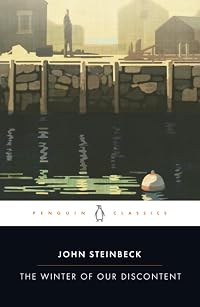
The Winter of Our Discontent
by John Steinbeck
On This Page
Description
Ethan Hawley, a descendant of proud New England sea captains, works as a clerk in the grocery store owned by an Italian immigrant. His wife is restless, his teenaged children are troubled and discontented, hungry for the tantalizing material comforts he cannot provide. Then one day, in a moment of moral crisis, Ethan decides to take a holiday from his own scrupulous standards.Tags
Recommendations































Member Reviews
Ethan Allen Hawley comes from a wealthy New England family whose fortune dribbled away after the end of the whaling industry. With Ethan's father, the last vestiges were lost to speculative investing and the Great Depression; Ethan himself failed to keep the grocery store he owned afloat, and when we meet him he is employed by the current owner, an old Sicilian man named Marullo who leaves most of the day-to-day operation of the business to Ethan. While Ethan is a good-natured, conscientious employee, a loving husband and father with a tendency to odd endearments and silliness, we sense an underlying dissatisfaction, a "quiet desperation", in his daily routine. He is scrupulously honest--never takes anything home from the store without show more accounting for it and deducting the price from his wages; turns down a bribe from a competing supplier to "throw a little business our way"; refuses to risk investing his wife's small inheritance for fear of losing her security. And yet. He must do something, as he sees it, so his wife can hold her head up, so his son and daughter will feel pride in being Hawleys, so he himself can be something more than just a "grocery clerk" whose ancestors once owned a substantial portion of the town. When he learns that Mr. Marullo may have immigrated illegally 40 years before, he begins to hatch a multi-faceted plot that involves both theft and betrayal, and that relies heavily on the untouchable integrity he's known for. It's impossible not to like Ethan Hawley, a man who clearly loves his family (even when he's "advising" his daughter to kill her brother), a man who names his suits (Old Blue, Sweet George Brown, Dorian Grey, Burying Black and Dobbin), who gives speeches to the canned goods while sweeping out the store in the morning, who half-quotes and paraphrases and sports endlessly with words...in fact, we root for him to succeed, we do not want him to get caught with dirty hands, we want it all to work out...right, somehow. show less
Published in 1961, The Winter of Our Discontent is Steinbeck's last novel before he died in 1968. While literary criticism has been mixed, I have to say that I loved this novel from start to finish. It is set on the East Coast in the fictional New Baytown, New York, where the Hawley family once was wealthy and well-respected. However, the protagonist's father lost the family fortune, which is why Ethan Allen Hawley now works as a clerk in a store the family had once owned. Ethan still lives in the old Hawley house with his wife, Mary, and his two kids, Ethan Allen (Jr.) and Ellen. The course of the novel is probably best described by the Shakespeare quotation from Richard III that the novel draws its title from: "Now is the winter of show more our discontent, made glorious summer by this son of York." Ethan's family is not happy with their station in life and they feel looked down on in town because of having only just enough money to get by and Ethan being a mere store clerk. Ethan, who does not seem unhappy, feels his family's as well as the societal pressure from the people around him. On a daily basis he is confronted with aphorisms such as "Money makes money." Only that he does not have any to spare. This eventually leads Ethan to try to turn his luck around and restore the family to its former glory, not so much for himself, but rather for his family.
One aspect that I generally admire about Steinbeck's writing is how he crafts his characters. This is the same for The Winter of Our Discontent where I loved the complexity and depth of Ethan Allen Hawley, especially with regard to his development in the novel until the very last page. I found myself rooting for the upstanding and honest Ethan, and then, when he plots to rob the local bank (planning to take only as much as he needs, mind), I found myself rooting for his success and hoping that he would not be caught. I could really feel how Ethan was torn between sticking to his beliefs and listening to his moral compass and at the same time giving in to societal pressures that he could not push away completely lest he disappoint his family. I attribute this to Steinbeck's skillful writing. In this respect, it is worth mentioning that Steinbeck changes the narrative perspective in the novel. While the largest part is written in first-person perspective from Ethan's point of view, there are also certain parts that are written in third person, both with a limited and an omniscient narrator. To my mind, while seeming odd, this gives the book more depth and helps highlight the general theme of morality in the American society of 1960.
An outstanding novel that is definitely worth reading and does not have to hide behind The Grapes of Wrath or Of Mice and Men. 4.5 stars. show less
One aspect that I generally admire about Steinbeck's writing is how he crafts his characters. This is the same for The Winter of Our Discontent where I loved the complexity and depth of Ethan Allen Hawley, especially with regard to his development in the novel until the very last page. I found myself rooting for the upstanding and honest Ethan, and then, when he plots to rob the local bank (planning to take only as much as he needs, mind), I found myself rooting for his success and hoping that he would not be caught. I could really feel how Ethan was torn between sticking to his beliefs and listening to his moral compass and at the same time giving in to societal pressures that he could not push away completely lest he disappoint his family. I attribute this to Steinbeck's skillful writing. In this respect, it is worth mentioning that Steinbeck changes the narrative perspective in the novel. While the largest part is written in first-person perspective from Ethan's point of view, there are also certain parts that are written in third person, both with a limited and an omniscient narrator. To my mind, while seeming odd, this gives the book more depth and helps highlight the general theme of morality in the American society of 1960.
An outstanding novel that is definitely worth reading and does not have to hide behind The Grapes of Wrath or Of Mice and Men. 4.5 stars. show less
Oddly, it seems it was when things were going best for America that some of her brightest Nobel laureate authors distinguished themselves writing about failure, decline, and dissolution. Those are pretty timeless themes, so maybe I’m cherry picking my examples, or seeing patterns where none exist, but hear me out. In 1928-29, when the nation was swept up in the (perceived) prosperity of the greatest stock bubble in our history, William Faulker wrote The Sound and the Fury (TSATF), describing the Compton family’s spectacular plunge from landed Southern wealth into poverty, madness, alcoholism and incest. Then in 1961, when America was enjoying unprecedented wealth and status as an economic, military and political superpower, John show more Steinbeck wrote The Winter of Our Discontent, about miserable Ethan Hawley living in the long shadow of his family’s past glory.
Where TSATF follows the decay of an old Southern plantation family from their antebellum glory to modern disgrace, Winter of Our Discontent traces the New England Hawley family from a successful ship Captain in the mid 1800’s, to his heirs who expanded the business until Ethan‘s father lost it all in the Great Depression. Ethan gets by as a clerk in the local grocery to support his wife (Mary) and two kids (Allen and Ellen), but honest work stocking shelves is a daily assault on his wounded pride, which is only magnified by the fact that the store is owned by a Sicilian immigrant (Mr. Marullo), whose complex business deals strike Ethan as vaguely illegal. Since Ethan is an imperfect narrator, it’s impossible to know whether Marullo’s wealth really is ill-gotten, or whether Ethan’s suspicions are just a manifestation of (anti-Italian) racism, not very different from Jason Compton's racism towards Dilsey in The Sound and the Fury. This question of prejudice, in conjunction with his clinging romanticism about his family’s past glory negate any sympathy the reader might otherwise feel for Ethan; they are the refuge of a loser who can’t make it in the world on his own merits. Likewise, Ethan's cynical wit, which allows him to demean the achievements of his hard-working, more successful neighbors. The snarky jokes are entertaining at first, but quickly become tedious and pathetic, as it becomes clear they are more about his low self-esteem than humor. Ethan’s only redeeming character is his honesty, which prevents him from taking a bribe from a produce supplier.
Things take an interesting turn when Mary is (mis)led to believe Ethan will soon come into a big fortune. You can enjoy the ironic details for yourself, but this is where The Sound and the Fury and The Winter of Our Discontent part ways: the Comptons are too overwhelmed to fight their cruel circumstances, but Ethan is quite different. As he realizes Mary is being deceived, and no grand riches are on their way, it causes something in his psyche to snap. He resolves to resurrect the Hawley name, by any means necessary. It’s a little bit of a (Gone With the Wind) "As God is my witness, I‘ll never go hungry again!" moment, but it lacks the moral high ground any good indignation should have. It’s more like the "white rage" that keeps Fox News and Rush Limbaugh up in the ratings: a sort of humiliation fused with entitlement, and a bit of racism and nostalgia thrown in. It’s ugly, and only gets uglier, as Ethan hatches mercenary schemes to build wealth at the expense of old friendships and the honesty which had been his one saving grace. This isn’t a traditional "American dream" rags-to-riches story. If anything, it’s a rejection of the hard work and determination that dream is founded on. Pretty soon Ethan is planning a bank robbery, helping an old pal drink himself to death, and engineering an (admittedly clever) real estate swindle.
The details make for a rich and captivating story, but it is all a bit too tragic to call enjoyable. By the end of the novel, Ethan is poised to become wealthy and powerful beyond all expectations, but he is also beginning to reap the consequences of his amorality. His son Allen, overeager to contribute to the family’s growing prestige, is disgraced when his national prize-winning essay is discovered to be a plagiary. The story ends with Ethan contemplating suicide in the aftermath of the scandal.
So back to where this review started: Why did Steinbeck write such a dark tale during a period when the national mood was so optimistic (the Kennedy administration), and his own personal fortunes were so bright? He always liked to write about tough people enduring difficult times, but this isn’t a story about perseverance and keeping the faith; it’s about giving up on the work ethic, putting ends before means, and money before friends. Even with the moral retribution at the end, Winter of Our Discontent feels subversive. Given his talent as a writer, and his gift for observation, I wonder whether Steinbeck was tapping into some shift in the national character which would have been pretty subtle around 1961. Like Alan Ginsburg, Hugh Hefner and Lenny Bruce before him, was Steinbeck an early leading indicator of the turmoil and discontent that was to surface at the end of the 60’s? And if "yes", what was it that touched Steinbeck so? I’ve always thought the upheaval of the late 60's was largely the product of the Vietnam War and national heartbreak/disillusionment over the Kennedy assassination, but this book calls those assumptions into question, having been written before either JFK’s untimely death or war in Indochina could be foreseen.
That’s the sort of book this is: the character development is so-so, and the story itself doesn’t have any Earth-shaking surprises, but wondering what the author meant by it all, and what his inspirations might have been is very interesting indeed. It’s too bad this was Steinbeck’s last novel; I would love to have seen what direction he went from here. show less
Where TSATF follows the decay of an old Southern plantation family from their antebellum glory to modern disgrace, Winter of Our Discontent traces the New England Hawley family from a successful ship Captain in the mid 1800’s, to his heirs who expanded the business until Ethan‘s father lost it all in the Great Depression. Ethan gets by as a clerk in the local grocery to support his wife (Mary) and two kids (Allen and Ellen), but honest work stocking shelves is a daily assault on his wounded pride, which is only magnified by the fact that the store is owned by a Sicilian immigrant (Mr. Marullo), whose complex business deals strike Ethan as vaguely illegal. Since Ethan is an imperfect narrator, it’s impossible to know whether Marullo’s wealth really is ill-gotten, or whether Ethan’s suspicions are just a manifestation of (anti-Italian) racism, not very different from Jason Compton's racism towards Dilsey in The Sound and the Fury. This question of prejudice, in conjunction with his clinging romanticism about his family’s past glory negate any sympathy the reader might otherwise feel for Ethan; they are the refuge of a loser who can’t make it in the world on his own merits. Likewise, Ethan's cynical wit, which allows him to demean the achievements of his hard-working, more successful neighbors. The snarky jokes are entertaining at first, but quickly become tedious and pathetic, as it becomes clear they are more about his low self-esteem than humor. Ethan’s only redeeming character is his honesty, which prevents him from taking a bribe from a produce supplier.
Things take an interesting turn when Mary is (mis)led to believe Ethan will soon come into a big fortune. You can enjoy the ironic details for yourself, but this is where The Sound and the Fury and The Winter of Our Discontent part ways: the Comptons are too overwhelmed to fight their cruel circumstances, but Ethan is quite different. As he realizes Mary is being deceived, and no grand riches are on their way, it causes something in his psyche to snap. He resolves to resurrect the Hawley name, by any means necessary. It’s a little bit of a (Gone With the Wind) "As God is my witness, I‘ll never go hungry again!" moment, but it lacks the moral high ground any good indignation should have. It’s more like the "white rage" that keeps Fox News and Rush Limbaugh up in the ratings: a sort of humiliation fused with entitlement, and a bit of racism and nostalgia thrown in. It’s ugly, and only gets uglier, as Ethan hatches mercenary schemes to build wealth at the expense of old friendships and the honesty which had been his one saving grace. This isn’t a traditional "American dream" rags-to-riches story. If anything, it’s a rejection of the hard work and determination that dream is founded on. Pretty soon Ethan is planning a bank robbery, helping an old pal drink himself to death, and engineering an (admittedly clever) real estate swindle.
The details make for a rich and captivating story, but it is all a bit too tragic to call enjoyable. By the end of the novel, Ethan is poised to become wealthy and powerful beyond all expectations, but he is also beginning to reap the consequences of his amorality. His son Allen, overeager to contribute to the family’s growing prestige, is disgraced when his national prize-winning essay is discovered to be a plagiary. The story ends with Ethan contemplating suicide in the aftermath of the scandal.
So back to where this review started: Why did Steinbeck write such a dark tale during a period when the national mood was so optimistic (the Kennedy administration), and his own personal fortunes were so bright? He always liked to write about tough people enduring difficult times, but this isn’t a story about perseverance and keeping the faith; it’s about giving up on the work ethic, putting ends before means, and money before friends. Even with the moral retribution at the end, Winter of Our Discontent feels subversive. Given his talent as a writer, and his gift for observation, I wonder whether Steinbeck was tapping into some shift in the national character which would have been pretty subtle around 1961. Like Alan Ginsburg, Hugh Hefner and Lenny Bruce before him, was Steinbeck an early leading indicator of the turmoil and discontent that was to surface at the end of the 60’s? And if "yes", what was it that touched Steinbeck so? I’ve always thought the upheaval of the late 60's was largely the product of the Vietnam War and national heartbreak/disillusionment over the Kennedy assassination, but this book calls those assumptions into question, having been written before either JFK’s untimely death or war in Indochina could be foreseen.
That’s the sort of book this is: the character development is so-so, and the story itself doesn’t have any Earth-shaking surprises, but wondering what the author meant by it all, and what his inspirations might have been is very interesting indeed. It’s too bad this was Steinbeck’s last novel; I would love to have seen what direction he went from here. show less
John Steinbeck’s novels are pure class in writing style and construction of people, images and worlds. Yet they are all eerily familiar, even fifty years later. People are still lying and doing the dodgy on each other. Everyone wants more money, a better job and some time away from the kids. The Winter of Our Discontent is a timeless tale about money, greed and trying to be honest when everyone else is getting ahead by being deceitful.
Initially the reader is introduced to Ethan Allen Hawley, the protagonist, in the third person. After a couple of chapters, the story is told from Ethan in the first person. This unusual style repeats itself in part two of the novel. Normally that would annoy me but in this novel, it just works. We get show more the bigger, unbiased picture of a small town past its glory days, before honing in on perhaps the last honest man in town. Ethan is from a whaling family, whose fortunes started to turn when their boat burned in suspicious circumstances. He still has the big house, but he lost the store he owned after World War II. Now he works in that grocery store for an Italian owner, and his family don’t have a car or television. His wife feels their poverty but doesn’t really let on. Ethan’s children however feel the lack of material wealth and let his know it. Ethan is at heart an honest man, but he feels pushed to try to turn things around. He sets off a chain of events that will change things for him and the town and are all morally shades of grey. These include a quick call to immigration and giving his former best friend, now a drunk, a lot of money for a deal that cut out the dishonest, rich people in town. Ethan even plans a robbery on the bank but is thwarted at the last minute. It’s fascinating to think whether he was just after the money, or revenge on the bank manager whose family may have destroyed the Hawley’s ship and is part of the dishonesty amongst the town’s elite.
Despite setting these events in motion, Ethan does his darndest to remain honest. He knocks back advances to undercut his boss and sleep with his wife’s friend. He struggles with what the line to cross is for dishonesty, and what is required to keep his family happy and content. And how is it different or worse to what others are doing? And what would have happened anyway? What breaks Ethan is when his son benefits from his own dishonesty but states to his father that it doesn’t matter because everybody does it.
The novel is an interesting commentary on the level of deceit people are willing to partake in and how much leaves them still comfortable with their conscience. For Ethan, it’s not that much and for his boss, it makes him tired of running. Yet others seem to have no limit to what they will do to get ahead and stay ahead of the pack. Some are willing to call it out or at least make suggestions that they know what’s going on. Others are happy to let ethics slide if it doesn’t bother them. It’s quite different to Steinbeck’s earlier novels but it still packs a punch today, raising questions of duty to others and most of all, self.
http://samstillreading.wordpress.com show less
Initially the reader is introduced to Ethan Allen Hawley, the protagonist, in the third person. After a couple of chapters, the story is told from Ethan in the first person. This unusual style repeats itself in part two of the novel. Normally that would annoy me but in this novel, it just works. We get show more the bigger, unbiased picture of a small town past its glory days, before honing in on perhaps the last honest man in town. Ethan is from a whaling family, whose fortunes started to turn when their boat burned in suspicious circumstances. He still has the big house, but he lost the store he owned after World War II. Now he works in that grocery store for an Italian owner, and his family don’t have a car or television. His wife feels their poverty but doesn’t really let on. Ethan’s children however feel the lack of material wealth and let his know it. Ethan is at heart an honest man, but he feels pushed to try to turn things around. He sets off a chain of events that will change things for him and the town and are all morally shades of grey. These include a quick call to immigration and giving his former best friend, now a drunk, a lot of money for a deal that cut out the dishonest, rich people in town. Ethan even plans a robbery on the bank but is thwarted at the last minute. It’s fascinating to think whether he was just after the money, or revenge on the bank manager whose family may have destroyed the Hawley’s ship and is part of the dishonesty amongst the town’s elite.
Despite setting these events in motion, Ethan does his darndest to remain honest. He knocks back advances to undercut his boss and sleep with his wife’s friend. He struggles with what the line to cross is for dishonesty, and what is required to keep his family happy and content. And how is it different or worse to what others are doing? And what would have happened anyway? What breaks Ethan is when his son benefits from his own dishonesty but states to his father that it doesn’t matter because everybody does it.
The novel is an interesting commentary on the level of deceit people are willing to partake in and how much leaves them still comfortable with their conscience. For Ethan, it’s not that much and for his boss, it makes him tired of running. Yet others seem to have no limit to what they will do to get ahead and stay ahead of the pack. Some are willing to call it out or at least make suggestions that they know what’s going on. Others are happy to let ethics slide if it doesn’t bother them. It’s quite different to Steinbeck’s earlier novels but it still packs a punch today, raising questions of duty to others and most of all, self.
http://samstillreading.wordpress.com show less
The brilliance of John Steinbeck intimidates me. I spend a great deal of my time while reading his books nodding my head in agreement and gasping in awe at how he tackles the profound and the everyday with the same amount of elan.
First off, I enjoyed this story. I cared about Ethan Allen Hawley, and not just his person but his soul. I wanted him to emerge unscathed even though I knew he could not, because no one can compromise his own morality and remain unsoiled. I cried for what I knew was his major loss and yet I ended still hoping he could find some way to live with what he had done without resorting to lying to himself, which would only deepen the corruption.
This is the world he lives in, and I dare say it is the world we live in show more as well:
The Town Manager sold equipment to the township, and the judges fixed traffic tickets as they had for so long that they did not remember it as illegal practice--at least the books said it was. Being normal men, they surely did not consider it immoral. All men are moral. Only their neighbors are not.
How much immorality is too much? Do the ends justify the means? Is your sin less egregious if you are sinning against a sinner? And, to quote Mark 8:36, "For what shall it profit a man, if he shall gain the whole world, and lose his own soul?"
There is a reason John Steinbeck is considered one of the great American authors. It has something to do with his ability to tell a fascinating tale and still pack so many unobtrusive, salient issues into its telling.
Just one more quote, because who wouldn't appreciate this kind of imagery: "The young boys, bleeding with sap, sit on the stools of Tanger's Drugstore ingesting future pimples through straws. They watch the girls with level goat-eyes and make disparaging remarks to one another while their insides whimper with longing." Digest that. show less
First off, I enjoyed this story. I cared about Ethan Allen Hawley, and not just his person but his soul. I wanted him to emerge unscathed even though I knew he could not, because no one can compromise his own morality and remain unsoiled. I cried for what I knew was his major loss and yet I ended still hoping he could find some way to live with what he had done without resorting to lying to himself, which would only deepen the corruption.
This is the world he lives in, and I dare say it is the world we live in show more as well:
The Town Manager sold equipment to the township, and the judges fixed traffic tickets as they had for so long that they did not remember it as illegal practice--at least the books said it was. Being normal men, they surely did not consider it immoral. All men are moral. Only their neighbors are not.
How much immorality is too much? Do the ends justify the means? Is your sin less egregious if you are sinning against a sinner? And, to quote Mark 8:36, "For what shall it profit a man, if he shall gain the whole world, and lose his own soul?"
There is a reason John Steinbeck is considered one of the great American authors. It has something to do with his ability to tell a fascinating tale and still pack so many unobtrusive, salient issues into its telling.
Just one more quote, because who wouldn't appreciate this kind of imagery: "The young boys, bleeding with sap, sit on the stools of Tanger's Drugstore ingesting future pimples through straws. They watch the girls with level goat-eyes and make disparaging remarks to one another while their insides whimper with longing." Digest that. show less
Ethan Allen Hawley, the protagonist of this author’s last book, has many layers. Being the descendant of a prominent family who has fallen on hard times, Ethan lives in his ancestral home in New Baytown, a small fishing town, and works as a grocery clerk in the store he once owned. Ethan and his family barely scrape by, living without many of the conveniences his friends have. Although he sees corruption everywhere, Ethan holds himself to a high moral standard. He seems to be satisfied with his life, even though his family and most of his friends don’t understand his complacency with his situation. As the story progresses, we discover Ethan isn’t quite who he seems to be. Finally, Ethan struggles with his conscience when his son show more shows himself to be openly deceitful. Steinbeck is an excellent writer who clearly illustrates how the complex consequences of deceit and pride can impact our humanity. This book prompts the reader to think deeply. show less
Rating: 6* of five
The Publisher Says: Ethan Allen Hawley, the protagonist of Steinbeck’s last novel, works as a clerk in a grocery store that his family once owned. With Ethan no longer a member of Long Island’s aristocratic class, his wife is restless, and his teenage children are hungry for the tantalizing material comforts he cannot provide. Then one day, in a moment of moral crisis, Ethan decides to take a holiday from his own scrupulous standards.
Set in Steinbeck’s contemporary 1960 America, the novel explores the tenuous line between private and public honesty that today ranks it alongside his most acclaimed works of penetrating insight into the American condition. This edition features an introduction and notes by Steinbeck show more scholar Susan Shillinglaw.
My Review: This is a wonderful short novel by a master of his craft at the peak of his form. It is also his last novel.
Some people at the time it was published felt it was a wrong turning for Steinbeck (The Grapes of Wrath, Tortilla Flat) to abandon both the west coast that had made him famous and brought his considerable social conscience to the world's attention for an east coast grifter's POV. The Winter of Our Discontent is a story that has nothing but shades of gray. Everyone in it is shady somehow. That is, I think, what verschmeckled the reviewers and made the public angry. Up until then, there were clear-cut Good Guys and Bad Guys in every Steinbeck tale. Here...no, no one qualifies as all good or all bad.
The POV is of Ethan, a man who is the degenerate scion of a venerable family. He is married with teenaged kids, and he will do anything to support his family. Including, to their horror, work for an Italian grocer as his clerk. The nerve of the man, a son of the founder of his town, working for someone who *should* be his gardener, according to his friends and his kids.
Well, he thinks, how can I help it, we all gotta eat. So he hatches a plot that will restore the family "honor" by swindling a friend. He goes through with it. He gets what he wants. And, frankly, so does the "swindled" friend, an alcoholic prowling for his next few thousand drinks.
This isn't really Steinbecky stuff, it's too hard to pin down from a moral standpoint. On the other hand, it's superbly told, and it's amazingly well crafted, and it's undoubtedly the best thing Steinbeck wrote after 1950. Reviews were harsh, sales were poor, and Steinbeck lost heart for fiction after that. He published two travel books before his death in 1968, a mere 30 years after "The Grapes of Wrath" burst on the scene. Imagine the wonders he could have produced had he lived to an Updikey 80-plus.
What a wonderful read, and so overlooked...please don't overlook it any longer! show less
The Publisher Says: Ethan Allen Hawley, the protagonist of Steinbeck’s last novel, works as a clerk in a grocery store that his family once owned. With Ethan no longer a member of Long Island’s aristocratic class, his wife is restless, and his teenage children are hungry for the tantalizing material comforts he cannot provide. Then one day, in a moment of moral crisis, Ethan decides to take a holiday from his own scrupulous standards.
Set in Steinbeck’s contemporary 1960 America, the novel explores the tenuous line between private and public honesty that today ranks it alongside his most acclaimed works of penetrating insight into the American condition. This edition features an introduction and notes by Steinbeck show more scholar Susan Shillinglaw.
My Review: This is a wonderful short novel by a master of his craft at the peak of his form. It is also his last novel.
Some people at the time it was published felt it was a wrong turning for Steinbeck (The Grapes of Wrath, Tortilla Flat) to abandon both the west coast that had made him famous and brought his considerable social conscience to the world's attention for an east coast grifter's POV. The Winter of Our Discontent is a story that has nothing but shades of gray. Everyone in it is shady somehow. That is, I think, what verschmeckled the reviewers and made the public angry. Up until then, there were clear-cut Good Guys and Bad Guys in every Steinbeck tale. Here...no, no one qualifies as all good or all bad.
The POV is of Ethan, a man who is the degenerate scion of a venerable family. He is married with teenaged kids, and he will do anything to support his family. Including, to their horror, work for an Italian grocer as his clerk. The nerve of the man, a son of the founder of his town, working for someone who *should* be his gardener, according to his friends and his kids.
Well, he thinks, how can I help it, we all gotta eat. So he hatches a plot that will restore the family "honor" by swindling a friend. He goes through with it. He gets what he wants. And, frankly, so does the "swindled" friend, an alcoholic prowling for his next few thousand drinks.
This isn't really Steinbecky stuff, it's too hard to pin down from a moral standpoint. On the other hand, it's superbly told, and it's amazingly well crafted, and it's undoubtedly the best thing Steinbeck wrote after 1950. Reviews were harsh, sales were poor, and Steinbeck lost heart for fiction after that. He published two travel books before his death in 1968, a mere 30 years after "The Grapes of Wrath" burst on the scene. Imagine the wonders he could have produced had he lived to an Updikey 80-plus.
What a wonderful read, and so overlooked...please don't overlook it any longer! show less
Members
- Recently Added By
Lists

20th Century Literature
1,161 works; 55 members

1960s, Best books published therein
254 works; 22 members

Best Domestic Fiction
77 works; 6 members

Carole's List
445 works; 13 members

Books Read in 2023
5,547 works; 145 members

Publisher's Weekly Bestsellers - Part II - 1940 - 1979
355 works; 5 members

SHOULD Read Books!
354 works; 9 members

Tammen Keltainen kirjasto
81 works; 1 member

Blue Pyramid 1,276 Best Books of All Time
1,248 works; 32 members

to get
244 works; 2 members

Books Read in 2016
110 works; 1 member

Reading LIst
648 works; 1 member

Top Five Books of 2025
954 works; 303 members
Talk Discussions
Past Discussions
Steinbeckathon 2012: The Winter of Our Discontent in 75 Books Challenge for 2012 (April 2012)
Author Information

479+ Works 207,074 Members
In recent years Steinbeck has been elevated to a more prominent status among American writers of his generation. If not quite at the world-class artistic level of a Hemingway or a Faulkner, he is nonetheless read very widely throughout the world by readers of all ages who consider him one of the most "American" of writers. Born in Salinas County, show more California on February 27, 1902, Steinbeck was of German-Irish parentage. After four years as a special student at Stanford University, he went to New York, where he worked as a reporter and as a hod carrier. Returning to California, he devoted himself to writing, with little success; his first three books sold fewer than 3,000 copies. Tortilla Flat (1935), dealing with the paisanos, California Mexicans whose ancestors settled in the country 200 years ago, established his reputation. In Dubious Battle (1936), a labor novel of a strike and strike-breaking, won the gold medal of the Commonwealth Club of California. Of Mice and Men (1937), a long short story that turns upon a melodramatic incident in the tragic friendship of two farm hands, written almost entirely in dialogue, was an experiment and was dramatized in the year of its publication, winning the New York Drama Critics Circle Award. It brought him fame. Out of a series of articles that he wrote about the transient labor camps in California came the inspiration for his greatest book, The Grapes of Wrath (1939), the odyssey of the Joad family, dispossessed of their farm in the Dust Bowl and seeking a new home, only to be driven on from camp to camp. The fiction is punctuated at intervals by the author's voice explaining this new sociological problem of homelessness, unemployment, and displacement. As the American novel "of the season, probably the year, possibly the decade," it won the Pulitzer Prize in 1940. It roused America and won a broad readership by the unusual simplicity and tenderness with which Steinbeck treated social questions. Even today, The Grapes of Wrath remains alive as a vivid account of believable human characters seen in symbolic and universal terms as well as in geographically and historically specific ones. Ma Joad is one of the most memorable characters in twentieth-century American fiction. It is her courage that sustains the family. Steinbeck's best and most ambitious novel after The Grapes of Wrath is East of Eden (1952), a saga of two American families in California from before the Civil War through World War I. Cannery Row (1945), The Wayward Bus (1947), and Sweet Thursday (1955) are lighter works that find Steinbeck returning to the lighthearted tone of Tortilla Flat as he recounts picaresque adventures of modern-day picaros. The Winter of Our Discontent (1961) struck some reviewers as being appropriately titled because of its despairing treatment of humanity's fall from grace in a wasteland world where money is king. Steinbeck also wrote important nonfiction, including Russian Journal (1948) in collaboration with the photographer Robert Capa; Once There Was a War (1958) and America and Americans (1966), which features pictures by 55 leading photographers and a 70-page essay by Steinbeck. His interest in marine biology led to two books primarily about sea life, Sea of Cortez (1941) (with Edward F. Ricketts) and The Log from the Sea of Cortez (1951). Travels with Charley (1962) is an engaging account of his journey of rediscovery of America, which took him through approximately 40 states. Steinbeck was married three times and died in New York City on December 20, 1968 of heart disease and congestive heart failure. He was 66, and had been a life-long smoker. (Bowker Author Biography) show less
Some Editions
Awards and Honors
Distinctions
Series
Belongs to Publisher Series
Work Relationships
Is contained in
Is abridged in
Reader's Digest Condensed Books 1961 v03: The Winter of Our Discontent / The Agony and the Ecstasy / The Making of the President, 1960 / A Lodging for the Emperor / Goodbye Mr. Chips by Reader's Digest
Reader's Digest Best Sellers 1961: To Kill a Mockingbird | Agony and the Ecstasy | Winter of our Discontent | Fate is the Hunter by John T. Beaudouin
Has as a student's study guide
Common Knowledge
- Canonical title
- The Winter of Our Discontent
- Original title
- The Winter of Our Discontent
- Original publication date
- 1961
- People/Characters
- Ethan Allen Hawley
- Important places
- Long Island, New York, USA; New York, USA; USA
- Related movies
- Hallmark Hall of Fame: The Winter of our Discontent (1983 | IMDb)
- Epigraph
- Readers seeking to identify the fictional people and places here described would do better to inspect their own communities and search their own hearts, for this book is about a large part of America today.
- Dedication
- To Beth, my sister, whose light burns clear
- First words
- When the fair gold morning of April stirred Mary Hawley awake, she turned over to her husband and saw him, little fingers pulling a frog mouth at her.
- Quotations
- You know how advice is. You only want it if it agrees with what you wanted to do anyway.
- Last words
- (Click to show. Warning: May contain spoilers.)Else another light might go out.
Classifications
Statistics
- Members
- 6,173
- Popularity
- 2,021
- Reviews
- 113
- Rating
- (3.93)
- Languages
- 19 — Czech, Danish, Dutch, English, Estonian, Finnish, French, German, Hungarian, Italian, Lithuanian, Norwegian (Bokmål), Polish, Portuguese, Romanian, Russian, Spanish, Swedish, Turkish
- Media
- Paper, Audiobook, Ebook
- ISBNs
- 79
- ASINs
- 94