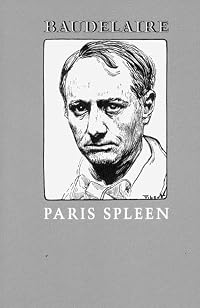
Paris Spleen
by Charles Baudelaire
On This Page
Description
A modernist classic translated for the twenty-first centuryTags
Recommendations


















Member Reviews
I enjoy Baudelaire most when he is at his snarkiest and/or most morbid. Thankfully in this collection of prose poems he often hovers in one or both of these states. I could've skipped some of the "love" poems, but whatever...even the most disconnected poet writes those from time to time. I rarely think about what it would be like to spend a day with a certain poet, but Baudelaire provokes that thought in me. However, he'd probably rather skulk around by himself than hang around another "damned bastard of a cloud-monger" like me. And I think that's just fine.
Who among us has not dreamt, in moments of ambition, of the miracle of a poetic prose, musical without rhythm and rhyme, supple and staccato enough to adapt to the lyrical stirrings of the soul, the undulations of dreams, and sudden leaps of consciousness.
Contrary to popular belief, I had never read Baudelaire until now. I've trusted Walter Benjamin and lately Calasso to provide me with a well informed ethos about this central figure. There are many concerns that this is the literature of the young, to which I shout, absurd. This is the lettres of the Absolute, the eternally curious.
Below the bile, there is a hum of sensitivity. Behind the debris are the tears of the sensitive. Is it forgiving, likely not? There is a buzzing pulse at show more play, a hum and a forgiving glance. show less
Contrary to popular belief, I had never read Baudelaire until now. I've trusted Walter Benjamin and lately Calasso to provide me with a well informed ethos about this central figure. There are many concerns that this is the literature of the young, to which I shout, absurd. This is the lettres of the Absolute, the eternally curious.
Below the bile, there is a hum of sensitivity. Behind the debris are the tears of the sensitive. Is it forgiving, likely not? There is a buzzing pulse at show more play, a hum and a forgiving glance. show less
I never really understood the appeal of Les Fleurs du Mal, but so many people love it that I started to feel bad. What was I missing? Along comes this book, Paris Spleen, which is full of prose poems made of equal parts humor, cynicism, and insight (and often all three within a paragraph). I like these poems because reading it, I feel like I have a sense of who Baudelaire might have been as a person...
Plus, his humor is so odd:
Soup and Clouds
My adorable little minx was serving me supper; through the dining room's open window I was contemplating the shifting architectures God creates from vapour, those marvellous constructions of the evanescent. As I watched, I thought: "Those apparitions are nearly as beautiful as my sweet lady's show more eyes, the mad little green-eyed monster."
Suddenly a violent fist landed in my back and I heard a charming, raw voice hysterical and brandy-damaged, the voice of my little darling, saying: "Get on with your bloody soup, cloud merchant." show less
Plus, his humor is so odd:
Soup and Clouds
My adorable little minx was serving me supper; through the dining room's open window I was contemplating the shifting architectures God creates from vapour, those marvellous constructions of the evanescent. As I watched, I thought: "Those apparitions are nearly as beautiful as my sweet lady's show more eyes, the mad little green-eyed monster."
Suddenly a violent fist landed in my back and I heard a charming, raw voice hysterical and brandy-damaged, the voice of my little darling, saying: "Get on with your bloody soup, cloud merchant." show less
No matter where! As long as it's out of the world!
Baudelaire has a depth that draws me, fascinates me and excites me.
This is a part of my favourite one:
"Across the ocean of roofs I can see a middle-aged woman, her face already lined, who is forever bending over something and who never goes out. Out of her face, her dress, and her gestures, our of practically nothing at all, I have made up this woman's story, or rather legend, and sometimes I tell it to myself and weep.
If it had been and old man I could have made up his just as well.
And I go to bed proud to have lived and to have suffered in some one besides myself.
erhaps you will say "Are you sure that your story is the really one?" But what does it matter what reality is outside show more myself, so long as it has helped me to live, to feel that I am, and what I am?" show less
Baudelaire has a depth that draws me, fascinates me and excites me.
This is a part of my favourite one:
"Across the ocean of roofs I can see a middle-aged woman, her face already lined, who is forever bending over something and who never goes out. Out of her face, her dress, and her gestures, our of practically nothing at all, I have made up this woman's story, or rather legend, and sometimes I tell it to myself and weep.
If it had been and old man I could have made up his just as well.
And I go to bed proud to have lived and to have suffered in some one besides myself.
erhaps you will say "Are you sure that your story is the really one?" But what does it matter what reality is outside show more myself, so long as it has helped me to live, to feel that I am, and what I am?" show less
Set in a modern, urban Paris, the prose pieces in this volume constitute a further exploration of the terrain Baudelaire had covered in his verse masterpiece, The Flowers of Evil: the city and its squalor and inequalities, the pressures of time and mortality, and the liberation provided by the sensual delights of intoxication, art, and women. Published posthumously in 1869, Paris Spleen was a landmark publication in the development of the genre of prose poetry--a format which Baudelaire saw as particularly suited for expressing the feelings of uncertainty, flux, and freedom of his age--and one of the founding texts of literary modernism.
Inspired by Bertrand's Gaspard de la Nuit Baudelaire borrowed the idea of turning french poetry on its head by releasing this collection of prose poems. The real virtues of the poetry, the play with language, internal rhyme, and grammar, don't come through very strongly in translation.
Luckily for Baudelaire's english speaking audience, the subjects of his poems were so rich and his imagery was so vivid that even after all of those elements are lost, his poetry still stands up under scrutiny. The only downside of this collection is that it's not a dual language version-- even if you don't speak a foreign language you can still get a sense for its rythym by comparing the original and the translation side by side.
The prose poems in this show more collection (and the ones in Les Fleurs du Mal) focus on the internal life of the city. Ina time when Paris was being systematically destroyed and rebuilt, Baudelaire looks past the veneer of the city to the heart of its citizens. While British poets from the same time lose themselves in the architecture of the city and in the city's natural elements, Baudelaire and his contemporaries focused specifically on the people that make up the city.
Paris Spleen gives you an outsider's look into Parisian life. As the narrator of these pieces moves through the city, he shares his assumptions about life as seen through windows, as passed on corners, as watched but not necessarily participated in. When the narrator actually does take part in the world around him, he does so with gestures so grand that they exist only for the sake of metaphor. In one instance, the narrator berates a glass dealer for harassing the poor and tosses a flower pot at him. In another, men are described as carrying chimeras on their backs as they go through their daily routines.
Although at times the narrative leans towards the surreal, the images are accessable and each poem flows quickly. If you can't read the poems in their original language, this is a great translation to pick up. show less
Luckily for Baudelaire's english speaking audience, the subjects of his poems were so rich and his imagery was so vivid that even after all of those elements are lost, his poetry still stands up under scrutiny. The only downside of this collection is that it's not a dual language version-- even if you don't speak a foreign language you can still get a sense for its rythym by comparing the original and the translation side by side.
The prose poems in this show more collection (and the ones in Les Fleurs du Mal) focus on the internal life of the city. Ina time when Paris was being systematically destroyed and rebuilt, Baudelaire looks past the veneer of the city to the heart of its citizens. While British poets from the same time lose themselves in the architecture of the city and in the city's natural elements, Baudelaire and his contemporaries focused specifically on the people that make up the city.
Paris Spleen gives you an outsider's look into Parisian life. As the narrator of these pieces moves through the city, he shares his assumptions about life as seen through windows, as passed on corners, as watched but not necessarily participated in. When the narrator actually does take part in the world around him, he does so with gestures so grand that they exist only for the sake of metaphor. In one instance, the narrator berates a glass dealer for harassing the poor and tosses a flower pot at him. In another, men are described as carrying chimeras on their backs as they go through their daily routines.
Although at times the narrative leans towards the surreal, the images are accessable and each poem flows quickly. If you can't read the poems in their original language, this is a great translation to pick up. show less
Le Spleen de Paris (Paris Spleen/Petits Poèmes en prose) gồm tập hợp 50 bài thơ văn xuôi (prose poem) của Baudelaire.
50 “ngụ ngôn về cuộc sống hiện đại” này đưa chúng ta vào những chuyến tham quan khác nhau do một flâneur, một kẻ lang thang ẩn danh, dẫn dắt. Suốt ngày và đêm, trong những quán cà phê lấp lánh và những con phố nhỏ bẩn thỉu, Baudelaire trầm ngâm về cái kỳ quái trong cái tầm thường, cái cao cả trong cái trần tục. Kẻ ngoại cuộc giàu xúc cảm này đưa ra cái nhìn độc đáo về Paris những năm 1850, hé lộ đời sống đô thị đông đúc trước thềm thay đổi lớn, ta thấy một Paris show more đầy mâu thuẫn, đáng ngạc nhiên và khó lường như chính người hướng dẫn của chúng ta. show less
50 “ngụ ngôn về cuộc sống hiện đại” này đưa chúng ta vào những chuyến tham quan khác nhau do một flâneur, một kẻ lang thang ẩn danh, dẫn dắt. Suốt ngày và đêm, trong những quán cà phê lấp lánh và những con phố nhỏ bẩn thỉu, Baudelaire trầm ngâm về cái kỳ quái trong cái tầm thường, cái cao cả trong cái trần tục. Kẻ ngoại cuộc giàu xúc cảm này đưa ra cái nhìn độc đáo về Paris những năm 1850, hé lộ đời sống đô thị đông đúc trước thềm thay đổi lớn, ta thấy một Paris show more đầy mâu thuẫn, đáng ngạc nhiên và khó lường như chính người hướng dẫn của chúng ta. show less
Members
- Recently Added By
Published Reviews
ThingScore 100
En dan ga je ze lezen, die kleine, geciseleerde verhaaltjes over 'De vreemdeling', 'De wanhoop van de oude vrouw', 'De belijdenis van de kunstenaar', 'De dubbele kamer' of, een heel mooie, 'De klok', dat begint met de zin 'Chinezen kunnen in de ogen van een kat zien hoe laat het is', en je belandt in een àndere wereld, tussen en in het gewoel van het moderne, grootsteedse, negentiende-eeuwse show more Parijs met zijn herrie, zijn massa's, zijn drugs en andere genotmiddelen, en je bent tegelijkertijd wèg uit het zinderend hete Amsterdam anno 1995 en er ook in terug, want o, wat heeft Baudelaire in deze schetsen het innerlijk van een grotestadsbewoner, hunkerend naar schoonheid, en meegesleurd met het vuil dat zich aan de trottoirranden en in metrostations ophoopt, prachtig, prachtig verbeeld. show less
added by sneuper
Lists

Best of French Literature
138 works; 27 members

French Books
102 works; 15 members

Poésie (recueils)
10 works; 1 member

Harold Bloom - The Western Canon: C. The Democratic Age
336 works; 15 members
Five star books
1,755 works; 108 members

Favourite Books
1,817 works; 308 members

19th Century
190 works; 16 members

Poetry Collections
79 works; 6 members

Books Read in 2017
4,249 works; 130 members
Paris, City of Lights
103 works; 17 members

poetry
15 works; 1 member

Just Kids by Patti Smith
43 works; 1 member
Author Information

759+ Works 19,314 Members
Charles Baudelaire, 1821 - 1867 Charles Baudelaire had perhaps had an immeasurable impact on modern poetry. He was born on April 9, 1821, to Joseph-Francois Baudelaire and Caroline Archimbaut Dufays in Paris. He was educated first at a military boarding school and then the College Louis-le-Grand, where he was later expelled in 1839. Baudelaire show more then began to study law, at the Ecole de Droit in Paris, but devoted most of his time to debauchery. After an abortive trip to the East, he settled in Paris and lived on an inheritance from his much despised step father, while he wrote poetry. During this period he met Jeanne Duval, a mulatto with whom he fell in love with and who became the "Black Venus," the muse behind some of his most powerful erotic verse. Baudelaire strove to portray sensual experiences and moods through complex imagery and classical form, avoiding sentimentality and objective description. Thus he profoundly influenced the later French symbolist writers, including Mallarme and Rimbaud, and such English-language poets as Yeats, Eliot, and Stevens. With much of his inheritance squandered, Baudelaire turned to journalism, especially art and literary criticism, the first of which were "Les Salons". Here he discovered the work of Edgar Allan Poe, which became an influence on his own poetry. While continuing to write unpublished verse, Baudelaire became famous as critic and translator of Poe. This reputation enabled Baudelaire to publish his most famous collection of poetry, "Les Fleurs du Mal" (The Flowers of Evil) in 1857. The result was an obscenity trial and the banning of six of the poems. Though he continued to write journalism with some success, he became increasingly depressed and pessimistic. Baudelaire attempted suicide in 1845, an attempt to get attention, and became minorly involved in the French Revolution. Today Baudelaire's work is considered the "last brilliant summation of romanticism, precursor of symbolism and the first expression of modern techniques". It was his originality that set him apart and ultimately proved to be his end. Baudelaire died, apparently from complications of syphilis, on August 31, 1867, in Paris. (Bowker Author Biography) show less
Some Editions
Awards and Honors
Awards
Notable Lists
Series
Belongs to Publisher Series
Work Relationships
Is contained in
Has as a student's study guide
Common Knowledge
- Canonical title
- Paris Spleen
- Original title
- Le Spleen de Paris
- Alternate titles*
- Piccoli poemi in prosa; Petits Poèmes en prose
- Original publication date
- 1869; 1862
- Important places*
- Pariisi, Ranska
- Dedication*
- A Arsène Houssaye
- First words
- Dear friend, I send you a work no one can claim not to make head or tail of, since, on the contrary, there is at once both tail and head, alternating and reciprocal.
- Quotations*
- Si era all'esplosione del nuovo anno: caos di fango e di neve, percorso da mille carrozze, scintillante di giocattoli e di dolci, brulicante di cupidigie e di disperazioni, delirio uficiale di una grande città, fatto apposta... (show all) per sconvolgere il cervello anche al solitario più forte (P.43)
Così dunque, anche tu (un cane), indegno compagno della mia triste vita, assomigli al pubblico, a cui non si può mai offrire dei profumi delicati che lo esasperano, ma solo lordure accuratamente scelte (P.53)
Ma che importa l'eternità della dannazione a chi ha trovato in un istante l'infinito della gioia? (p.59)
Il sole opprime la città con la sua luce radente e terribile; la sabbia è abbagliante e il mare scintilla. Il mondo attonito s'accascia senza resistenza e fa la siesta che è una specie di morte saporosa, in cui il dormient... (show all)e, semisveglio, gusta le voluttà del suo annientamento (p.113)
Ci salutiamo quando ci incontriamo, ma come due vecchi gentiluomini in cui un'innata cortesia non è in grado di spegnere completamente la memoria di vecchi rancori (p.135)
I dolori più terribili sono i dolori muti (p.141) - Last words
- (Click to show. Warning: May contain spoilers.)And each time time the poet dons the painter's vest, he cannot help thinking of good dogs, of philosopher dogs, of Indian summer, and of the beauty of mature women.
- Blurbers
- Pichois, Claude
- Original language
- French
*Some information comes from Common Knowledge in other languages. Click "Edit" for more information.
Classifications
Statistics
- Members
- 2,371
- Popularity
- 8,253
- Reviews
- 22
- Rating
- (4.17)
- Languages
- 22 — Arabic, Catalan, Czech, Danish, Dutch, English, Esperanto, Estonian, Finnish, French, German, Greek, Italian, Latvian, Lithuanian, Multiple languages, Norwegian (Bokmål), Polish, Spanish, Swedish, Turkish, Portuguese (Portugal)
- Media
- Paper, Audiobook, Ebook
- ISBNs
- 171
- ASINs
- 47