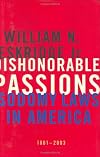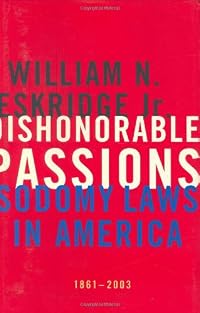
Dishonorable Passions: Sodomy Laws in America, 1861-2003
by William N. Eskridge Jr.
On This Page
Description
"In Dishonorable Passions the distinguished legal scholar William N. Eskridge Jr. examines the remarkable chronicle of sodomy legislation and its legacy today. Although the American colonies and the early states prohibited sodomy as "the crime against nature," they rarely punished such conduct if it was between consenting adults behind closed doors, By 1900, however, with the growth of urban areas, increased immigration, and the newly coined category of "homosexual," the emerging regulatory show more state began to target elements it considered "degenerates." During the McCarthy era, the slate essentially declared war of "homosexual" sodomites. The anti - homosexual campaign of the 1950s and the sexual revolution of the 1960s fueled a social movement that sought to overturn consensual sodomy laws. In a dramatic and unpredictable story, the campaign against sodomy laws was not successful until a conservative Supreme Court buried them for good in Lawrence v. Texas (2003)." "Featuring vivid portraits of both the hunted (including such figures as Walt Whitman, Margaret Mead, and Bayard Rustin) and the hunters (Anthony Comstock, Earl Warren, and J. Edgar Hoover), dishonorable passions is a landmark account of a seldom investigated but fascinating aspect of our history and a key battlefront in the struggle for personal freedom."--BOOK JACKET. show lessTags
Recommendations








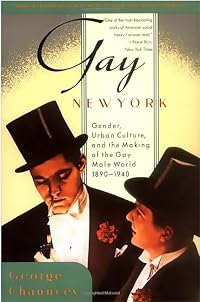
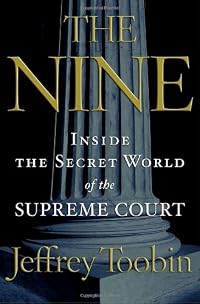
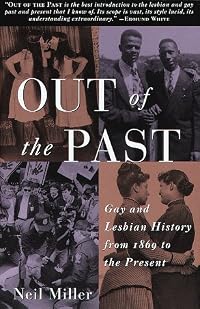


Member Recommendations
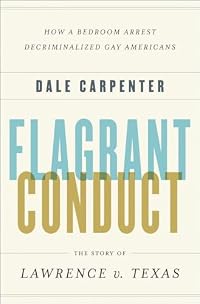
LibraryRCDallas Both about Lawrence v. Texas
Member Reviews
This doorstop begins unpromisingly, with fifty pages devoted to the poetic artistry of Walt Whitman, which, as one might suspect, is completely irrelevant to the book's stated topic, whereupon follows a section almost as long devoted to internecine tactical disputes among nineteenth-century feminist leadership, which is, if anything, even less relevant. Had these fancies been resisted by author or editor, this would have been a relatively readable 300 page book instead of a 400 page groaner. When the author gets down to business, this is a pretty definitive delve into the subject of American sodomy legislation. The author is a better thinker than writer, though, and his verbosity makes this a difficult go; he never settles for one word show more when he can think of six, and piles example onto example when one or two would have done quite nicely. He comes to his task carrying a brief; indeed he wrote an amicus brief for the Supreme Court for consideration in the Lawrence case which overturned Texas' sodomy law at the turn of the century., and he states, albeit at book's end, that he wrote his book to persuade traditionalists that almost all legislation against sodomy is wrongheaded and counterproductive. His final chapter is an important meditation on the intersection of public opinion with legislative and judicial measures . One does, however, need to come to this with considerable persistence and a high degree of interest in the topic. show less
While I was familiar with the decisions in Hardwick, Romer and Laurence this nuanced history of the cases and their social and historical contexts gave me great perspective on them and on their current analogs. Also, while perhaps not as viscerally satisfying, I appreciate the humanity brought to those on both sides, instances of really evil people in this history are rare.
Ratings
Members
- Recently Added By
Author Information
29 Works 482 Members
William N. Eskridge Jr. is the John A. Garver Professor of Jurisprudence at Yale Law School.
Awards and Honors
Classifications
- Genres
- Politics and Government, Nonfiction, LGBTQ+, History, General Nonfiction, Sexuality and Gender Studies
- DDC/MDS
- 345.7302536 — Society, Government, and Culture Law Criminal Law North America United States
- LCC
- KF9328 .S6 .E84 — Law Law of the United States Law of the United States (Federal) Criminal law
- BISAC
Statistics
- Members
- 84
- Popularity
- 378,374
- Reviews
- 2
- Rating
- (3.67)
- Languages
- English, French
- Media
- Paper, Ebook
- ISBNs
- 3
- ASINs
- 2