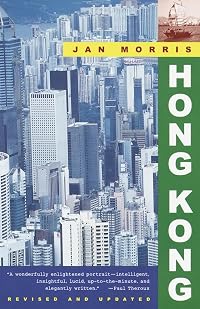
Hong Kong: Epilogue to an Empire
by Jan Morris
On This Page
Description
In its last days under British rule, the Crown Colony of Hong Kong is the world's most exciting city, at once fascinating and exasperating, a tangle of contradictions. It is a dazzling amalgam of conspicuous consumption and primitive poverty, the most architecturally incongruous yet undeniably beautiful urban panorama of all. World renowned travel writer Jan Morris offers the most insightful and comprehensive study of the enigma of Hong Kong thus far.Tags
Recommendations


















Member Recommendations


Member Reviews
I wanted very much to like this book because I adore the author, but it just wasn't a hit for me. It's a bad sign when I find myself reading the New York Times health page to get my reading fix, instead of opening my current book. The best thing about this book was also the worst thing: too much detail. In certain places the level of detail was exciting, bringing the feel of Hong Kong right into my head. In far more places it made my mind wander, and was quite effective at putting me to sleep at night.
Hong Kong is densely factual. Someone else described it this way and that was my ah-ha moment. I couldn't put my finger on why it was such a slog to read. Morris spends an inordinate amount of time describing one of Hong Kong's first modern structures but fails incite any passion about it. Her detached voice left me wondering what is the fascination with the area? She spent a long time describing a photograph of a building I wanted her to include it in the book. This, you will see, is a reoccurring pet peeve of mine. Morris's photographs are uninspiring and grainy.
A word of warning. Hong Kong is outdated. I found myself wondering about the Hong Kong of today. Are there still more Rolls-Royces per head in the city?
At first I wasn't show more sure I would enjoy Hong Kong. Aside from dated material, in the early pages, Morris jumps from pleasures of the flesh to pleasure of the palette to playing mah-jongg and the mythology of disturbing the spirits in the earth within several seemingly unrelated pages.
My take-aways: honey was a euphemism for sex for hire. Opium was a legally smoked drug until 1940. A deeper understanding of the art and logic of feng shui. At least I learned something. show less
A word of warning. Hong Kong is outdated. I found myself wondering about the Hong Kong of today. Are there still more Rolls-Royces per head in the city?
At first I wasn't show more sure I would enjoy Hong Kong. Aside from dated material, in the early pages, Morris jumps from pleasures of the flesh to pleasure of the palette to playing mah-jongg and the mythology of disturbing the spirits in the earth within several seemingly unrelated pages.
My take-aways: honey was a euphemism for sex for hire. Opium was a legally smoked drug until 1940. A deeper understanding of the art and logic of feng shui. At least I learned something. show less
Even though the cover of the edition I have sports the subtitle ‘Epilogue to an Empire’, the correct subtitle to Jan Morris’ Hong Kong is ‘The End of an Empire’, more accurate in that even this 1990 updating still long preceded the handing over of the colony to mainland China in 1997, a truer encapsulation of the eclipse of Empire. What this revision does do, however, is to take into account the social and cultural repercussions of the Tiananmen Square massacre which took place in the year which intervened between hardback and paperback, an inauspicious augury for the run-up to 1997 which Morris discusses in the closing pages.
I had two justifications to read this book, if any were needed. One was because I enjoyed Morris’ show more foray into fiction, the two instalments that comprise Hav, in which she visited an imaginary Mediterranean country in her guise as a travel writer; into this she poured her experiences of commenting on many places worldwide and distilling the essential character or personality of each geographical entity, thereby successfully evoking the otherness of so many unfamiliar locations. The second reason was because, having myself spent a decade as a child in Hong Kong, I was curious to know both the changes which had taken place in the half century or so since I had left and to see if the impressions I’d acquired as that child under ten had any bearing on reality.
It was an unsettling read. Alongside many fleeting memories prompted by smells, sights and sounds that Morris hints at in passing she relates more uncomfortable historical facts largely concerning the forcible annexation of the island and adjacent territories, albeit by treaty, and multiple examples of misgovernment ranging from ineptitude to arrogance, occasionally mitigated by a kind of benign dictatorship. As well as more historically distant distressing episodes in the colony’s history, I was largely unaware of the nature of the Japanese occupation which had ended less than five years before I was first taken to live there, on the Kowloon peninsula, at the tender age of less than two years old. I was however fascinated to have much of what I took for granted put into context: streets named after influential individuals, Hong Kong’s significance in geopolitics and commerce, the isolated nature of the ex-pat community and the unique relationship that existed between native Chinese and transient British. I also had an inkling of why post-war Hong Kong itself felt transient, not just because populations and economies were growing, but because there was an uneasy stand-off involving Britain, Communist China and the United States, whose cultural sway was then much more prevalent than I understood.
I did also find this a tough read: two or three times I put it aside, not because Morris is not an engaging writer (she certainly is, with the enviable ability to confidently intersperse dispassionate observations with personal anecdotes) but because the information she packs in is dense and, even for one with a little experience of the island, bewildering. Have no doubt about it, she writes with authority as a frequent visitor, a widely-read researcher and an experienced commentator, but I was often confused as to whether this was primarily a history, a social critique or a travelogue. Of necessity this is told from the viewpoint of an interested outsider; there is not much reflection of the views of the ordinary Chinese people, and it would be wrong to criticise the book for not so doing: after all, the clue is in the subtitle of the book.
There is a fine bibliography going up to the eighties when the book was first published, several sketch maps to help the reader navigate around the island and its hinterland, and a detailed index, though I would have also welcomed a short glossary of terms such as hong which frequently re-appear in later pages after only a passing definition which it is easy to miss or forget. And of course much has changed in the interim, meaning that the few select photographs can only literally give snapshot impressions of life in the Pearl of the Orient, and that inadequately. But nowadays in the world of the internet a wider variety of images are almost instantly available so as to render the paucity of pictures irrelevant.
http://calmgrove.wordpress.com/2012/11/13/hongkong/ show less
I had two justifications to read this book, if any were needed. One was because I enjoyed Morris’ show more foray into fiction, the two instalments that comprise Hav, in which she visited an imaginary Mediterranean country in her guise as a travel writer; into this she poured her experiences of commenting on many places worldwide and distilling the essential character or personality of each geographical entity, thereby successfully evoking the otherness of so many unfamiliar locations. The second reason was because, having myself spent a decade as a child in Hong Kong, I was curious to know both the changes which had taken place in the half century or so since I had left and to see if the impressions I’d acquired as that child under ten had any bearing on reality.
It was an unsettling read. Alongside many fleeting memories prompted by smells, sights and sounds that Morris hints at in passing she relates more uncomfortable historical facts largely concerning the forcible annexation of the island and adjacent territories, albeit by treaty, and multiple examples of misgovernment ranging from ineptitude to arrogance, occasionally mitigated by a kind of benign dictatorship. As well as more historically distant distressing episodes in the colony’s history, I was largely unaware of the nature of the Japanese occupation which had ended less than five years before I was first taken to live there, on the Kowloon peninsula, at the tender age of less than two years old. I was however fascinated to have much of what I took for granted put into context: streets named after influential individuals, Hong Kong’s significance in geopolitics and commerce, the isolated nature of the ex-pat community and the unique relationship that existed between native Chinese and transient British. I also had an inkling of why post-war Hong Kong itself felt transient, not just because populations and economies were growing, but because there was an uneasy stand-off involving Britain, Communist China and the United States, whose cultural sway was then much more prevalent than I understood.
I did also find this a tough read: two or three times I put it aside, not because Morris is not an engaging writer (she certainly is, with the enviable ability to confidently intersperse dispassionate observations with personal anecdotes) but because the information she packs in is dense and, even for one with a little experience of the island, bewildering. Have no doubt about it, she writes with authority as a frequent visitor, a widely-read researcher and an experienced commentator, but I was often confused as to whether this was primarily a history, a social critique or a travelogue. Of necessity this is told from the viewpoint of an interested outsider; there is not much reflection of the views of the ordinary Chinese people, and it would be wrong to criticise the book for not so doing: after all, the clue is in the subtitle of the book.
There is a fine bibliography going up to the eighties when the book was first published, several sketch maps to help the reader navigate around the island and its hinterland, and a detailed index, though I would have also welcomed a short glossary of terms such as hong which frequently re-appear in later pages after only a passing definition which it is easy to miss or forget. And of course much has changed in the interim, meaning that the few select photographs can only literally give snapshot impressions of life in the Pearl of the Orient, and that inadequately. But nowadays in the world of the internet a wider variety of images are almost instantly available so as to render the paucity of pictures irrelevant.
http://calmgrove.wordpress.com/2012/11/13/hongkong/ show less
Another recent re-reading of this excellent historical portrait led to this review, but it was also stimulated by another review in which the reader complains of Ms Morris as reflecting a ‘western perspective’. Given that the Hong Kong of which Jan Morris writes was created by Westerners, from a declining pearl of the East, and that those same creators returned the territory and its teeming millions back to the East in an unprecedented action for a former Empire, a ‘western perspective’ would seem to me to be perfectly valid.
Indeed, quoting Frank Ching (秦) a noted Hong Kong author, from his own review of the book in the New York Times (1989); “She approaches the subject of Hong Kong as a student of British imperialism” show more and he notes that she does a superb job.
For decades Hong Kong was not only a refuge for ‘mainland’ Chinese but a destination that encouraged the growth of a true Chinese middle and educated class that now inherits that ‘western’ imperialistic generated wealth and relative democracy.
Our ‘western’ concerns and doubts of this, the first hand-over of free millions to a Communist regime, are not yet stilled and Jan Morris in her excellent book, outlines the historical roots that will eventually confirm the reality of the new ‘eastern” Hong Kong. show less
Indeed, quoting Frank Ching (秦) a noted Hong Kong author, from his own review of the book in the New York Times (1989); “She approaches the subject of Hong Kong as a student of British imperialism” show more and he notes that she does a superb job.
For decades Hong Kong was not only a refuge for ‘mainland’ Chinese but a destination that encouraged the growth of a true Chinese middle and educated class that now inherits that ‘western’ imperialistic generated wealth and relative democracy.
Our ‘western’ concerns and doubts of this, the first hand-over of free millions to a Communist regime, are not yet stilled and Jan Morris in her excellent book, outlines the historical roots that will eventually confirm the reality of the new ‘eastern” Hong Kong. show less
This is more history and culture than travel log. I learned a bit about Hong Kong and this was written before Hong Kong was turned over to China. It therefore is more a history of British Hong Kong and British history than it is about Chinese history though I would say the author tried to be very unbiased. I listened to the audio that was available on audible play. The reading was just okay and I found it hard to stay focused.
Excellent, essayistic overview of Hong Kong history, filled with obervations and eye-opening facts. Extremely well-written. Recommended.
I started this, but it got too dull, and her western perspective got to annoying to bear.
Members
- Recently Added By
Published Reviews
Ms. Morris, a historian, travel writer and author of the ''Pax Britannica'' trilogy, is fascinated by the story of Hong Kong, the last major colony not only of Britain but of any of the former colonial powers of Europe. She approaches the subject of Hong Kong ''as a student of British imperialism.'' She sets herself the task of portraying ''the last of the great British colonies as it is in show more its last years.'' She does a superb job. show less
added by John_Vaughan
Lists

Best British Empire History Books
39 works; 8 members

Paul French's Ultimate China Bookshelf
31 works; 1 member
Author Information

88+ Works 10,628 Members
Jan Morris served as an intelligence officer with the 9th Queen's Royal Lancers, studied at Oxford University, and was a reporter for the Times and the Guardian before launching a successful career as a novelist, history author, and travel writer
Awards and Honors
Common Knowledge
- Canonical title
- Hong Kong: Epilogue to an Empire
- Important places
- Hong Kong
- Dedication
- For Ruben Provstgård Morys born 1986
- First words
- The traveller in China sees many marvels.
- Last words
- (Click to show. Warning: May contain spoilers.)On the ground they speak of riches and energies and entertainments, of all the vigour and enterprise that the arrival of the British 150 years ago fired in this place; it would make a better conclusion to a book, as it would to an Empire, if in the end they spelt out a grander message in the reflection.
Classifications
- Genres
- Travel, Nonfiction, General Nonfiction
- DDC/MDS
- 951.25 — History & geography History of Asia East Asia: China, Taiwan, Hong Kong, Korea Southeast China Hong Kong
- LCC
- DS796 .H757 .M67 — History of Europe, Asia, Africa and Oceania Asia History of Asia China Local history and description Hong Kong
- BISAC
Statistics
- Members
- 346
- Popularity
- 91,375
- Reviews
- 9
- Rating
- (3.59)
- Languages
- 5 — Chinese, Danish, English, German, Italian
- Media
- Paper, Audiobook, Ebook
- ISBNs
- 21
- ASINs
- 13